Tucker Carlson EXPOSES Israel’s Parasitic Attachment to the US: “It’s Destroying Our Country!”
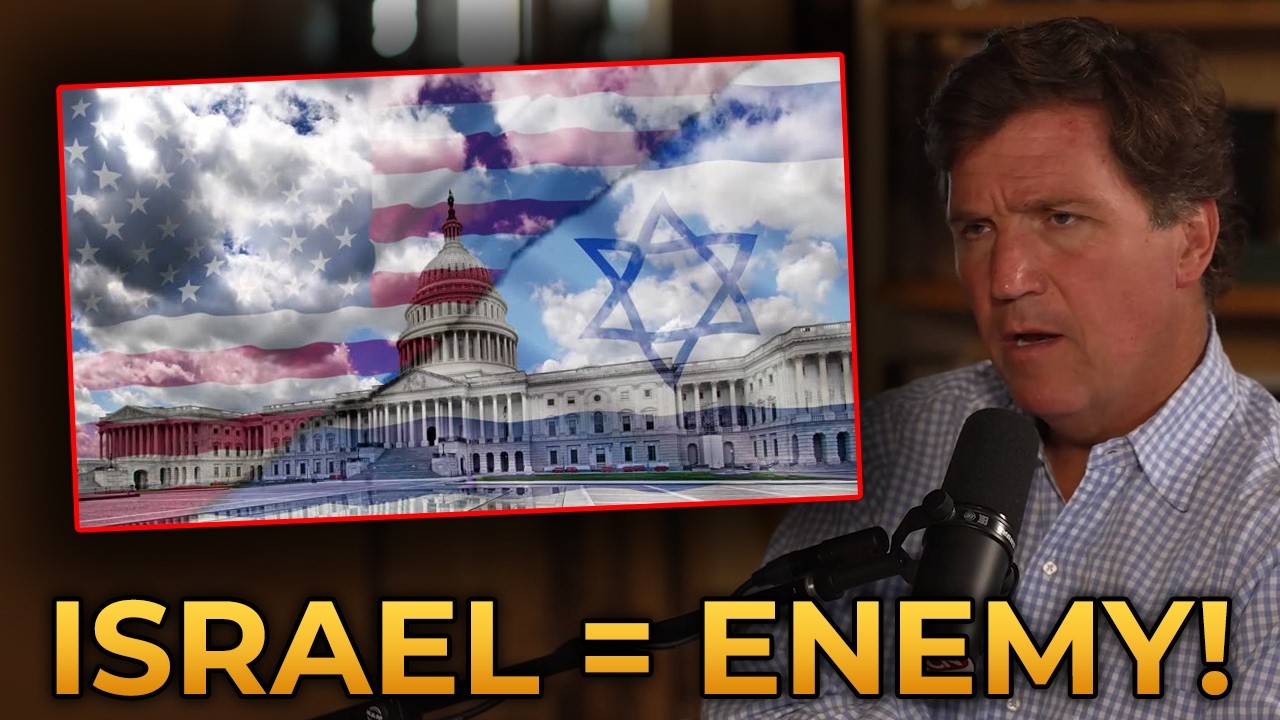
In American politics, few foreign policy debates are as emotionally charged—or as consequential—as the one surrounding the United States’ relationship with Israel. A recent conversation between media personality Tucker Carlson and foreign policy analyst Trita Parsi has reignited that debate in a particularly intense form.
The discussion, framed around war, public opinion, and Washington’s long-standing Middle East strategy, reflects a growing ideological split inside the United States. It is not just about foreign policy anymore. It is about trust in institutions, generational change, political identity, and the limits of American power.
Whether one agrees with their conclusions or not, the conversation captures a real shift: assumptions that once anchored U.S. foreign policy are no longer universally accepted.
What follows is an exploration of the ideas raised in that discussion, the broader context behind them, and why they are resonating with a segment of the American public today.
A Conversation That Signals a Shift
At the heart of the dialogue is a provocative claim: that U.S. foreign policy in the Middle East—particularly toward Israel—has become disconnected from the interests and priorities of ordinary Americans.
Carlson and Parsi argue that decades of military involvement, diplomatic alignment, and financial support for regional conflicts have created a system that is increasingly difficult to justify in terms of domestic benefit. In their framing, this is not simply a question of alliance management. It is a structural relationship that shapes American politics, defense spending, and even domestic culture.
They suggest that support for Israel within U.S. political institutions has historically been broad and bipartisan, but that this consensus is weakening—especially among younger Americans and segments of the political right that define themselves as “America First.”
This is where the conversation becomes especially charged. The speakers interpret this shift not just as policy disagreement, but as a deeper rejection of what they view as “endless war” politics.
Critics, however, would argue that such framing risks oversimplifying a highly complex geopolitical relationship, reducing decades of diplomacy and security cooperation into a single narrative of influence and dependency.
Both perspectives now coexist in the American political mainstream in ways that would have been far less visible even a decade ago.
The Question of Public Opinion—and a Generational Divide
One of the most striking themes in the conversation is the claim that American public opinion toward Israel is changing rapidly.
Carlson and Parsi point to younger conservatives and independents who are increasingly skeptical of foreign military engagement in general. This group, shaped by the Iraq and Afghanistan wars, rising national debt, and domestic economic pressure, tends to view overseas commitments with suspicion.
In their view, unconditional support for long-term military partnerships abroad no longer resonates the way it once did. Instead, there is growing emphasis on domestic priorities: infrastructure, cost of living, healthcare, and political accountability.
This generational divide is not unique to Israel-related policy. It reflects a broader transformation in American political identity. The post-9/11 consensus that defined early 2000s foreign policy has eroded, replaced by skepticism toward interventionism regardless of region or ally.
Still, public opinion is not monolithic. Support for Israel remains strong in many segments of the U.S. population, including across significant portions of both major political parties. What has changed is the level of consensus: foreign policy debates are now more openly contested, and assumptions once considered stable are being questioned in public forums.
“Endless War” and the Burden of Empire
A central argument in the discussion is that the United States has become overextended militarily and diplomatically. The speakers connect U.S. involvement in the Middle East to broader critiques of American “empire”—a term used here not in the formal colonial sense, but to describe a global network of military bases, alliances, and interventions.
The claim is that this structure is costly, politically divisive, and increasingly disconnected from domestic needs. Military spending, in this view, competes directly with social and economic investment at home.
This critique is not new. It has appeared in different forms across the political spectrum—from libertarian isolationists to progressive anti-war movements. What is new is its convergence across ideological lines, particularly among younger voters who do not neatly fit traditional party categories.
However, foreign policy experts often caution against reducing complex alliances to simple cost-benefit calculations. The U.S.–Israel relationship, for example, is also framed by supporters as a strategic partnership involving intelligence sharing, regional stability, and defense cooperation.
In other words, what one side sees as “burden,” another sees as “security architecture.”
Intelligence Sharing and the Structure of Alliances
Another controversial topic raised in the conversation is the nature of intelligence cooperation between the United States and Israel. The speakers suggest that legislative efforts—such as provisions embedded in broader defense bills—could deepen institutional integration between intelligence systems.
These claims reflect a broader concern about transparency and oversight in foreign policy decision-making. Critics of expansive intelligence cooperation often worry about accountability: who controls information, how it is used, and how much congressional oversight exists.
Supporters of such cooperation argue the opposite: that intelligence sharing among allies is standard practice, essential for counterterrorism, and governed by strict protocols designed to protect national interests.
Historically, the U.S. maintains intelligence relationships with many countries. The uniqueness of the U.S.–Israel relationship lies not in the existence of cooperation, but in its depth and consistency.
As with many aspects of foreign policy, the debate here is less about facts and more about interpretation: whether close cooperation represents strategic necessity or excessive entanglement.
A More Fundamental Question: Who Benefits?
Perhaps the most emotionally resonant theme in the discussion is the question of benefit. The speakers repeatedly return to a single idea: whether U.S. foreign policy decisions serve American citizens first.
This framing—often associated with “America First” politics—argues that foreign alliances should be evaluated primarily through their domestic impact. Do they improve economic stability? Do they reduce risk of conflict? Do they serve national interest as understood by voters?
Opponents of this view argue that global leadership necessarily involves commitments that cannot be reduced to immediate material return. Alliances, they say, are not transactions but long-term strategic investments in stability.
This tension—between transactional politics and strategic responsibility—is not unique to Israel policy. It appears in debates about NATO, Ukraine, trade agreements, and military presence in Asia.
What makes the Israel debate distinctive is its intensity in American political culture. Few foreign policy topics evoke as much passion, or as little consensus on basic framing assumptions.
The Role of Political Narratives
Another important layer in the conversation is the role of narrative itself. Both speakers suggest that political discourse is shaped by entrenched institutions, media ecosystems, and lobbying structures that influence how issues are discussed.
This is where the conversation becomes most controversial. Assertions about coordinated influence or systemic bias are difficult to measure empirically and are often interpreted very differently depending on political perspective.
Some see these concerns as legitimate critiques of how policy is shaped in Washington. Others see them as overly simplistic explanations for complex diplomatic realities, or as narratives that risk attributing unified intent to diverse actors and institutions.
What is clear, however, is that trust in institutions—media, government, and foreign policy establishments—has declined significantly over the past two decades. This erosion of trust creates space for alternative interpretations of long-standing alliances and policies.
The Broader Geopolitical Reality
Outside the ideological debate, the Middle East remains a region of ongoing strategic importance to the United States. Issues such as energy markets, regional stability, counterterrorism, and global trade routes continue to shape policy decisions.
Israel, as a technologically advanced and militarily capable state, remains a key partner in many of these areas. At the same time, U.S. relations with other regional actors—including Gulf states, Iran, and Turkey—add layers of complexity that cannot be reduced to a single bilateral lens.
This complexity is often lost in highly polarized political conversations, where structural realities are filtered through ideological interpretation.
Foreign policy, in practice, is rarely about choosing between simple options. It is about managing competing risks, imperfect alliances, and shifting global conditions.
Where This Debate Is Heading
What makes the Carlson–Parsi conversation noteworthy is not necessarily its conclusions, but its timing. It reflects a broader shift in American political discourse, where previously settled assumptions are being reopened.
Three trends stand out:
First, foreign policy is becoming more politicized domestically. It is no longer a niche concern of elite institutions but a mainstream political issue.
Second, generational attitudes toward military intervention and alliances are changing, particularly among younger voters across party lines.
Third, trust in traditional foreign policy institutions is declining, creating space for more radical rethinking of long-standing commitments.
Whether this leads to significant policy change remains uncertain. Institutional inertia in U.S. foreign policy is strong, and alliances—once formed—tend to persist across administrations.
Conclusion: A Debate About More Than One Country
At first glance, the conversation between Tucker Carlson and Trita Parsi appears to focus narrowly on U.S.–Israel relations. But beneath the surface, it reflects something much broader: a struggle over how America defines its role in the world.
Is the United States primarily a global stabilizer, responsible for maintaining alliances and projecting influence abroad? Or should it retreat from extensive foreign commitments and refocus on domestic priorities?
These questions are not new, but they are being asked with increasing urgency—and in increasingly public, polarized, and emotionally charged ways.
What comes next will depend less on any single conversation, and more on whether American political institutions can adapt to a public that is no longer unified around the assumptions that once defined its foreign policy.
And that uncertainty, more than any specific claim or argument, is what makes this debate so significant.