Tucker Carlson Applauds Christianity’s TURN Against Zionism: “It’s a New Reformation!”
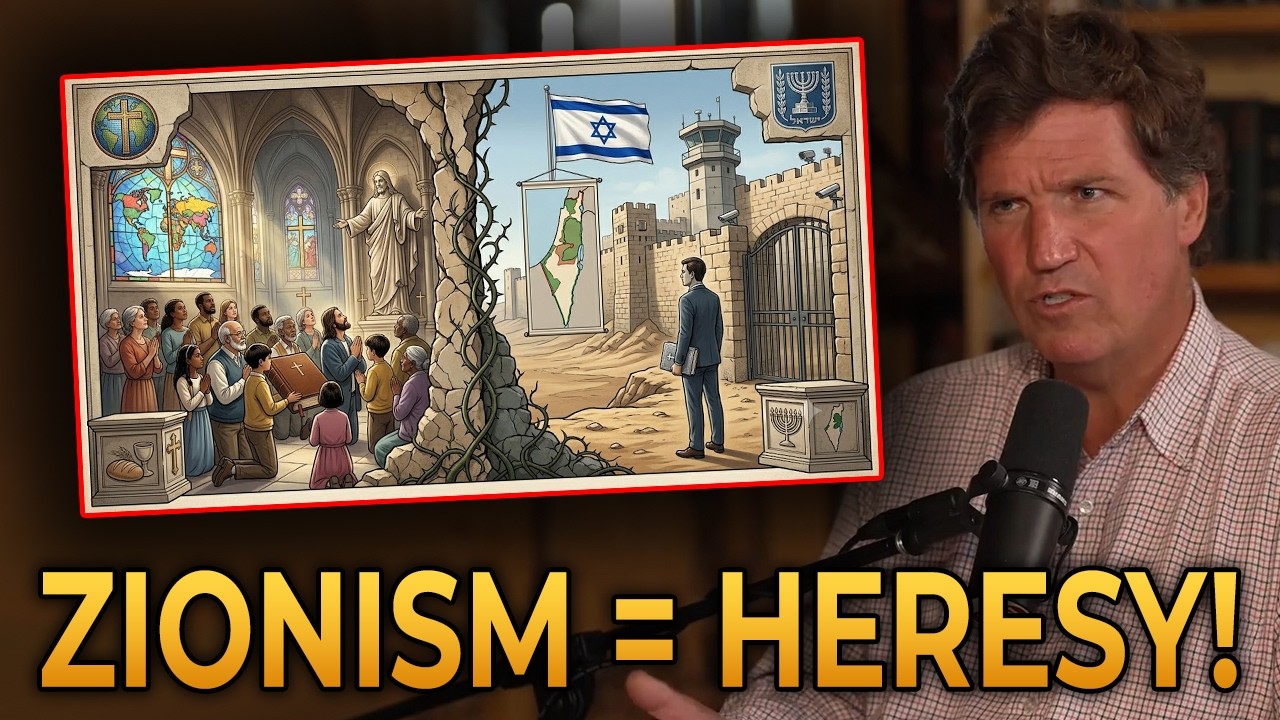
Is Protestant Christianity Entering a Second Reformation? Why More Evangelicals Are Questioning Christian Zionism
Something unusual is happening inside American Protestant Christianity—and it’s happening quietly.
Not through massive church splits or headline-making denominations, but through millions of ordinary believers opening their Bibles, comparing what they’ve been taught with Scripture, and asking questions they never thought to ask before. The issue at the center of this awakening isn’t just politics or foreign policy. For many, it’s something far more profound: Has the modern Church misunderstood the relationship between Christianity, Israel, and the promises of God?
That question has become impossible to ignore.
For decades, one of the defining features of American evangelical politics has been unwavering support for the modern State of Israel. In many churches, this support has not simply been presented as good foreign policy—it has often been portrayed as a biblical obligation. Christians were taught that blessing Israel was equivalent to blessing God, that standing with Israel fulfilled Genesis 12, and that questioning Israeli government policy placed one at odds with Scripture itself.
Today, however, a growing number of evangelicals are beginning to challenge those assumptions.
In a recent discussion, Tucker Carlson and theologian J.D. Hall argued that a significant theological shift is taking place among Protestants. They described it as something resembling a “second Reformation”—not because churches are abandoning Christianity, but because many believers are revisiting long-held doctrines in light of Scripture.
Whether or not one agrees with their conclusions, their conversation reflects a broader trend that has become increasingly visible across churches, podcasts, independent media, and online Bible studies.
Why Are Christians Asking New Questions?
According to Hall, the internet has fundamentally changed theological discussion.
For generations, many Christians relied almost exclusively on pastors, denominational teaching, Christian television, or popular authors to shape their understanding of Scripture. Today, anyone can compare sermons with biblical texts, read centuries of church history, access original theological writings, and hear competing interpretations from scholars around the world.
This access has led many believers to ask difficult questions.
Does Genesis 12 really command Christians to support the modern Israeli state?
Who exactly are the people of God under the New Covenant?
How should Christians interpret Paul’s writings in Romans and Galatians?
These are no longer niche theological debates confined to seminaries. They are becoming everyday conversations inside evangelical churches.
According to Hall, many older Christians are discovering interpretations of Scripture they had never encountered before, despite decades of church attendance.
The Difference Between Israel and the Church
One of the central arguments discussed is the distinction between ancient biblical Israel and the modern political nation established in 1948.
Supporters of Christian Zionism often connect Old Testament promises made to Abraham and Israel directly to today’s State of Israel.
Hall argues that this connection is not as straightforward as many Christians have been taught.
He points repeatedly to the New Testament, particularly Paul’s letters, where the focus shifts from ethnic identity to faith in Christ.
Galatians emphasizes that believers become heirs to Abraham through faith.
Romans 11 discusses Israel, unbelief, and the inclusion of Gentiles.
For Hall, these passages indicate that God’s covenant people are defined by faith in Jesus rather than ethnicity alone.
This theological framework differs significantly from dispensational theology, which generally maintains distinct prophetic roles for ethnic Israel and the Church.
The Rise of Dispensationalism
Another major theme of the discussion is historical.
Hall argues that unconditional Christian support for modern Israel is not a belief held consistently throughout church history.
Instead, he traces much of contemporary Christian Zionism to the rise of dispensational theology during the nineteenth century.
Dispensationalism emphasizes distinct eras in God’s plan and often teaches that biblical prophecy requires a restored Jewish nation in the land of Israel before Christ’s return.
Over time, these ideas became highly influential in American evangelicalism through prophecy conferences, study Bibles, bestselling books, television ministries, and popular preaching.
Critics argue that this theological system has become so culturally dominant that many Christians assume it represents historic Christianity, even though other Protestant, Catholic, and Orthodox traditions interpret many of the same passages differently.
Politics Meets Theology
Perhaps the strongest claim made during the discussion is that theology has directly influenced American foreign policy.
Carlson and Hall argue that millions of Christians have supported military interventions, diplomatic policies, and financial aid because they believed Scripture required unconditional loyalty to Israel.
In their view, this has blurred the distinction between biblical faith and political ideology.
They argue that Christians should evaluate governments—including Israel’s—using the same moral standards applied to every nation.
Rather than assuming divine approval for modern political actions, they believe governments should be judged according to justice, mercy, and the protection of innocent life.
This perspective has become more visible since the war in Gaza, where graphic images and widespread public debate have led many believers to reconsider previously unquestioned assumptions.
Why Gaza Changed the Conversation
According to Carlson, the conflict in Gaza has forced many Christians to confront difficult moral questions.
For years, many accepted the phrase “Israel has a right to defend itself” without much further reflection.
But as civilian casualties increased and images spread across social media, many believers began asking whether support for a nation’s right to self-defense automatically justifies every military action.
For some Christians, these questions became impossible to separate from their theology.
If Jesus commands believers to love enemies, pursue peace, and protect the innocent, how should Christians evaluate warfare?
Should loyalty to biblical principles ever be replaced by loyalty to a particular government?
These questions have fueled growing debate inside churches.
Is Christian Zionism Becoming Less Influential?
Evidence suggests that attitudes among younger evangelicals are changing.
While older generations often inherited strong pro-Israel convictions, younger Christians increasingly distinguish between supporting Jewish people, opposing antisemitism, and endorsing every policy of the Israeli government.
Many continue to reject antisemitism unequivocally while also believing that criticism of any nation’s government—including Israel’s—should not automatically be equated with hatred toward an ethnic or religious group.
This distinction has become central to many current debates.
Scripture at the Center
Throughout the conversation, Hall repeatedly returns to one point:
Christians should allow Scripture—not political movements—to determine their beliefs.
He argues that many believers are reading Galatians, Romans, and other New Testament books with fresh eyes.
Rather than accepting inherited interpretations, they are asking what the apostles themselves taught.
Whether readers ultimately agree with Hall’s conclusions or not, his challenge is straightforward: examine the biblical text carefully.
For many Christians, this renewed emphasis on direct engagement with Scripture represents a healthy development regardless of where it leads.
The Role of Independent Media
Another factor accelerating these conversations is the decline of traditional gatekeepers.
Independent podcasts, online debates, YouTube channels, and digital publications have allowed theological discussions to reach audiences far beyond seminaries.
Subjects that were once considered too controversial for many churches are now being discussed openly by millions.
Supporters argue this creates greater accountability.
Critics worry it can also amplify misinformation and polarization.
Both concerns are worth considering.
Nevertheless, the result is unmistakable: more Christians are actively examining doctrines they previously accepted without question.
Beyond Politics
Perhaps the most significant aspect of this debate is that many participants insist it is not primarily about geopolitics.
For them, the central issue is Christ.
If salvation comes through Jesus alone, they argue, then no ethnic identity, nationality, or political state can occupy the central place reserved for Him.
That conviction shapes how they interpret God’s promises, the Church, Israel, and the mission of Christianity itself.
From this perspective, allegiance belongs first to Christ rather than to any earthly nation.
Is This Really a Second Reformation?
Calling the current movement a “second Reformation” may be premature.
The Protestant Reformation transformed Western civilization by redefining authority, salvation, Scripture, and church practice.
Today’s debates are far more limited in scope.
Yet there are interesting parallels.
Both movements emphasize returning to Scripture.
Both encourage believers to examine inherited traditions critically.
Both challenge established religious assumptions.
Whether this becomes a lasting theological shift or simply another cycle of evangelical debate remains to be seen.
The Bigger Picture
Regardless of where one stands on Christian Zionism, one reality is becoming increasingly clear: many Christians are no longer satisfied with inherited answers.
They are reading Scripture for themselves.
They are revisiting church history.
They are asking difficult questions about prophecy, Israel, politics, and the Church.
Some will remain committed to Christian Zionism.
Others will reject it entirely.
Many will likely settle somewhere in between.
What makes this moment remarkable is not unanimous agreement—it is the willingness to reexamine assumptions that were once considered beyond debate.
If that trend continues, American Protestantism may indeed be entering one of its most significant periods of theological reflection in generations.
Whether history ultimately remembers it as a reformation, a correction, or simply a renewed season of biblical study will depend not on political movements or internet personalities, but on where believers conclude the Scriptures themselves lead.