Tucker Carlson Reveals Why He ACTUALLY Left the GOP: “They’re the Enemy!”
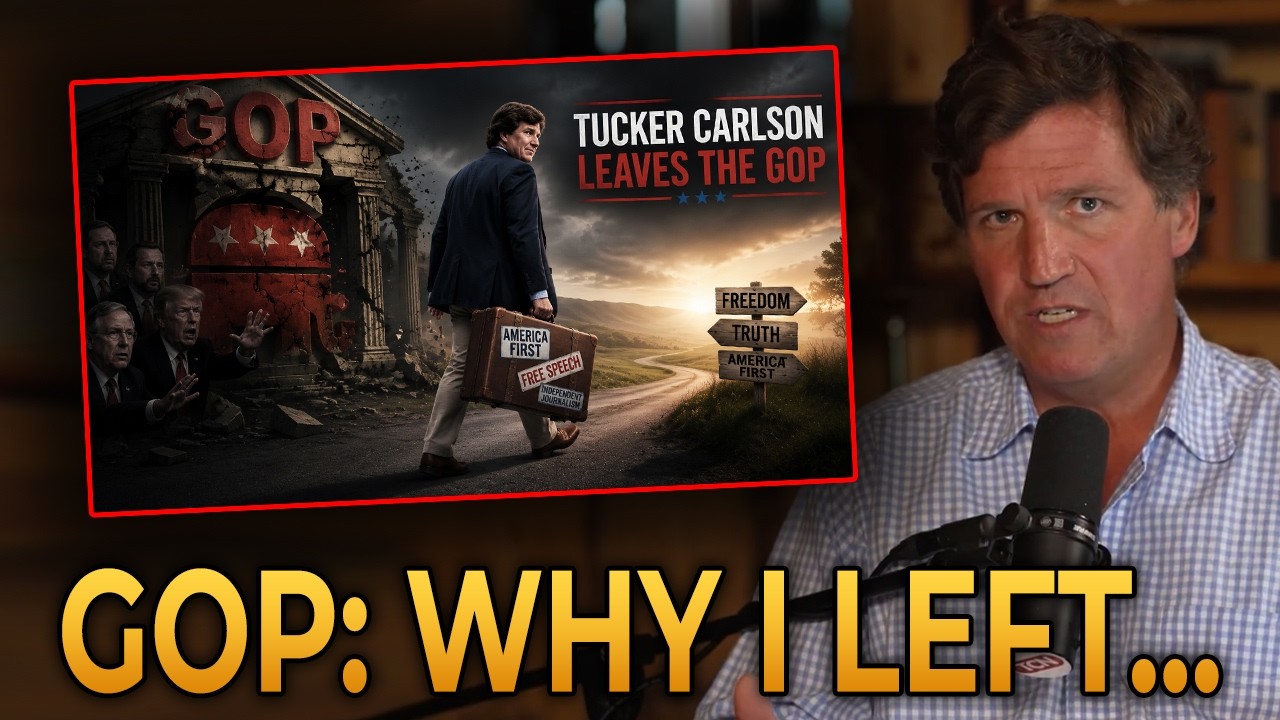
When a Political Identity Breaks: Tucker Carlson, Party Disillusionment, and the Fracturing of American Conservatism
It’s a rare moment when a well-known political voice publicly steps away from the party they were long associated with. Even rarer is when that moment sparks a broader conversation about whether the two-party system itself is still functioning as intended.
In a recent podcast conversation, media figure Tucker Carlson described a growing sense of disconnection from the Republican Party and from American political institutions more broadly. What followed wasn’t just a personal reflection—it became a wider debate about trust, representation, foreign policy priorities, and the future of political coalitions in the United States.
This article explores the ideas raised in that discussion, the reactions they’ve triggered, and what they reveal about a political system under increasing strain.
A Break With Familiar Ground
Carlson’s remarks, as presented in a discussion with veteran analyst Daniel Davis, centered on a sense of betrayal—not by a single policy or politician, but by what he perceives as a convergence between America’s two major parties on core issues.
His argument is not simply that Republicans have failed to deliver on promises, but that the differences between Republicans and Democrats at the leadership level have narrowed to the point where, in his view, they often function as variations of the same governing class.
At the emotional core of his frustration is a sense that voters are repeatedly presented with sharp cultural disagreements during election cycles, only to see those disagreements dissolve when it comes to foreign policy, economic spending, and institutional power.
This idea—that the “culture war” is loud but ultimately secondary to deeper bipartisan continuity—is central to understanding the appeal of Carlson’s message.
The “Uniparty” Thesis and Political Disillusionment
One of the most provocative claims emerging from this conversation is the idea that America effectively operates under a “uniparty” system. This view suggests that despite public polarization, the political establishment converges on key issues once in power.
Supporters of this perspective argue that:
Economic policy tends to favor continuity over disruption
Foreign policy maintains long-standing strategic commitments regardless of party control
Government spending continues to rise regardless of campaign promises
Institutional interests remain stable across administrations
Critics of this view argue that it oversimplifies real policy differences between parties and ignores meaningful variations in areas like taxation, regulation, judicial appointments, and social policy.
Still, the perception of convergence has become increasingly influential among segments of voters who feel that electoral outcomes do not significantly alter the direction of national policy.
That perception—accurate or not—has real political consequences. It fuels abstention, third-party interest, and internal rebellion within both major parties.
Culture War Politics and the Illusion of Choice
A key theme in Carlson’s critique is the idea that cultural issues dominate political discourse in ways that obscure structural agreement elsewhere.
Issues such as gender policy, education debates, and media controversies often generate intense emotional engagement and constant media coverage. Yet, in Carlson’s view, these debates function more as symbolic battlegrounds than as drivers of actual state power.
This critique is not unique to Carlson. Political analysts across the spectrum have noted that modern politics often prioritizes visibility and narrative conflict over legislative substance.
The result is a political environment where:
Voters feel constantly mobilized but rarely satisfied
Media cycles amplify division while underreporting continuity
Parties define themselves through opposition rather than governance
In this environment, dissatisfaction can grow even among voters who technically “win” elections, because the underlying expectations of change are rarely met.
Foreign Policy: The Most Sensitive Fault Line
One of the most controversial aspects of Carlson’s argument concerns foreign policy alignment and the perceived influence of external commitments on domestic decision-making.
While Carlson frames this as a matter of national priority and sovereignty, critics of this view caution against reducing complex international relationships to simplistic narratives of control or loyalty.
What is broadly accurate, however, is that foreign policy is one of the areas where bipartisan continuity is most visible. Across administrations of both parties, long-standing alliances, military commitments, and strategic frameworks tend to persist with relatively modest shifts.
This consistency can be interpreted in two very different ways:
As stability in long-term national interest
Or as evidence of limited democratic responsiveness in foreign policy decisions
Which interpretation one accepts often depends less on the facts themselves and more on one’s broader trust in institutions.
A Growing Sense of Political Exhaustion
The idea that Americans are becoming politically exhausted is not new, but it is increasingly visible across ideological lines.
Figures like Marjorie Taylor Greene have publicly expressed frustration with elements of the Republican establishment, arguing that the party often fails to meaningfully challenge the broader political status quo once in power.
This sentiment is not limited to the right. On the left, progressive activists and some elected officials similarly argue that the Democratic Party has drifted away from its populist or working-class roots.
The result is a strange convergence: dissatisfaction is growing at both ends of the political spectrum, even as those groups disagree sharply on causes and solutions.
This shared frustration is one of the key drivers behind renewed interest in:
Third-party movements
Independent candidates
Issue-based coalitions
Localized political organizing
However, translating dissatisfaction into viable political alternatives remains structurally difficult.
Why Third Parties Struggle to Emerge
The idea of a viable third party often resurfaces during periods of political frustration, but the American system presents significant structural barriers.
These include:
Ballot access laws that vary by state
Debate inclusion thresholds
Fundraising disadvantages compared to established parties
Voter risk aversion in winner-take-all elections
Even when public support for alternative options exists, these institutional constraints make sustained third-party success rare.
As Carlson himself noted in discussion, dissatisfaction alone does not automatically produce a functional political alternative. It often produces fragmentation instead.
This raises a difficult question: if voters lose faith in both major parties, does the system reform—or simply become more unstable?
The Media Environment and Narrative Polarization
Another major factor shaping this debate is the role of media ecosystems in amplifying political identity.
Modern political media is no longer centralized. Instead, it is fragmented across:
Cable news networks
Digital-native publications
Podcasts and long-form interviews
Social media platforms
This fragmentation allows audiences to select information environments that reinforce their existing beliefs, often intensifying polarization.
Carlson himself is a product of this ecosystem shift. After leaving traditional television media, he became one of the most influential figures in long-form political podcasting and digital commentary.
This transition reflects a broader trend: trust in legacy media institutions has declined, while personality-driven media has grown in influence.
The consequence is not simply disagreement, but competing informational realities—where different audiences interpret the same political events through entirely different frameworks.
Is the Two-Party System Under Strain?
Whether the United States is approaching a structural political realignment is an open question. Historically, American politics has undergone periodic shifts—party systems have realigned multiple times since the 19th century.
Signs that are often cited as evidence of strain include:
Increasing numbers of independent voters
Lower trust in political institutions
Internal factionalism within both parties
Rising support for outsider candidates
However, historical precedent also suggests that entrenched two-party systems are remarkably resilient, especially under electoral rules that reinforce their dominance.
What may be changing is not necessarily the existence of the two-party system, but the coherence of the coalitions within it.
Beyond the Headlines: What Carlson’s Break Actually Represents
At one level, Carlson’s comments reflect a personal ideological journey. At another, they function as a signal of broader cultural and political dissatisfaction among segments of the electorate who feel alienated from institutional politics.
Whether one agrees with his conclusions or not, the underlying themes resonate widely:
A belief that political promises are routinely broken
A perception that institutional power is insulated from voter pressure
A sense that cultural conflict is emphasized over material change
A frustration with the predictability of policy outcomes
These themes are not confined to any single ideology. They appear across multiple political communities, suggesting that the issue is less about left versus right and more about trust in governance itself.
Conclusion: A System Under Pressure, Not Collapse
Despite the intensity of the rhetoric surrounding political disillusionment, the American political system is not collapsing. It is, however, under sustained pressure from multiple directions.
Figures like Tucker Carlson and politicians like Marjorie Taylor Greene are expressing frustrations that reflect broader currents in public opinion. Meanwhile, analysts like Daniel Davis help contextualize these shifts within foreign policy and institutional dynamics.
What emerges is not a single unified movement, but a fragmented landscape of dissatisfaction—one that cuts across ideological lines and raises fundamental questions about representation, accountability, and the future of American political identity.
Whether this leads to reform within existing parties or the emergence of entirely new political structures remains uncertain. What is clear, however, is that confidence in the system is no longer assumed—it is being actively questioned.
And in modern politics, that shift alone is significant enough to reshape the conversation for years to come.