Tucker Carlson and John Mearsheimer: “Our Government Has Enabled Israel’s Worst Atrocities!”
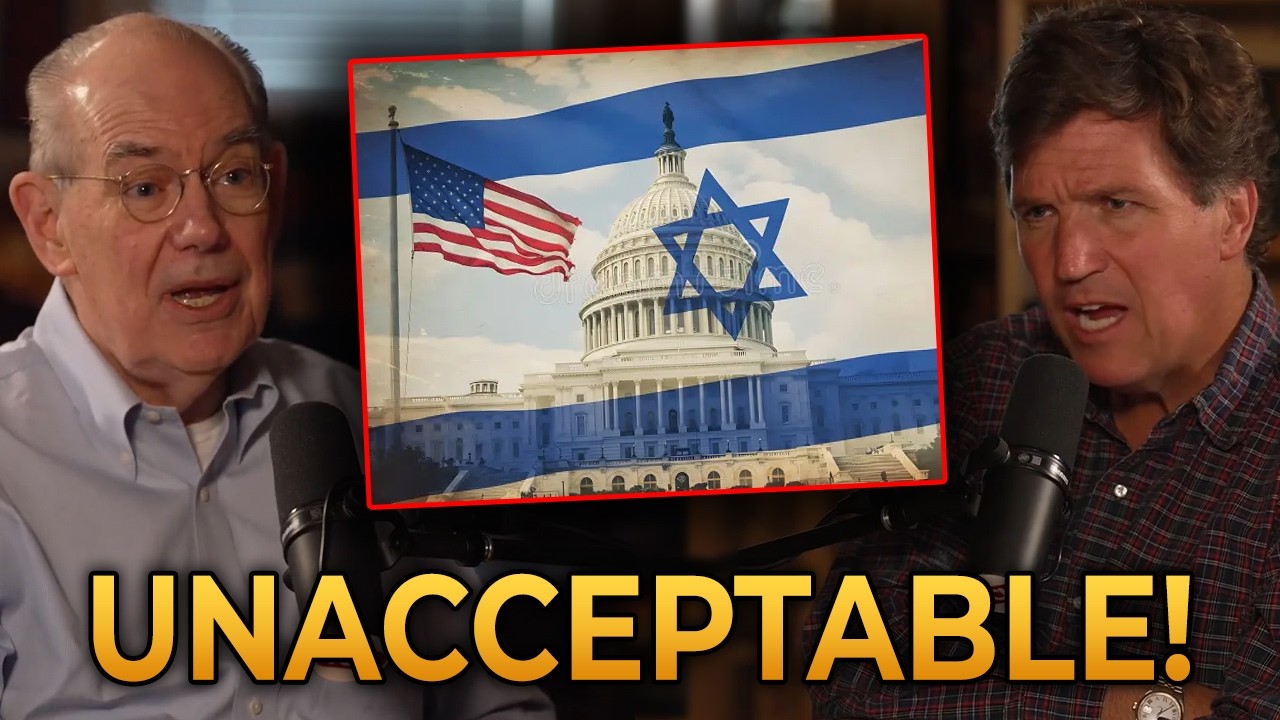
The opening feels like a political earthquake that most people only notice in fragments—clips, arguments, headlines. But underneath it is something larger: a growing, uneasy question about how power, alliances, and public opinion actually interact in the United States today.
A Turning Point in the Debate Over America’s Foreign Policy
Something unusual is happening in American political discourse. Voices once confined to the margins are now sitting at the center of mainstream conversation, questioning long-standing assumptions about U.S. foreign policy, military alliances, and the country’s relationship with Israel.
Two figures frequently cited in this shift—media commentator Tucker Carlson and political scientist John Mearsheimer—represent an unlikely convergence of populist media critique and academic realism. Despite their different backgrounds, both have recently articulated concerns about the strategic costs and political consequences of the U.S.–Israel relationship in ways that have intensified public debate.
The conversation they are part of is no longer just about one country or one conflict. It has expanded into questions about lobbying power, democratic accountability, military interventionism, and whether American foreign policy still reflects the interests of its own citizens.
And increasingly, people across the political spectrum are asking a once-taboo question: who exactly sets the direction of U.S. foreign policy—and why?
A Relationship Built on Strategic Alignment—and Controversy
The relationship between the United States and Israel has long been one of the most closely aligned partnerships in global politics. The U.S. provides military aid, diplomatic backing at the United Nations, intelligence cooperation, and broader strategic support. In return, Washington sees Israel as a key ally in a volatile region.
But critics argue that this alignment has become unusually rigid—sometimes to the point where it overrides other strategic considerations.
In recent commentary, Carlson and Mearsheimer have suggested that unconditional support may create unintended consequences: encouraging risk-taking behavior, limiting diplomatic flexibility, and entangling the United States in regional conflicts that do not clearly serve its national interest.
Supporters of the current policy reject this framing entirely. They argue that the alliance is rooted in shared democratic values, security cooperation, and long-standing geopolitical necessity in the Middle East.
What makes the current moment different is not that these disagreements exist—they always have—but that they are now being aired more publicly, more frequently, and in more ideologically diverse spaces than before.
The “Lobby” Debate and Political Influence in Washington
One of the most controversial aspects of this discussion is the role of advocacy organizations, particularly the American Israel Public Affairs Committee, commonly known as AIPAC.
Critics argue that AIPAC and related political networks exert significant influence over U.S. policy by shaping legislative priorities, funding campaigns, and reinforcing bipartisan support for Israel. They claim this creates a political environment in which dissenting views are discouraged or marginalized.
Supporters counter that AIPAC is simply one of many interest groups in a pluralistic democracy, comparable to defense, energy, or technology lobbies that also advocate for their preferred policies. In this view, influence is not unique—it is structural, and embedded in the American political system itself.
The tension between these interpretations reflects a deeper disagreement: whether U.S. foreign policy is primarily driven by democratic accountability or by institutional and financial incentives that operate outside direct public control.
Gaza, War, and the Moral Weight of Foreign Policy
No part of this debate exists in abstraction. It is shaped by real and ongoing conflicts, especially in Gaza, where military operations and humanitarian conditions have drawn global scrutiny and intense political polarization.
Critics of U.S. policy argue that unconditional military and diplomatic support for Israel has made Washington complicit in the escalation of violence. They often frame this in moral terms, suggesting that American foreign policy has drifted away from its stated principles of human rights and conflict restraint.
Others reject that conclusion and argue that Israel’s actions are driven by security threats, including attacks from militant groups, and that U.S. support is part of a broader strategy of regional stability and deterrence.
What is clear, however, is that Gaza has become a symbolic focal point in the broader debate over American power. It is no longer just a regional conflict—it is a lens through which people interpret the credibility, morality, and consequences of U.S. foreign policy itself.
A Shift in Public Opinion—and a Fragmenting Consensus
One of the most striking claims made in recent commentary is that American public opinion is changing, particularly among younger generations. Surveys and polling trends over the past decade have suggested a gradual decline in unconditional support for Israel among certain demographic groups, alongside increasing polarization around the issue.
This shift does not necessarily translate into a unified position. Instead, it reflects fragmentation: some Americans remain strongly supportive of the alliance, others are critical, and many are uncertain or disengaged.
What is different today is that these disagreements are more visible. Social media, independent media platforms, and long-form interviews have created spaces where previously marginal viewpoints can circulate widely without passing through traditional editorial filters.
This has allowed figures like Carlson to reach audiences that would previously have been exposed only to establishment perspectives on foreign policy.
The Role of Media: From Consensus to Contestation
For much of the late 20th century, foreign policy debate in the United States was shaped by a relatively narrow consensus among mainstream media outlets, think tanks, and political elites. Disagreements existed, but they were often contained within predictable boundaries.
Today, that ecosystem has fractured.
Alternative media platforms have become influential arenas where foreign policy is openly debated in ways that would have been rare on traditional broadcast networks. Critics argue that this represents a democratization of information. Others see it as fragmentation that makes coherent policy-making more difficult.
What is undeniable is that narratives about U.S. foreign policy are no longer controlled by a small number of gatekeepers. Competing interpretations now coexist in a crowded and often combative information environment.
Empire, Overreach, and the Historical Parallel
A recurring theme in critiques of U.S. foreign policy is the idea of imperial overextension. Historically, great powers have often faced difficulties when sustaining global commitments that exceed domestic political consensus or economic capacity.
In this framing, the United States is seen as managing a network of alliances, military bases, and security commitments that collectively resemble an informal empire. Supporters of this view argue that this structure creates both financial strain and geopolitical backlash.
They point to prolonged conflicts in the Middle East, including Iraq, Afghanistan, and Syria, as evidence that interventionist strategies often produce unintended and long-lasting consequences.
Opponents of this interpretation argue that such comparisons are misleading, and that American alliances—including with Israel—are fundamentally voluntary, mutually beneficial, and grounded in shared interests rather than coercive control.
The Argument Over Consequences: Stability or Instability?
A key disagreement in this debate centers on consequences. Critics argue that unconditional support for allies in volatile regions can escalate conflicts and entrench long-term instability. They suggest that more conditional or restrained engagement could reduce the likelihood of prolonged wars.
Supporters counter that disengagement or reduced support could embolden adversaries, destabilize allies, and create power vacuums that lead to even greater conflict.
This is not simply a moral disagreement—it is a strategic one. It reflects different theories of international relations: restraint versus deterrence, multipolar balance versus alliance dominance, and caution versus assertive engagement.
Political Realignment and Cross-Ideological Coalitions
One of the more surprising developments in this debate is the emergence of cross-ideological agreement on certain aspects of foreign policy criticism. Figures from both left-wing and right-wing traditions occasionally converge in their skepticism of interventionist wars or unconditional foreign aid.
This does not mean a unified coalition exists. Far from it. But it does suggest that traditional political labels—left and right—are sometimes less predictive of foreign policy views than generational, institutional, or populist divides.
The question raised by commentators is whether these overlapping critiques could eventually form a more coherent political force, or whether they will remain fragmented and internally inconsistent.
What Comes Next: Stability or Transformation?
The central uncertainty is not whether debate will continue—it clearly will—but whether it will translate into policy change.
Several possibilities exist:
One is continuity, where U.S. foreign policy remains largely stable despite increasing public disagreement. Another is gradual adjustment, where policymakers introduce more conditionality and strategic restraint without fundamentally altering alliances. A third, more disruptive scenario is political realignment, where foreign policy becomes a more central electoral issue and reshapes party coalitions.
At this stage, none of these outcomes is guaranteed.
What is clear is that the conversation itself has changed. Topics once considered politically sensitive or marginal are now part of mainstream discussion. That alone represents a significant shift in the landscape of American political discourse.
Conclusion: A Debate That Reflects a Larger Question
At its core, the debate over the United States and Israel is not only about one alliance or one region. It is about how a global superpower defines its responsibilities, manages its commitments, and responds to changing public expectations.
Whether one agrees with critics like Tucker Carlson or scholars like John Mearsheimer, the intensity of the debate signals something important: the traditional consensus on foreign policy is under pressure.
And as media ecosystems fragment, public opinion shifts, and geopolitical tensions evolve, the United States may be entering a period where its long-standing assumptions about alliances, influence, and intervention are no longer taken for granted.
What replaces them is still uncertain—but the argument over it has already begun.