Jeffrey Sachs Issues Iran Warning: “The War Isn’t Over Yet! Israel Will Sabotage the Deal!”
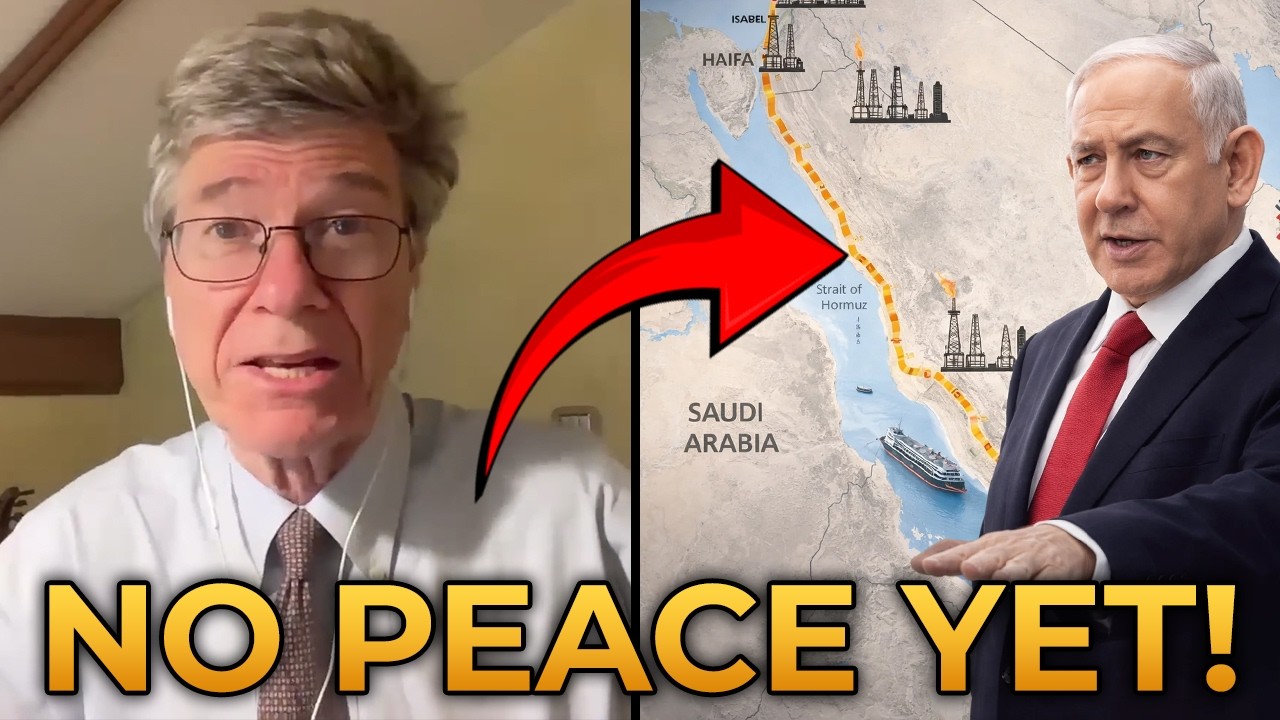
The war that was supposed to reshape the Middle East may instead be remembered for how little it actually changed.
What happens when a war ends—but nobody agrees on what it achieved?
That question sits at the center of a heated political commentary surrounding the recent Iran–Israel–United States confrontation. In a lengthy discussion drawing on the views of economist Jeffrey Sachs and media commentary around figures like Donald Trump, the conflict is portrayed not as a strategic breakthrough, but as a chaotic, poorly defined episode that may have produced more confusion than resolution. Claims of ceasefires, memorandums of understanding, and diplomatic “off-ramps” are circulating—but so too are warnings that none of it may hold.
At the center of this uncertainty lies a deeper argument: that modern wars in the Middle East—especially those involving Iran and indirectly Israel—are increasingly difficult to “win” in any traditional sense. Instead, they generate cycles of retaliation, economic shock, political backlash, and diplomatic fragmentation. And according to critics featured in this debate, even the world’s most powerful state—the United States—may no longer be able to dictate the outcome.
What follows is not just a story about a war. It is a story about power, perception, and the growing instability of the global order itself.
A ceasefire that may not exist in practice
On the surface, recent reports suggest a possible diplomatic arrangement involving Iran, mediated in part through intermediaries such as Pakistan and regional actors like Oman. The proposal, as described in commentary, includes reopening strategic shipping routes such as the Strait of Hormuz, partial unfreezing of Iranian assets, and a reduction in active hostilities.
But even supporters of the framework admit the details are murky.
There is no finalized signed agreement. Terms appear to be shifting. And crucially, key stakeholders—including Israel—are not formally integrated into the arrangement, raising immediate questions about enforcement.
Sachs and others caution that history offers little reason for optimism. Past diplomatic attempts in the region have repeatedly collapsed under pressure from renewed strikes, proxy escalations, or unilateral reinterpretations of ceasefire terms. In this view, even if a paper agreement emerges, the operational reality on the ground may remain unchanged.
The result is a fragile equilibrium: not peace, but suspended conflict.
The war that “ended” too many times
One of the most striking themes in the commentary is the claim that the Iran conflict has “ended” multiple times already—only to restart under different conditions.
This reflects a broader skepticism about modern war reporting, where political leaders and media outlets often declare victory or closure long before conditions stabilize.
In the current narrative, the war is described as:
A “lose-lose” confrontation
Strategically incoherent
Politically driven rather than militarily necessary
And ultimately inconclusive for all parties involved
Even the framing of victory is contested.
Iran, according to critics, suffered significant infrastructure damage, casualties, and economic disruption. Yet it retained its governmental structure and avoided the regime collapse that some early war rhetoric implied was possible.
Benjamin Netanyahu and allied strategic planners, meanwhile, are portrayed in the commentary as having failed to achieve decisive strategic transformation in Iran or the region. And the United States, under both Trump-era policy influence and broader bipartisan consensus, is depicted as having absorbed costs without clear gains.
This leads to the central paradox: everyone can claim damage inflicted on their adversary—but no one can convincingly claim strategic success.
The Strait of Hormuz and the illusion of control
One of the most geopolitically sensitive elements of the discussion is the Strait of Hormuz, a critical global oil chokepoint.
In the proposed arrangement, operational oversight and toll structures may shift toward Iranian and Omani coordination. Supporters describe this as a stabilizing compromise. Critics interpret it differently: as a structural concession forced by the realities of escalation.
The Strait is not merely a shipping route. It is a pressure point for global energy markets. Any change in its governance affects insurance rates, shipping logistics, and global inflation risk.
In the commentary, this becomes symbolic of a larger argument: that war has not restored control or deterrence, but instead redistributed leverage.
What was once assumed to be firmly under Western strategic influence is now contested terrain.
Israel, the United States, and the question of alignment
A central and controversial claim in the discussion is that U.S. foreign policy in the Middle East is heavily shaped by alignment with Israeli strategic interests.
Critics argue that Washington’s involvement in regional conflicts often extends beyond direct American security needs, and instead reflects deeper institutional and political entanglements.
In this framing, United States is portrayed as absorbing disproportionate financial and military burdens, while Israel maintains regional military advantages supported by U.S. diplomatic and logistical backing.
The result, according to this view, is a “special relationship” that has become increasingly difficult to question within mainstream political discourse.
Supporters of this argument claim:
U.S. taxpayer resources are heavily committed to regional conflicts
American domestic priorities are deprioritized in foreign policy decisions
Military escalation cycles persist without clear congressional debate
And political criticism of the alliance is socially or institutionally discouraged
Critics of this framing, however, would argue the opposite: that U.S.–Israel cooperation is rooted in shared security concerns, intelligence coordination, and regional deterrence objectives.
What is clear is not consensus—but polarization.
A war with no clear winner
Perhaps the most important claim in the commentary is also the simplest: nobody won.
Iran is damaged but intact
Israel is strategically strained and diplomatically scrutinized
The United States has expended resources without decisive geopolitical gain
Regional stability remains fragile
In traditional geopolitical theory, wars are expected to end with clear shifts in power. Territory changes hands. Governments fall. Treaties redefine borders.
But in this case, none of those outcomes fully materialized.
Instead, the conflict resembles what some analysts describe as “managed instability”—a condition where active warfare subsides temporarily, but underlying tensions remain unresolved.
This is why the term “ceasefire” is itself contested. It may describe not peace, but pause.
The political consequences in Washington
The domestic implications in the United States are becoming part of the debate itself.
Critics argue that prolonged foreign entanglements contribute to:
Rising national debt
Inflationary pressure through defense spending
Political fragmentation between ideological factions
Growing public skepticism toward foreign intervention
Supporters of continued engagement counter that withdrawal could destabilize global markets, weaken deterrence, and embolden adversaries.
But even within U.S. politics, there is visible tension between competing visions:
One prioritizing global military presence and alliances
Another advocating restraint and domestic focus
This divide is increasingly shaping electoral discourse, particularly among younger voters who are more skeptical of long-term military commitments abroad.
The idea of “sabotaged peace”
One of the most provocative arguments in the commentary is the claim that peace agreements in the region are often structurally unstable—not because diplomacy fails in principle, but because key actors may not fully accept the constraints of negotiated settlement.
In this view, ceasefires are not endpoints but transitional phases that can be undermined by:
Ambiguous enforcement mechanisms
Unresolved territorial disputes
Proxy conflicts
Political incentives that reward escalation
Whether or not one agrees with this interpretation, it reflects a broader historical pattern in the region: agreements frequently collapse under pressure from events on the ground.
A shifting global order
Beyond the immediate conflict, the deeper narrative is about global power transition.
The war is interpreted by some analysts as evidence that the United States is no longer able to unilaterally shape outcomes in complex regional conflicts. Even with overwhelming military capacity, outcomes are constrained by:
Local political resilience
Asymmetric warfare
Regional alliances
Economic interdependence
And global diplomatic fragmentation
This does not mean American power has disappeared. But it suggests it may be less decisive than in previous decades.
In that sense, the conflict becomes less about Iran or Israel alone—and more about the limits of modern empire.
Conclusion: a war that explains more than it resolves
If there is one consistent theme running through the commentary, it is dissatisfaction with the idea that this war had any coherent strategic purpose or outcome.
Instead, it is portrayed as:
Expensive
Inconclusive
Politically divisive
And strategically ambiguous
Whether future diplomacy stabilizes the region remains uncertain. Agreements may be signed, ceasefires may be announced, and official narratives may declare closure.
But beneath those announcements, the underlying tensions remain unresolved.
And that may be the defining feature of modern conflict in the Middle East: wars that do not end so much as they transform—into something quieter, longer, and harder to define.
In that sense, the real question is not whether this war is over.
It is whether anything meaningful was ever resolved at all.