Tucker Carlson TRASHES Netanyahu for Undermining FRAGILE Iran Peace Deal
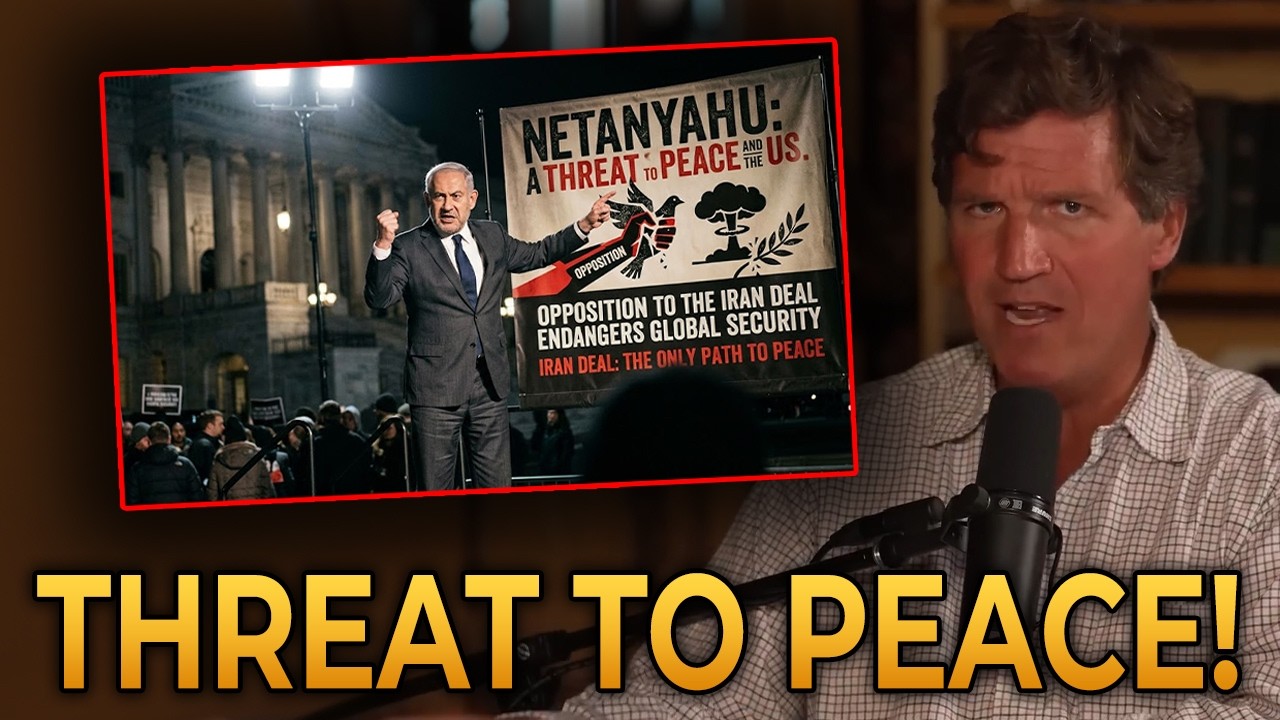
Is Trump Breaking with Netanyahu? Tucker Carlson’s Explosive Critique Signals a Growing Divide on the American Right
The political battle over America’s role in the Middle East may have entered a completely new phase.
For years, disagreements over Israel, Iran, and U.S. foreign policy largely followed predictable partisan lines. Today, however, one of the fiercest conflicts is unfolding inside the American conservative movement itself. Figures who once stood shoulder to shoulder behind President Donald Trump are now openly challenging one another over whether continued alignment with Israel serves America’s interests—or risks dragging the United States into another costly regional conflict.
That debate reached a new level after commentator Tucker Carlson sharply criticized Israeli Prime Minister Benjamin Netanyahu, arguing that Israeli actions could jeopardize diplomatic efforts involving Iran. His comments echoed a growing faction of “America First” conservatives who believe Washington should prioritize avoiding another prolonged Middle Eastern war over maintaining its traditional approach toward Israel.
Whether one agrees with Carlson or not, his remarks highlight a significant political shift. Questions that were once considered untouchable within conservative circles are now being debated publicly, with increasing intensity. The dispute is no longer simply about Iran or Israel. It is about the future direction of American foreign policy—and who ultimately shapes it.
A Civil War Inside the America First Movement
For decades, support for Israel has been one of the few issues that united much of the Republican Party. Military aid, intelligence cooperation, and close diplomatic ties were generally treated as non-negotiable pillars of U.S. foreign policy.
Today, that consensus appears increasingly fragile.
Carlson argues that many of the loudest advocates for continued confrontation with Iran rely on emotional rhetoric rather than practical strategic analysis. According to his criticism, supporters of an aggressive military approach often dismiss opposing viewpoints instead of engaging with the underlying arguments.
His broader point is not simply about one policy disagreement. It is about how foreign policy debates are conducted.
Carlson suggests that when critics question military intervention or express skepticism about America’s commitments abroad, they are frequently accused of ulterior motives rather than answered with evidence. In his view, this style of argument weakens public discussion while preventing serious evaluation of America’s long-term interests.
Supporters of Israel strongly reject that characterization, arguing that Israel faces genuine security threats and that robust American support remains essential for regional stability. They contend that Iran’s military capabilities and regional influence justify continued pressure and close U.S.-Israeli cooperation.
The divide between these perspectives has become one of the defining fault lines within conservative politics.
Netanyahu, Trump, and an Uncertain Peace Process
At the center of Carlson’s commentary lies one fundamental question:
Can any diplomatic agreement with Iran survive if Israel believes it threatens its national security?
Carlson argues that this represents the greatest obstacle facing any potential negotiations. In his analysis, domestic opposition within Congress is less significant than resistance from Israel’s government, which has consistently maintained that Iran cannot be trusted and that military pressure remains necessary.
This perspective portrays the challenge facing Trump as deeply political.
If the former president wishes to pursue diplomacy, Carlson argues, he would need to convince American voters that reducing tensions serves U.S. interests—even if that means publicly disagreeing with Israeli leaders.
Such a move would represent a dramatic departure from decades of American political tradition.
Throughout modern U.S. history, presidents from both parties have generally emphasized unwavering support for Israel, even while occasionally disagreeing over specific policies. Carlson suggests that today’s circumstances may require a more independent American approach.
Whether Trump ultimately embraces that path remains uncertain.
The Growing Influence of America First Foreign Policy
The debate also reflects the broader evolution of the America First movement.
Originally centered on trade, immigration, and border security, the movement has increasingly expanded into foreign policy. Many of its supporters argue that America’s military interventions over the past two decades produced enormous financial costs while failing to achieve lasting strategic success.
To these critics, Iraq and Afghanistan serve as cautionary examples.
Their argument is straightforward: military campaigns that begin with limited objectives often expand into years of costly involvement with uncertain outcomes.
Carlson does not argue that every international conflict should be ignored. Rather, he questions whether additional military escalation consistently produces better results than diplomacy.
This skepticism has become increasingly influential among conservative voters, particularly those who believe American resources should be focused primarily on domestic priorities.
The Mike Huckabee Controversy
Carlson also devoted significant attention to comments made by U.S. Ambassador Mike Huckabee regarding Israel’s historical importance.
According to Carlson, Huckabee’s remarks illustrated what he sees as a broader tendency among some defenders of Israeli policy to rely on sweeping ideological claims instead of historical or strategic arguments.
Carlson criticized the ambassador’s language as exaggerated and argued that such rhetoric makes productive debate more difficult rather than easier.
Supporters of Huckabee would likely counter that his remarks were intended as a theological or cultural statement reflecting shared Judeo-Christian traditions rather than a literal historical claim.
The disagreement illustrates how discussions surrounding Israel often extend beyond military strategy into questions of religion, identity, and national values.
The Politics of Moral Legitimacy
Perhaps Carlson’s most consequential argument concerns what he describes as Israel’s “moral legitimacy” among the American public.
He suggests that changing public attitudes—particularly after recent conflicts—have altered the political landscape in ways that neither Washington nor Jerusalem can ignore.
Polling over recent years has shown growing divisions among Americans regarding U.S. policy toward Israel, with opinions varying significantly across age groups and political affiliations.
Carlson argues that these changing attitudes create political space for leaders willing to reconsider longstanding assumptions.
Whether those shifts prove lasting remains an open question.
Why Internal Conservative Divisions Matter
The most striking aspect of the current debate may not be criticism coming from progressive activists or Democratic politicians.
Instead, it is that many of the loudest critics now come from influential conservative voices.
Journalists, podcasters, and commentators who broadly support Trump’s domestic agenda increasingly disagree over foreign policy.
Some argue that supporting Israel remains essential for American national security.
Others believe the relationship should become more conditional, with Washington placing greater emphasis on avoiding military entanglements.
This disagreement reflects competing visions of what “America First” actually means.
For one side, standing firmly with allies strengthens American influence.
For the other, limiting overseas commitments better protects American interests.
The Netanyahu Question
Netanyahu himself remains central to these disagreements.
Supporters view him as an experienced leader confronting extraordinary security challenges.
Critics argue that his government’s policies risk escalating regional tensions while complicating American diplomatic objectives.
Carlson suggests that repeated military actions during sensitive negotiations make diplomacy considerably more difficult.
Supporters of Israel respond that deterrence often requires maintaining military pressure and that negotiations without credible leverage rarely succeed.
These competing strategic philosophies have existed for decades.
What has changed is how openly they are now debated within conservative media.
Can Diplomacy Succeed?
The ultimate question remains whether diplomacy can produce lasting stability.
Advocates of negotiations argue that prolonged military confrontation increases economic uncertainty, raises energy prices, and risks wider regional escalation.
Supporters of a harder line contend that concessions may embolden adversaries without resolving the underlying security threats.
History offers examples supporting both perspectives.
Some diplomatic agreements have reduced tensions.
Others have collapsed amid renewed conflict.
As a result, neither side can point to an uncontested historical formula for success.
Trump’s Political Balancing Act
Trump now faces competing pressures from different factions of his own political coalition.
One group emphasizes unwavering support for Israel and continued pressure on Iran.
Another increasingly prioritizes avoiding military intervention and reducing America’s commitments overseas.
Maintaining support from both constituencies may prove difficult if future events force clear policy choices.
Carlson argues that Trump’s political instincts increasingly recognize the public’s fatigue with foreign conflicts.
Whether that translates into long-term policy remains uncertain.
Beyond Personalities
Although media attention often focuses on Carlson, Netanyahu, or Trump, the larger issue extends beyond individual personalities.
The debate reflects broader questions that American policymakers have confronted for decades:
Should the United States continue serving as the primary security guarantor in the Middle East?
How much influence should allies have over American strategic decisions?
When does military deterrence become counterproductive?
Can diplomacy realistically prevent future conflict?
These questions have no easy answers.
Reasonable observers can reach different conclusions while examining the same events.
A Debate That Is Only Beginning
Regardless of where one stands politically, one reality is difficult to ignore.
Conservative foreign policy is changing.
Ideas that once existed on the margins are now being discussed by some of the movement’s most influential voices. Traditional assumptions are facing sustained criticism not only from political opponents but from within the broader conservative coalition itself.
Whether this ultimately leads to a lasting transformation of Republican foreign policy—or simply represents a temporary disagreement during a particularly volatile moment—remains to be seen.
What is clear is that the conversation has fundamentally shifted.
The dispute is no longer merely about one ceasefire, one diplomatic negotiation, or one military operation. It is about America’s role in the world, the limits of military power, the responsibilities of alliances, and the competing visions of what truly serves the national interest.
As these debates continue, the outcome will shape not only U.S. policy toward Israel and Iran but also the future identity of the America First movement itself. The questions raised today are unlikely to disappear anytime soon, and the answers could define American foreign policy for years to come.