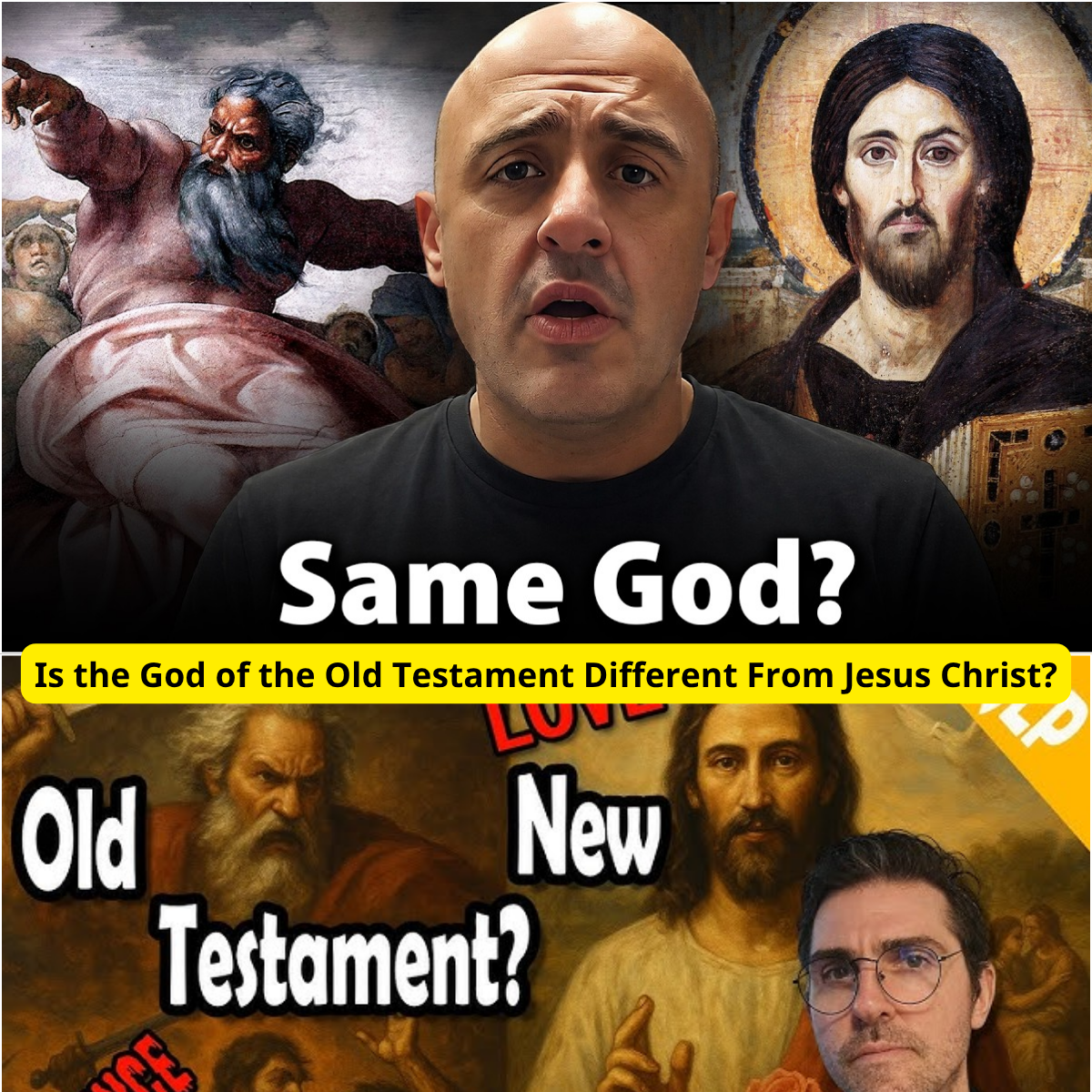
Is the God of the Old Testament Different From Jesus Christ?
Is the God of the Old Testament Different From Jesus Christ?
The glowing red digital digits on the soundboard blinked, marking the two-hour limit of the live broadcast. Inside the studio of The Truth Line, a popular theological call-in show broadcasting out of Austin, Texas, the air was warm and smelled faint of ozone and reheated coffee.
Samson sat before his high-end condenser microphone, adjusting his headphones with a practiced, calm flick of his wrist. He was a broad-shouldered man with a neatly trimmed beard, a bald head that caught the studio lights, and eyes that had spent decades scanning ancient texts. Known for his encyclopedic memory of scripture and an unapologetic, rapid-fire delivery, Samson didn’t tolerate sloppy thinking.
His producer’s voice clicked into his earpiece: “We’ve got Julian on line three. College kid from Ohio. Sounds a bit out of his depth, but he’s wrestling with some heavy stuff.”
Samson hit the blinking button on his console. “Julian, welcome to the show. What’s on your mind today, brother?”
A young, hesitant voice crackled through the monitors. “Hey, Samson. Thanks for taking my call. Um, so I wanted to ask about the Gnostics. Specifically, the difference in how God acts in the Old Testament versus the New Testament…”
“Slow down just a beat, young man,” Samson cut in, leaning forward, a sharp grin tugging at the corner of his mouth. “You said it a bit too fast. You’re asking about what to say against Gnostics? Gnostic with a ‘G’?”
“Right, yeah,” Julian stammered, clearing his throat. “Gnostic with a G. It’s just… one of my friends at school claims to be one now. And right now, I’m mostly just listening and asking him questions. But his main point is the massive difference in the nature of God between the New Testament and the Old Testament. He’s essentially preaching Marcionism—though I don’t want to butcher the term. He looks at the Old Testament and sees a completely different character.”
“And what exactly makes him think the nature of God changes?” Samson asked, his tone shifting into the analytical posture of a seasoned apologist.
“Well, you know, the obvious stuff,” Julian said. “Like the global flood in Genesis, or God commanding the Israelites to go into Canaan and wipe out the Philistines. It feels like two completely different entities.”
Samson chuckled, a rich, resonant sound that vibrated through the microphone. He leaned back in his leather chair, tapping a rhythm against his desk.
“Julian, let me ask you a question. Your friend is pointing to the New Testament to argue that the Old Testament God is a bloodthirsty monster, right? But is this the same New Testament where Jesus Christ actually points to the global flood as an absolute historical event?”
A brief silence hung on the line.
“In Luke chapter 17,” Samson continued, his voice stepping up in intensity, “Jesus doesn’t just validate the flood; He uses it as an explicit precursor to what He will personally do to people when He returns in judgment. So, how do you appeal to the New Testament to show a soft, gentle shift in the character of God, when it’s Jesus Himself who confirms the devastation of the flood? He uses the total destruction of ancient humanity as a terrifying warning to His own generation about the coming of the Son of Man.”
“Yeah… I guess that’s where I’m getting confused,” Julian admitted, his voice small. “It feels like a heresy the early church dealt with centuries ago, but it’s still tripping people up.”
“It absolutely is Marcionism, and it’s completely inconsistent,” Samson said, flipping open a heavy, leather-bound Bible on his desk. The pages rustled crisply into the microphone. “You cannot logically tell me the God of the Old Testament is a different being when the New Testament is entirely saturated with examples of Old Testament judgments that Jesus explicitly ratifies. He gave His divine amen to Noah’s narrative.”
Samson traced his finger down the text of Luke 17. “Listen to the text, Julian. Verse 25: ‘But first the Son of Man must suffer many things and be rejected by this generation. And as it was in the days of Noah, so it will be also in the days of the Son of Man.’ It’s right there in black and white. And it’s not just Jesus. Look at Second Peter chapter 3. The Apostle Peter writes plainly that God destroyed the ancient world by water, and that this current world is being reserved for a destruction by fire. Look at First Peter chapter 3, discussing the ark. The New Testament writers didn’t look at the Old Testament judgments with embarrassment; they looked at them as blueprints for the future.”
He paused, letting the weight of the scripture settle over the airwaves. “So, what other examples does your Gnostic friend try to throw at you to prove a contradiction?”
Julian took a breath, seemingly bolstered by the breakdown. “Well, the other big one he brings up is Moses and the sheer violence in the conquest narratives. Like, God commanding the Israelites to go in, draw the sword, and spare nothing that breathes. Men, women, children. He says a loving Jesus could never be aligned with that kind of slaughter.”
“Fascinating,” Samson countered instantly, his eyebrows shooting up. “So he thinks that event separates Jesus from the Father. Yet, it’s the exact same Jesus Christ who constantly appeals to the absolute authority of the Law of Moses. In John chapter 5, Jesus looks at the religious leaders and says, ‘Moses wrote about Me. If you believed Moses, you would believe Me.’ Think about the utter irony of your friend’s position. He uses a text to reject the Old Testament, while the central figure of that text says the author of the Old Testament wrote about Him!”
Samson flipped the pages expertly, the rhythmic slap of paper echoing in the quiet studio. “Look at Luke chapter 24, verses 44 through 49. After the resurrection, Jesus walks with the disciples and declares that everything written about Him in the Law of Moses, the Prophets, and the Psalms must be fulfilled. He completely binds His identity to the God who authorized those conquests.”
“And it goes deeper than Moses,” Samson pressed on, his voice gaining a sharp, rhythmic cadence. “Jesus regularly uses the total annihilation of Sodom and Gomorrah as a baseline for His own theological warnings. In Matthew chapter 11, verses 20 through 24, and Matthew chapter 10, verse 15, He upbraids the cities where His miracles were performed. He looks at Capernaum and says, ‘If the mighty works done in you had been done in Sodom, it would have remained until this day. But it shall be more tolerable for the land of Sodom on the day of judgment than for you.’ The same Sodom and Gomorrah from Genesis 18 and 19, where brimstone wiped out every living breathing thing, including children. Jesus validates its destruction and promises something even more severe for those who reject the gospel. Your friend is inventing a passive, safe, Europeanized Jesus that simply does not exist in the Greek text.”
“Could you repeat those verses again? Sorry, I’m writing this down,” Julian asked, the sound of a pen scratching frantically audible over the line.
“Matthew 11:20-24 and Matthew 10:15,” Samson repeated clearly. “Write them down, study them, and hand them to him. What else has he got?”
The line went quiet for a moment as Julian adjusted his thoughts. When he spoke again, the subject took a sudden, radical turn, revealing a deeper, more personal anxiety.
“Well, shifting gears a bit… it’s about defending innocent children. I’ve been reading up on Christian Just War theory. Say someone walks up and puts a gun to your neighbor’s head—as an individual, you have a moral obligation to intervene and defend them, right? But looking at history, and even today, it seems like we have an unprecedented, heartbreaking amount of innocent children dying across the world. How are we supposed to stop that? It weighs on me heavily.”
Samson’s expression softened, the aggressive edge of the apologist giving way to a grounded, realistic empathy. He looked at the sound meters bouncing on his console.
“Julian, let me ask you a very practical question. How are you going to stop it? If you are living in a society that doesn’t possess a Christian government, with politicians who have zero interest in legislating according to God’s moral law, what the heck are you going to do?”
“I don’t know,” Julian murmured. “I just feel like we should be able to protect them in some way.”
“Be realistic, young man,” Samson said, his tone firm but deeply supportive. “You are living in the exact same historical reality that the early Apostles did. For the first three hundred years of the Church, Christians lived under a hostile, pagan Roman Empire. They possessed absolutely no political clout, no legislative power, and no military influence. They were, quite literally, lambs to the slaughter. They watched their own children torn apart by beasts in the Colosseum or burned alive as torches in Nero’s gardens. They had zero ability to physically defend anyone outside of their immediate, desperate circumstances.”
Samson leaned into the microphone. “It wasn’t until Constantine legalized Christianity with the Edict of Milan, and later Emperor Theodosius made it the official religion of the state, that systemic, cultural changes occurred to protect the vulnerable on a massive scale. But that took over three centuries of endurance. So, what did the early church do for those three hundred years? What was their weapon?”
“I guess… they prayed?” Julian offered.
“Exactly!” Samson said, slamming his hand lightly on the desk for emphasis. “They prayed relentlessly. They changed the culture from the bottom up, one soul at a time, until the empire itself buckled under the weight of the gospel. When the opportunity arises to vote, to advocate, or to physically protect someone in front of you, you do it with everything you’ve got. But outside of that, you recognize your limitations under a broken world, you pray, and you trust the sovereignty of God. There’s nothing else you can do, brother.”
“That makes sense,” Julian said, a visible sense of relief washing over his voice. “I agree with you. And honestly, I see the beauty and the historical reality of the miracles across the ancient churches—the Eastern Orthodox, the Catholic Church… I respect that. But it brings me to another question I’ve been struggling with. Why is it so important to pursue the ‘fullness of the faith’ if people can find God in these different pockets?”
“Let’s be precise here,” Samson corrected instantly. “Nobody who understands theology says knowing the fullness of the truth isn’t necessary. There is a massive structural difference between a person who genuinely believes they have the fullness of truth because they are living out what they’ve been taught, versus a person who is actively confronted with the historical and biblical facts, but says, ‘You know what? I’m not interested.’ That’s a completely different posture of the heart.”
Samson shifted his weight, his eyes narrowing slightly as he checked the studio clock. “Jesus didn’t say ‘you shall know a fraction of the truth and it’ll make you feel okay.’ He said, ‘You shall know the truth, and the truth shall set you free.’ If a man doubles down on error when presented with clear evidence, simply because he prefers his own interpretation or comfort zone, that is where culpability lies. God sees the heart, Julian. He knows who is seeking Him in sincerity and who is just defending a brand.”
“Yeah, I suppose it comes down to personal research and humility,” Julian said. “Which actually brings me to the Filioque debate… I’ve been reading about how the Western church added it to the Nicene Creed, and it’s causing a lot of friction in my studies.”
Samson let out a booming laugh, his face lighting up. “Ah, the Filioque! God bless you, kid. You really like diving into the deepest parts of the ocean, don’t you? Let me tell you something that might shock you: virtually everyone actually believes in the theology behind the Filioque, even if they don’t like using the specific Latin term.”
“Wait, really?”
“Think about it,” Samson explained, gesturing with his hands as if teaching a class. “No mainstream Eastern Orthodox theologian denies that the Holy Spirit proceeds from the Father and through the Son in some eternal, economic sense. The primary historical objection to the Filioque isn’t purely theological; it’s structural and political. It was added to the Nicene-Constantinopolitan Creed in the West around the sixth century—specifically around the year 512—without a universal, ecumenical council involving the East.”
“Right, I read it was added to combat Arianism,” Julian interjected. “But wasn’t Arianism dealt with much earlier at the Council of Nicaea?”
“You didn’t hear what I said, young man,” Samson countered gently but firmly, shaking his head. “There was a massive, violent resurgence of Arianism in the West during the sixth century among the Germanic tribes. Heresies don’t just die out because a council signs a piece of paper. They resurface constantly throughout history. Heck, you have Arianism walking up to your porch today—they’re called Jehovah’s Witnesses! They believe Christ is a created, inferior deity. So, to safeguard the absolute equality of the Son with the Father, the Western church inserted ‘and the Son’ into the creed to emphasize His divine authority.”
Samson leaned forward, his voice dropping to a sharp, confidential register. “The East was furious because the West acted unilaterally, changing a creed hammered out in 381 at Constantinople without consulting them. But here is the historical reality: they remained in full communion with the Catholic Church for another five hundred years until the Great Schism of 1054! If the Filioque itself was an inherently damnable, soul-destroying heresy, they wouldn’t have shared the same chalice for half a millennium. The real debate today is the precise metaphysical sense of how the Spirit proceeds. If you don’t believe me, go watch the recent debates between guys like David Erhan and Christian Wagner. Even the highest-level scholars spend hours navigating the semantic modes of procession because it’s incredibly deep water.”
“Huh,” Julian muttered, clearly processing the historical timeline. “The Eastern Rite parish I’ve been visiting actually doesn’t say the Filioque in their creed during liturgy. I found that interesting.”
“Because they are an Eastern Catholic church!” Samson exclaimed, a triumphant grin spreading across his face. “They are allowed to preserve their traditional liturgical heritage by omitting the phrase from the recital, but because they are in full, visible communion with the Pope, they must completely affirm the underlying theology of the Filioque as defined by the Magisterium. Go ask their priest next Sunday. Say, ‘Father, since you don’t recite it, do you reject the doctrine?’ He legally and canonically cannot say yes. They are saying the exact same truth using different linguistic tools.”
“And let me give you one final historical nugget to consider,” Samson added, tapping his finger on his desk. “St. Augustine of Hippo is recognized as a fully canonized saint in the Eastern Orthodox Church. Correct?”
“Yeah, I believe so.”
“Well, St. Augustine wrote De Trinitate—the most comprehensive, monumental tome on the Trinity in the ancient world—and he explicitly, aggressively outlines and defends the concept of the Filioque as understood by the Western church. So, if the Filioque is a damnable heresy that sends people straight to hell, how on earth is the man who synthesized the doctrine still venerated as a saint on their calendar? You can’t have a heretic in hell who is simultaneously a saint in heaven. It’s a massive logical contradiction.”
Julian let out a breathless laugh on the other end of the line. “Wow. That’s… that’s an incredible point, Samson. Seriously.”
The studio clock showed less than a minute left in the broadcast. The music bed began to fade in softly beneath Samson’s microphone—a rhythmic, ambient cue that the show was coming to an end.
“Look into these things, brother,” Samson said, his voice dropping into a warm, fatherly tone that balanced the intensity of the hour. “You are a remarkably sharp young man. But I want to leave you with one vital piece of advice: stay humble. When God blesses you with a quick mind and a passion for theology, it is incredibly easy for the ego to get puffed up. And once you get puffed up with intellectual pride, God gets disgusted.”
He smiled warmly at the console, his voice filled with an authentic, self-deprecating wit. “Don’t take yourself too seriously, Julian. Remember, you’re not as great as you think you are. Heck, I’m certainly not as great as I think I am, and I pray every single day that I never think I’m great. God can only use an instrument when it humbles itself enough to realize it’s just a kid trying to understand a massive, beautiful mystery. Keep studying, stay small, and God will exalt you in His time.”
“Thank you so much, Samson. God bless you.”
“God bless you too, young man. Keep hunting for the truth.”
Samson hit the disconnect button, slipping his headphones off as the final credits rolled. He leaned back, took a sip of his lukewarm coffee, and smiled into the quiet studio, ready for the next soul searching for the light.