A Single Dad let Stranded Woman Stay The Night — Next Morning 20 Range Rovers Surrounded His House
A Single Dad let Stranded Woman Stay The Night — Next Morning 20 Range Rovers Surrounded His House
Chapter I: The Horizon at Silver Creek
The gray light broke over Silver Creek like a slow pane of dirty glass, casting a pale, unblinking glare across the frosted gravel of the yard. It was the kind of mountain morning that felt less like dawn and more like the lifting of a shroud.
Holden Carver stood on the porch of the small clapboard house, his boots resting an inch from the warped edge of the top step. He wore an old hunter-green flannel shirt against the bite of the high-altitude cold, his hands wrapped around a heavy ceramic mug of black coffee. He did not move. He did not call the county sheriff. He did not step back inside to the safety of the wood-stove heat.
Arrayed in a silent, predatory half-circle around his front yard were twenty matte-black Range Rovers. Their exhaust pipes sent thick, rhythmic plumes of white vapor into the freezing mountain air, the low rumble of their V8 engines vibrating through the floorboards beneath Holden’s feet. For three long minutes, no one stepped out. The tinted windows remained completely opaque, reflecting the dark pines and the jagged teeth of the Front Range behind them.
Then, the heavy oak door behind Holden clicked open. Marin Halberstam walked out onto the porch. She did not wear the crisp, armored tailoring of a defense logistics executive anymore; she wore an oversized, chunky wool cardigan she had borrowed from a local diner owner, her dark hair pulled back into a hasty knot. She stood exactly one step to Holden’s left, her arms crossed tightly over her chest. She said absolutely nothing, but her presence shifted the air.
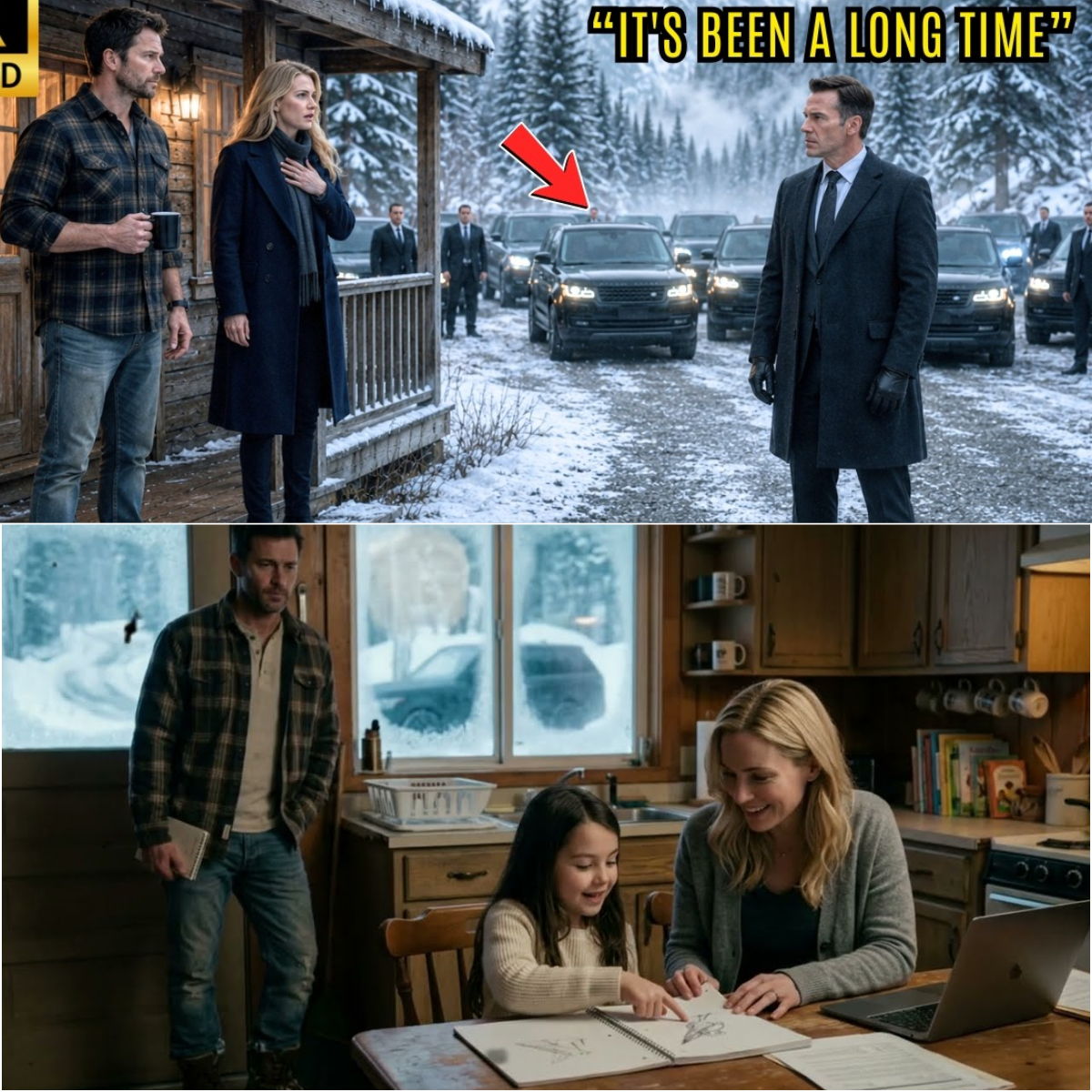
At that movement, the heavy door of the lead Range Rover swung open. A man in a dark, flawless charcoal suit stepped out onto the frost-rimed gravel. He adjusted the lapels of his coat, squinted through the rising steam, and walked forward until he reached the base of the porch steps. He stopped, looking up at the man with the coffee mug.
“It’s been a long time, Holden,” the man in the suit said. His voice was lower and softer than the luxury vehicle suggested, carrying the clipped, formal cadence of someone who lived his life in windowless corridors.
Holden looked back at him with the flat, unreadable expression of a man who had been waiting precisely twelve years to see this exact face again. Behind them, the vast mountain silence seemed to tighten like a wire. None of them knew how the morning would end. Some mornings merely advance the calendar; others completely rewrite a life. This was one of them.
Chapter II: The Whiteout on the Pass
The catalyst for the twenty Range Rovers had begun the afternoon before, unfolding with the simple, predictable rhythm of a Colorado winter storm.
Holden Carver’s life in Silver Creek was measured in grease, steel, and silence. He had been in Boulder since dawn, delivering a meticulously rebuilt commercial transmission to a fleet client who paid in crisp hundred-dollar bills and asked no questions about Holden’s past. It was tedious, honest work—the kind of work that allowed a man to disappear into the turning of a wrench.
His eight-year-old daughter, Ren, had stayed at her Aunt Lala’s since morning. That was the usual arrangement whenever Holden had a long job down the mountain. Ren would help Lala wipe down the laminate counters at the Silver Creek Diner, eat a monstrous slice of homemade cherry pie, and eventually go to sleep in the small back room that still smelled of cedar shavings and industrial dish soap. Holden had intended to drive back that evening, sleep on his own sofa, and pick her up the next day.
He had not planned for the sky to fall.
The clouds had crawled low and black over the Front Range by three in the afternoon, spilling over the peaks like spilled ink. By four, the National Weather Service had bumped the winter storm warning forward by six crucial hours. By five, the snow was no longer falling; it was slanting sideways, a blinding white sheet pinned against the windshield of his rusted Ford pickup.
Gripping the steering wheel until his knuckles turned the color of the ice below, Holden bypassed the canyon highway and took the Silver Creek Pass—a treacherous, narrow ribbon of switchbacks that rose above the timberline. He knew the heavy steel gate at the summit would lock before nine, cutting the town off from the valley.
He almost missed the sedan.
It was parked at an unnatural angle on the shoulder near the second switchback, its hazard lights pulsing weakly, like a dying heartbeat against the encroaching whiteout. It was a late-model black European sedan—expensive, low-slung, and entirely unsuited for a mountain pass in December.
The driver was outside, standing with her back to the howling wind. She held a heavy steel tire iron in her gloved hand, staring into an open, empty trunk with a stillness that bordered on defiance.
Holden slowed his truck, its chains rattling against the packed ice, and pulled in twenty feet ahead. He stepped out into the gale, the wind tearing at his jacket. The woman stood up straight as he approached. She did not flinch, nor did she retreat toward the shelter of her vehicle. She had the distinct, unmistakable posture of someone more accustomed to giving complex instructions than receiving assistance.
Her first words were clipped, carrying the sharp edge of the East Coast. “I have already called for corporate assistance. A recovery team is on the way.”
“No, it isn’t,” Holden said, his voice level against the wind.
She blinked, snow gathering on her dark eyelashes. “Excuse me?”
“The pass gate at the summit closes in twenty minutes,” Holden said, pointing a gloved finger toward the white wall above them. “The state troopers have already pulled the trucks down. You won’t reach a cell tower or a tow truck for sixty miles, and the plows aren’t coming up tonight.”
The woman measured him for a long, calculating moment. The temperature was dropping with terrifying speed, the air turning brittle. Holden could feel the frost beginning to bind the fabric of his jeans.
“My name is Holden Carver,” he said, keeping his hands visible by his sides. “I live four miles down the back descent. You can sit in my cab while I bring you down the mountain. After that, the choice is yours.”
She did not offer her name. She simply nodded once—a sharp, executive decision—walked to the passenger side of her stranded sedan to retrieve a small, expensive leather overnight bag, and locked the doors with a crisp click of her key fob.
Chapter III: The House of Clean Lines
The drive down into the basin of Silver Creek was conducted in total, heavy silence. The cellular bars on the sedan driver’s phone died completely within the first mile, the screen going dark in her lap. She did not look at it again.
When they pulled up to the small clapboard house, an old golden retriever lifted her graying muzzle from the braided rug by the door, sniffed the frozen air once, and went back to sleep by the wood stove. Holden did not ask for his guest’s identity, and she offered nothing but her coat.
He heated a pot of leftover bean soup on the propane stove, the blue flame casting long shadows across the pine cabinets. They ate at the small, scratched kitchen table, exchanging perhaps eight sentences between them. They spoke of the wind, the condition of the mountain pass, and the specific, temperamental way the plumbing behaved when the thermometer dipped below zero.
Holden noticed the way she held her antique silver spoon—firmly, high up on the handle, the way a draftsman handles a fountain pen. He noted it and said nothing.
When the meal was finished, he made up the small bed in Ren’s room, laying out two clean, faded yellow towels. He took the lumpy living room sofa for himself. Long after she had closed the bedroom door, Holden sat in the dark, listening to the old house creak under the weight of the gale. The short-barreled revolver stayed exactly where it always did—in the locked drawer beneath the kitchen counter—and he didn’t sleep until the wind died just past two in the morning.
The woman woke before dawn. The house was remarkably warm, heated by a steady stove she had not heard him tend. Somewhere out in the pines, a great horned owl was calling its last, lonely note of the night.
She lay still for a few minutes, her eyes tracking the details of the small bedroom: a low shelf filled with children’s field guides on ornithology, a plush stuffed fox missing its left button eye, and a small nightlight shaped like a crescent moon.
When she finally rose and stepped into the living room, she searched the walls with a practiced, investigative eye. There were no military photographs on display. No medals housed in velvet shadow boxes. No American flag folded into a precise, ceremonial triangle. The mantlepiece held only a single, unframed photograph of a blonde woman in her early thirties, laughing at something just out of frame.
Yet, the woman noted other details—things most civilians would miss. The sightlines through every single window were completely unobstructed; the brush outside had been cleared back exactly thirty yards. The heavy oak door to the kitchen could be barred from the inside, right from where Holden had slept on the sofa. And the kitchen drawer she passed had a small, reinforced cylinder lock flush against the grain—an unusual feature for a rustic utensil drawer.
The man who lived here had constructed a very quiet, very ordinary life, but he had done so with the deeply ingrained habits of someone who once needed to know exactly which door he could see from which chair.
Chapter IV: The Arrival of the Convoy
Holden came in from the porch just as the sky turned the color of lead, snow clinging to the wool of his collar. He set a steaming mug of black coffee on the counter in front of her without a word.
“Thank you,” she said, her voice smoother now that she was warm.
He nodded once.
Before either could speak, her phone on the kitchen table vibrated violently, its screen illuminating the dark grain of the wood. The signal indicator showed two weak bars. The display listed forty-seven missed calls. She picked it up on the first live ring.
“Miss Halberstam? Oh, thank God,” a frantic voice crackled through the small speaker. “Miss Halberstam, we’ve been running tracking grids all night. A highway camera at the truck stop in Lyons caught your vehicle at 6:42 last night, and the GPS pinged once after the slide. The security team is roughly thirty minutes out from your last known coordinates.”
The woman looked across the rim of her coffee mug, her eyes locked onto Holden’s face. His expression remained entirely unreadable.
“Thank you, Renata,” she said into the receiver, her voice dropping into a commanding, unshakeable register. “I am perfectly safe. Tell Decker to bring the team in slow. The roads are pure ice.”
She set the device down. “My name is Marin Halberstam,” she said, her gaze steady. “I am the chief executive officer of Halberstam Aero Logistics. The man bringing that security team is my director of protection, a man named Decker. I owe you an explanation for this intrusion, Mr. Carver, though I admit I do not yet know the full scope of it myself.”
Holden nodded once. Just once. He didn’t ask a question. He didn’t look surprised by the billion-dollar surname. He simply took his coffee and went back to the porch to wait.
Sixeen minutes later, the first heavy engine rumbled at the base of the creek road. Then another. Then twenty matte-black Range Rovers filled the valley, locking the small clapboard house in a flawless tactical enclosure.
When Decker—the man in the charcoal suit—stepped toward the porch and uttered those five quiet words, Marin felt a cold sensation settle in the pit of her stomach. For the first time in her adult life, she realized she had absolutely no idea whose house she had been sleeping in.
Decker turned to her as she stepped onto the porch, his hand resting instinctively near the closure of his jacket. “Ma’am, the perimeter isn’t clear enough for an open-air briefing. We need to get you back inside.”
Marin looked at Holden. The mountain mechanic gave the smallest, most imperceptible nod she had ever seen a man give. It wasn’t permission; it was an agreement.
“Inside,” Marin commanded.
Chapter V: The Legacy of a Ghost
By noon, the kitchen table had been transformed into a cold, metallic command post. Decker sat with a ruggedized leather folder open, his satellite terminal humming quietly beside the stove. Three of his personal security details had spread across the perimeter of the pine woods, while the remaining seventeen vehicles had pulled back to the main county road, turning the valley into an impenetrable fortress.
“The forensics team processed your sedan twenty minutes ago, ma’am,” Decker said, his voice flat. “The primary brake line wasn’t ruptured by the slide. It was cut clean. A three-quarter slice designed to hold under normal pressure but fail completely under a heavy braking load down the pass. The steering linkage was tampered with at the base of the column as well. Two distinct mechanical failures intentionally timed for one mountain event.”
Marin sat perfectly still, her hands wrapped around the borrowed mug. “My route was changed at 15:30 yesterday afternoon, Decker. The corporate driver was reassigned five minutes later. Who authorized the swap?”
“Garrett Vance,” Decker replied.
The name of her Chief Operating Officer hung in the warm air of the kitchen like woodsmoke. Marin closed her eyes for three seconds. When she opened them, she looked past Decker to the far corner of the room, where Holden Carver stood with his arms crossed, his shoulder resting against the doorframe.
“Decker,” Marin said softly. “How do you know the man who saved my life?”
Decker hesitated, a rare deviation for a man of his training. He looked at Holden, but Holden gave him absolutely nothing but a cold, steady stare.
“I served under Mr. Carver,” Decker said, choosing his words with immense care. “In a specialized joint-agency unit that doesn’t appear on any organizational chart you would have the clearance to read, ma’am. He left the service twelve years ago. I am answering you now only because he hasn’t told me to shut my mouth.”
Marin let the revelation settle into the silence of the room. She did not press for details; she knew the architecture of government secrets well enough to recognize a wall when she hit one. Instead, she turned her attention back to the logistics of her own survival.
“The pattern,” Marin said, her eyes narrowing as she recalled the forensic details. “The route swap, the driver reassignment, the targeted brake failure on a mountain road. Have you ever seen this specific signature before, Decker?”
Holden Carver took half a breath, his gaze dropping to the worn linoleum floor. The movement lasted less than a second, but Marin saw it. Decker saw it, too.
“Once,” Decker said quietly. “Twelve years ago. A different name was on the operational file.”
He did not say whose name it was, and Marin did not ask. She was beginning to understand that she was merely a passenger in a much older, much darker conversation that had been waiting in these mountains long before her car slid off the road.
“Decker,” Marin said, her palms flat against the pine table. “I run a global defense logistics corporation with eleven thousand employees and a chief operating officer who just tried to bury me on a mountain pass. I don’t know who in my own headquarters is clean. If I go back to Denver today, I walk into a building I cannot trust. What is your recommendation?”
“Stay here, ma’am,” Decker said without hesitation. “Give us seven days. We map the digital threat from here using the satellite relay. We isolate the traitorous cells inside the company. We move only when we know exactly who is holding the ground.” He paused, looking toward the doorframe. “Assuming Mr. Carver allows it.”
Marin looked up at Holden. The man who had once been someone else looked back at her. He didn’t say yes. He didn’t say no. He simply turned away from the door and walked into the back room to split more wood for the stove.
Chapter VI: The Bird Ledger
By Thursday afternoon, the matte-black convoy had dissolved into the landscape. The town of Silver Creek noticed the strange men with the earpieces, but they did not ask questions. It was the kind of high-country enclave where strangers were watched closely and then allowed to be strange in peace.
Decker took over the corner booth at Lala’s diner, converting it into his mobile command post. He drank his coffee black, ate a single plate of sourdough pancakes every afternoon, and ran his secure comms from a tiny earpiece that no one in the diner pretended to see. Lala refilled his cup every twenty minutes without comment.
Up at the house, Marin worked from the small kitchen table. Wearing a borrowed blue cardigan that Lala had dropped off with the brief remark, “It’s cold up here; don’t ask where it came from,” Marin quietly negotiated a transatlantic satellite logistics contract worth $1.3 billion, her voice steady and demanding while the retriever slept at her feet.
On the third afternoon, the front door creaked open, and little Ren Carver walked in from the diner. She carried a small, spiral-bound notebook with a frayed cardboard cover. Without asking for permission, she climbed onto the wooden bench next to the billionaire executive and opened it.
“This one is a dark-eyed junco,” Ren said, pointing a small, dirt-smudged finger at a pencil drawing. “And this one is a chickadee. This one’s a mountain bluebird, but I only saw him once near the old mill.”
Marin turned the pages with immense care. The drawings were simple, childish, and entirely beautiful in their lack of precision. There was no art displayed on Holden’s refrigerator; the child kept her world protected inside books.
“What’s this one?” Marin asked, pointing to a small sketch of a bird clinging vertically to a trunk.
“A white-breasted nuthatch,” Ren said proudly, leaning her head against Marin’s arm. “They walk upside down on the bark. Head first, going down the tree. They’re the only ones who can do that.”
Marin nodded gravely, allowing the child to lean against her for the next twelve pages, the faint scent of cedar shavings settling between them.
Chapter VII: The Motion of Yesterday
The peace of the mountain sanctuary broke at dawn on the fifth morning.
Garrett Vance had finally pulled the location data from Marin’s corporate phone—a administrative privilege he had been quietly exploiting for thirty-six hours before committing to the drive from Denver. He arrived in three sleek black SUVs, bringing two senior corporate attorneys, a complicit board member named Howell, and a private psychiatrist who had been paid a small fortune over his career never to read a mental health chart out loud.
Vance didn’t know Holden’s address, so he went straight to the diner.
Marin arrived twenty minutes later, the borrowed cardigan buttoned to her throat, with Decker standing three paces behind her. She sat across from Vance in the vinyl booth, her hands folded flat.
“Marin, thank God,” Vance said, his face a perfect mask of corporate concern. “You’ve been completely off the grid for five days. The board is panicking. I brought Dr. Mills along because we wanted to ensure your physical well-being after such a traumatic accident.”
“Do you have a certified court order, Garrett?” Marin asked, her voice dropping the temperature in the booth by ten degrees.
Vance’s smile faltered for a fraction of a second. “Marin, this isn’t a legal ambush—”
“Do you have a signed court order, Garrett? Yes or no?”
“No,” Vance said, his jaw tightening.
“Then I am not required to speak with your doctor, with Howell, or with you,” Marin said, rising from the booth. “I am the chief executive officer of Halberstam Aero, in full possession of my faculties, on personal leave by my own directive. You’ve driven a very long way for nothing.”
Vance leaned forward, his polished facade cracking. “There is an emergency provision in the corporate bylaws, Marin. Section Four. If three board members sign a declaration of immediate incapacity—”
The bell over the diner door chimed with a clear, metallic ring.
Sheriff Burl Tanahill stepped inside, tipping his wide-brimmed hat at Lala before walking directly to the booth. He was sixty years old, silver-haired, and possessed the massive, immovable build of an old cattle rancher.
“Mr. Vance,” the sheriff said, his voice mild but entirely devoid of negotiation. “Your three vehicles are currently blocking the emergency lane for the town fire hydrant outside my diner. I’m going to ask you to move them immediately, or take this entire conversation back down to the valley where you came from.”
Vance opened his mouth to protest, looking at his lawyers.
“I won’t say it a second time, sir,” Tanahill added, his hand resting casually on his utility belt.
Vance stood up, his face dark with rage. The attorneys followed him out into the bright winter light like a row of black crows.
Holden Carver was sitting on the third stool from the door, a mug of coffee between his hands. He had been there since before Vance arrived. He had not turned his head once during the entire confrontation, and he did not turn it now as the door clicked shut behind them.
Chapter VIII: The Last Recording
The corporate convoy left Silver Creek within the hour, but they did not leave clean. By nightfall, Decker’s sweep teams had found two listening devices—one planted in the wooden eaves of the diner, another hidden in the public phone booth outside the local hardware store.
But the real movement happened in secret.
At seven the following morning, Lala drove her old red pickup up the creek road. She found Marin alone on the porch, Holden having already left for the isolated garage at the edge of the property.
Lala held a thick, faded manila envelope against her chest with both hands. The paper was yellowed at the edges, sealed with heavy packing tape that had dried to a brittle brown.
“Anne left this with me twelve years ago,” Lala said, her voice shaking slightly against the mountain cold. “My sister told me to keep it dark until one of two things happened. Either the man who caused her crash came back to finish it, or someone else turned up at the front door asking the exact same kind of questions. She told me the name of the company back then, Marin. The name was Halberstam Aero Logistics.”
Marin did not move. The wind stirred the hair around her face.
“Anne said someone would eventually come who’d been put on the exact same road she was put on,” Lala whispered, reaching out to hand over the heavy paper. “She said when that happened, what was hers became theirs. For twelve years, I’ve been the keeper. You’re the owner now.”
“Does Holden know?” Marin asked, her fingers closing around the cold paper.
“No,” Lala said, shaking her head as a tear caught the morning light. “Anne made me swear an oath on it. She said he would carry the information as guilt for the rest of his life and never be free of the service. She said she wanted to give it to someone who had the power to finish what she started.”
Inside the envelope was a single black USB thumb drive and a folded piece of notebook paper. Written on the page in a neat, elegant script were five words: For whoever you are, please.
Marin sat alone in Holden’s living room, his old ruggedized laptop resting on her knees. She inserted the drive. A single, low-resolution video file opened.
A blonde woman in her early thirties sat at a kitchen table—this exact kitchen table, twelve years younger. Her hair was tied back with a simple rubber band, and a pair of reading glasses was pushed up onto her forehead. She looked directly into the camera lens with an unshakeable, terrifying calm.
“My name is Anne Carver,” the recording began, her voice identical to the warmth Marin had sensed in the house. “I am a senior forensic accountant under independent contract with the Office of the Inspector General. I am recording this because I do not believe I will live to finish the work I have started, and I want what I know to outlive the people who are tracking me.”
She spoke for forty minutes.
With the cold, mathematical precision of an auditor, she named seventeen separate international shell companies. She read off bank routing numbers, offshore jurisdictions, and specific dates of illicit defense contract diversions. She named Garrett Vance only once, near the very end, classifying him as an auxiliary operative who handled the domestic logistics of the grease money.
Then, she detailed the specific tactical pattern used to eliminate inconvenient witnesses within the firm: Brake line, steering linkage, route swap, driver swap.
Near the final minute of the video, Anne leaned closer to the lens. “If you are watching this, it means my car didn’t make it down the pass. My husband has no proof of what I was investigating; I hid it from him to keep him alive. But if you are standing where I once stood, then this evidence belongs to you.”
She paused, her lips trembling for the briefest instant. “Tell Lala she was a good sister. Tell Holden I loved him. Tell whoever you are… be very careful.”
The screen went black.
Marin’s hand remained frozen on the trackpad. Then, slowly, her shoulders began to shake. She had not cried since her father’s death ten years ago, and she did not cry loudly now. She wept the way some people pray—in total, silent isolation while the mountain winter pressed against the glass.
Chapter IX: The Forty-Seventh Floor
She showed Holden the drive that evening.
He sat at the kitchen table while she cued the file up on the screen. He watched the entire forty minutes without moving a single muscle in his jaw, his hands flat against the pine wood. When the recording ended, he remained staring at the blank screen for five full minutes.
“I always knew she had found something,” Holden said, his voice dropping into a register that made the wood stove seem cold. “I just never had the proof.” He turned his eyes to Marin. “You brought her back to me.”
They did not sleep. Working with Decker until the sky turned gray, Marin used her executive authority to issue an emergency corporate subpoena for a forensic audit of Halberstam Aero’s auxiliary contracts. She authorized Decker to transmit Anne’s digital ledger to three specific federal investigators by name and secure clearance level.
The emergency board meeting was convened at ten the next morning on the forty-seventh floor of the Halberstam Tower in downtown Denver—a massive needle of dark, reflective glass that pierced the low city clouds.
Marin walked into the boardroom alone, leaving Ren in the executive reception area with a coloring book and Holden sitting beside her, wearing the only dark button-down shirt he owned.
Garrett Vance was already seated at the head of the mahogany table, flanked by eleven board members and the company’s general counsel. A court reporter sat in the corner, her fingers hovering over her machine.
“We have a number of critical items on the docket this morning,” Marin said, remaining standing as she reached the head of the table. “Mr. Vance’s motion of temporary incapacity is one of them. Mine is the other.”
For forty minutes, she laid out the audit data. She didn’t name Holden or his wife; she referred only to the federal source material. She presented the seven independent forensic reports on her sedan, the matching signatures from twelve years ago, the bank routing numbers, and the seventeen shell companies that led directly to Vance’s private accounts in Macau.
Vance’s face turned the color of old paper. Sensing the room shifting, he slid a document across the polished wood toward the general counsel.
“Madame Chairman,” Vance said, his voice straining. “I would like this affidavit entered into the official record. It details a long-running confidence scheme by the individual currently sheltering you in Silver Creek—a man named Holden Carver—designed to extort defense executives.”
Marin took the document without a shred of expression. She handed it to the forensic analyst Decker had quietly stationed near the door. The analyst opened a secure terminal, ran two digital cross-checks, and looked up within ninety seconds.
“The document’s metadata shows a creation time of 03:15 this morning,” the analyst announced into the silent room. “The notarial seal belongs to a Nevada registration that was legally revoked in 2023. The signer of record does not exist on any federal or corporate register under any spelling. The document is a fabrication generated by Mr. Vance’s office less than seven hours ago.”
Marin slid the fraudulent affidavit back across the mahogany, her eyes locked on her Chief Operating Officer.
“Next item on the dockets,” Marin said, her voice echoing off the glass walls of the forty-seventh floor. “The immediate termination and federal arrest of Garrett Vance.”
Through the massive glass windows, the city of Denver stretched out below them, vast and indifferent. But inside the room, the circle had finally closed. The mountain had come down to the valley, and the long winter of Silver Creek was finally over.