Atheist Tries To DEBUNK God Using DNA (It Backfires!)
Atheist Tries To DEBUNK God Using DNA (It Backfires!)
In the theater of modern intellectual combat, few battlegrounds are as fiercely contested as the microscopic interior of the human cell. For decades, the discovery of DNA has hovered over the secular scientific establishment like an uninvited guest. It is a molecule that refuses to behave like mere matter. Instead, it reads like a text.
Recently, a digital skirmish captured this enduring tension. A prominent atheist creator attempted to definitively “debunk” the classic teleological argument—the idea that the complex, information-rich architecture of DNA points directly to an intelligent creator. The video, widely shared across secular and apologetics circles alike, was framed as a triumphant takedown of creationist thought. It enlisted evolutionary theorists, utilized sophisticated animations of biological signaling, and confidently proclaimed that the riddle of life’s code had been solved by a mechanism requiring no mind at all: co-evolution.
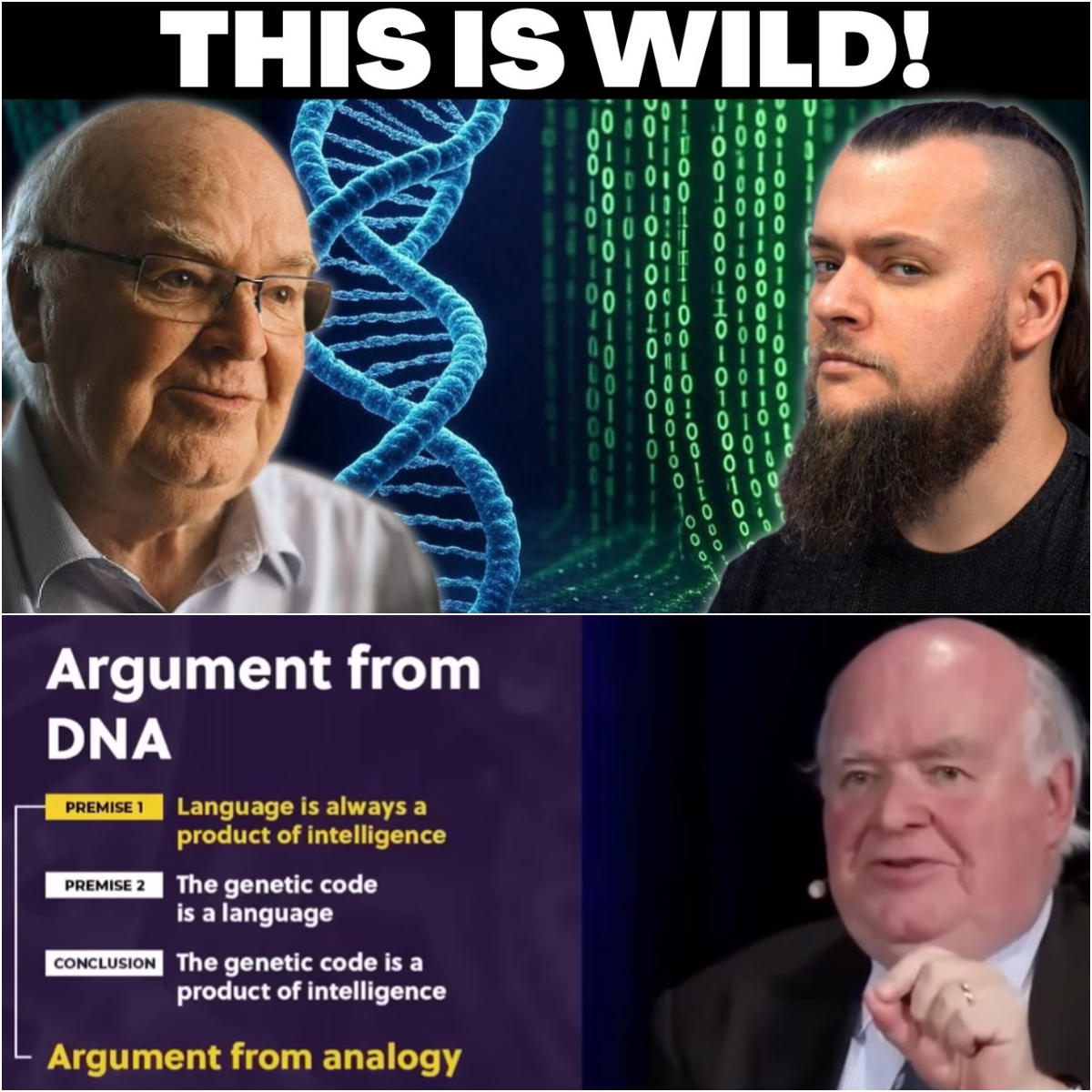
Yet, as the arguments are stripped of their rhetorical flair and subjected to rigorous analytical scrutiny, the triumphant takedown begins to resemble something else entirely. Rather than dismantling the argument for intelligent design, the attempt inadvertently exposed the profound explanatory deficits of the materialistic worldview. In trying to banish a coder, the critics ended up highlighting just how uniquely sophisticated the code truly is.
The Syllogism of the Cell
To understand why the materialistic counterargument stumbles, one must first understand the elegant simplicity of the argument it seeks to destroy. For years, thinkers have summarized the linguistic nature of biology into a straightforward logical syllogism:
Premise 1: Language is always a product of intelligence.
Premise 2: The genetic code is a language.
Conclusion: Therefore, the genetic code is a product of intelligence.
This argument is structurally bulletproof. If the premises are true, the conclusion is inescapable. Recognizing this, modern critics have abandoned attempts to dispute the logic itself. Instead, they have trained their sights on Premise 1, launching an all-out effort to prove that language can, in fact, emerge naturally from the blind, unguided forces of nature.
The battle strategy relies heavily on broadening definitions. To strip language of its inherently intelligent origin, secular theorists have begun reclassifying almost every interactive physical process in nature as a “simple language.” They point to birds vocalizing to attract mates, bacteria releasing molecules to coordinate group behavior, and hormones signaling tissues within a single body. In one particularly colorful analogy popular in secular commentary, the chemical communication between a mammal’s endocrine system and its physical development is described as tissues “talking” to one another.
The crown jewel of this argument is the co-evolutionary relationship between flowering plants and insect pollinators. The narrative goes that insects initially sought out ancient plants merely to consume protein-rich pollen. Over generations, any random mutation that made a plant flash brighter colors or emit a sharper fragrance helped insects find it faster, benefiting both species. Through this mutual pressure, a visual and chemical “signaling system” emerged. This, the secular world argues, is language generated by nature alone.
The fatal flaw of this thesis, however, lies in a massive intellectual sleight of hand. It conflates a physical reaction with a symbolic code.
The Grand Confusion: Cues vs. Codes
There is a fundamental, unbridgeable chasm between a physical cue and a symbolic language.
When a flower emits a fragrance that attracts a bee, or when a hormone travels through the bloodstream to trigger a biological change, we are witnessing the direct, predictable operation of physical chemistry. The hormone fits into a cellular receptor like a key into a lock. The reaction is governed entirely by spatial geometry, electrical charges, and chemical affinities. There is no translation occurring. The chemical is the action.
DNA operates on an entirely different plane of reality.
The genetic code is not a series of inevitable chemical reactions. It is a digital, symbolic, and rule-based system. Within the cell, three-letter nucleotide sequences known as codons serve as symbols for specific amino acids. Crucially, there is no direct chemical necessity linking a specific codon to a specific amino acid. The relationship is entirely arbitrary, established by a complex intermediary architecture of transfer RNA (tRNA) and ribosomes.
To illustrate this, consider the written word “STOP.” There is nothing inherent in the physical chemistry of the ink or the pixels that forces those four letters to mean the cessation of motion. The meaning exists because an intelligent convention assigned it. If you change the convention, you change the meaning, while the physical properties of the ink remain identical.
This is precisely how the cell operates. The ribosome acts as a literal translation mechanism, decoding an abstract molecular alphabet into functional proteins. It does not just react to physics; it interprets meaning according to a pre-existing rulebook.
By pointing to flowers and bees to explain the origin of DNA, materialistic theorists are engaging in a profound category error. Natural selection can easily enhance a pre-existing physical cue—making a flower brighter or a scent stronger. But it cannot invent a symbolic alphabet, construct a dual-ended translation apparatus, and assign arbitrary meanings to structural symbols. The plant did not invent a linguistic code; it merely turned up the volume on a chemical beacon.
Upstream from Evolution
Even if one were to grant the loose definition of chemical signaling as a “language,” the co-evolutionary explanation suffers from a crippling chronological paradox: it presupposes the very thing it is trying to create.
Co-evolution is, by definition, the mutual adaptation of two or more already existing organisms over vast periods of time. For co-evolution to take place, you must already have organisms capable of reproduction, metabolic survival, and genetic variation.
But where do those organisms come from? They are built by the instructions encoded within DNA.
The central enigma of the origin of life is entirely upstream from natural selection. You cannot invoke evolution to explain the origin of the genetic code when the genetic code is the absolute prerequisite for evolution to occur in the first place. Without the digital instructions in DNA, there is no replication. Without replication, there is no variation. Without variation, natural selection has no raw material to act upon.
To say that the genetic code emerged via co-evolution between primitive genes and primitive ribosomes is to assume the existence of a highly sophisticated, fully functioning digital translation system in order to explain how that very system came to be. It is the biological equivalent of arguing that a complex computer operating system spontaneously assembled itself because the software and the hard drive co-evolved to cooperate.
The Mirage of the “God of the Gaps”
Sensing the weakness of their biological explanations, secular commentators frequently pivot to philosophical critiques. The most common accusation hurled at defenders of intelligent design is that they are committing a “God of the gaps” fallacy—an appeal to ignorance that merely inserts a divine creator wherever current scientific knowledge falls short.
This critique, however, fundamentally misrepresents the nature of the argument.
An argument from ignorance follows a flawed structure: We don’t know how material causes produced this phenomenon; therefore, a supernatural cause must have done it.
But the inference to intelligent design is not based on what we don’t know; it is based on what we do know. It is a rigorous inference to the best explanation, utilizing the exact same uniformitarian principles that historical scientists and forensic investigators use every day.
Our uniform and repeated experience establishes that large amounts of specified, digital, prescriptive information always originate from a conscious, intelligent mind. Whether it is a line of computer code, a Shakespearean sonnet, or a radio signal flashing Morse code, the diagnostic signature of intent is unmistakable.
When John Lennox, the eminent Oxford mathematician, famously challenged his colleagues to consider the implications of finding their names written in the sand on a beach, he was driving at this exact truth. If you see just four or five letters arranged to spell “JOHN,” you instantly and correctly infer an intelligent input. No amount of wave action, wind erosion, or tidal necessity could ever satisfy the mind as a credible explanation for that sequence.
Why, then, when we look inside the human genome and find a digital text consisting of billions of letters arranged in a precise, functional order, should we suddenly abandon our uniform experience? To insist that the beach requires a mind but the genome requires only chemistry is not scientific objectivity; it is a rigid commitment to materialism at the expense of logic.
The Silence of the Labs
When the rhetorical smoke clears, the reality within the scientific community is far more humble than the confident proclamations of internet atheism suggest. Behind closed doors, leading origin-of-life researchers openly admit that the genesis of the genetic code remains a profound, impenetrable mystery.
The deeper we delve into the molecular machinery of life, the more labyrinthine it becomes. We do not find a sloppy, primitive blueprint that slowly coalesced out of a primordial soup. We find a fully optimized, error-minimizing, digital information storage and retrieval system that defies naturalistic simulation.
The latest attempt to debunk God using the language of DNA did not fail because its presenters lacked charisma or production value. It failed because the universe refuses to accommodate the myth of self-assembling information. Matter is a magnificent medium for carrying a message, but it has never, in the history of human observation, been caught writing one.
In the end, the linguistic nature of DNA remains an unyielding monument to intention. It stands as a silent, microscopic testament to the fact that in the beginning, before the first cell ever replicated, there was not just matter and motion. In the beginning, there was a Mind.