Tucker Carlson on MAGA: “What Coalition? Trump Destroyed It!”
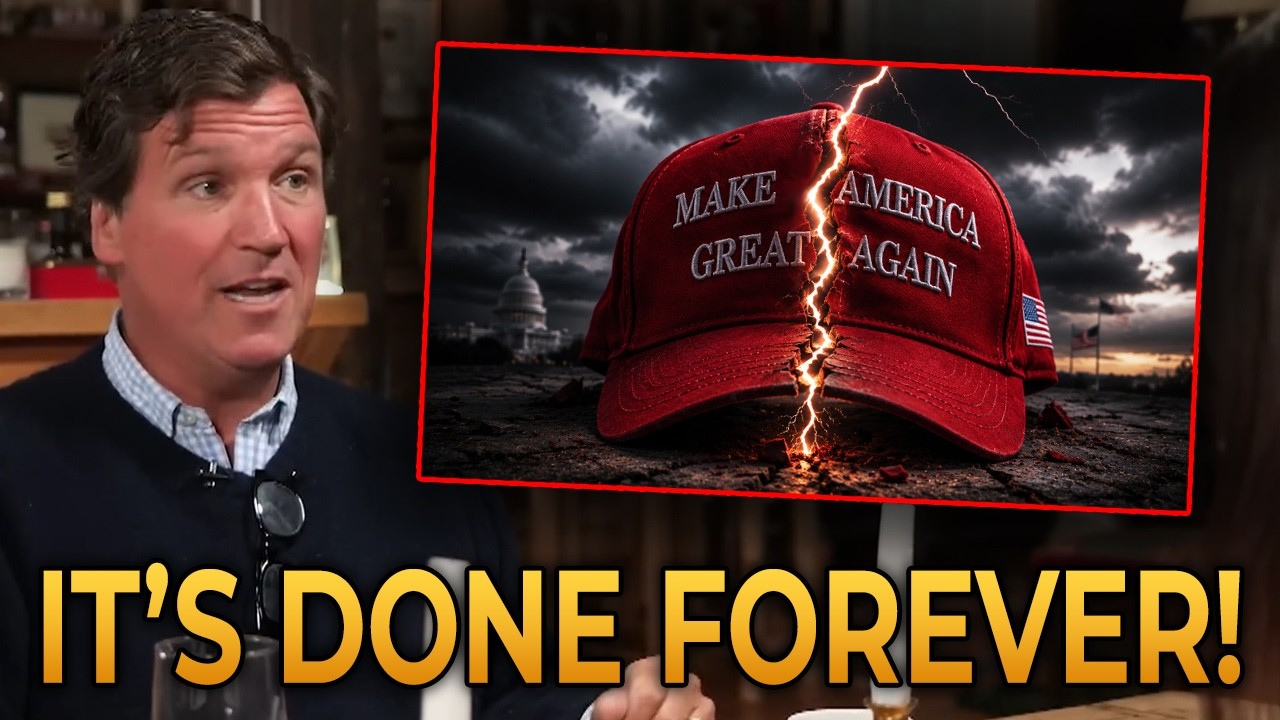
The End of MAGA? Tucker Carlson’s Stark Warning and the Political Crisis Facing Donald Trump
For years, “Make America Great Again” was more than a campaign slogan. It became one of the most influential political brands in modern American history, reshaping the Republican Party, redefining conservative politics, and helping Donald Trump build an unusually broad coalition of voters. But according to Tucker Carlson, that coalition may already be over—and not because of Democrats, the media, or the courts.
His argument is simple: Trump himself destroyed it.
Whether one agrees with that conclusion or not, it raises one of the most important questions heading into the next presidential cycle. If the movement that transformed American politics has fractured, what replaces it? And can any politician—including Vice President JD Vance—inherit what remains?
These questions are becoming harder to ignore as debates over foreign policy, government spending, executive power, and political loyalty increasingly divide the very coalition that once appeared nearly unstoppable.
Tucker Carlson’s Declaration: “The MAGA Movement Is Over”
During a recent interview, Tucker Carlson offered perhaps his most dramatic assessment yet of the current political landscape.
Asked where the future of MAGA now stands, Carlson laughed before delivering a blunt verdict:
“That’s over.”
His reasoning was not centered on polling numbers or electoral strategy. Instead, Carlson argued that Trump’s decision to support military action connected to Israel fundamentally contradicted the principles that originally attracted millions of supporters.
Carlson has long maintained that “America First” should mean exactly what the phrase suggests: American interests must take priority over the interests of any foreign country. In his view, once voters believe a president has abandoned that principle, the political movement built upon it inevitably begins to unravel.
Whether one accepts that argument or rejects it, Carlson’s comments reflect an increasingly visible debate inside the Republican coalition itself. The disagreements are no longer simply about taxes, immigration, or trade. They increasingly revolve around foreign policy and the extent to which the United States should become involved in overseas conflicts.
Was MAGA Ever a Real Movement?
Carlson also challenged something even more fundamental.
He questioned whether MAGA was ever a coherent political movement at all.
According to Carlson, Trump effectively defined MAGA as whatever he wanted it to mean at any given moment. If the movement changes whenever one individual changes his position, Carlson argues, it resembles a personal political brand more than a lasting ideological coalition.
That distinction matters.
Historically, durable political movements tend to survive individual leaders because they are built around consistent principles. The conservative movement existed before Ronald Reagan and continued after him. The progressive movement likewise outlived numerous Democratic presidents.
Carlson suggested that MAGA may have lacked that same institutional foundation.
Its greatest strength—its close identification with Donald Trump—may also have been its greatest weakness.
America First vs. Foreign Intervention
At the center of the dispute lies the meaning of “America First.”
Supporters of that philosophy generally argue that the United States should avoid unnecessary foreign wars, reduce overseas commitments, and prioritize domestic issues such as inflation, infrastructure, border security, manufacturing, and economic growth.
Critics, however, argue that global leadership sometimes requires military commitments abroad and that alliances remain central to American security.
This divide has become increasingly visible within the Republican Party.
Some conservatives continue supporting robust American involvement overseas, while others advocate a much more restrained foreign policy.
Carlson believes this divide has now become impossible to ignore.
He argues that many voters who supported Trump specifically because he promised to avoid new wars now feel disappointed by decisions they believe contradict those promises.
Whether that disappointment represents a temporary political disagreement or a permanent fracture remains an open question.
JD Vance: The Heir—or the Cleanup Crew?
If Trump eventually leaves office, attention naturally turns toward the next generation of Republican leadership.
JD Vance is frequently mentioned near the top of that list.
Many political observers view him as one of the strongest potential presidential candidates for 2028.
But Carlson’s broader conversation—and the commentary surrounding it—raises another possibility.
Rather than inheriting a thriving political movement, Vance may instead inherit a divided one.
Supporters argue that Vance represents a younger version of the populist conservative movement that reshaped Republican politics.
Critics contend that he has become too closely identified with the current administration to successfully separate himself from its controversial decisions.
Political branding often becomes difficult to untangle.
Vice presidents rarely receive credit only for the successes of an administration while escaping responsibility for its failures.
That creates a complicated challenge for Vance.
If he distances himself too aggressively from Trump, he risks alienating Trump’s loyal supporters.
If he remains too closely aligned, he may inherit public dissatisfaction over decisions made during the administration.
Political Consistency Under the Microscope
One criticism repeatedly aimed at Vance is that his political positions have evolved significantly over the years.
Supporters view that evolution as evidence that he changed his mind after seeing new evidence and gaining governing experience.
Critics instead argue that it reflects political calculation rather than conviction.
This debate is hardly unique to Vance.
Many prominent American politicians have reversed positions throughout their careers.
The larger question is whether voters interpret those changes as thoughtful growth or opportunism.
Perception often matters as much as reality.
If voters believe a politician adapts positions primarily for electoral advantage, rebuilding trust becomes considerably harder.
The Growing Divide Within Conservative Media
One of the most interesting themes emerging from these discussions is not simply disagreement among politicians, but disagreement among conservative media personalities themselves.
Only a few years ago, many of these figures appeared broadly aligned.
Today, major voices within conservative media increasingly criticize one another.
Some remain firmly supportive of Trump’s leadership.
Others argue that parts of the movement have drifted away from its original priorities.
Still others believe the real conflict is between establishment Republicans and a newer populist wing.
These disagreements illustrate that the Republican coalition is becoming more ideologically diverse—and perhaps more fragmented—than it appeared during Trump’s earlier campaigns.
Living in Different Political Realities
Another important observation concerns today’s media environment.
Carlson argued that Americans increasingly consume entirely different streams of information depending on where they get their news.
This phenomenon is hardly limited to conservatives.
Progressive audiences, conservative audiences, libertarians, independents, and other political communities often rely on completely different media ecosystems.
As a result, people can develop sharply different understandings of the same events.
One voter may believe a particular issue dominates national politics, while another has barely heard it mentioned.
Social media algorithms further reinforce this tendency by recommending content similar to what users have previously engaged with.
The result is not simply disagreement—it is often a fundamentally different perception of political reality.
This fragmentation makes national political consensus increasingly difficult.
Can a Movement Survive Without Trump?
The central strategic question now facing Republicans is straightforward.
Can Trumpism survive without Trump?
Political history offers mixed answers.
Movements built around clear philosophical principles often endure beyond individual leaders.
Movements centered primarily on one charismatic personality frequently struggle once that leader exits the stage.
If Carlson is correct that MAGA functioned largely as an extension of Trump’s personal political identity, its long-term survival becomes uncertain.
On the other hand, if voters primarily embraced broader themes such as economic nationalism, immigration reform, government accountability, and skepticism toward foreign intervention, those ideas may continue attracting support under new leadership.
The answer may ultimately depend on whether future Republican candidates emphasize enduring principles rather than personal loyalty.
The Challenge Facing the Republican Party
Regardless of one’s views about Trump, Carlson, or Vance, one reality appears increasingly difficult to dismiss.
The Republican Party is experiencing an internal debate unlike any it has faced in decades.
Traditional conservatives, populists, libertarians, national security hawks, economic nationalists, and younger anti-establishment voters all remain part of the broader coalition—but they do not always agree on the direction the party should take.
Foreign policy has become one of the most visible dividing lines.
Questions that once united Republicans now produce intense internal disagreement.
How much should the United States spend overseas?
When should military force be used?
What obligations should America have toward long-standing allies?
How should national interest be defined?
These are no longer theoretical questions.
They increasingly shape the future of Republican politics.
Could 2028 Become a Defining Election?
If Trump does not run again after his current term, the Republican nomination could become one of the most competitive contests in recent memory.
JD Vance would likely enter that race with significant advantages, including national recognition and executive experience.
Yet he would almost certainly face scrutiny over every major decision made during the administration.
Other potential candidates may argue they represent a cleaner break from recent controversies.
Some may emphasize traditional conservatism.
Others may campaign on a more explicitly populist platform.
Still others could attempt to unite the competing factions under a broader “America First” message that extends beyond any one political figure.
Much will depend on how Republican voters interpret the final years of Trump’s presidency.
A Political Turning Point
American politics rarely remains static.
Coalitions evolve.
Parties realign.
Movements rise, fracture, and sometimes reassemble in unexpected ways.
Carlson’s declaration that “MAGA is over” may ultimately prove either remarkably prescient or dramatically premature.
History will decide.
What cannot easily be denied, however, is that significant debates are unfolding inside the American right.
Questions about foreign policy, executive leadership, party identity, media influence, and political succession are no longer confined to think tanks or campaign strategists.
They are now central to the conversation shaping the Republican Party’s future.
Whether Donald Trump’s political legacy ultimately becomes a lasting ideological movement or remains a uniquely personal political phenomenon will influence American politics for years to come.
The next chapter may not simply determine who leads the Republican Party after Trump.
It may determine what the Republican Party actually stands for once the Trump era finally comes to an end.