Don’t Pray the Rosary Until Hearing St. Louis de Montfort’s 2 Warnings
Don’t Pray the Rosary Until Hearing St. Louis de Montfort’s 2 Warnings
The low, rhythmic hum of the studio equipment faded as the red recording light on the camera flickered to life. Father Thomas sat at his walnut desk, the familiar weight of his vestments settling over his shoulders. Outside the high windows of the rectory, the late afternoon light of May 2026 was beginning to wane, casting long, deep shadows across the room. On his desk lay a well-worn, leather-bound copy of The Secret of the Rosary, its pages soft and yellowed from decades of study.
He leaned forward, adjusting the microphone arm. When he spoke, his voice possessed that peculiar, compelling blend of a seasoned academic and a trusted older brother—an conversational tone tailored perfectly for an audience searching for depth in a shallow digital world.
“My friends, before you set your fingers on the beads of your rosary today, you need to pause,” Father Thomas began, looking directly into the high-definition lens. “You need to listen to two distinct, severe warnings given by St. Louis de Montfort. If you understand them, they will radically, permanently alter the trajectory of your spiritual life. If you’d like to support the work we do on this channel, please consider doing so through ‘Buy Me a Coffee.’ Now, let’s get right into it.”
He leaned back slightly, resting his hands on the edge of the desk. “To understand the first warning, we have to look at a historical reality that took place in the heart of Rome—a story that sounds almost unbelievable to our modern, achievement-oriented minds. It’s the story of a woman who thought she knew exactly how to buy her way into heaven.”
The studio grew completely still as Thomas began to weave the narrative, his voice dropping into a dramatic, slow cadence that brought the ancient streets of Italy alive.
“There was a lady in Rome,” Thomas said, his eyes narrowing with intensity. “She was exceptionally pious, but she was also deeply self-willed. By all outward appearances, her holy life put the strictest religious orders in the Church to shame. She was the kind of Catholic who did everything. She made the stations of Rome every single day. She wore a rough sackcloth beneath her fine dresses, wore a hair shirt that cut into her skin, and gave herself the discipline—literal physical penance—several times a week. She fasted constantly.”
Thomas tapped his finger on the desk. “She was a spiritual overachiever. But she had a fatal flaw: she wanted to be the director of her own soul. When the great St. Dominic came to Rome, she decided to seek his counsel and made her confession to him. Dominic, reading her soul with the clarity of a saint, listened to her long list of heroic penances. And for her penance, he gave her something incredibly simple: he told her to say exactly one rosary, and advised her to pray it every single day.”
A faint smile crossed Thomas’s face. “And do you know what she did? She excused herself. She looked at this great saint and essentially said, ‘Father, I don’t have time for that. I have my regular exercises. I do the stations, I wear the hair shirt, I fast. The rosary is a simple devotion; it’s not for someone of my spiritual stature.’ Dominic urged her over and over, begging her to take his advice, but she would not hear of it. She left his confessional horrified, thinking this new spiritual director was completely incompetent, trying to force her to take up a devotion for which she had absolutely no taste.”
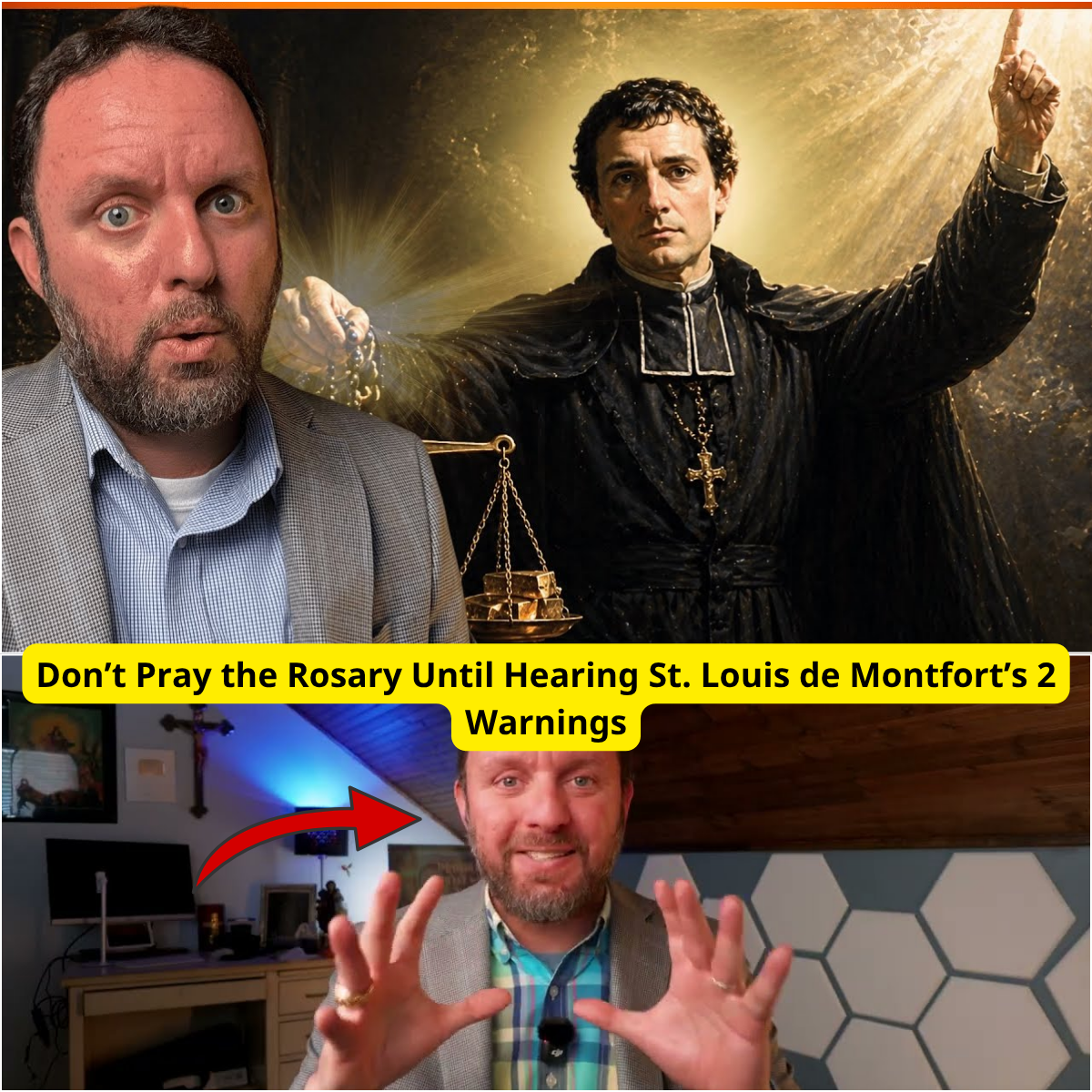
Thomas’s tone suddenly shifted, becoming dark and solemn. “But God has a way of shattering our spiritual pride. Sometime later, while this lady was at prayer, she fell into a deep ecstasy. In an instant, she found herself standing before the supreme judge, Jesus Christ. St. Michael the Archangel stood there holding the massive, golden scales of divine justice.”
He leaned in toward the lens, his voice a sharp whisper. “Michael took all of her heroic penances—the hair shirts, the fasts, the daily stations, the hours of prayers—and he piled them onto one side of the scale. Then, onto the other side, he placed her hidden sins, her self-will, and her spiritual imperfections. To her absolute horror, the tray of her good works was light as air. The scale tipped violently. Her sins and imperfections greatly outweighed her lifetimes of penance. Filled with an agonizing alarm, realizing she was damned, she screamed out for mercy, imploring the Blessed Virgin Mary to be her advocate.”
Thomas paused, letting the weight of the moment hang in the silence. “Our Lady appeared. She didn’t bring a new mountain of penances. Instead, she reached down and took the one and only rosary that this woman had actually prayed as part of her penance with St. Dominic. She dropped that single strand of beads onto the tray of good works.”
He struck the table softly with his palm. “The scale crashed down. That one single rosary was so heavy, so dense with supernatural merit, that it completely outweighed all of her sins and all of her other self-made good works combined. Our Lady looked at her with severe mercy and reproved her for refusing to follow the counsel of Dominic. The moment the woman snapped out of the vision, she didn’t waste a second. She rushed through the streets of Rome, threw herself at the feet of St. Dominic, and wept, begging him to teach her how to pray the rosary every day.”
Thomas stood up from his chair, pacing behind his desk, his hands gesturing dynamically as he connected the ancient story to the modern world.
“St. Louis de Montfort tells this story to deliver the first massive warning to our lives,” Thomas explained, looking back at the camera. “What we do in the spiritual life matters incredibly. We live in an American culture that loves autonomy. We love to build our own brands, our own schedules, and even our own custom-made spiritualities. We think that if we are busy doing ‘good things’ of our own choosing, God must be impressed. But this story proves that your self-made penances are worth nothing compared to the objective weight of grace.”
He stopped pacing, leaning against the edge of the studio table. “Why is a rosary so heavy on the scales of God? Why does it outweigh a lifetime of hair shirts? Because when you perform your own penances, you are offering God your merits. You are offering the small, flawed currency of your own human effort. But when you pray the rosary, you are meditating on and offering to the Father the literal life, death, and resurrection of Jesus Christ, bound together with the perfect love of His mother. You are handing God a divine currency. The merit of Jesus and Mary is infinite. If you want the most effective, explosive use of your limited prayer time, you stop playing the spiritual entrepreneur and you pick up the beads.”
He walked back to his seat, his eyes bright with enthusiasm. “And if you’re still not convinced of the physical, historical power of this prayer, look at how it literally rewrote the map of Western civilization. Look at King Alfonsus VI of Aragon and Castile.”
Thomas opened the book again, his eyes scanning the text quickly. “Alfonsus was a king who had been leading a completely disorderly, sinful life. God had punished him in several ways, and he was eventually ruined, forced to take refuge in a small town belonging to one of his allies. It just so happened that St. Dominic was in that very town on Christmas Day. Dominic stood in the pulpit and preached his usual sermon on the immense power of the rosary. He made a radical promise: he told the congregation that anyone who said the rosary devoutly every day would overcome their enemies and regain everything they had lost.”
Thomas leaned forward, his voice rising. “The broken king was sitting in the pews. He listened attentively. Afterward, he sent for Dominic and asked him, ‘Is what you said actually true, or is it just pious rhetoric?’ Dominic looked him in the eye and said, ‘Nothing is more true. Practice this devotion, join the confraternity, and you will see for yourself.’ The king made a resolution. For one solid year, he knelt down every single day and prayed his rosary.”
“Exactly one year later, on the next Christmas Day, the king finished his prayers, and the ceiling of his room seemed to vanish,” Thomas said, his voice alive with dramatic energy. “Our Lady appeared to him. She said, ‘Alfonsus, you have served me for a year by saying my rosary devoutly every day. I have come to reward you. I have obtained the complete forgiveness of your sins from my Son. And I present you with this literal rosary—wear it, and I promise that none of your enemies will ever harm you again.’“
Thomas leaned back, his expression one of pure awe. “The king was overjoyed. He ran to the queen, told her about the heavenly gift, and because she had recently lost her eyesight, he touched her eyes with the holy rosary. Boom. She was instantly, miraculously cured. But it didn’t stop with domestic miracles. The king rallied his broken troops. Armed with nothing but a restored faith and that rosary, he attacked his enemies. He routed them completely. He won back every single inch of his lost territory. He became so inexplicably successful in war that soldiers from all over Europe abandoned their armies just to fight under his standard, because they realized that whenever Alfonsus went to battle, victory was absolute. And do you know why? Because he refused to draw his sword until he had first said his rosaries on his knees.”
Thomas pointed directly at the camera. “Let me give you the historical mathematics of that battle. That specific campaign led by King Alfonsus was the ultimate turning point that broke the back of the Moorish occupation. It was the battle that began the process of driving the Muslim forces completely out of Portugal and Spain. Think about the domino effect of that. If it had not been for a broken king kneeling down to pray the rosary, Portugal and Spain would have remained Islamic territories. If they had become Muslim, we would never have had Catholic Portugal or Catholic Spain. We would never have had the global missionary expansions, we would never have had St. Teresa of Avila, St. John of the Cross, and we would never have had the apparitions of Our Lady of Fatima in 1917. One man’s daily rosary altered the geography and the spiritual architecture of the modern world.”
Thomas took a slow, deliberate breath, letting the historical weight of the narrative settle before his face grew intensely serious. He rested his elbows on the desk, his eyes locking onto the lens for the second, deeper warning.
“Now, let’s move past what we do, and look at how we give,” Thomas said, his voice dropping into a quiet, confidential register. “The second warning from St. Louis de Montfort strikes at a hidden fear that even the most devout, traditional Catholics get completely wrong. It’s a fear rooted in spiritual survivalism.”
He opened his book to a marked section near the back. “In his masterpiece, True Devotion to Mary, Montfort addresses a common objection that people raise when they hear about total consecration. Listen to this objection carefully, because I bet many of you have thought it yourself.”
He read with a slow, clear articulation:
“Others perhaps would say: ‘If I surrender to the Most Holy Virgin all the value of my actions so that she may apply it to whom she wills, perhaps I will have to suffer for a long time in purgatory.'”
Thomas closed the book with a sharp slap. “Montfort doesn’t mingle words here. He looks at that fear and calls it exactly what it is: an objection that comes from a deep, hidden love of oneself, and a profound ignorance regarding the sheer generosity of God and His Holy Mother. He calls it self-destructive.”
Thomas leaned in, his voice vibrating with a grounded, passionate intensity. “Think about the logic of love. Is it ever possible that a fervent, generous soul—someone who is more attentive to the interests of God than to their own safety, someone who throws everything they have into Mary’s hands without holding back a single penny of spiritual merit—is it possible that such a noble person would be more punished in the next world for having been more generous in this one? Absolutely not! Montfort promises that on the contrary, our Lord and His Mother will be infinitely more generous to that soul in this world and the next, in the order of nature, grace, and glory.”
He stood up again, his hands open. “When you pray the rosary for the souls in purgatory, you are using the most powerful weapon in the Church’s arsenal. But Montfort says don’t just pray it and hoard the merit like a spiritual bank account to shorten your own future sentence. That is the mentality of a slave, not a child. He says the ultimate secret is Total Consecration.”
Thomas walked back to the desk, leaning forward with his hands flat on the wood, his face filling the frame. “If you have never consecrated yourself to the Blessed Mother, you are missing the entire engine of the spiritual life. Consecration is a formal, legal, and spiritual act by which you take everything you are, everything you have, and every single merit of your prayers, and you place them entirely into Mary’s hands.”
He smiled, using a practical, modern analogy. “Think about it like high-finance. If you have a small amount of money, and you keep it hidden under your mattress because you’re afraid of losing it, inflation eats it alive. It stays small. But if you take that wealth and you entrust it to a brilliant, master financial investor, what do they do? They multiply it. They leverage it. They make it grow exponentially. That is what happens when you hand your prayers to the Blessed Mother. You give her a simple, distracted rosary, and by the time she presents it to the Holy Trinity, she has stripped away your vanity, purified your intentions, and multiplied its value by her own infinite grace.”
Thomas nodded slowly. “There are two specific paths I recommend for this. First, the gold standard: the traditional 33-day method of St. Louis de Montfort, which breaks down your self-love through rigorous prayer. Or, if you need a shorter, punchier route tailored for our fast-paced world, look at the 9-day preparation by St. Maximilian Kolbe—a magnificent 20th-century martyr whose entire focus was using consecration as a tool for global evangelization.”
His expression softened, a deeply personal, vulnerable look appearing in his eyes. “I don’t say this to you as a theory from an old book. In my own personal life, the daily rosary and total consecration have had a staggering, undeniable fruit. I have prayed for the souls in purgatory for years, and I have felt their gratitude. And as for my own life? This very channel, this studio, the fact that I am standing here talking to you right now—it only exists because I signed my life over to her. She has intervened in my life, guided my steps, and saved me from spiritual and physical dangers so severe that I can’t even begin to recount them on camera without weeping.”
The gentle, swelling chords of the video’s acoustic outro music began to float softly through the studio speakers, creating a warm, reflective atmosphere. Thomas adjusted his headphones, looking deeply into the lens for his final, urgent appeal to his digital parish.
“My friends, the warnings have been posted,” Thomas said, his voice dropping into a tender, resolute cadence. “Do not waste your life building a self-willed tower of prayers that weighs nothing on the scales of justice. Pick up the weapon that contains the very life of Christ. And when you pray it, do not hold back out of fear of purgatory. Give it all away. Empty your pockets into the hands of the Queen, and watch how she transforms your poverty into spiritual royalty.”
He pointed down toward the screen. “If this video has challenged you or shed light on your prayer life today, please hit that subscribe button, like the video, and consider supporting our work through ‘Buy Me a Coffee’ so we can keep broadcasting these uncompromised truths. And to help you execute what we talked about today, please check out our channel sponsors in the links below. First, download the Rosary Experience App for iOS or Android—it’s packed with sacred art and beautiful videos designed specifically to kill distractions and help you focus intensely on the mysteries. And second, visit purgator.org, an incredible platform where you can permanently register the names of your deceased loved ones so that our global community can pray them out of the fires as quickly as possible.”
He smiled warmly as the music reached its emotional peak. “Until next time, my friends—keep your hands on the beads, give everything away, and never fear the generosity of the Queen. God bless you, and I’ll see you in the next video.”