They Saw It: Ancient Records from Egypt, Greece, and Rome Prove the Crucifixion Darkness
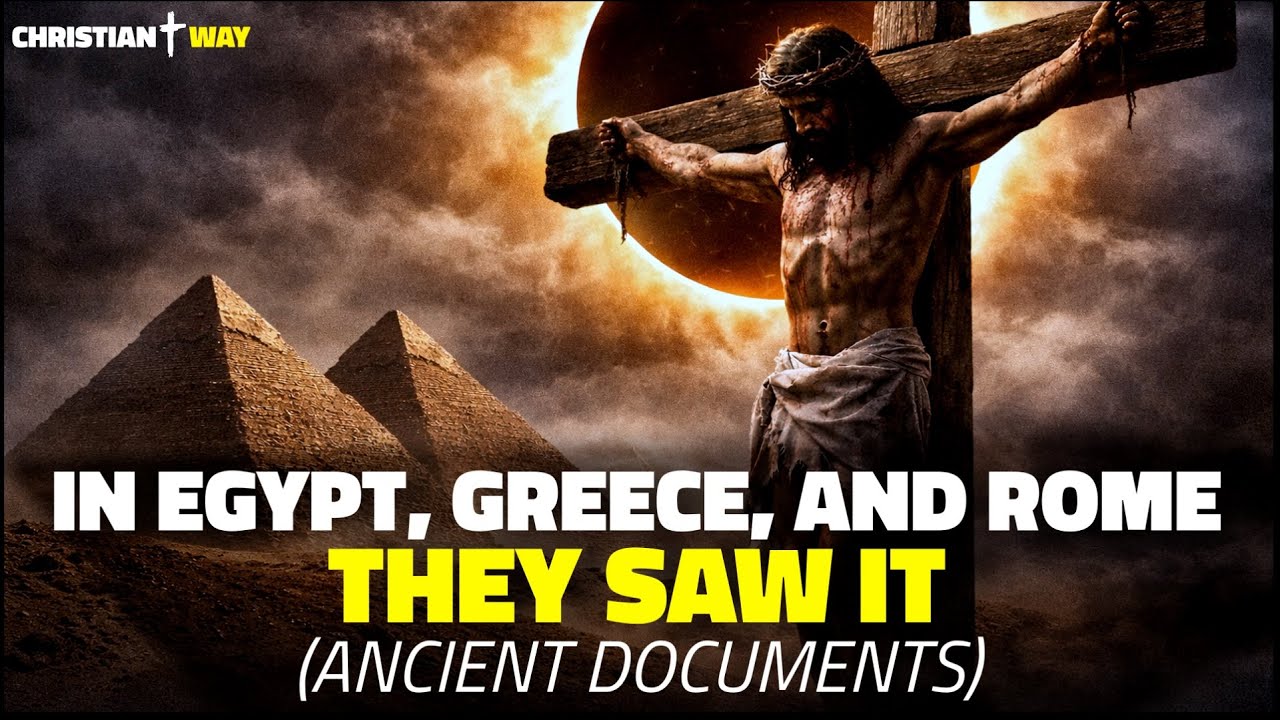
The Day the Sun Refused to Shine: Ancient Records That Seem to Confirm the Crucifixion of Jesus
What if the most dramatic event in human history was not recorded only in the Bible?
What if pagan historians, Roman officials, Greek scholars, and even Jewish religious texts preserved fragments of the same astonishing story—a story of darkness at noon, earthquakes shaking distant lands, and a world that seemed to react to the death of a single man hanging on a cross outside Jerusalem?
For centuries, skeptics have claimed that the Gospel accounts of the crucifixion belong to the realm of faith alone. Yet scattered across ancient history are records that continue to spark debate among historians, theologians, and researchers. Some believe these documents provide remarkable confirmation that something extraordinary happened on the day Jesus died. Others remain unconvinced. But one thing is certain: the mystery refuses to disappear.
And the deeper we look into the historical record, the more intriguing the story becomes.
A Darkness That Should Not Have Happened
The Gospel writers describe a startling event during the crucifixion of Jesus. According to Matthew, Mark, and Luke, darkness covered the land from noon until three in the afternoon.
At first glance, some might assume this was simply a solar eclipse. For generations, critics have suggested exactly that. The explanation sounds reasonable—until astronomy enters the conversation.
Jesus was crucified during Passover. This detail is not merely theological; it is astronomical. Passover occurs during a full moon.
A solar eclipse can happen only when the moon passes directly between the Earth and the sun. This alignment is possible only during a new moon, not a full moon. During a full moon, the moon is on the opposite side of the Earth.
In other words, a natural solar eclipse during Passover is astronomically impossible.
The problem becomes even larger when we consider duration. The Gospels describe approximately three hours of darkness. Even the longest total solar eclipses last only a few minutes. Modern astronomy simply cannot explain three hours of darkness at midday through an ordinary eclipse.
This is where the historical mystery begins.
Because ancient writers outside Christianity appear to have noticed something unusual as well.
Thallus: The Historian Who Accidentally Confirmed the Event
One of the earliest non-Christian references comes from a historian named Thallus.
Writing around the middle of the first century, only a few decades after the crucifixion, Thallus attempted to explain reports of darkness associated with Jesus’ death. Ironically, his explanation may have preserved evidence for the very event he sought to dismiss.
According to later writers who quoted his work, Thallus argued that the darkness was an eclipse.
At first this may sound like a denial. Yet there is an important implication.
If the darkness had never happened, Thallus could simply have dismissed the Christian claim altogether. Instead, he accepted that some unusual darkness occurred and attempted to provide a natural explanation for it.
In trying to explain away the event, he may have unintentionally acknowledged that people throughout the region remembered something extraordinary taking place.
For historians, this detail matters.
The debate was not whether darkness occurred. The debate was what caused it.
Phlegon and the Day That Became Night
An even more intriguing witness appears in the writings of Phlegon of Tralles, a Greek historian known for recording unusual events.
Phlegon described a remarkable occurrence during the fourth year of the 202nd Olympiad—a date corresponding roughly to A.D. 32 or 33, the period most commonly associated with the crucifixion.
His account speaks of a darkness so profound that stars became visible in the daytime.
Imagine standing beneath a midday sky and suddenly seeing the stars.
Such descriptions immediately capture attention because they parallel the Gospel narratives in striking ways.
But Phlegon’s report contains another detail.
He also mentions a major earthquake.
This is significant because Matthew’s Gospel specifically states that the earth shook and rocks split at the moment of Jesus’ death.
Could these be references to the same event?
Historians continue to debate the question, but the overlap remains fascinating. Independent records from different traditions appear to point toward an unusual period of darkness accompanied by seismic activity.
The coincidence is difficult to ignore.
When a Roman Lawyer Challenged an Empire
By the late second century, Christianity faced intense persecution throughout the Roman Empire.
It was during this period that a brilliant lawyer named Tertullian wrote one of the most famous defenses of the Christian faith.
Tertullian was not addressing sympathetic readers. He was writing directly to Roman authorities.
His argument included a bold claim regarding the darkness at the crucifixion.
He insisted that official records existed in Roman archives documenting the phenomenon.
Think carefully about the significance of such a statement.
A lawyer does not challenge hostile authorities to verify evidence unless he believes the evidence actually exists.
Tertullian essentially told Roman officials: “Check your own records.”
Whether those archives still survive is another matter. They do not. But the confidence with which he appealed to them has intrigued scholars for centuries.
Why would he make such a claim if he expected immediate exposure?
The question remains one of the most interesting aspects of early Christian apologetics.
The Temple Signs Recorded by Jewish Tradition
Perhaps the most surprising evidence comes not from Christians or pagans, but from Jewish sources.
Within the Babylonian Talmud appears a passage describing strange events associated with the final decades before the destruction of the Second Temple in A.D. 70.
The text records several disturbing signs.
The temple gates reportedly opened by themselves.
The principal lamp of the menorah repeatedly went out.
Most remarkable of all was the tradition surrounding the scarlet thread.
According to Jewish custom, a red thread was associated with the Day of Atonement. Tradition held that if God accepted the sacrifice offered for the sins of Israel, the thread would turn white.
The Talmud records that during the forty years before the Temple’s destruction, the thread ceased turning white.
The timing is what captures attention.
Forty years before A.D. 70 brings us to approximately A.D. 30—the very period associated with Jesus’ crucifixion.
Jewish scholars interpret these passages differently than Christians do, of course. Yet many Christians see profound symbolism in the chronology.
They view it as a sign that the old sacrificial system had reached its fulfillment.
Whether one accepts that interpretation or not, the historical timing remains intriguing.
Dionysius and the Language of the Stars
Ancient Christian tradition preserves another remarkable story.
Before becoming a follower of Christ, Dionysius the Areopagite was said to be studying astronomy in Egypt.
According to the tradition, he witnessed the mysterious darkness that occurred during the crucifixion.
As a student of celestial movements, he allegedly understood that the phenomenon did not match the behavior of a normal eclipse.
The famous statement attributed to him has echoed through centuries:
“Either the divine is suffering, or the machinery of the universe is breaking apart.”
Whether the quote survives in exactly its original form is debated. Yet its message captures the reaction many people would have had if such an event truly occurred.
The sky itself seemed wrong.
Nature appeared to be mourning.
The universe looked as though it was responding to something immense.
Why Ancient Witnesses Matter
It is important to understand what these historical references do—and do not—prove.
They do not function as mathematical proof of every theological claim within Christianity.
History rarely works that way.
What they do provide is something perhaps equally compelling: independent testimony that unusual events surrounding the crucifixion were discussed far beyond the Christian community.
When pagan historians mention darkness, when Jewish texts record strange temple signs, and when Christian writers confidently appeal to public records, we are dealing with more than isolated stories.
We are encountering a historical conversation that has lasted nearly two thousand years.
The question becomes not merely whether Christians believed something happened.
The question becomes why so many different sources remembered that period as extraordinary.
The Cosmic Meaning of the Crucifixion
For Christians, the darkness was never simply about weather.
The darkness symbolized creation itself responding to its Creator.
The earthquake represented more than geology.
It represented history being shaken at its foundation.
The torn veil of the Temple signified more than a damaged curtain.
It symbolized a new relationship between God and humanity.
This is why the crucifixion remains unique among historical events.
The death of Jesus was not presented as the tragic end of a religious teacher.
It was presented as a cosmic turning point.
The Gospel writers described heaven, earth, and humanity intersecting at a single moment.
And according to many ancient accounts, even those who did not believe in Jesus found themselves forced to record strange occurrences surrounding that day.
History Bears the Marks
Modern culture often treats faith and history as enemies.
One belongs to churches, the other to universities.
One speaks of miracles, the other of evidence.
Yet the story of the crucifixion refuses to fit neatly into those categories.
The deeper researchers examine ancient records, the more they discover that the death of Jesus was not ignored by the wider world.
Greek historians discussed unusual darkness.
Roman writers referenced extraordinary phenomena.
Jewish texts recorded troubling signs in the Temple.
Christian witnesses proclaimed that these events pointed to the fulfillment of God’s plan.
No single document settles every debate.
No ancient source answers every question.
But together they create a remarkable picture: a world that remembered something extraordinary happening during the reign of Tiberius, in the province of Judea, on a Friday that would forever change history.
The Light Returned
The most powerful part of the story is often overlooked.
The darkness did not last forever.
According to the Gospel accounts, after three hours, the light returned.
For Christians, this detail carries profound meaning.
Darkness had its hour.
Suffering had its moment.
Death appeared to win.
But none of them had the final word.
Three days later came the event that transformed frightened disciples into fearless witnesses and changed the course of civilization—the resurrection.
Whether one approaches these accounts as a believer, a skeptic, or simply a student of history, the historical echoes surrounding the crucifixion remain impossible to ignore.
Ancient records, scattered across cultures and continents, continue to point back to one extraordinary day.
A day when the sky darkened.
A day when the earth trembled.
A day when history itself seemed to pause.
And perhaps that is why the story still captivates humanity after two thousand years.
Because if those witnesses were right, then the crucifixion was not merely an event in history.
It was the moment history found its center.