Jesus Is Appearing in North Korea: The Hidden Secret and the Forbidden Miracle
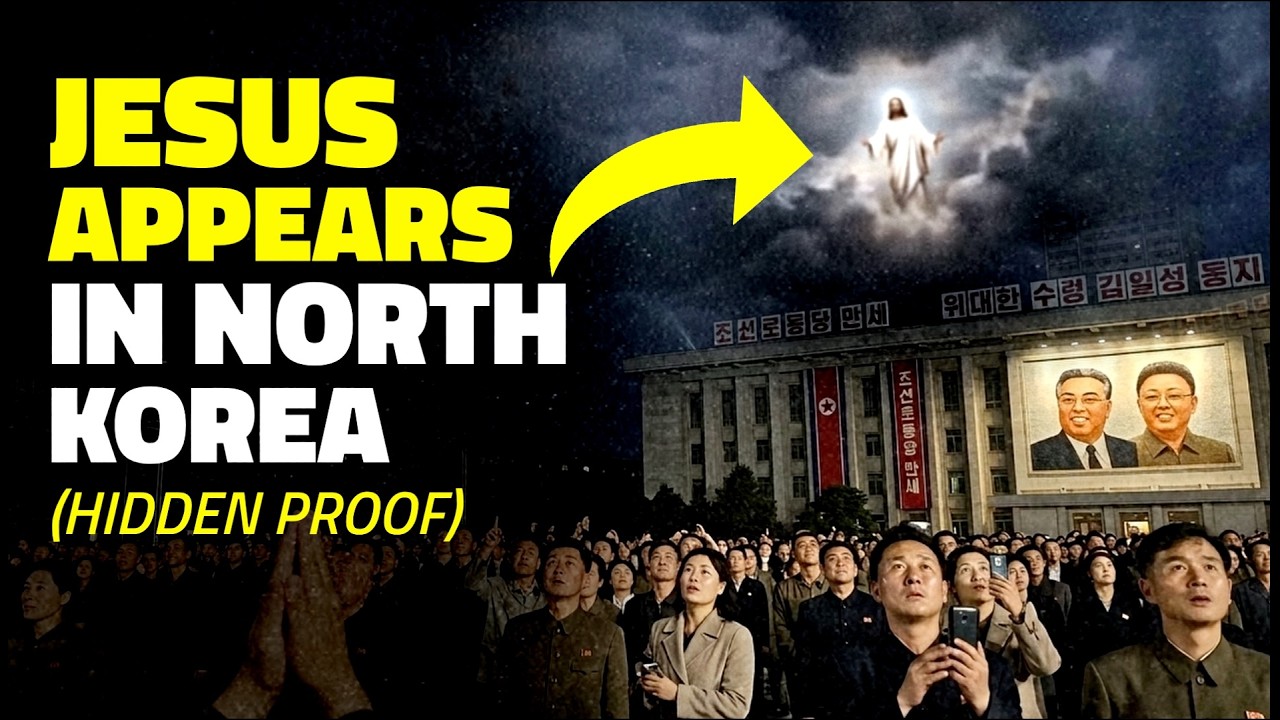
Whispers Behind the World’s Most Sealed Border: The Strange Claims Emerging from North Korea’s Hidden Churches
In one of the most tightly controlled nations on Earth, stories are surfacing that sound almost impossible to believe. They come from escapees, whispered interviews, and fragmented testimonies carried across borders at great personal risk.
And they all seem to point to something extraordinary happening inside North Korea.
The silence of a sealed nation
Modern North Korea is often described as the world’s most isolated state. Officially known as the Democratic People’s Republic of Korea, it operates under one of the strictest surveillance systems ever built. Information is tightly controlled, movement is restricted, and religious activity outside state approval is forbidden.
Yet beneath this surface of absolute control, a different narrative persists.
Human rights organizations, including groups such as Open Doors and The Voice of the Martyrs, estimate that hundreds of thousands of people may still practice Christianity underground despite the risks of imprisonment, torture, or execution. These believers are not visible on maps, nor are they acknowledged in official statistics. Their existence is reconstructed from defector testimonies and rare field reports.
And according to some of those testimonies, faith in North Korea has not simply survived—it has taken on deeply unusual forms.
Pyongyang’s forgotten identity
To understand how this situation emerged, historians often look back to a very different period in Korean history.
Long before it became the capital of a hardened surveillance state, Pyongyang was once widely known as a center of Christian revival in East Asia. Early 20th-century records describe explosive religious growth during the period often referred to as the Great Pyongyang Revival, when churches multiplied and Christian communities expanded rapidly across the northern Korean peninsula.
Missionaries and local accounts from that era described Pyongyang as a city transformed by religious enthusiasm, sometimes even calling it the “Jerusalem of the East.”
That world collapsed with the rise of the Kim dynasty and the Korean War, after which religion outside state ideology was systematically suppressed.
What replaced it was not simply atheism, but a tightly constructed political belief system centered on loyalty to the state.
A suppressed spiritual memory
Despite decades of suppression, some defectors suggest that religious memory never fully disappeared.
Interviews conducted in South Korea with refugees from the North describe fragments of hidden worship practices, secret prayers, and oral traditions passed quietly within families. In many cases, individuals reportedly only learned that what they were practicing had a name—Christianity—after leaving the country.
These accounts remain difficult to verify independently, but they have been collected and documented by multiple humanitarian organizations working with defectors.
The most controversial claims, however, go further than hidden worship.
They enter the realm of personal spiritual experiences.
The most disputed testimonies
Among thousands of interviews collected from defectors over the past decades, a small subset describes highly unusual experiences occurring in extreme conditions such as political prison camps or escape attempts.
Some individuals report moments of intense psychological distress during which they perceived a comforting presence, often described in strikingly similar language: a radiant figure dressed in white, associated with peace, guidance, or protection.
To be clear, these accounts are not presented as verified physical events by mainstream historians or neuroscientists. Most researchers interpret them through psychological frameworks—such as trauma responses, hallucinations caused by starvation, or dissociative states under extreme stress.
However, within religious communities, these testimonies are sometimes interpreted differently: as spiritual encounters.
This divergence in interpretation has fueled ongoing debate between secular analysts and faith-based organizations.
Escape across the frozen border
One of the most frequently repeated elements in defector narratives involves escape attempts across the heavily guarded borders of North Korea.
Routes often pass through dangerous terrain near the border with China, where refugees risk landmines, freezing rivers, and armed patrols. Many attempts fail. Those who succeed describe experiences of extreme fear and disorientation.
In some testimonies collected by aid groups, individuals claim they experienced sudden clarity or guidance during escape—moments they interpreted as external assistance during critical decisions.
Again, these interpretations vary widely depending on worldview. Humanitarian workers tend to describe them as instinctive survival responses heightened by adrenaline and desperation. Religious communities often interpret them as divine intervention.
What remains consistent, however, is the emotional intensity of these accounts.
The underground church phenomenon
Despite the risks, multiple estimates suggest that a hidden Christian population still exists within North Korea. Numbers vary widely—from tens of thousands to possibly several hundred thousand—depending on methodology and source.
These underground believers are said to meet in extreme secrecy, often changing locations frequently, avoiding written records, and relying on memorized scripture.
Possession of a Bible is reportedly considered a severe crime, potentially punishable by imprisonment in political labor camps. As a result, religious practice—if it occurs—must be invisible.
Some defectors describe prayer practices conducted in silence, coded language, or disguised as ordinary conversation. Others mention symbolic gestures or memorized chants passed down through generations.
The secrecy is so deep that even within families, individuals may not fully know who shares their beliefs.
The psychological landscape of belief under pressure
Experts studying religion under authoritarian regimes often emphasize that belief systems tend to adapt under extreme pressure rather than disappear.
In the case of North Korea, scholars suggest that religious ideas may persist in fragmented or symbolic forms, even when formal institutions are destroyed.
This includes the reinterpretation of religious language, the blending of cultural memory with faith, and the emergence of private spiritual experiences that are never publicly expressed.
In such environments, distinguishing between metaphor, memory, and reported experience becomes extremely complex.
This complexity is one reason why defector testimonies are both valuable and difficult to interpret.
Aid groups and the flow of information
Because direct access to religious communities inside North Korea is nearly impossible, much of what is known comes indirectly.
Organizations such as Open Doors and The Voice of the Martyrs rely heavily on interviews conducted after individuals leave the country. These interviews form one of the only windows into internal religious life.
According to aggregated reports, persecution remains severe. Many defectors describe strict surveillance systems where even small deviations from state ideology can lead to punishment.
In this context, the persistence of any underground belief system is often described by aid groups as remarkable.
But beyond statistics, the stories themselves carry emotional weight that continues to attract global attention.
Competing interpretations of the same stories
The most striking aspect of these narratives is not only what they describe, but how differently they are interpreted.
For secular researchers, accounts of visions or miraculous guidance are typically analyzed through the lens of psychology, trauma, and memory reconstruction.
For religious communities, the same accounts are often viewed as evidence of spiritual resilience or divine presence in suffering.
This divide reflects a broader global tension between empirical explanation and faith-based interpretation.
Neither perspective fully eliminates the other; instead, they coexist in constant tension.
Survival, faith, and the human need for meaning
Regardless of interpretation, one fact remains widely acknowledged: survival under extreme oppression often produces deeply transformative psychological experiences.
In environments where individuals face starvation, isolation, and constant fear, the human mind seeks meaning and structure. Religious belief, in many cases, becomes a framework for endurance.
Whether expressed through organized doctrine or private inner experience, faith can function as both psychological support and identity preservation.
This helps explain why underground belief systems are so difficult to eradicate completely, even under intense state pressure.
The broader question
The existence of hidden religious communities in North Korea raises larger questions that extend beyond one country.
How does belief survive when it is criminalized? What happens to spiritual identity when it is forced underground? And how do we interpret personal testimonies that exist outside the boundaries of scientific verification?
These questions do not have simple answers.
They sit at the intersection of history, psychology, politics, and theology.
A story still unfolding
What makes the situation in North Korea particularly compelling is that it is not a closed chapter of history. It is ongoing.
New defectors continue to arrive. New testimonies continue to be recorded. And new interpretations continue to emerge about what life inside the country truly looks like.
Some see a story of survival under oppression. Others see a story of hidden faith persisting against all odds. Still others see a psychological narrative shaped by extreme conditions.
But everyone agrees on one thing: the full truth of life inside North Korea remains one of the least accessible realities in the modern world.
And perhaps that is why these stories continue to circulate—because in the absence of certainty, the human imagination, memory, and faith all try to fill the silence.
Closing reflection
Whether viewed through the lens of sociology, politics, or religion, the accounts emerging from North Korea reveal something profoundly human: the persistence of belief under pressure.
In a place where nearly every form of public expression is controlled, the idea that private conviction might still exist—quiet, hidden, and deeply personal—remains both difficult to verify and impossible to ignore.
And as long as that uncertainty remains, the stories will continue to travel beyond the borders of North Korea—where they will be interpreted, questioned, and retold in very different ways.
Some will see miracle.
Others will see psychology.
But all will see something that refuses to disappear: the human search for meaning, even in the darkest conditions.