HAPPENING NOW: The March 3rd Prophetic Sign | Blood Moon, Iran, Israel
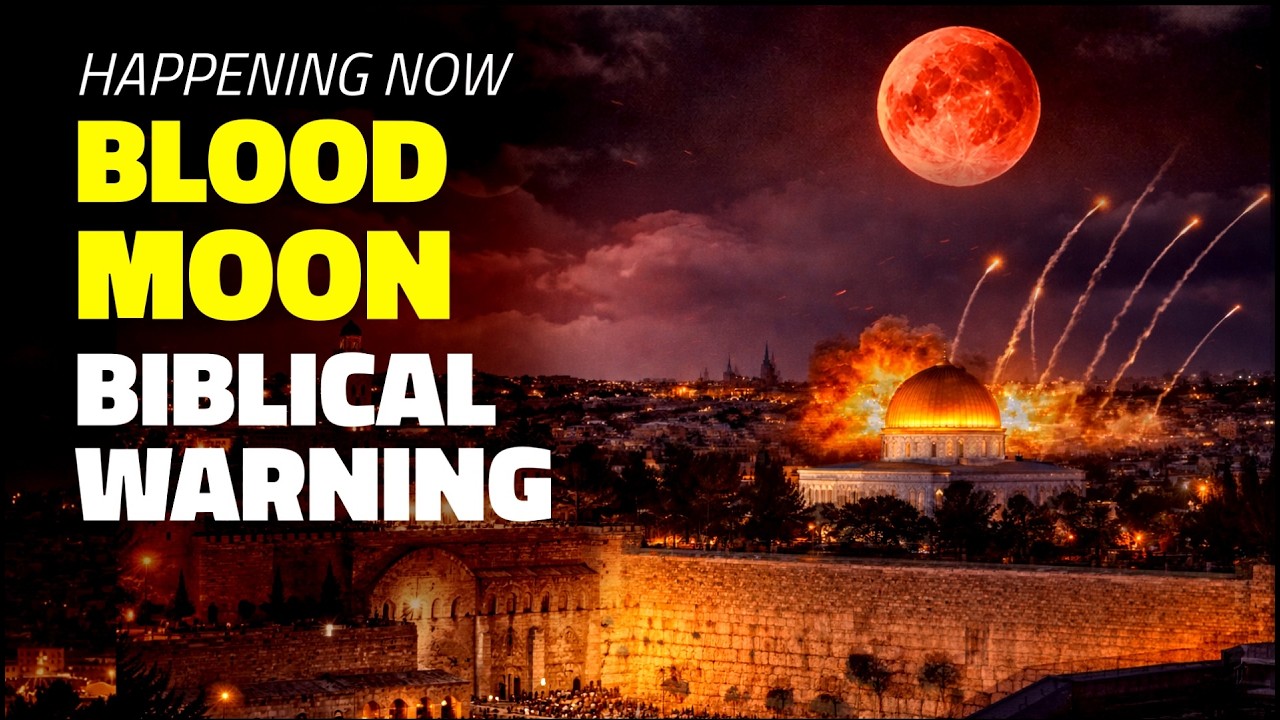
When the Sky Turned Red: The Blood Moon of March 3rd and the Questions It Ignited
On March 3rd, 2026, the night sky over much of the world shifted into an eerie shade of crimson.
It lasted only a short time. Astronomers called it a total lunar eclipse.
But for others, it felt like something far more unsettling.
A sky that refuses to stay neutral
In the early hours of March 3rd, observers across continents reported the same striking image: the Moon suspended in space, no longer silver-white, but glowing in deep shades of red. Scientists quickly explained the phenomenon as light bending through Earth’s atmosphere during a lunar eclipse.
Yet explanations do not always settle the imagination.
That particular eclipse coincided with the Jewish festival of Purim—a historical commemoration of survival and reversal, rooted in the ancient Persian Empire, modern-day Iran. The overlap of timing immediately captured attention online, where coincidence and meaning often blur into each other.
For some, it was simply astronomy meeting calendar coincidence.
For others, it felt like something was being said.
Between science and meaning
Modern astronomy treats lunar eclipses as predictable mechanics: Earth blocks sunlight, scattering red wavelengths onto the lunar surface. Nothing mysterious. Nothing symbolic.
But human beings rarely experience the sky as purely mechanical.
Across cultures and centuries, the heavens have been read as language. Ancient traditions—from Greco-Roman writers to apocalyptic literature in texts like the Book of Enoch—often described celestial events as signs embedded within a larger moral or spiritual order.
The question, then, is not whether eclipses are scientifically explainable. They are.
The question is whether meaning can still be attached to them.
That tension sits at the heart of the modern debate: is the universe silent, or is it speaking in a language we’ve forgotten how to read?
Purim, Persia, and the shadow of history
The coincidence that fueled much of the online discussion was the alignment with Purim.
In the biblical account preserved in the Book of Esther, the Jewish people face annihilation under a decree issued within the Persian imperial court. The narrative turns on reversal—danger becomes deliverance, destruction becomes survival.
Because of that history, Purim is not just a holiday. It is a ritual memory of existential threat and unexpected rescue.
So when a deep red eclipse appeared on the same day, some observers drew symbolic parallels between ancient Persia and modern geopolitical tensions involving Iran, the modern successor state of that historical region.
In analytical terms, historians caution against collapsing ancient narratives into modern politics.
But symbolically, the overlap was enough to ignite widespread interpretation.
The sky as a “clock of meaning”
The idea that celestial movements carry meaning is not new.
Ancient religious texts often describe the heavens as structured communication. In some apocalyptic literature, the sky functions as a kind of moral calendar, marking transitions in human history.
Even within biblical tradition, the heavens are sometimes described as “signs”—not because they dictate events, but because they frame human awareness of time.
This interpretive lens leads some modern readers to revisit passages such as those in prophetic literature, including references in the Book of Joel, where imagery of “the moon turning to blood” appears alongside warnings of upheaval and calls for reflection.
Whether these texts are read literally, metaphorically, or symbolically varies widely. But their presence ensures that events like eclipses are never interpreted in a purely neutral vacuum.
A modern world that no longer looks upward
One of the more philosophical arguments emerging from discussions around the March 3rd eclipse is cultural rather than astronomical.
In highly technological societies, the sky has largely lost its interpretive role. Weather satellites replaced omens. Space agencies replaced mythological readings of celestial motion.
The heavens became data.
Yet despite this shift, emotional responses to rare astronomical events remain powerful. Social media reactions to eclipses consistently show awe, unease, and curiosity—even among those who reject symbolic interpretations.
This suggests something persistent in human cognition: even when we understand the mechanism, we still feel meaning.
The return of ancient language in a digital age
Online discourse around the eclipse revealed a familiar pattern. Scientific explanations circulated quickly, but so did symbolic interpretations.
Some users referenced prophetic traditions, others pointed to apocalyptic literature, while others emphasized coincidence theory—the idea that humans naturally detect patterns even where none exist.
Psychologists refer to this tendency as apophenia: the human brain’s inclination to connect unrelated events into meaningful narratives.
Yet dismissing interpretation entirely does not fully explain why certain events—like eclipses—repeatedly attract symbolic framing across cultures and eras.
Something about them resists being “just another event.”
The Book of Esther and hidden presence
Much of the symbolic interpretation of the March 3rd eclipse centered on the Book of Esther.
In that narrative, one of its most unusual theological features is the absence of explicit mention of God. Unlike other biblical texts, divine intervention is implied rather than stated, operating through coincidences, timing, and political reversals.
This literary structure has led many theologians to describe Esther as a story about hidden providence—where meaning is present but not directly visible.
That interpretive idea became central in modern discussions of the eclipse: the suggestion that meaning might exist in events that appear, on the surface, to be purely natural.
Whether one accepts that framing or not, it reflects a long-standing interpretive tradition: history as layered rather than flat.
The role of prophecy in modern imagination
Prophetic literature, especially from ancient sources, often uses celestial imagery as metaphor for disruption or transformation. The language is symbolic, not predictive in the modern scientific sense.
However, in digital culture, prophetic language often becomes reactivated during unusual astronomical events. Social platforms amplify this effect, allowing symbolic readings to spread rapidly alongside scientific explanations.
The result is a layered public discourse where astronomy, theology, psychology, and geopolitics coexist in the same interpretive space.
The March 3rd eclipse became one such moment.
Why eclipses still feel personal
Despite centuries of scientific advancement, eclipses continue to produce emotional responses that feel disproportionate to their physical explanation.
Part of this is perceptual: a sudden darkening of the sky interrupts normal expectation. Part of it is historical: eclipses were once feared as omens across many civilizations.
But there is also a deeper psychological dimension. Celestial events bypass everyday control. No technology, political system, or personal action can alter them. They occur regardless of human context.
That lack of control often triggers reflection.
From observation to interpretation
The central divide in reactions to the March 3rd event can be summarized simply:
Science describes what happened.
Interpretation asks what it means.
Neither replaces the other. They operate in different domains.
For astronomers, the eclipse was predictable and routine in cosmic terms.
For interpreters of symbolic systems, the coincidence with Purim and geopolitical tensions made it culturally significant.
Both readings coexist, even when they disagree.
The persistence of symbolic thinking
Anthropologists note that symbolic interpretation of natural phenomena is one of the oldest cognitive habits in human history. Before scientific astronomy, eclipses were often interpreted as disruptions in cosmic order.
Modern science has removed fear but not fascination.
Instead, interpretation has shifted from survival-based meaning (omens of disaster) to existential meaning (signs of reflection, warning, or transition).
The language has changed, but the instinct remains.
Between fear and reflection
What makes discussions around events like the March 3rd eclipse particularly intense is not just the sky itself, but the context in which it appears.
Periods of geopolitical tension, cultural uncertainty, or global instability tend to amplify symbolic readings of natural events. The human mind searches for coherence when external conditions feel unstable.
In that sense, the sky becomes a screen onto which collective anxiety and hope are projected.
Conclusion: a sky that means different things to different eyes
The March 3rd lunar eclipse will remain, in scientific records, a routine astronomical alignment involving Earth’s shadow and reflected sunlight.
But culturally, it became something more complex—a moment where science, symbolism, history, and interpretation intersected.
For some, it was nothing more than light and geometry.
For others, it was a reminder of ancient narratives about survival, judgment, and reversal.
And for many in between, it was simply a rare moment to look upward and feel, however briefly, that the universe is not entirely indifferent.
Because even in an age dominated by data and prediction, the sky still has a way of asking questions it does not answer.
And people, as they always have, continue to respond.