Evidence Found in China: They Knew About Jesus’ Death as It Happened (Ancient Documents)
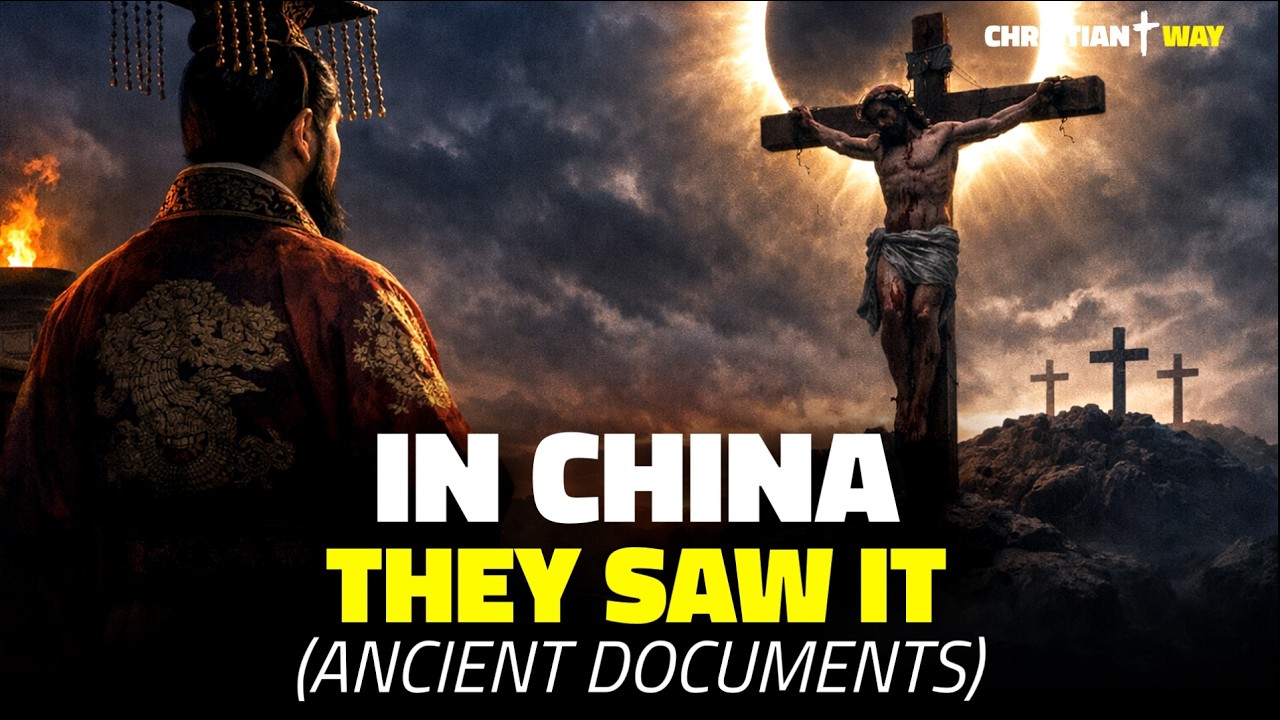
Did Ancient China Record the Death of Jesus? The Astonishing Historical Mystery Hidden in Imperial Archives
What if some of the most intriguing records connected to the life of Jesus were not preserved in Rome, Jerusalem, or Athens—but in the archives of ancient China, thousands of miles away from the land where Christianity was born?
For centuries, skeptics have asked a challenging question: If the sky truly darkened when Jesus died on the cross, as the Gospels describe, why do we not find references to such an event outside the Bible? Surely an occurrence dramatic enough to plunge the world into darkness would have attracted the attention of other civilizations. What if the answer has been sitting in ancient historical records all along?
The story you are about to explore combines history, astronomy, language, archaeology, and faith. Whether one approaches it as a believer, a skeptic, or simply a curious student of history, the connections are fascinating. Some researchers argue that ancient Chinese records may contain references not only to the birth of Christ but also to extraordinary celestial events surrounding His crucifixion and resurrection.
If true, it would mean that while Jesus walked the dusty roads of Judea, observers on the opposite side of the world were unknowingly documenting signs connected to the most influential life in human history.
The Question That Refuses to Disappear
The Gospel accounts describe several remarkable events during the crucifixion of Jesus. Among the most striking is the darkness that covered the land during the final hours before His death.
According to the Gospel narratives, darkness fell from noon until about three o’clock in the afternoon. For believers, this event represented creation itself responding to the death of its Creator. For critics, however, it raises difficult questions.
If such darkness occurred, where are the independent records?
Ancient civilizations were meticulous observers of the sky. The Romans tracked celestial events. The Babylonians were famous astronomers. Chinese scholars maintained some of the most detailed astronomical records in history. If an unusual phenomenon occurred, one might expect someone to have noticed.
The remarkable claim explored by many researchers is that someone did.
Not in Jerusalem.
Not in Rome.
But in China.
Ancient China and the Forgotten Worship of One Supreme God
Most people imagine ancient China as a civilization dominated by ancestor worship, dragons, and numerous deities. Yet many historians point out that China’s earliest religious traditions were far more complex.
Long before the arrival of Buddhism and centuries before Taoism became influential, Chinese rulers spoke of a supreme heavenly authority known as Shangdi.
The name is often translated as “Supreme Ruler” or “Highest Emperor.”
Shangdi was not represented by statues. He was not depicted in images. He was regarded as transcendent, invisible, and above all other powers.
This fact surprises many people.
In ancient ceremonies, Chinese emperors offered sacrifices to Shangdi and prayed for the well-being of the nation. Some scholars have noted striking similarities between these rituals and certain concepts found in the Old Testament.
At the center of these ceremonies was the idea that heaven ruled over humanity and that moral order mattered.
The emperor was not considered divine. Rather, he governed under what became known as the “Mandate of Heaven.”
If heaven withdrew its favor, the nation would suffer.
If heaven approved, the nation would prosper.
This worldview made Chinese astronomers extraordinarily attentive to unusual events in the sky.
To them, celestial signs were not random occurrences.
They were messages.
Why Chinese Astronomers Were Different
In many ancient cultures, astronomy was a respected profession.
In China, it was a matter of national security.
Imperial astronomers monitored the heavens constantly. Their observations influenced state decisions and imperial policies. Comets, eclipses, unusual stars, and planetary alignments were all carefully recorded.
Accuracy was essential.
An astronomer who failed to report an important celestial event could face severe punishment. Their records were expected to be precise and reliable.
Because of this, Chinese astronomical archives are considered among the most valuable historical resources in the ancient world.
They recorded comets that were later confirmed by modern science.
They documented supernovas that are still studied today.
They tracked celestial phenomena with extraordinary diligence.
This is why researchers become excited whenever Chinese records appear to overlap with major biblical events.
The Star That Appeared in the East
The Gospel of Matthew tells the famous story of wise men who followed a mysterious star to the place where Jesus was born.
The nature of this star has been debated for centuries.
Was it a comet?
A planetary conjunction?
A supernova?
A miraculous event beyond ordinary explanation?
Interestingly, Chinese astronomical records from around the period traditionally associated with Christ’s birth mention an unusual celestial object appearing in the sky.
Ancient chronicles describe what is often translated as a “broom star” or bright stellar phenomenon visible for an extended period.
Some researchers have proposed that this event may correspond to the Star of Bethlehem described in Matthew’s Gospel.
Others remain skeptical, arguing that the connection cannot be proven.
Yet the timing is intriguing.
The possibility that observers in China documented a celestial event associated with Christ’s birth continues to capture the imagination of historians and theologians alike.
But even more remarkable claims concern the events surrounding His death.
The Darkness at the Crucifixion
The crucifixion presents a significant challenge for historians because the Gospel descriptions appear to involve a darkness unlike an ordinary solar eclipse.
Astronomically speaking, a traditional solar eclipse cannot occur during Passover.
Passover takes place during a full moon.
A solar eclipse requires a new moon.
The positions simply do not align.
Critics have long pointed to this fact as evidence that the Gospel account must be symbolic rather than historical.
Yet some ancient records from China describe a strange darkening of the sky during the period associated with Christ’s crucifixion.
According to interpretations promoted by certain Christian researchers, Chinese chronicles contain references to an unusual darkness in which both the sun and moon appeared obscured.
Such descriptions do not fit a normal eclipse.
Instead, they suggest an extraordinary atmospheric phenomenon or an event that observers struggled to classify.
It is important to note that historians debate these interpretations, and there is no universal agreement regarding their meaning.
Nevertheless, the language found in some of these records has generated intense interest.
Why?
Because the descriptions sound remarkably similar to accounts of an unnatural darkness.
A darkness that should not have been possible.
A darkness that seemed to defy normal astronomical explanations.
The Emperor’s Astonishing Declaration
Perhaps the most intriguing claim involves an imperial decree associated with these celestial events.
According to certain interpretations of ancient Chinese records, an emperor responded to the mysterious darkness with an official proclamation.
The wording has fascinated Christian scholars for decades.
The decree reportedly suggested that the sins or wrongdoing of the people had somehow fallen upon a single individual.
To modern Christian readers, such language sounds strikingly familiar.
At the heart of Christian theology is the belief that Jesus bore the sins of humanity through His sacrificial death.
Could a ruler thousands of miles away have unknowingly echoed one of Christianity’s central doctrines?
Skeptics argue that such interpretations may read too much into ancient texts.
Believers see something different.
They see a remarkable coincidence—or perhaps a providential sign.
Either way, the parallels are difficult to ignore.
Imagine the scene.
While Roman soldiers stood at Golgotha.
While frightened disciples scattered.
While darkness covered the land.
An emperor on the other side of the world contemplated strange signs in the heavens and issued a declaration that some believe mirrors the meaning of the cross itself.
It is one of the most captivating possibilities in historical research.
The Mystery Hidden in Chinese Characters
Another aspect of this discussion involves the Chinese language itself.
Some Christian authors have argued that ancient Chinese characters preserve echoes of stories found in Genesis.
Whether these interpretations represent historical reality or later symbolic readings remains a matter of debate.
Still, the examples are fascinating.
One frequently cited example involves the character associated with a large vessel or boat.
Some researchers note that its components can be interpreted as suggesting eight persons aboard a vessel, corresponding to Noah, his wife, his three sons, and their wives.
Others point to characters that seem to combine concepts related to temptation, trees, and human beings.
Perhaps the most famous example involves a character associated with righteousness.
Certain Christian interpreters observe that it can be viewed symbolically as a lamb covering a person.
For believers, such patterns appear to preserve fragments of humanity’s earliest memories of God.
For linguists, the issue is more complicated, and many scholars caution against drawing firm conclusions.
Yet these observations continue to fascinate millions because they suggest a deeper question:
Could traces of biblical history have survived in cultures far removed from Israel?
Three Days Later
The story does not end with darkness.
According to Christian belief, Jesus rose from the dead on the third day.
Researchers interested in Chinese records point to reports of unusual celestial phenomena occurring shortly after the period associated with the crucifixion.
Among these are references to luminous halos and unusual solar displays.
In Chinese symbolism, such signs often carried meanings related to harmony, restoration, or reconciliation between heaven and earth.
Again, historians debate the significance of these reports.
No ancient Chinese astronomer wrote, “Jesus has risen from the dead.”
The records simply document what observers saw.
Yet for many believers, the timing is deeply meaningful.
Darkness.
Then light.
Judgment.
Then reconciliation.
Death.
Then life.
The pattern resonates strongly with the Christian narrative.
What Historians Actually Say
A balanced approach requires acknowledging an important fact.
Many of the strongest claims connecting Chinese records directly to Jesus remain controversial.
Professional historians do not universally agree that the documents provide definitive proof of the crucifixion.
Some dates are disputed.
Some translations vary.
Some interpretations depend on theological assumptions.
This does not mean the records are meaningless.
Rather, it means they should be approached with both curiosity and caution.
Historical investigation is rarely simple.
Ancient documents often contain ambiguities.
Translations evolve.
Context matters.
The fascinating aspect of these Chinese records is not that they conclusively prove every detail of the Gospel accounts.
It is that they raise questions that continue to intrigue scholars and believers alike.
Why This Matters Today
Whether one accepts these connections fully or views them as intriguing possibilities, they point toward a larger truth.
The story of Jesus has never belonged to a single nation, language, or culture.
From the earliest centuries, Christianity spread across continents, reaching people from vastly different backgrounds.
What makes the Chinese connection so compelling is that it reminds us how universal humanity’s search for God has always been.
Ancient Chinese emperors looked toward heaven seeking meaning.
Jewish prophets spoke of a coming Messiah.
Greek philosophers searched for ultimate truth.
Roman historians attempted to understand the forces shaping history.
Different civilizations asked the same fundamental questions.
Why are we here?
What is truth?
Does heaven speak?
Can humanity be reconciled with God?
The Christian claim is that these questions ultimately converge in the person of Jesus Christ.
The Archives and the Cross
Perhaps the most remarkable aspect of this story is not whether every historical connection can be proven beyond doubt.
It is the image itself.
Imagine dusty scrolls preserved for centuries in imperial archives.
Imagine scholars carefully recording movements of stars and strange changes in the sky.
Imagine observations made with no awareness of events unfolding in distant Judea.
And then imagine future generations discovering parallels between those records and the Gospel narrative.
Coincidence?
Providence?
Historical mystery?
Each reader must decide.
What cannot be denied is that the story continues to captivate people around the world.
For believers, it serves as a reminder that God’s fingerprints may appear in unexpected places.
For skeptics, it offers a fascinating case study in how cultures interpret extraordinary events.
For historians, it remains a puzzle worthy of careful investigation.
Two thousand years later, the debate continues.
Yet perhaps that is fitting.
The life, death, and resurrection of Jesus have always inspired questions that transcend borders, languages, and civilizations.
And if even a fraction of these ancient Chinese records truly correspond to the events described in the Gospels, then the heavens may have testified not only over Jerusalem—but across the entire world.
The archives remain.
The records endure.
And the mystery is still inviting us to look deeper.