A Virgin Mary Image Appeared in the Americas—Not Human-Made! Las Lajas Like Guadalupe
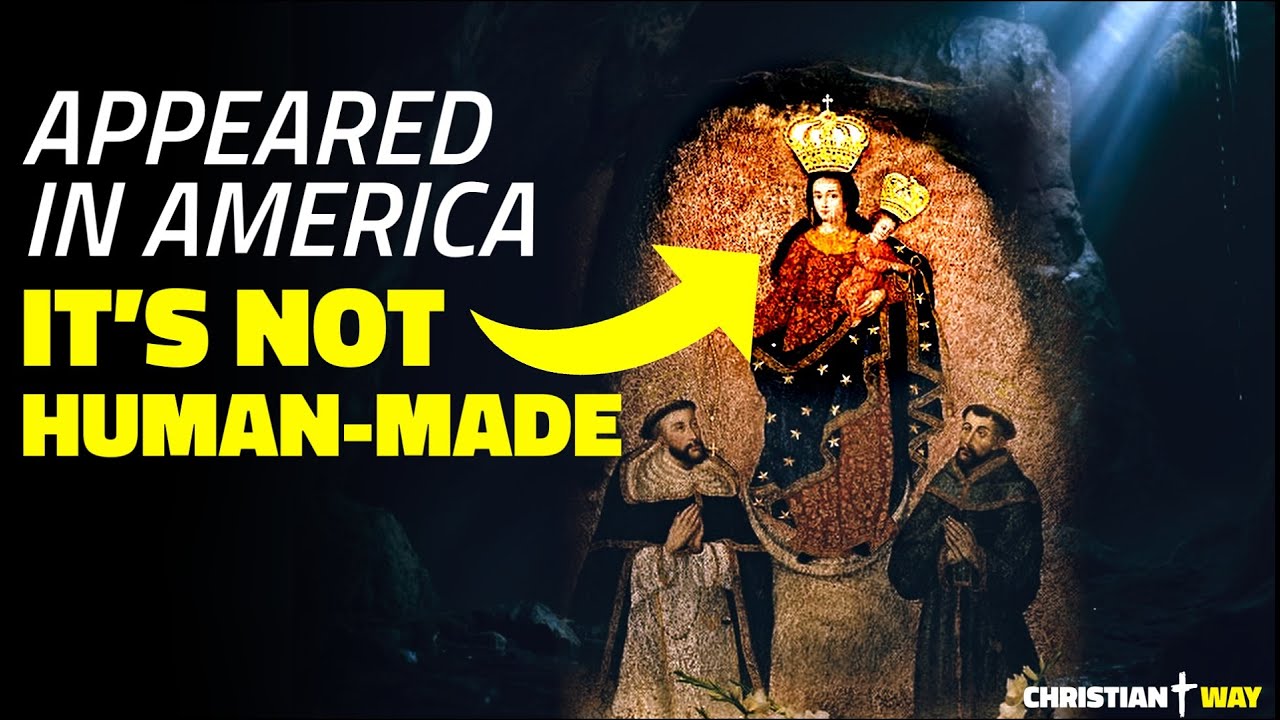
The Mystery of Las Lajas: The Image in the Mountain That Science Still Cannot Fully Explain
High in a remote canyon on the border of Colombia and Ecuador, an image appears to emerge directly from the living rock itself.
Not painted on the stone. Not carved into it. Not attached to its surface.
According to generations of believers, the image has been there for centuries, silently defying explanation while overlooking one of the most breathtaking sanctuaries ever built. And what makes this mystery even more intriguing is that modern investigations have raised questions that remain unanswered to this day.
Was it the work of an unknown artist?
A rare geological phenomenon?
A religious legend that grew over time?
Or could Las Lajas represent one of the most extraordinary mysteries in the history of sacred art?
The deeper you travel into the story, the stranger it becomes.
A Cathedral Suspended Above an Abyss
Few places on Earth create a first impression as dramatic as Las Lajas.
Imagine standing at the edge of a deep mountain canyon. Far below, a river crashes through the rocks. Towering cliffs rise on both sides, covered with dense vegetation and frequently wrapped in mist.
Then, seemingly impossible, a Gothic cathedral appears.
The sanctuary stretches across a bridge suspended nearly 100 meters above the river below. Its soaring towers, pointed arches, and stained-glass windows look as if they belong in medieval Europe rather than the rugged wilderness of South America.
Yet for most pilgrims, the architecture is not the main attraction.
The true object of fascination lies behind the altar.
Embedded within the mountain itself is an image of the Virgin Mary accompanied by figures traditionally identified as Saint Dominic and Saint Francis.
For more than two centuries, this image has drawn visitors from around the world.
And with every generation, the same question returns:
How did it get there?
The Canyon That Became Sacred
To understand the mystery, it is necessary to return to the eighteenth century.
The region surrounding Las Lajas was once considered isolated and dangerous. The steep canyon walls and unpredictable weather made travel difficult. Few people willingly entered the area.
Everything changed in 1754.
According to local tradition, an Indigenous woman named María Mueses was traveling through the canyon with her young daughter, Rosa.
A violent storm suddenly erupted.
Seeking shelter from the rain and lightning, the pair took refuge in a rocky cave formed by the canyon walls.
What happened next would become one of the most famous religious stories in South America.
Rosa, who was reportedly deaf and unable to speak, suddenly pointed toward the rock wall and exclaimed that a beautiful lady was calling her.
María saw nothing.
But the child continued insisting that a mysterious woman and a child were present within the cave.
At first, the experience was dismissed.
Yet according to tradition, Rosa repeatedly returned to the site, claiming to see the same heavenly visitors.
Then the story took an even more dramatic turn.
The Event That Changed Everything
Some time later, Rosa reportedly became gravely ill and died.
Devastated by grief, María carried her daughter’s body back to the cave where the child had claimed to encounter the mysterious lady.
There she prayed.
The tradition surrounding Las Lajas records that Rosa was miraculously restored to life.
Whether viewed as history, legend, or a mixture of both, the story spread rapidly through the region.
People began traveling to the cave.
They gathered to pray.
They examined the rock wall that had become the center of so many extraordinary claims.
And as they looked more closely, they noticed something remarkable.
An image seemed to be emerging from the stone.
Not a vague pattern that required imagination.
Not random discoloration.
But a detailed religious image with recognizable figures, colors, and features.
The discovery transformed an obscure canyon into a destination for pilgrims.
Yet the greatest mystery was still waiting to be uncovered.
An Image Unlike Any Other
Throughout history, countless religious images have been painted onto walls, wood panels, canvases, and stone surfaces.
At first, many assumed that Las Lajas must be another example of religious artwork.
After all, what other explanation could there be?
However, investigators eventually began noticing unusual details.
The image showed no obvious evidence of brushwork.
There were no visible outlines typical of preliminary sketches.
The colors appeared unusually stable despite centuries of exposure to humidity, temperature changes, smoke from candles, and environmental wear.
Most paintings deteriorate over time.
Yet observers often remarked that the image at Las Lajas appeared remarkably vibrant.
These observations encouraged further study.
And that is where the mystery entered a new phase.
What Researchers Found
As scientific methods advanced during the twentieth century, various examinations of the image and surrounding rock were conducted.
Researchers expected to discover a layer of pigment resting on the surface of the stone, similar to a fresco or mural.
Instead, some analyses suggested something unusual.
The colors did not appear to behave like conventional paint applied to a surface.
Rather than forming a separate layer, the coloration seemed closely integrated with the rock itself.
This finding generated significant interest.
If the image were painted, where were the expected traces of artistic preparation?
Where were the clear signs of pigment application?
How had the image survived for so long in such a challenging environment?
These questions remain central to discussions about Las Lajas today.
Believers view the findings as evidence that the image possesses an origin beyond ordinary human capability.
Skeptics argue that unusual natural processes, incomplete historical records, or misunderstood artistic techniques could still provide explanations.
The debate continues because neither side possesses a definitive answer.
The Challenge of the Stone
One reason Las Lajas attracts attention is the nature of its canvas.
Unlike traditional artwork, the image appears on a rocky cliff face within an active mountain environment.
Stone is not an easy medium.
Moisture penetrates cracks.
Minerals shift over time.
Temperature changes create expansion and contraction.
Biological growth gradually covers exposed surfaces.
Any artwork placed directly on such a surface faces constant threats.
Yet the image has survived through centuries of environmental exposure.
This durability has fueled claims that the image differs fundamentally from ordinary paintings.
Supporters frequently point out that maintaining vivid coloration under such conditions would be difficult even with modern materials.
Critics respond that unusual preservation does not automatically imply supernatural origins.
Still, the image’s longevity remains one of its most fascinating characteristics.
Comparisons to Other Religious Mysteries
Las Lajas is often compared to other famous religious images that have generated scientific and theological discussion.
Among the most frequently cited examples is the image associated with the Virgin of Guadalupe in Mexico.
Both cases involve claims that traditional artistic explanations fail to account for certain observed characteristics.
Both have inspired generations of devotion.
And both occupy a unique position between faith and science.
For believers, such similarities suggest a pattern of divine intervention throughout history.
For researchers, they represent opportunities to investigate how religious traditions develop around unusual physical objects.
Regardless of one’s perspective, the comparisons demonstrate a broader truth.
Human beings remain deeply fascinated by mysteries that appear to exist at the boundary between the natural and the supernatural.
Building a Church Around a Miracle
The growing reputation of the image eventually created a practical challenge.
Pilgrims continued arriving.
The cave could no longer accommodate the increasing number of visitors.
One option would have been to remove the image and transfer it to another location.
But that proved impossible.
The image was inseparable from the mountain itself.
As a result, an extraordinary decision was made.
Rather than moving the image, builders would construct a sanctuary around it.
The project required tremendous effort.
Workers faced difficult terrain, dangerous conditions, and immense engineering challenges.
The final result remains one of the most spectacular religious structures in the world.
Completed in 1949 after decades of construction, the sanctuary spans the canyon on a monumental bridge.
The mountain wall containing the image serves as part of the church itself.
The altar stands directly before the rock.
Pilgrims do not gaze upon a painting hanging inside a building.
They encounter the mountain itself.
Faith Written in Stone
Beyond the scientific questions, Las Lajas is ultimately a place of faith.
Visitors arriving at the sanctuary quickly notice thousands of small plaques covering nearby walls.
These plaques, known as ex-votos, were left by individuals who believe they received answers to prayers.
Some express gratitude for recovery from illness.
Others commemorate protection during accidents, family reunifications, or personal transformations.
Together they form a collective testimony of hope.
Whether one interprets these accounts as miracles, coincidences, or psychological experiences, their emotional power is undeniable.
Each plaque represents a deeply personal story.
Each reflects someone’s conviction that something extraordinary happened in their life.
And every year, new plaques continue to appear.
Why the Mystery Endures
In a world increasingly shaped by technology, data, and scientific analysis, places like Las Lajas continue to attract attention because they resist simple categorization.
Science excels at explaining mechanisms.
Faith explores meaning.
Las Lajas exists where those two realms intersect.
Researchers can analyze minerals.
Historians can investigate documents.
Engineers can study the construction of the sanctuary.
Yet the deeper questions remain remarkably resilient.
Why did this image appear where it did?
How exactly was it formed?
Why has it inspired such devotion across generations?
And why do people continue traveling thousands of miles to see it?
These questions extend beyond geology and art history.
They touch something deeper within human nature.
The desire for wonder.
The search for meaning.
The hope that reality may contain more than what we immediately perceive.
A Message Hidden in the Canyon
Perhaps the greatest significance of Las Lajas lies not in proving a miracle but in inspiring reflection.
For centuries, the image has stood within a rugged canyon, enduring storms, floods, political upheavals, and the passage of time.
Empires have risen and fallen.
Technologies have transformed civilization.
Scientific knowledge has expanded beyond anything imaginable in the eighteenth century.
Yet the mystery remains.
Visitors still stand before the image and ask the same questions their ancestors asked generations ago.
Some leave convinced they have witnessed evidence of divine action.
Others depart intrigued but unconvinced.
Almost none leave indifferent.
And that may be the true power of Las Lajas.
It invites us to pause.
To wonder.
To recognize that not every mystery has been solved.
Whether one views the image as a miraculous sign, an extraordinary natural phenomenon, or an unsolved historical puzzle, it continues to fulfill a remarkable role.
It reminds us that wonder still exists.
Hidden among mountains.
Written into stone.
Waiting to be discovered by those willing to look a little deeper.