250,000 People Saw the Virgin Mary — The Most Documented Apparition in History | Zeitoun
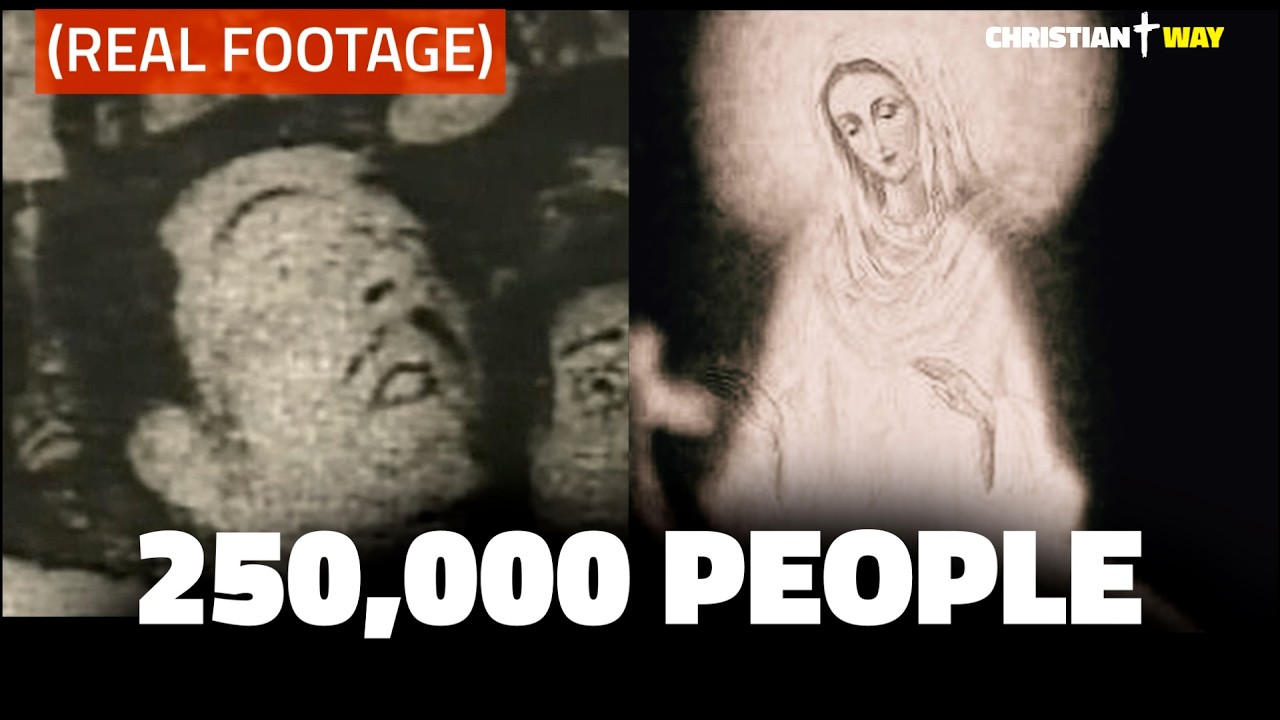
The Apparition Seen by 250,000 People: The Astonishing Mystery of Our Lady of Zeitoun
Shortly after sunset on an ordinary evening in Cairo, two Muslim mechanics looked up and thought they were witnessing a tragedy. A woman appeared on top of a church dome, standing dangerously close to the edge. One of them shouted for her to come down. Within minutes, police were called. Crowds gathered. Traffic stopped. But what happened next would transform a local incident into one of the most extraordinary religious mysteries of the twentieth century.
The woman did not jump.
Instead, she began to glow.
What started as a suspected suicide attempt became a phenomenon witnessed by hundreds of thousands of people over the next three years. Christians saw her. Muslims saw her. Skeptics saw her. Government officials saw her. Police officers saw her. Even Egypt’s president reportedly came to observe with his own eyes. Cameras photographed her. Television crews filmed the events. Investigators searched for explanations and found none.
For many believers, this was no ordinary event. It was the largest public Marian apparition in recorded history.
This is the story of Our Lady of Zeitoun.
A Nation in Crisis
To understand why the events of Zeitoun captured the imagination of an entire nation, we must first understand Egypt in 1968.
The country was wounded.
Only months earlier, Egypt had suffered a devastating defeat in the Six-Day War. National pride had been shattered. Economic difficulties weighed heavily on the population. Religious tensions simmered beneath the surface. Hope seemed increasingly difficult to find.
In the northern district of Cairo known as Zeitoun stood the Church of Saint Mary, a modest Coptic Orthodox church located along a busy street lined with garages, workshops, and residential buildings.
On the evening of April 2, 1968, nothing suggested that this ordinary location was about to become the center of worldwide attention.
Across from the church, two mechanics were finishing work at a public transportation garage. Their names were Farouk Mohammed Atwa and Abdel Aziz Ali.
Neither man was looking for miracles.
Neither man expected to witness history.
The Woman on the Dome
At approximately 8:30 p.m., Farouk glanced toward the church and noticed a female figure standing on the central dome.
His immediate reaction was fear.
The figure appeared to be dangerously positioned near the edge of the roof. Believing that a woman was about to throw herself off the building, he shouted for her to stop.
Abdel ran to alert authorities.
Passersby joined in, yelling warnings.
Within minutes, a crowd formed below the church.
Then something strange happened.
The woman stood upright.
Those watching began to realize that this was no ordinary person.
The figure emitted an intense light. Yet unlike the harsh glare of a spotlight, the radiance seemed soft and gentle. Witnesses later described her movements as graceful and fluid, unlike anything they had ever seen.
As she moved across the dome, observers noticed something even more unusual.
There was no shadow beneath her.
The light appeared to originate from her.
A murmur spread through the crowd.
Then someone cried out:
“Seta Mariam!”
“Our Lady Mary!”
The atmosphere changed instantly.
People fell silent.
Others began to pray.
Many simply stared in disbelief.
The First Reported Miracle
One of the most intriguing aspects of the first night concerns Farouk himself.
According to later testimony, he had been scheduled for surgery the following day due to a severe condition affecting one of his fingers.
As he pointed toward the luminous figure on the dome, he claimed that his condition was suddenly healed.
Whether one accepts this testimony as miraculous or not, it marked the beginning of countless reports that would emerge from Zeitoun over the following years.
But before anyone could speak of miracles, investigators wanted answers.
Could this all be a hoax?
The Blackout Test
Authorities responded quickly.
The growing crowd had already begun disrupting traffic and creating public concern.
Police initially suspected a trick.
Perhaps someone was projecting an image onto the church.
Perhaps hidden equipment was being used to create an illusion.
Investigators searched the roof.
No one was there.
They examined nearby buildings.
Nothing suspicious was found.
Yet the figure remained visible.
Determined to expose the supposed deception, authorities took a dramatic step.
They ordered the electricity shut off throughout the area.
Streetlights went dark.
Buildings lost power.
The church itself disappeared into darkness.
If the figure were a projection, it should have vanished instantly.
Instead, witnesses claimed the opposite occurred.
The luminous figure became even brighter.
People reported that her radiance illuminated faces in the crowd and cast light over the surrounding area.
The apparition remained visible before slowly fading away, not like a switched-off lamp, but like mist dissolving into the night air.
The following morning, newspapers across Egypt carried the story.
What should have been a local curiosity became national news.
And it was only the beginning.
Three Years of Apparitions
If the phenomenon had occurred once, historians might have dismissed it as confusion, exaggeration, or collective excitement.
But the events continued.
Again and again.
For three years.
From 1968 until 1971, reports of apparitions persisted.
Sometimes the figure appeared several times in a single week.
Sometimes she remained visible for only a few minutes.
On other occasions, witnesses claimed she stayed for hours, remaining above the church until dawn.
The crowds grew larger with every appearance.
Eventually, estimates suggested that more than 250,000 people witnessed the phenomenon over the course of the apparitions.
Such numbers make Zeitoun unique among Marian apparitions.
Most famous apparitions involve only a handful of visionaries.
Zeitoun unfolded in public view.
No special invitation was required.
Anyone could come and look.
What Did People Actually See?
Descriptions varied in minor details, but several elements appeared consistently throughout eyewitness testimonies.
Witnesses described a woman clothed in flowing white garments.
Often she wore a bluish-white veil.
Sometimes a crown appeared above her head.
A halo of brilliant light frequently surrounded her.
Many observers reported that she carried the infant Jesus.
Others claimed she held an olive branch, a symbol that resonated deeply in a nation still recovering from war.
Unlike a static image, the figure moved.
She bowed toward the cross atop the church.
She raised her hands in blessing.
She walked across the domes and rooftops.
Witnesses described seeing her from different angles, suggesting a three-dimensional presence rather than a flat projection.
Perhaps even more mysterious were the luminous forms that frequently accompanied the apparitions.
The Doves of Light
Many witnesses reported seeing glowing shapes moving through the sky above the church.
These forms were often described as doves.
Yet observers insisted they were unlike ordinary birds.
They appeared luminous.
They moved silently.
They changed direction instantly.
Some reportedly formed geometric patterns or crossed formations in the sky.
According to numerous testimonies, these lights glided without visible wing movement.
Photographs from the period appear to show unusual luminous shapes surrounding the church during certain appearances.
To believers, the doves symbolized divine presence.
To skeptics, they represented one more puzzle in an already perplexing event.
Either way, they became one of the most memorable features of the Zeitoun phenomenon.
Official Investigations
The scale of the events made investigation unavoidable.
Both civil authorities and church leaders launched inquiries.
Police officials conducted extensive searches of the area.
No evidence of fraud was discovered.
Technological explanations faced significant difficulties.
In 1968, sophisticated projection systems capable of creating large moving images in open air did not exist in the form required to explain the reports.
Church authorities were equally cautious.
The Coptic Orthodox Church established a commission to examine the claims.
Investigators interviewed witnesses and observed the phenomenon directly.
Eventually, the church issued an official declaration recognizing the apparitions.
This decision was significant.
Religious institutions are often reluctant to endorse extraordinary claims without extensive examination.
Yet after months of investigation, church leaders concluded that something genuine had occurred.
Even observers from the Catholic Church took interest.
Reports from Catholic clergy indicated that many respected witnesses had observed the phenomenon firsthand.
The story was no longer confined to Egypt.
It had become an international mystery.
President Nasser and an Unusual Response
One of the most fascinating aspects of the Zeitoun story involves the Egyptian government itself.
President Gamal Abdel Nasser was not known for promoting religious visions.
He was a secular nationalist leader.
Yet historical accounts suggest that he personally observed the phenomenon.
According to various reports, Nasser visited the area discreetly to witness events firsthand.
More remarkably, authorities reportedly facilitated crowd access by modifying nearby structures and traffic arrangements.
This response surprised many observers.
If officials had believed the phenomenon was an obvious fraud, suppression would have been the easier option.
Instead, the government allowed public observation to continue.
The events became a rare moment in which people from different religions and political viewpoints stood together, gazing upward at the same mysterious sight.
Reports of Healing
Alongside the apparitions came numerous claims of miraculous healing.
A medical committee was formed to evaluate some of these reports.
Cases included individuals suffering from serious illnesses, disabilities, and chronic conditions.
One frequently cited account involved a woman diagnosed with a malignant tumor.
After attending an apparition and praying, she reportedly experienced a sudden recovery.
Subsequent examinations allegedly revealed no trace of the disease.
Another story described a paralyzed man who regained mobility during an apparition.
Still another involved a mute individual who reportedly began speaking.
Supporters of the apparitions point to these cases as evidence of supernatural intervention.
Critics argue that extraordinary medical claims require extraordinary evidence.
Regardless of interpretation, healing testimonies became inseparable from the larger story of Zeitoun.
Why Zeitoun?
Many believers see deeper significance in the location itself.
According to ancient Christian tradition, the Holy Family—Jesus, Mary, and Joseph—passed through parts of Egypt during their flight from King Herod.
Local tradition associates the area of Zeitoun with that journey.
Some accounts even suggest that Mary rested near the location where the church was later built.
An additional layer of mystery comes from a story dating back decades before the apparitions.
According to tradition, a man involved in building the church claimed to have received a promise that the Virgin Mary would one day appear there.
The church was completed in the 1920s.
The apparitions began roughly half a century later.
For believers, the timing seemed far more than coincidence.
A Message Without Words
Perhaps the most remarkable aspect of the Zeitoun apparitions is what did not happen.
There were no lengthy messages.
No secrets.
No dramatic prophecies.
No public speeches.
For three years, the figure appeared in silence.
Many theologians have reflected on this silence.
Egypt in the late 1960s was marked by division, conflict, and uncertainty.
In such an environment, perhaps words were unnecessary.
The appearance itself became the message.
A silent reminder of hope.
A symbol of peace.
A visible sign that transcended religious boundaries.
Muslims came.
Christians came.
Skeptics came.
And for a brief moment, they all looked toward the same light.
The Enduring Mystery
More than half a century later, the events of Zeitoun remain difficult to categorize.
Believers see overwhelming evidence of a genuine supernatural visitation.
Skeptics continue searching for natural explanations.
Yet neither side can easily dismiss the sheer scale of what occurred.
Mass hallucinations are rarely photographed.
Frauds rarely endure for three years under public scrutiny.
And few unexplained events attract witnesses from every segment of society, including government officials, police officers, religious leaders, and ordinary citizens.
Whether one views Zeitoun as a miracle, a mystery, or an unresolved historical puzzle, its impact is undeniable.
For three years, in the heart of Cairo, hundreds of thousands of people claimed to witness a radiant woman walking upon a church dome.
The lights of a city dimmed.
The noise of everyday life paused.
And countless eyes turned upward.
Perhaps that is why the story still captivates people today.
Not simply because of what appeared above the church, but because of what it represented.
A reminder that even in times of darkness, people continue to search for signs that there is something beyond what can be measured, explained, or controlled.
And on those extraordinary nights in Zeitoun, many believed they found exactly that.