Shocking Miracle in America: Here’s How Native Americans Knew Jesus Before the Church
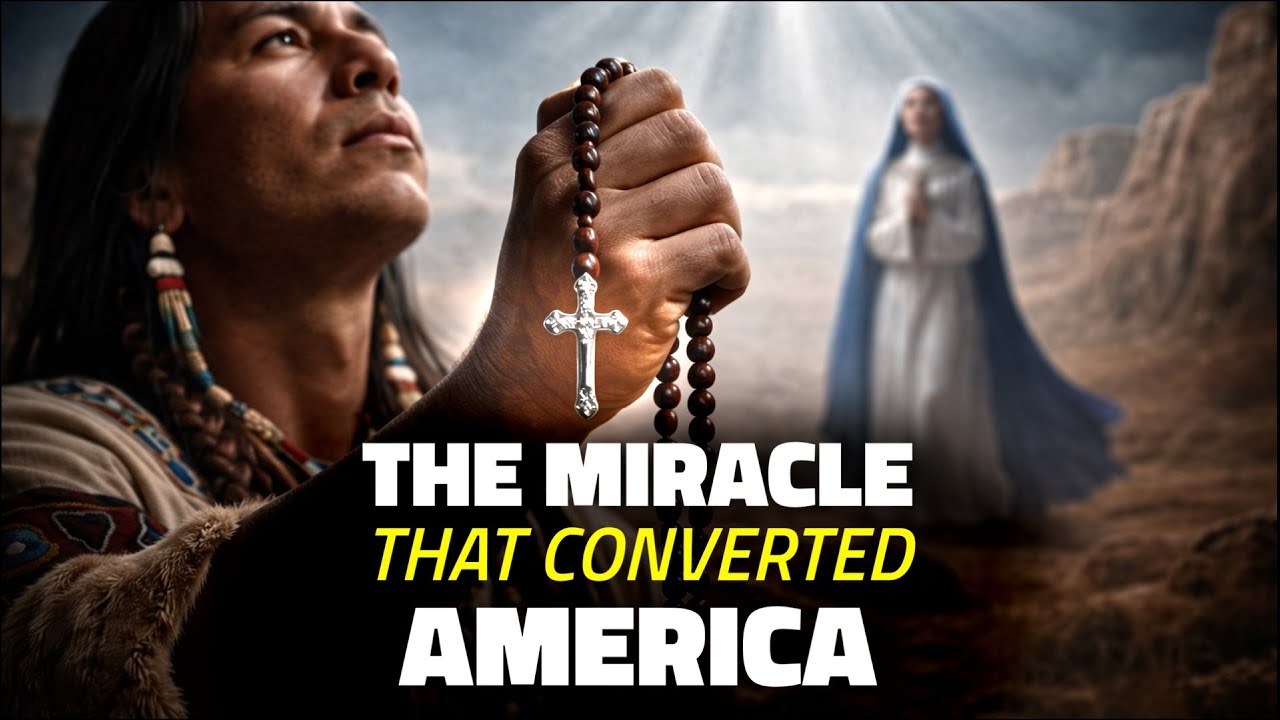
The Lady in Blue: The Nun Who Evangelized America Without Ever Leaving Her Convent
In the summer of 1629, a group of Spanish missionaries entered the wilderness of what is now Texas expecting violence. Instead, they encountered a mystery that would leave them questioning everything they thought they knew about distance, prayer, and the limits of human possibility.
The warriors who emerged from the trees were not carrying weapons.
They were carrying crosses.
Even more astonishing, these Native people had never met a European missionary, yet they already knew Christian prayers. Some wore rosaries around their necks. Others could make the sign of the cross. They spoke of heaven, baptism, and a woman dressed in blue who had taught them about God.
When the stunned friars asked who this woman was, the answer seemed impossible:
“The Lady in Blue.”
The explanation for that answer was not hidden somewhere in the deserts of North America. It was waiting thousands of miles away inside a secluded convent in Spain, where a cloistered nun claimed she had traveled across the ocean without ever leaving her cell.
For centuries, the story has fascinated historians, theologians, skeptics, and believers alike. It is a story documented in missionary reports, church investigations, royal correspondence, and eyewitness testimony. At its center stands one of the most extraordinary figures in Christian history: Sister María of Jesús de Ágreda, the mysterious “Lady in Blue.”
Was she truly appearing among Native tribes while simultaneously living inside a Spanish monastery? Was this a miracle of bilocation? A misunderstanding? Or something even stranger?
Whatever the answer may be, the evidence surrounding her life remains one of the most remarkable mysteries ever recorded.
A Missionary Puzzle in the New World
The story begins in the early seventeenth century.
Spain was expanding its missionary presence throughout the Americas. Franciscan friars traveled through harsh deserts, mountains, and forests in an effort to establish missions among indigenous peoples.
One of those missionaries was Father Alonso de Benavides, a respected Franciscan leader responsible for overseeing missionary activity in New Mexico.
Benavides was not a dreamer. He was an administrator, an organizer, and a practical man. His reports were sent directly to the Spanish Crown and Church authorities. Accuracy mattered.
Over time, however, he and other missionaries noticed something deeply puzzling.
Whenever they entered certain regions, they discovered indigenous groups that seemed strangely prepared for Christianity.
The people already knew basic Christian teachings.
They recognized crosses.
Some understood prayer.
Others spoke about baptism and salvation.
Most astonishing of all, they claimed they had received these teachings from a mysterious woman dressed in blue.
At first, the missionaries assumed the stories were misunderstandings. Perhaps traders had carried fragments of Christian ideas into the interior. Perhaps the tribes had encountered Europeans previously.
Yet the details did not fit.
Many of these communities had no documented contact with Europeans.
And the descriptions of the woman remained remarkably consistent.
She was young.
She wore blue garments.
She appeared suddenly.
She taught them about God.
She urged them to seek out men wearing brown robes—the Franciscan missionaries.
How could this be possible?
The Testimony of the Jumano People
The mystery reached its peak when members of the Jumano tribe traveled great distances specifically to request missionaries.
When questioned, they explained that the Lady in Blue had repeatedly visited them.
According to their testimony, she spoke their language effortlessly.
She instructed them in Christian beliefs.
She taught them prayers.
She showed them how to make the sign of the cross.
Most remarkably, she told them that missionaries would soon arrive and that they should listen carefully to their message.
The friars were stunned.
The Native people even possessed religious objects that appeared European in origin.
Crosses.
Rosaries.
Liturgical items.
No one could explain how such objects had reached tribes living far from established settlements.
Father Benavides later recorded these events in an official report addressed to King Philip IV of Spain.
He admitted that something extraordinary appeared to have happened.
Someone had prepared the way before the missionaries arrived.
But who?
A Hidden Nun in a Small Spanish Town
To find the answer, we must cross the Atlantic Ocean.
Nearly 8,000 kilometers away, in the small Spanish town of Ágreda, lived a Franciscan Conceptionist nun named María de Jesús de Ágreda.
Outwardly, her life seemed unremarkable.
She lived within the walls of a cloistered convent.
She rarely traveled.
She spent long hours in prayer and contemplation.
Yet among those who knew her, María had already developed a reputation as an extraordinary mystic.
Witnesses reported that she sometimes entered profound states of ecstasy lasting hours or even days.
During these experiences she appeared completely detached from the physical world.
Some claimed to have witnessed levitations.
Others described supernatural insights and unusual spiritual gifts.
Still, nothing prepared them for what María would eventually reveal.
The Nun Who Claimed to Visit America
After emerging from certain mystical experiences, María began telling her spiritual director about strange journeys.
She insisted that angels carried her to distant lands.
She described vast territories she had never visited physically.
She spoke of people with copper-colored skin.
She described unfamiliar plants, animals, rivers, and landscapes.
Most surprising of all, she claimed she preached the Gospel to these people.
At first, her confessors approached these claims cautiously.
The seventeenth century was not an era in which extraordinary spiritual claims were accepted casually.
False visions could bring severe consequences.
Church authorities investigated alleged miracles rigorously.
Yet María continued describing places and peoples she had never seen.
According to her testimony, God had sent her to prepare souls for future missionaries.
She claimed that she taught indigenous people basic Christian truths and encouraged them to seek baptism when priests eventually arrived.
At the time, many found these accounts difficult to believe.
But then reports began arriving from America.
And the descriptions matched.
The Meeting That Changed Everything
The turning point came when Father Benavides returned to Spain.
Having heard rumors about the mysterious nun, he decided to investigate personally.
He approached the meeting as a skeptic.
In his mind, there had to be a rational explanation.
Perhaps the stories had become exaggerated.
Perhaps the nun was mistaken.
Perhaps she had somehow received information indirectly.
Determined to uncover the truth, Benavides questioned her extensively.
He asked detailed questions about regions she had supposedly visited.
He expected vague answers.
Instead, he received precise descriptions.
She knew geographical details.
She knew tribal customs.
She knew information that should have been inaccessible to someone who had never left her convent.
Then came the moment that reportedly shocked him most.
María described specific missionary activities he himself had performed in America.
She recounted events she should never have known.
She described people he had met.
Ceremonies he had conducted.
Even details about clothing and circumstances that were not publicly known.
According to later accounts, one description involved a tribal leader who was blind in one eye.
The detail was correct.
For Benavides, the experience was deeply unsettling.
He later concluded that the nun somehow possessed knowledge she could not have acquired naturally.
Understanding Bilocation
How could such a phenomenon be explained?
Within Christian mystical tradition, the term often associated with these reports is bilocation.
Bilocation refers to the apparent presence of a person in two locations simultaneously.
The phenomenon has been attributed throughout history to several mystics and saints.
Among the most famous examples are Saint Anthony of Padua, Saint Martin de Porres, and Padre Pio.
According to traditional accounts, bilocation does not mean a physical body literally splits into two bodies.
Rather, it describes a supernatural manifestation through which a person appears, communicates, and interacts in another location while remaining physically elsewhere.
Whether one accepts such explanations or not, María’s case remains unique because of the volume of supporting testimony.
She reportedly claimed more than 500 visits to Native American peoples over an eleven-year period.
Church Investigations
Stories of miracles attract attention.
They also attract scrutiny.
María’s claims eventually came under investigation.
Church authorities examined her writings, interviewed witnesses, and questioned her extensively.
The Spanish Inquisition itself reviewed aspects of her case.
Contrary to modern stereotypes, church investigators often approached miraculous claims with skepticism rather than blind acceptance.
Their task was to distinguish authentic spiritual experiences from deception, delusion, or exaggeration.
After extensive examinations, María was never condemned.
Investigators found her sincere and orthodox in her beliefs.
Her accounts remained controversial, but authorities did not dismiss her as fraudulent.
This outcome strengthened interest in the extraordinary reports emerging from both Spain and the Americas.
Why the Native Testimonies Matter
One reason the mystery endures is that it does not rely solely on María’s own statements.
Independent testimony exists from indigenous communities.
Various Native traditions preserved stories about a mysterious woman dressed in blue.
The details often aligned remarkably well with the appearance of a Franciscan Conceptionist nun.
The blue mantle described by Native witnesses matched the distinctive clothing worn by María’s religious order.
Generations later, stories of the Blue Lady continued circulating among tribes in regions of Texas and New Mexico.
Historians debate the precise reliability of oral traditions. Yet their persistence contributes to the enduring fascination surrounding the case.
The existence of parallel testimonies from both sides of the Atlantic is what transforms the story from a simple mystical claim into a historical puzzle.
The Author of a Spiritual Classic
María de Ágreda’s legacy extends far beyond the mystery of bilocation.
She became one of the most influential spiritual writers of her era.
Her most famous work, The Mystical City of God, presents an extensive meditation on the life of the Virgin Mary.
The book attracted both admirers and critics, yet it remained widely read for centuries.
Its influence reached theologians, clergy, religious communities, and even royalty.
María also maintained correspondence with Philip IV of Spain, serving as a spiritual advisor over many years.
This relationship further demonstrates the respect she commanded during her lifetime.
Far from being an obscure visionary, she became one of the most significant religious figures in seventeenth-century Spain.
The Mystery of Her Incorrupt Body
Another aspect of María’s story continues to attract pilgrims and researchers.
When her remains were examined centuries after her death, reports indicated an unusual state of preservation.
Her body is often cited as one of the cases associated with incorruptibility in Catholic tradition.
For believers, such preservation represents a sign of divine favor.
For skeptics, environmental and natural factors may offer possible explanations.
Regardless of one’s perspective, the phenomenon adds another layer to an already extraordinary life.
Today, visitors continue traveling to Ágreda to learn about the woman whose story crossed oceans and centuries.
A Mystery That Refuses to Disappear
Four hundred years later, historians still debate what truly happened.
Skeptics argue that cultural exchanges, misunderstandings, or embellished accounts may explain many aspects of the story.
Believers see something more profound.
They point to consistent testimonies, documented investigations, missionary records, and the remarkable correspondence between reports from America and Spain.
Whatever conclusion one reaches, the story of the Lady in Blue remains difficult to ignore.
It challenges assumptions about history, faith, and the limits of human experience.
Most importantly, it asks a timeless question.
Can prayer reach farther than we imagine?
According to the witnesses who encountered María de Ágreda, the answer was yes.
A cloistered nun with no ships, no maps, no armies, and no means of travel may have crossed an ocean through nothing more than faith.
Whether viewed as miracle, mystery, or historical enigma, her story continues to inspire because it points toward a possibility many people long to believe:
That no distance is too great for God.
The deserts of Texas and the walls of a Spanish convent seemed worlds apart. Yet somehow, through one extraordinary woman, they became connected.
And that is why the mystery of the Lady in Blue still captivates hearts today.
Long after the missionaries, the kings, and the tribal chiefs have passed into history, the question remains alive:
Who was the woman in blue who appeared in the desert?
And how did she get there?