Jesus Appears in Israel: The Hidden Message of Israel’s Most Famous Rabbi!
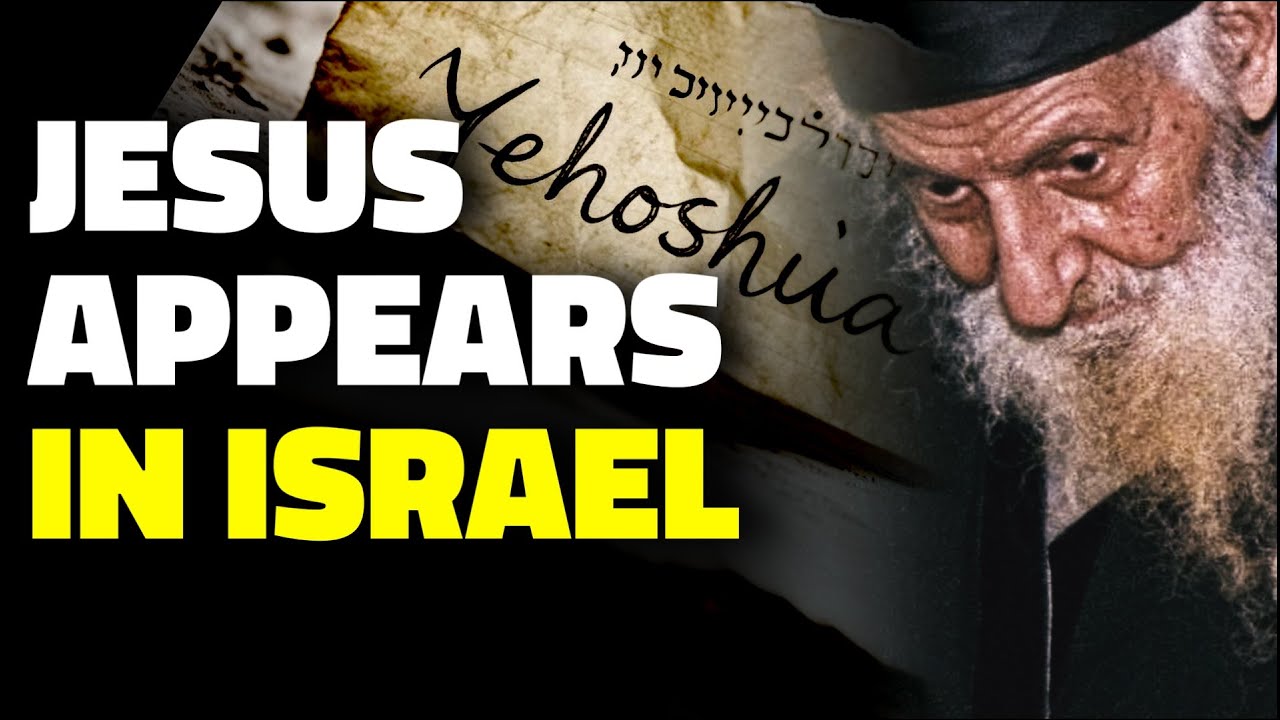
The Rabbi’s Secret Note: Did Israel’s Most Revered Mystic Reveal Jesus as the Messiah?
The envelope sat unopened for an entire year.
Inside was a handwritten note left by one of the most respected rabbis in modern Jewish history—a man whose influence stretched across generations, whose counsel was sought by politicians, judges, and spiritual leaders alike. Before his death, he gave a simple but extraordinary instruction: do not open it until one year after I am gone.
No one suspected that a small piece of paper could ignite a controversy capable of shaking the foundations of two religions.
When the note was finally opened in 2007, those gathered expected a final blessing, a mystical teaching, or perhaps a personal message from a beloved spiritual master. Instead, they found something that stunned many of his followers into silence. Hidden within the words was a name—a name that, if interpreted as some claimed, pointed directly to the figure Judaism and Christianity have debated for nearly two thousand years.
Jesus.
Was this truly the final message of Rabbi Yitzhak Kaduri, one of the most influential Jewish mystics of the modern era? Or was it a misunderstanding, a forgery, or a story that grew larger with each retelling?
The mystery has never completely disappeared. Nearly two decades later, it continues to spark debate, inspire curiosity, and raise profound questions about faith, prophecy, and the future of Israel.
To understand why this story captured worldwide attention, we must first understand the man at the center of it.
The Lion of the Law
When Rabbi Yitzhak Kaduri died in January 2006, Israel witnessed one of the largest funerals in its modern history. More than 200,000 mourners filled the streets of Jerusalem to honor a man many considered a living saint.
Born in Baghdad during the late nineteenth century, Kaduri had lived through the fall of empires, two world wars, the establishment of the State of Israel, and the dawn of the digital age. By the time of his death, he was believed to be more than one hundred years old.
Yet age had not diminished his reputation.
For decades, people traveled great distances simply to receive his blessing. Stories circulated of healings, accurate predictions, and extraordinary spiritual insight. Whether one accepted these accounts or not, there was no denying his influence. Among many Orthodox Jews, Kaduri was regarded as one of the greatest Kabbalists of his generation.
His life revolved around prayer, Torah study, and the expectation of the coming Messiah.
Unlike political leaders who rose and fell with public opinion, Kaduri occupied a different realm. He represented continuity with centuries of Jewish tradition. His authority came not from power or wealth, but from a lifetime devoted to spiritual pursuits.
That is precisely why the events surrounding his final months attracted so much attention.
A Mysterious Encounter
According to reports from students and associates, something changed in the final year of Kaduri’s life.
During the autumn of 2005, he began speaking about the Messiah in a way that surprised those closest to him. He reportedly claimed that he had encountered the Messiah and that the long-awaited redeemer would soon reveal himself.
Such statements naturally generated excitement.
For centuries, the hope of the Messiah has occupied a central place in Jewish thought. Generations have prayed for the arrival of a king from the line of David who would bring peace, justice, and spiritual restoration.
When a respected rabbi suggested that he had received unusual insight into the Messiah’s identity, people listened.
Students reportedly pressed him for details.
Who was the Messiah?
How would people recognize him?
What would happen next?
Rather than offering a direct answer, Kaduri allegedly wrote a brief message and sealed it inside an envelope. He instructed that it remain closed until one year after his death.
At the time, few imagined how much speculation that decision would generate.
The Opening of the Note
One year later, the envelope was opened.
The message inside appeared simple. Written in Hebrew, it contained a short sentence that, at first glance, seemed unremarkable.
However, supporters of the story claim that Kaduri intended readers to focus on the first letter of each word. When these letters were combined, they allegedly formed the name “Yehoshua” or “Yeshua”—the Hebrew name associated with Jesus.
News of the revelation spread rapidly through religious circles and across the internet.
For some Christians, the claim appeared extraordinary. Here was one of Israel’s most respected rabbis seemingly identifying Jesus as the Messiah.
For many Jews, however, the interpretation raised immediate questions.
Was the note authentic?
Had it been misunderstood?
Was the acrostic intentional?
Could alternative explanations exist?
The controversy intensified because the alleged message touched one of the most sensitive theological questions in history.
The identity of the Messiah.
Why the Claim Was So Explosive
To appreciate the impact of the story, it is important to understand the historical relationship between Judaism and Christianity.
At the heart of their separation lies the question of Jesus.
Christians believe Jesus fulfilled the messianic prophecies of the Hebrew Scriptures. They see Him as the promised Messiah, the Son of God, and the Savior of the world.
Traditional Judaism, however, does not accept Jesus as the Messiah. Jewish expectations regarding the Messiah include events such as universal peace, the gathering of exiles, and the complete restoration of Israel—events many Jews believe have not yet occurred.
Because of this difference, the claim that a revered Orthodox rabbi identified Jesus as the Messiah was destined to provoke intense reactions.
If true, it would represent a remarkable development.
If false, it would be seen as a serious distortion of a respected spiritual leader’s legacy.
The debate continues to this day.
Questions, Controversies, and Doubts
As the story spread, skepticism followed.
Critics pointed out that extraordinary claims require extraordinary evidence.
Some questioned the authenticity of the note itself.
Others argued that the wording was too ambiguous to support such a dramatic conclusion.
Family members and associates offered varying perspectives, and discussions quickly became polarized. Some viewed the story as a breakthrough revelation. Others regarded it as a misunderstanding amplified by internet speculation.
The truth is that many aspects of the controversy remain disputed.
What cannot be disputed, however, is the enormous attention the story received.
Why?
Because it touched a nerve far deeper than historical curiosity.
It challenged people to reconsider assumptions they had held for generations.
The Growing Phenomenon of Dreams and Visions
Around the same period, another phenomenon began attracting attention among Christians, particularly those involved in ministry among Jewish communities.
An increasing number of testimonies emerged from individuals who claimed to have encountered Jesus in dreams.
These accounts came from people of diverse backgrounds—religious and secular, young and old, skeptical and devout.
Many described remarkably similar experiences.
A man dressed in white.
A figure radiating peace.
A voice speaking words of comfort, truth, or invitation.
Upon waking, they felt compelled to explore the New Testament or investigate Christian claims about Jesus.
Such testimonies are deeply personal and cannot be scientifically verified. Yet they have become a significant feature of modern conversion narratives across various parts of the world.
For believers, these stories represent evidence that God continues to work in unexpected ways.
For skeptics, they may reflect psychological, cultural, or spiritual factors that are difficult to measure.
Regardless of one’s perspective, the sheer number of such accounts has made them impossible to ignore.
A Mystery Rooted in Ancient Prophecy
Many Christians who discuss the Kaduri story connect it to passages from the New Testament, particularly the writings of the Apostle Paul.
In his Letter to the Romans, Paul speaks of a mystery concerning Israel and God’s unfolding plan for humanity.
These passages have been interpreted in numerous ways throughout history, but many Christians see them as pointing toward a future spiritual awakening among the Jewish people.
They also point to prophecies found in the Hebrew Scriptures that speak of recognition, repentance, and restoration.
Whether these interpretations are correct remains a matter of theological debate.
What is clear is that the Kaduri story resonates because it seems to intersect with questions that have occupied believers for centuries.
Questions about identity.
Questions about prophecy.
Questions about the relationship between the Old and New Testaments.
Beyond the Note
Perhaps the most fascinating aspect of this story is that it is not really about a note.
The note is merely the doorway.
The deeper issue is what it represents.
It forces people to confront a question that has shaped history for two millennia:
Who is Jesus?
For some, the answer is obvious.
For others, it remains the most important unresolved question in human history.
Yitzhak Kaduri spent more than a century studying sacred texts, exploring mystical traditions, and seeking divine truth. Whether one accepts the claims surrounding his final message or rejects them entirely, the story reminds us that the search for truth never loses its power.
A single handwritten note continues to spark discussion across religious boundaries because it points toward a mystery larger than itself.
The mystery of faith.
The mystery of revelation.
And the mystery of a man whose identity continues to divide, challenge, and inspire billions of people around the world.
Nearly twenty years after the envelope was opened, the debate remains unresolved. Yet perhaps that is precisely why the story endures.
Some secrets are forgotten when they are revealed.
Others become even more powerful.
The mystery of Rabbi Kaduri’s final message belongs firmly in the second category.