Tucker Carlson Reveals the HARD TRUTH About the Iran Deal: “This Is a Total Loss for the US!”
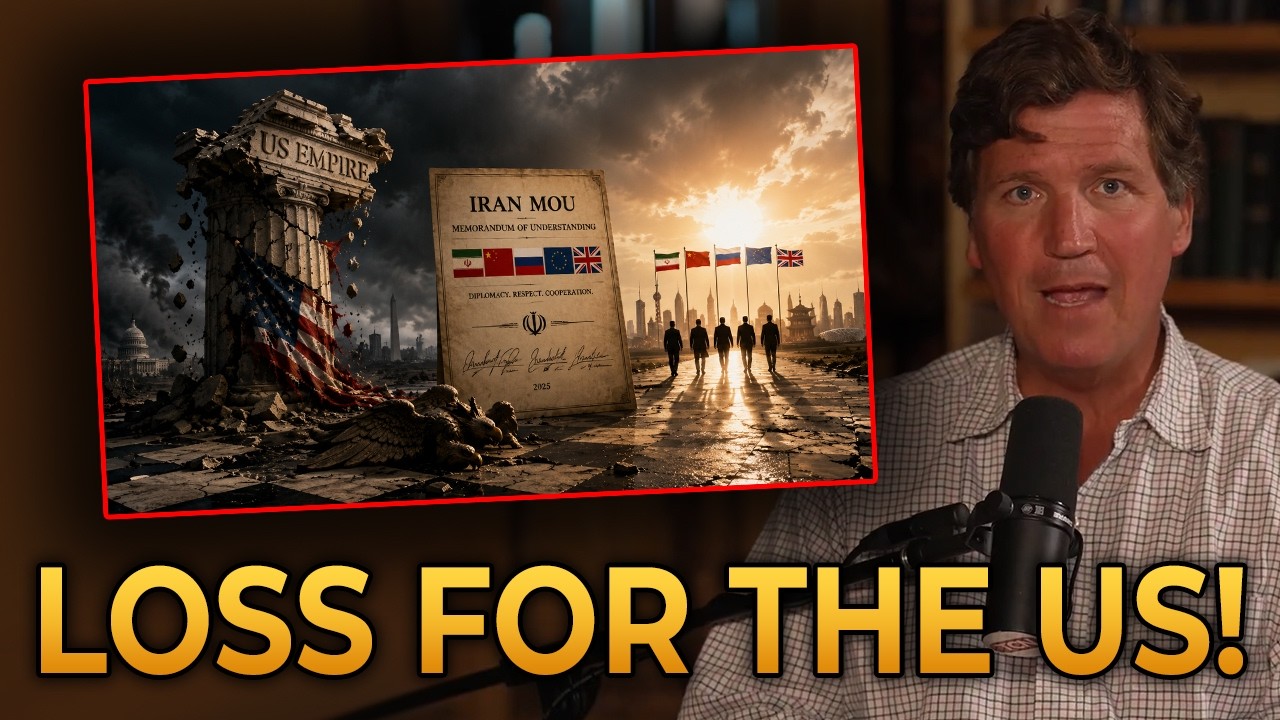
Tucker Carlson Says the Iran Deal Is an Admission of Defeat—And It’s Splitting the American Right Like Never Before
For years, America’s debates over the Middle East have followed a familiar script. Hawks demanded more pressure, critics warned against another endless war, and Washington largely stayed the course. But now, something different is happening. A proposed peace framework with Iran has exposed deep fractures inside the conservative movement, turning longtime allies into bitter rivals and raising uncomfortable questions about what America actually gained from months of confrontation.
According to Tucker Carlson, the answer is simple: the agreement is not a victory. It is an acknowledgment that the United States failed to achieve the objectives it set out to accomplish. Whether one agrees with that assessment or not, the political consequences are impossible to ignore. The debate is no longer simply about Iran. It has become a battle over America’s global role, its relationship with Israel, and the future direction of the Republican Party itself.
The reactions have been swift, emotional, and deeply revealing.
Carlson’s central argument is not merely that negotiations with Iran represent a policy shift. He argues they represent something much larger: an admission that military force alone could not reshape the strategic realities of the Middle East.
Throughout the conflict, administration officials repeatedly emphasized American military superiority. Supporters pointed to advanced aircraft, naval power, missile defense systems, and the elimination of senior Iranian military leaders as evidence that the United States retained overwhelming dominance. Yet Carlson argues that battlefield achievements alone do not determine political success.
Instead, he contends that the ultimate measure of victory is whether the original objectives are achieved. In his view, the proposed settlement itself suggests they were not.
Supporters of this interpretation point out that the United States initially spoke about dramatically weakening Iran’s regional influence, curbing its missile capabilities, limiting its nuclear program, and encouraging major political change inside the country. The framework now being discussed appears to move away from many of those maximalist ambitions in favor of negotiated arrangements.
To Carlson, that represents an acknowledgment that Iran remains an enduring regional power that cannot simply be removed from the geopolitical landscape.
Critics, however, strongly disagree.
Many foreign policy analysts argue that negotiations following military confrontation are not unusual. They contend that diplomacy often follows conflict and that reaching a negotiated settlement does not automatically mean military operations were unsuccessful. Rather, they argue, military pressure can be one factor that brings adversaries to the negotiating table.
That disagreement lies at the heart of today’s debate.
Another major theme emerging from Carlson’s commentary is the widening divide within the American conservative movement.
For much of the past decade, many leading conservative commentators broadly aligned behind Donald Trump’s foreign policy decisions. The recent negotiations, however, have produced a noticeable split.
Some conservative voices have welcomed efforts to reduce tensions and avoid another prolonged conflict in the Middle East. Others have criticized any agreement that they believe leaves Iran with significant influence or fails to permanently eliminate perceived security threats.
The result has been unusually public disagreements among figures who previously shared common political ground.
Carlson portrays these divisions as evidence that the traditional coalition holding together various factions of the American right is beginning to fracture. Rather than disagreements over domestic policy, the dispute centers on a fundamental question: What should American leadership in the Middle East actually look like?
Should the United States continue pursuing an interventionist strategy backed by military power?
Or should it shift toward a more restrained foreign policy that prioritizes reducing overseas commitments?
Those questions have existed for decades, but recent events have pushed them back to the forefront.
Carlson also argues that geography—not simply military capability—played a decisive role throughout the confrontation.
Iran occupies one of the world’s most strategically important locations. Situated alongside the Strait of Hormuz, the country has long been viewed as central to global energy markets. Even the possibility of disruption to shipping through the region can influence oil prices and financial markets around the world.
From this perspective, Carlson contends that military superiority alone cannot erase geographic realities. Any prolonged conflict involving Iran inevitably carries broader economic risks that extend well beyond the battlefield.
Energy markets provide one example.
Throughout periods of heightened tension in the Gulf, investors closely monitor shipping routes, oil production, and the potential impact on global supply chains. Governments around the world likewise watch developments carefully because disruptions can contribute to inflation and broader economic uncertainty.
Carlson argues these realities limited Washington’s available options, eventually making negotiations increasingly attractive regardless of political preferences.
Not everyone accepts that conclusion.
Many defense analysts maintain that American military capabilities continue to provide substantial deterrence and that diplomacy reflects strategic choice rather than necessity. Others argue that alliances throughout the region remain strong despite recent disagreements.
Still, the debate illustrates how differently observers interpret the same events.
A recurring concern raised during Carlson’s discussion involves America’s defense industrial capacity.
He argues that prolonged overseas commitments place increasing pressure on weapons production, missile inventories, and military readiness. According to this view, modern conflicts consume advanced equipment at rates that are difficult to replace quickly, raising broader questions about long-term sustainability.
This argument has become increasingly common across the political spectrum.
Independent defense experts have warned in recent years that maintaining sufficient stockpiles of precision-guided munitions, missile interceptors, and other advanced systems presents growing challenges, particularly as multiple international crises unfold simultaneously.
Supporters of a more restrained foreign policy cite these concerns as evidence that Washington should avoid becoming deeply involved in additional regional conflicts.
Advocates of a more interventionist approach counter that maintaining robust military capabilities requires continued investment and that reducing American engagement could encourage adversaries to become more aggressive.
Once again, identical facts often produce sharply different conclusions.
Economic concerns also feature prominently in Carlson’s analysis.
He argues that prolonged instability in the Middle East carries direct consequences for ordinary Americans through higher fuel prices, inflationary pressures, and increased government spending.
Even when fighting occurs thousands of miles away, fluctuations in global energy markets can affect transportation costs, consumer prices, and broader economic confidence.
Whether those impacts ultimately justify a different foreign policy remains a matter of debate, but few dispute that energy security remains closely connected to geopolitical stability.
Perhaps the most politically significant aspect of Carlson’s commentary is his description of shifting alliances inside conservative politics.
For months, many prominent voices defended the administration’s handling of the conflict. As negotiations have advanced, however, some of those same commentators have become sharply critical.
Carlson suggests this reflects deeper philosophical disagreements rather than temporary political messaging.
One faction believes American security depends upon maintaining strong military commitments alongside key regional allies.
Another believes those commitments have become too costly, too open-ended, and increasingly disconnected from America’s own national interests.
Neither side appears willing to compromise.
That divide may prove more consequential than the negotiations themselves.
The discussion also highlights broader questions about the limits of military power.
History offers numerous examples in which overwhelming conventional military superiority failed to produce desired political outcomes. From Afghanistan to Iraq, policymakers have repeatedly confronted the challenge of translating battlefield success into lasting strategic gains.
Carlson argues Iran presents a similar lesson.
Critics reject that comparison, pointing out that each conflict differs substantially in geography, objectives, and regional dynamics. Nevertheless, the broader question remains relevant: How should success be measured in modern conflicts?
Is it defined by military victories?
Political concessions?
Regional stability?
Or simply preventing wider war?
Different answers naturally lead to different judgments about the current negotiations.
The proposed agreement has also reopened long-standing debates about America’s global role.
Since the end of the Cold War, successive administrations have wrestled with balancing military leadership against growing public fatigue over overseas interventions.
Polling over the past two decades has often shown Americans becoming increasingly skeptical of prolonged foreign conflicts, even while continuing to support maintaining a strong national defense.
Carlson argues the latest developments reflect that broader shift in public opinion.
Whether or not policymakers ultimately embrace a less interventionist approach, public attitudes toward foreign policy appear to be evolving.
That evolution may shape elections and policy debates for years to come.
At the same time, supporters of continued engagement caution against drawing sweeping conclusions from a single agreement.
They argue that alliances remain essential to deterring adversaries, protecting international trade, and maintaining stability in strategically important regions.
From their perspective, diplomacy works best when backed by credible military strength.
The current debate therefore is not simply about one deal or one administration.
It reflects competing visions of America’s future role in the world.
Should Washington remain deeply involved in regional security across the Middle East?
Or should it reduce its commitments and focus more narrowly on defending core national interests?
Those questions extend well beyond Iran.
They touch nearly every major foreign policy challenge facing the United States today.
Perhaps the most striking feature of this moment is not the agreement itself but the realignment it has triggered.
Political figures who once spoke with remarkable unity now openly criticize one another. Longtime allies have become opponents almost overnight. Commentators who defended previous decisions now disagree sharply over what comes next.
Such rapid shifts suggest that the traditional foreign policy consensus inside the Republican Party may be undergoing significant change.
Whether that transformation proves temporary or permanent remains to be seen.
Carlson believes the negotiations mark the beginning of a broader rethinking of American foreign policy.
Others see them as a pragmatic adjustment within an otherwise familiar strategic framework.
Time will determine which interpretation proves more accurate.
What is already clear, however, is that the conversation has fundamentally changed.
Instead of debating only how to confront America’s rivals, policymakers and voters alike are increasingly asking whether certain conflicts should be entered at all—and what costs the United States is ultimately willing to bear.
Those questions are unlikely to disappear anytime soon.
Whatever happens with the proposed agreement, the political battle surrounding it has already reshaped the debate. It has exposed ideological divisions, challenged long-standing assumptions, and forced both supporters and critics of American intervention to defend their competing visions of national interest.
The deal itself may eventually be revised, expanded, or even abandoned.
But the arguments it has unleashed—about power, diplomacy, alliances, military limits, and America’s place in the world—are likely to endure long after the headlines fade.