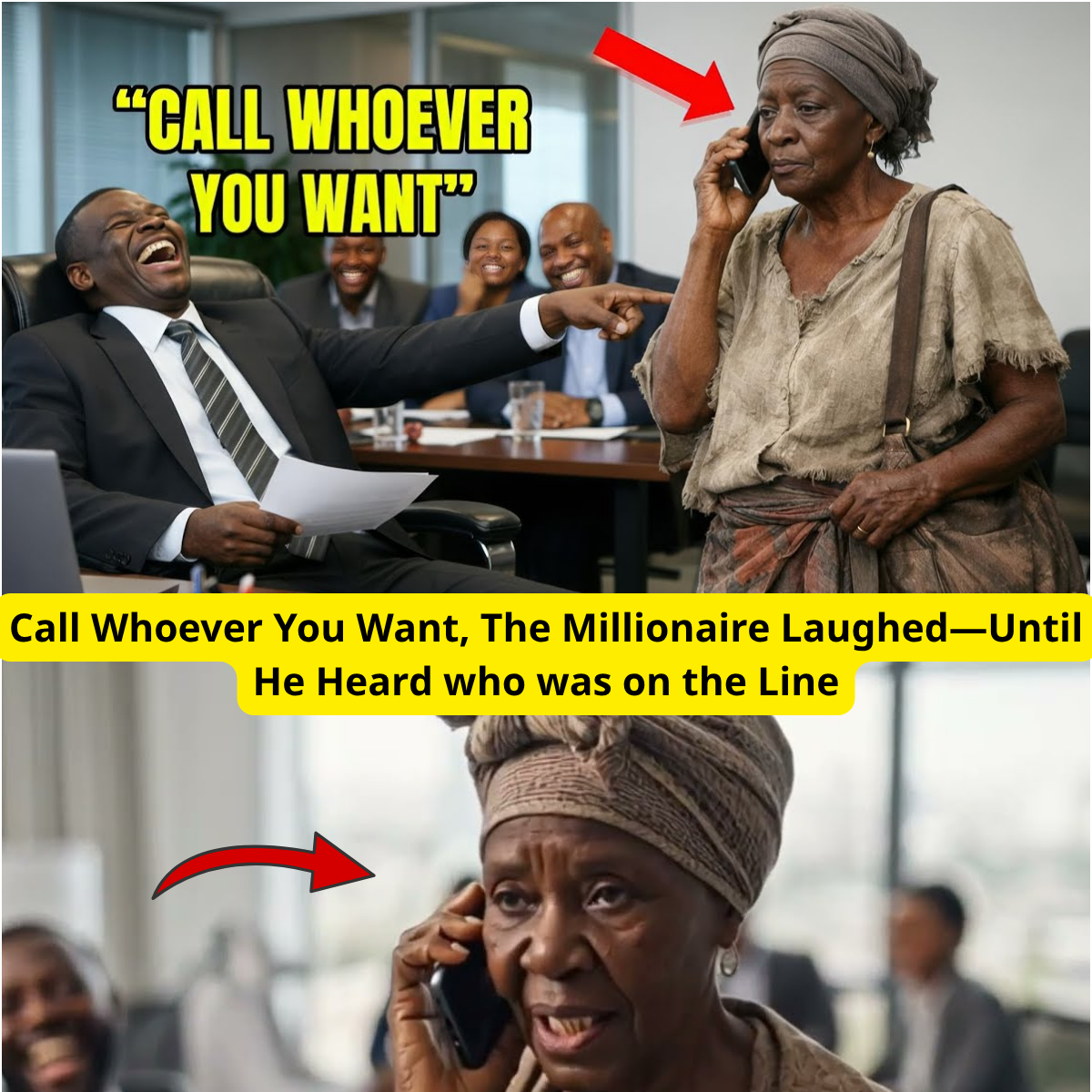
Call Whoever You Want, The Millionaire Laughed—Until He Heard who was on the Line
Call Whoever You Want, The Millionaire Laughed—Until He Heard who was on the Line
The boardroom of Blake International sat on the forty-second floor, a sweeping expanse of polished mahogany and floor-to-ceiling glass that looked out over the sprawling Chicago skyline. It was the kind of room specifically engineered to make ordinary people feel small. Every piece of furniture, from the Italian leather chairs to the minimalist light fixtures, practically screamed wealth, leverage, and institutional power. The people who filled the room carried themselves with the practiced ease of those who belonged there. They wore sharp, bespoke suits, checked their multi-thousand-dollar watches, and spoke in the hushed, urgent tones of high-stakes corporate warfare.
Everyone, that is, except for the elderly woman sitting near the far end of the long table.
She sat in the second-to-last chair, completely detached from the nervous energy vibrating through the room. She had no slim leather briefcase, no state-of-the-art laptop, and no expensive designer blazer. Instead, she wore a simple, faded floral dress, its cotton collar slightly worn from years of careful washing. On the table before her sat a canvas handbag—the utilitarian kind one would expect to see at a neighborhood farmer’s market or a local grocery store, not resting on a pristine, custom-varnished corporate table.
She sat with her hands folded quietly in her lap, watching the room with calm, incredibly steady gray eyes. Nobody greeted her when she walked in. Nobody asked for her name. In fact, as the executives shuffled in and out, adjusting their ties and opening their tablets, nobody looked at her twice. To them, she was an anomaly, a ghost, or perhaps someone’s grandmother who had wandered onto the wrong floor looking for the restroom. She was entirely invisible.
At exactly 8:20 a.m.—precisely twenty minutes late—Marcus Blake arrived.
He did not apologize for his tardiness. Men like Marcus Blake never apologized for keeping people waiting. In his world, showing up late wasn’t a mistake; it was a tactical display of dominance. They made the entire room hold its breath and called it “presence.” At forty-four years old, Marcus was the absolute golden boy of Midwestern private equity. He moved through the corporate suite like he already owned the air everyone else was breathing. And in his mind, within about two hours, he actually would.
The agenda for the morning was straightforward, almost routine for a man of his ambition. Blake Industries was completing the final stages of acquiring Cridge and Partners, a mid-sized logistics and distribution firm that had been operating quietly, efficiently, and incredibly profitably for over three decades. The original founder, Arthur Cridge, had passed away two years prior, and the company had been running on the sheer momentum of its pristine legacy ever since. Marcus had been circling the company like a hawk for nearly six months, identifying it as the perfect asset to strip down, consolidate, and absorb into his growing empire. Today was the day he would legally close the deal.
Marcus marched to the head of the table, threw his premium leather folio down, and slid into his high-backed chair. He smiled the razor-sharp smile of a man who had already won the war before the first shot was even fired. He looked down the line of his legal team, and his lead attorney, a slick, expensive man named Harrison, leaned close to whisper in his ear.
“All principal parties are present, Marcus. We are clear to begin the final signing sequence.”
Marcus scanned the room with immense satisfaction, his eyes sweeping from face to face, soaking in the compliance of the Cridge and Partners board members who had already been bought and paid for. But then, his gaze abruptly stalled. His eyes landed on the old woman sitting silently at the far end of the mahogany table.
Marcus frowned slightly, the smooth lines of his forehead creasing in irritation. He leaned over toward his personal assistant, who was prepping his tablet.
“Who is that woman at the end of the table?” Marcus whispered, his tone sharp. “Is she with the cleaning staff? Why is she sitting in a shareholder seat?”
The assistant glanced down the table, blinked in surprise, and shrugged quietly. “I’m honestly not sure, sir. She was already sitting there when the doors opened at seven-thirty. I assumed she was a guest of one of the minority board members.”
Marcus stared at the elderly woman for a moment longer. She didn’t flinch under his gaze. She didn’t even notice him staring—or if she did, she simply didn’t care. That bothered him more than he could reasonably explain. In Marcus’s universe, everyone noticed him. Everyone reacted to him. This woman’s absolute stillness felt like a quiet defiance.
“Let’s get this moving,” Marcus snapped, dismissing the distraction. “We have a hard stop at ten.”
The meeting commenced. The air in the room filled with the rhythmic click of keyboards and the rustle of high-grade paper. Documents were circulated, digital slides were flashed on the massive wall monitors, and columns of complex financial figures were presented. Everything was moving exactly according to the meticulous script Marcus Blake had spent four months writing. He could already feel the thrill of the conquest.
It wasn’t until Harrison, his lead attorney, reached the standard shareholder verification section of the contract that the smooth machinery of the acquisition hit a sudden, unexpected snag.
“Before we proceed to the final binding signatures,” Harrison announced, adjusting his glasses and looking over his documents, “corporate protocol requires us to formally confirm full shareholder representation in this room. We need to verify that all voting blocks are accounted for.”
A heavy, uncomfortable silence descended on the room. Across the table, one of the senior board members of Cridge and Partners—a man named Vance, who had been sweating through his collar the entire morning—shifted uneasily in his leather chair.
“There, uh… there may be one outstanding matter regarding the total voting allocation,” Vance stammered, keeping his eyes firmly glued to his legal pad.
Marcus looked up sharply, his pen freezing mid-air. The triumphant smile vanished from his lips. “What outstanding matter, Vance? We cleared the minority blocks weeks ago. Every single seat at this table has already signed the pre-intent forms.”
Vance hesitated, his eyes darting nervously toward the far end of the room.
And in that precise pocket of agonizing hesitation, the old woman at the end of the table spoke for the very first time.
“The outstanding matter,” Patricia Cole said calmly, “is me.”
Her voice was remarkably soft. It wasn’t weak, tremulous, or frail. It possessed a quiet, crystalline clarity that sliced straight through the ambient hum of the forty-second floor.
The entire boardroom went completely, utterly quiet. The sudden absence of sound was deafening.
Marcus Blake looked down the length of the table at her, staring as if she had just spoken in a foreign language. He looked at her faded dress, her canvas bag, and the complete lack of corporate armor on her persona. Then, Marcus did something that would actively haunt him for the rest of his professional life.
He laughed.
It was a loud, boisterous, mocking laugh, designed to completely diminish her presence and restore his absolute control over the room.
“I’m sorry, sweetheart,” Marcus said, his voice dripping with condescension, loud enough for every executive and assistant to hear. “But I don’t know who let you past security, or what exactly you think this meeting is about.” He raised his hand and gestured casually, almost dismissively, toward the double glass doors of the boardroom. “This is a multi-million-dollar corporate acquisition. These are serious people handling incredibly serious, highly confidential business. We don’t have time for tourists.”
He picked up his gold-plated fountain pen and looked back down at his documents, completely dismissing her existence.
“So, if you feel a bit lost—and clearly you are—you are welcome to call whoever you want,” Marcus chuckled, a cruel edge tracing his words. “Call your family, call a taxi driver, call whoever you need to get you home. But you need to vacate this room immediately.”
A few of the younger associates at the table looked away, shifting uncomfortably in their seats, embarrassed by the raw cruelty of the display. But nobody spoke up. Nobody dared contradict Marcus Blake.
Patricia Cole did not flinch. She did not frown, she did not blush, and she certainly did not raise her voice. Her expression remained as steady as a mountain lake. Slowly, with an agonizingly deliberate calm, she reached her hand into her worn canvas handbag. She bypassed a set of keys and a small grocery ledger, pulling out a remarkably sleek, unblemished smartphone.
She placed a call without blinking, her eyes locked directly on Marcus Blake’s face.
And the very moment the person on the other end of the line picked up, the atmosphere in the room shifted entirely.
“Yes,” Patricia said quietly into the receiver, her voice completely untroubled. “Bring them up now, please. All of them. I need the original shareholder certificates, the founding corporate trust documents, and the verified transfer records from the winter of 1993.”
She paused, listening intently to the voice on the other end.
“Yes, that’s correct. Floor forty-two. Main executive boardroom. I’ll be right here waiting.”
She ended the call, turned the phone over, and placed it face down on the polished mahogany table with a soft, definitive click. Then, she folded her spotted hands back over her lap, leaned back slightly, and waited.
Marcus Blake had stopped smiling.
The change wasn’t dramatic, and it didn’t happen all at once. It occurred the way a roaring fire goes out when the oxygen is slowly, systematically sucked from a room. Gradually, quietly, completely, the color began to drain from Marcus’s face. A cold, creeping dread took its place.
He looked over at Harrison, his lead attorney. Harrison was frantically scrolling through a database on his tablet, his brow furrowed in sudden panic. Marcus then looked across the table at Vance, the sweating board member. Vance wouldn’t look back; he was staring intently at his own hands as if they were the most fascinating things in the world.
In fact, within a matter of seconds, nobody in the room would make eye contact with Marcus Blake. That was the very first sign of a corporate execution. When powerful people suddenly refuse to look at you, it means the ship is already sinking, and they are preparing to swim.
“Harrison,” Marcus hissed, his voice still controlled but vibrating with an undercurrent of raw fury. “What documents is she talking about? What is going on here?”
Harrison swallowed hard, his fingers trembling slightly against the glass screen of his tablet. He leaned in close to Marcus, his voice a frantic whisper. “Marcus… we might have an issue. The founding paperwork for Cridge and Partners listed a blind asset trust created in 1993. We were assured by management that the trust had been dissolved and the shares absorbed by the board. But… the digital registry is failing to load the verification code.”
Vance finally cleared his throat, his voice cracking under the immense strain. “Sir… there is a legal matter we perhaps should have addressed more thoroughly prior to scheduling today’s final signing.”
“What matter?” Marcus barked, his composure fracturing.
The silence stretched across the table like a piano wire pulled to the absolute breaking point. Nobody breathed.
And then, the heavy double doors of the boardroom swung open.
A young, sharply dressed legal officer from an independent, white-glove compliance firm walked into the room. He carried a thick, sealed vault envelope made of heavy brown paper, stamped with official state notary seals. He didn’t look at Marcus Blake. He didn’t look at the attorneys. He scanned the room once, walked directly to the far end of the table, and placed the envelope squarely in front of Patricia Cole. He bowed his head respectfully, turned on his heel, and exited the room without saying a single word.
The room watched in absolute, paralyzed silence as Patricia opened the envelope with steady, unhurried hands. She removed a stack of thick, cream-colored parchment documents—papers that carried the distinct weight of historical authority. She reviewed them briefly, her eyes softening as she looked at a signature at the bottom of the page. Then, she slid the documents forward, straight down the center of the polished mahogany table.
“Cridge and Partners was founded by my late husband, Arthur,” Patricia said, her voice soft, certain, and utterly undeniable. “He built this enterprise over thirty-one years of hard, honest labor. When he passed away two years ago, the controlling ownership of the founding trust automatically transferred directly to me. I hold sixty-three percent of the total voting shares.”
The number landed in the room like a massive boulder dropped into perfectly still water.
Sixty-three percent.
The realization hit Marcus Blake like a physical blow to the chest. Sixty-three percent meant that every single negotiation he had forced over the last four months, every board member he had bullied, every concession he had wrestled away, and every document he was preparing to sign today was completely, totally worthless. He owned nothing in this room. He had never owned anything in this room.
The foundation he had spent millions of dollars building his acquisition strategy upon didn’t belong to him. It belonged to the woman sitting in the faded dress. The acquisition was legally invalid. The deal was dead.
And the elderly woman he had laughed at, mocked, and condescendingly called “sweetheart” in front of twenty high-level corporate witnesses was, in reality, the single most powerful person in the entire building.
Marcus opened his mouth to speak. His throat felt incredibly dry. He closed it, blinked rapidly, and opened it again. No sound came out. For the first time in a very long, aggressive career defined by filling every room with the booming authority of his own voice, Marcus Blake had absolutely nothing to say. The silence of the room suffocated him.
Patricia Cole gathered her original parchment documents with quiet, methodical hands, placing them neatly back into the brown envelope. She didn’t gloat. She didn’t look at Marcus with a smirk of triumph. She simply looked at the board members of Cridge and Partners one by one, her gaze lingering on Vance until the man lowered his head in shame.
Then, she addressed the entire room, her voice carrying the same soft, absolute certainty she had possessed from the moment she walked through the door.
“This company will not be sold to Blake Industries,” Patricia stated. “It will not be broken apart, it will not be liquidated, and its workers will not be laid off for the sake of a quarterly profit margin. This company was built on a promise of service and integrity, and it will be protected. That is exactly what my husband built it for, and that is exactly what it will remain.”
Slowly, she stood up from her leather chair. She adjusted the strap of her worn canvas handbag, looping it carefully over her arm. She turned and began the long walk toward the boardroom doors.
Just before she reached the exit, she paused briefly. She didn’t turn around to look back at Marcus Blake, who was still frozen at the head of the table, his face a mask of ruined ambition.
“Appearances,” Patricia said quietly, almost to herself, “have never once told the whole truth of a soul.”
Then, she walked out, the heavy glass doors clicking shut smoothly behind her.
The boardroom remained locked in absolute, stunned silence long after the echo of her footsteps vanished down the hallway. Because some of the most important lessons in life don’t need to be shouted. In fact, the ones that change you down to your very core never are.
Marcus Blake sat in the wreckage of his multi-million-dollar deal, finally understanding the heavy cost of his own arrogance. It was a lesson written in a faded dress and a canvas bag: never, under any circumstances, measure a person’s true power by the price of their clothes. What someone carries on the inside has never once shown up on the outside. Arrogance is never true strength; it is just a temporary noise that hasn’t been corrected by the truth yet. And the quietest people in the room are rarely the weak ones—they are simply the ones who have learned that the absolute right moment to speak is always worth waiting for.