The Forgotten Marian Apparition Behind a Powerful Devotion
By the winter of 1876, this woman was supposed to be dead already.
A doctor had examined her earlier that day and told her parents there was nothing more anyone could do.
She didn’t eat any food and she was weak.
It was just after midnight when she opened her eyes and saw a figure standing at the end of her bed.
The figure was just standing there in the dark looking straight at her.
Its face is disturbing and its eyes are full of hate.

She’s too weak to move, so she just stares back at it.
And then she understands what she’s looking at.
It’s the devil.
That is when she sees something else.
A second figure standing on the other side of the bed.
It’s a woman in white.
The devil takes one look at that woman and he runs out.
He fades into the dark.
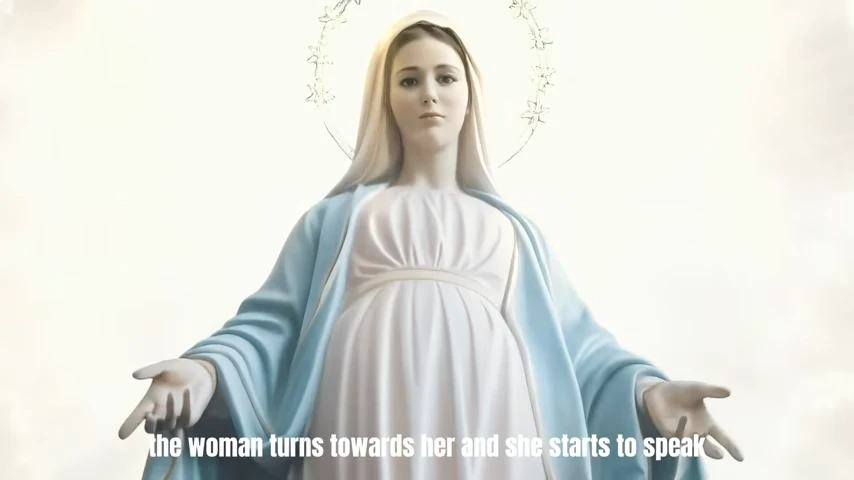
The woman turns towards her and she starts to speak.
And what she says to her over the next five nights will end with that dying woman sitting up in bed eating again and being completely healed.
And it will end with millions of Catholics wearing a small piece of cloth over their heart that nobody had ever heard of before.
Okay.
So before we start the story, let’s look at her medical records together so we know what we’re dealing with here.
Her name was Estella Faget and she had three diseases at the same time.
She had pulmonary tuberculosis.
That alone killed about 1 in seven people in the 19th century.
There was no cure or treatment they could offer.
So if you got it, you died slowly over the next few months or maybe years if you were lucky.
She has acute peronitis, an infection of the lining of her abdomomen.
In 1876, there are no antibiotics and there’s no surgery option and paratonitis kills within days and she had a tumor about the size of an orange on her left side.
On February 10th, 1876, a doctor named Bernard traveled from a nearby town called Buzz to examine her.
He looked at the tumor and he turned to her parents and he told them she had four or maybe 5 hours to live.
But she did not die in 4 hours.
She did not even die that day.
So let me take you back to who this woman actually was and how she actually ended up in that bed.
It started in a tiny village in the Champa region of northern France called St
Mei.
It is just outside the city of Shalons Mala, real flat country with vineyards and wheat fields.
Estella was born there on September 12th, 1843 in a poor family.
Since she was a little girl, she told everyone around her she wanted to be in a convent and become a nun.
She even told the village priest.
But as you may know, convents in the 19th century usually did not accept women who could not afford it.
So she had to wait.
In 1857, her father gave up on St
Mei and he moved the family to Paris, hoping to find work and a better future for his family.
Estella was 14 at the time.
They settled in a poor neighborhood and she found work at the local laundry, which was hard work.
A year later, she became seriously ill.
Years of exhaustion and barely having enough to eat had worn her body down.
Her parents brought her to the Sharite Hospice, a hospital in Paris that cared for the poor.
She survived.
At the hospital, she met nuns who cared for the sick.
Augustinian sisters dressed in white.
In 1860, when she was 17 years old, she told a parish priest, Father Leur, that she wanted to join the Augustinian sisters at Hotel J in Paris.
the nursing order that served in the oldest hospital in France.
Father Leur knew the order would never take her in because they required a payment.
Estella and her family still did not have that kind of money.
But he had been watching her.
He had been listening to her since she was a teenager and he was convinced she was meant for that life.
So he did something he was not supposed to do.
He paid the required fee himself in secret out of his own pocket and he never told her or her family about any of this.
On September 15, 1860, Estella Faget walked through the doors of Hotel Dio de Pararei wearing the Postelin’s robe about to start the life she had been dreaming of since she was a kid.
But what she did not know yet was that within 3 years she would lose all of it.
For 3 years, Estella was happy.
She prayed with the other sisters.
She trained as a nursing sister at the oldest hospital in France.
And then one day she fell.
She was hurrying to get ready for the evening meal at the convent.
That night she had been chosen to read while the other sisters ate.
She ran upstairs to grab her apron.
And on the way back down she slipped.
She fell down several stone steps and she twisted her knee.
At first, she told nobody, mostly because she was embarrassed.
She kept working, kept helping patients, tried to ignore the pain.
But a few days later, her knee swelled up badly and eventually she could not walk anymore.
The convent sent her a famous Paris surgeon named Valpo.
He prescribed absolute rest.
He put her knee in a brace for weeks, but it did not work.
When they took the brace off, Valpo told her the truth.
The knee was incurable.
The damage was permanent.
She would walk with this injury for the rest of her life.
A nursing sister has to be on her feet for 12 hours a day and do hard physical labor.
Estella could not do any of that anymore, so they told her she had to leave.
She packed her things, returned to Postelin’s robe.
She walked out of Hotel J and moved back in with her parents in her poor Paris apartment.
She was around 20 years old.
Her dream was gone and she needed work.
In 1865, she got a chance.
Somebody connected her to a Parisian family looking for a dress maker.
That family belonged to one of the oldest aristocratic families in France and they were very wealthy.
Estella showed up for the interview and she was hired on the spot.
She started as a dress maker because that kind of work was possible for her knee.
But within months it was clear she was good at more than that.
So she got promoted first to chambermaid then to nursemaid taking care of the family’s children.
And this was not the hard physical labor of of nursing the sick.
This was a wealthy family’s nursery.
For the next 10 years this was Estella’s life.
The family had a house in Paris and they also had a country estate in central France in the small village of Pelvois.
Estella followed them everywhere.
Paris in the winter, Pelois in the summer.
She also brought her parents to live near her.
Her father had never found steady work.
Her younger sister Augustine needed support.
And when her older sister died, she became the financial support for her entire family.
Years passed like this.
Estella was now 32 years old, but in June of 1875, this whole steady life she built started to fall apart.
She had an old case of peronitis from years earlier.
She had recovered from that one with the help of the family who had access to good doctors at the time, but this time it was different.
This time her peronitis came back chronic.
And while it was sitting in her abdominant, it went tubercular.
It spread through her stomach to her lungs and she started coughing on blood and she could barely keep any food down anymore.
The family sent her to Paris to a private clinic run by the Augustinis.
The doctor there was a famous professor from the Paris faculty of medicine.
His name was Buka and Buka tried different treatments but unfortunately nothing helped.
On August 29th, 1875, Professor Bqua gave his official opinion.
In his eyes, there was nothing more that could be done for Estelle.
He told the noble woman caring for her that he had run out of options and the best thing now, he said, was to send her back to the countryside, back to the small village of Pelleforce, where she could spend her final months.
As Stella kept getting worse, another doctor was brought in.
A man named Dr.
Bernard from a nearby town.
And after examining her, he came to the same conclusion.
She was dying.
By that point, Estella had been isolated in that room inside the house.
The noble woman feared the tuberculosis could maybe spread to the rest of the house.
So most days, Estella lay there all alone in pain and barely able to move.
And what worried her most was not even her own death.
It was her parents.
Her mother had been growing older and Estella was the only one who had some money to take care of them.
If she died, they would have nothing left.
And that is when she wrote a letter that eventually became pretty famous.
In early September 1875 from her sick bed, Estella picked up a pen and she wrote to the Virgin Mary.
The letter has been preserved.
We can read it today in her official own handwriting.
It opens with these words.
Oh my good mother, here I am once again.
Prostrate at your feet.
You cannot refuse to hear me.
You have not forgotten that I am your daughter and that I love you.
She tells Mary about her parents, about how they have no one else.
She asks Mary not for healing, but for enough strength to keep working so her parents will not have to beg for food.
See the pain of my parents.
You know that I am their sole support.
May I not complete the work begun by me? If because of my sins, a complete cure cannot be granted, obtain for me at least a little strength to be able to support my parents.
You see my good mother, they are on the point of being obliged to beg for their bread.
Then she finishes the letter.
She folds it up and she gives it to a woman named Madame Wasel Reer, one of the tutors who taught the children.
Estella asked her to do something very specific.
In the park outside the house, the family had built a small grotto, a quiet little shrine modeled after the famous grotto of Lords with a statue of the Virgin Mary inside.
It was meant to be a private place of prayer for the family.
So she handed that letter to that woman and she asked to place it at the feet of the statue and then to simply leave it there.
So she did what she asked.
3 months later, on December 18th, 1875, Estella took a sudden turn for the worse.
A priest was called to her bedside to give her the last rights, the final sacrament Catholics receive when death seems close.
Estella was only 32 years old, and by then she had spent months of suffering, barely eating, and everyone around her believed she was dying.
But somehow she survived the night.
And after that, the family she stayed at decided to move her out of the house.
So Estella was taken to a small house in the village of Pel of near the parish church and near the cemetery where many assumed she would soon be buried.
Her parents were allowed to stay with her.
And then the strange part began.
Weeks passed and Estella was not dying.
On February 10th, 1876, a doctor was called to her bedside.
He looked at the tumor and the doctor believed Estella only had a few more hours to live.
But the hours passed and Estella did not die.
She survived.
By February 14th, 1876, she was still lying in that same bed, barely able to move.
Just after midnight, she opened her eyes and according to Estelle, that was the moment the devil entered the room.
Most apparition stories start with Mary appearing.
This one does not.
This one starts with the devil.
She would later describe it like this.
In her own words, she saw at the foot of her bed the grimmencing face of the devil.
She froze.
She could not call for her parents.
She could not even move.
In the other corner of the room, something else appeared.
A woman in white.
Mary saw the devil, and she did not run.
She did not even seem afraid.
She turned to him and spoke first.
in a sharp voice.
The exact words are documented.
What are you doing here? Don’t you see that she wears my livery and that of my son? When Mary says Estelle wears her livery, she means something very specific.
Estella had been enrolled as a child of Mary at the age of 14.
and she wore a miraculous medal around her neck.
The medal from the 1830 apparitions in Paris, the first of the great French marine apparitions to Katherine Labour at Rudubak.
That medal was Mary’s livery, her uniform, her sign on Estelle.
And when Mary asks the devil, don’t you see that she wears my livery? She’s telling him that this girl is not his to take.
The devil disappeared.
In Estella’s own words, he vanished.
Mary turned to Estelle and started to speak.
The voice was gentle.
Estella would later say she had never heard anything so soft.
Mary said, “Fear nothing.
You know well that you are my daughter.
Take courage.
Be patient.
My son will let himself be moved.
You will suffer five more days in honor of the five wounds of my son.
On Saturday, you will be dead or healed.
If my son gives you back your life, I want you to publish my glory.
Five days, five wounds of Christ.
Saturday, dead or healed.
The terms were set.
And then something appeared between Mary and Estelle.
A flat marble plaque.
Estella recognized what it was immediately.
It was an ex photo, a devotional plaque that Catholics put up in churches to thank Mary for a miracle.
Old French churches were covered in these.
thousands of them engraved with names, dates, or with short messages of gratitude, for example.
Estella understood Mary wanted her to make one to thank her publicly.
After the healing, she asked Mary a practical question.
Where should it go? She started to list the places she knew.
At Pelva, Mary cut her off before she could finish the word pelvet.
And the answer Mary gave is one of the most quoted lines of the entire apparition because it shows something about how Mary works.
At NRA de Victtoire, they have plenty of marks of my power.
Whereas at Pelovasan, there’s nothing.
They need stimulation.
Notradam de Victtoir was the most famous marine basilica in Paris built by King Louis I 13 in 1629.
It was covered in 37,000 exphotos.
The biggest marine shrine in the 19th century France, Belosan was a village of maybe a thousand people and nobody had heard of it.
There was nothing there and that is exactly why Mary was choosing it.
Estella had promised to do everything in her power.
Mary smiled and said, “Courage, but I want you to keep your promise.
” Then she was gone.
The next morning, Estella told her parish priest, a man named Abas Mo, the priest of the small Pelvos parish, she gave him the whole story.
He did not know what to think.
But he was about to spend the next 46 years of his life as a keeper of the story.
He would die in 1922, and his last act would be to confirm in his will that he believed every word of it.
The first night was over, but there would be 14 more.
On Tuesday, February 15th, the second night, the devil came back to the foot of Estella’s bed.
This time, he did not stay for long.
Mary appeared in the corner of the bed almost immediately.
She looked at Estelle and said, “Don’t be afraid.
I am here.
This time, my son has let himself be moved.
He gives you back your life.
You will be healed on Saturday.
” She kept talking about what she meant by life, about what it meant to be alive.
What more precious thing has he given to man on earth than life? By giving you back your life, do not think you will be free from sufferings.
You will suffer and you will not be free from pains.
That is what makes life worthwhile.
Then Mary said something Estelle was not expecting.
Now let us look at the past and Mary did exactly that.
Reportedly, she showed Estelle her whole own life, the sins and the places where Estella had failed.
Estella would later refuse to say what specifically Mary showed her.
She only said this in her own account.
I keep silent on what the holy virgin told me.
I will only say that she made grave reproaches that I had welld deserved.
When the review was over, Mary looked at her with kindness and disappeared.
Estella lay there heartbroken.
She thought about every mistake she had made, and she became sure she had disappointed the only person who had come to help her.
On Wednesday night, Mary came back.
The devil was there again, further away this time.
But this time, Mary sounded different.
Come now, take courage, my child.
She gave gentle reproaches, but softer than the night before.
Mary said something that would echo for the rest of Estella’s life.
All this is in the past.
By a resignation, you have made up for these faults.
Mary showed her good deeds, the visits to the sick, the work in the village, and the way she had taken care of her parents.
They felt like nothing compared to her sins.
I am all merciful and mistress of my son.
That phrase, I am merciful, would later become the official title of Notradam the Pelfor.
These few good deeds and fervent prayers you sent to me have touched my motherly heart among others.
This little letter you wrote to me in September.
What touched me most was this sentence.
Mary then quoted the exact words back to Estelle.
From the letter she had written 6 months earlier.
See the pain of my parents.
If I were to fail them, they are about to beg for their bread.
I showed this letter to my son.
Your parents need you in the future.
Try to be faithful.
Do not lose the graces given to you and publish my glory.
The fourth night was shorter.
Mary appeared, but she did not stay long.
Mary kept repeating one phrase as she was leaving.
You will publish my glory.
Estella finally tried to ask how.
How could she publish anything? She was very poor.
Mary was already disappearing.
She called back as she went.
Friday, February 18th, 1876.
Mary had said on the first apparition that Estelle would be dead or healed by Saturday.
Saturday starts at midnight, just hours away.
Now, her parents have gone to sleep in the next room, and around midnight, Mary appears one more time.
This time, she does not appear in the corner of the room.
She walks right through the curtains, closer than she was ever before.
She talks about holy communion.
What afflicts me most is the lack of respect we have for my son in holy communion and the attitude of prayer we take when the mind is occupied with other things.
Then she pauses and she adds, I say this to people who claim to be pious.
So Mary is not complaining about people who do not believe in her son, but she is more so complaining about people who claim they do.
People who go to mass every Sunday.
People who pray the rosary and think of themselves as good Catholics and then receive the body of Christ while their minds are somewhere else.
The white marble plaque returns.
The same one from the first apparition.
It’s now hovering between Mary and the stell.
But this time it was changed.
A golden rose bud in each of the four corners.
a flaming heart of gold at the top, crowned with roses, pierced through with a sword, and cut into the marble in gold letters.
And the text Mary wants Estella to publish is, I invoked Mary at the height of my misery.
She obtained for me from her son my complete healing.
Estella asks her a question.
Can she tell people what happened? Mary answered carefully with a warning.
Yes.
But before speaking of it, you will wait for the opinion of your confessor and director.
You will face pitfalls.
You will be called a visionary.
Pay no attention to all of this.
Be faithful to me and I will help you.
So Mary is preparing her because she knows the mockery is coming.
Then Mary gives Estella her last instruction of that night.
If you want to serve me, be simple and let your actions match your words.
One can be saved in any state of life.
You can do much good and publish my glory.
Be simple.
That sentence will be carved on Estella’s tombstone 53 years later.
Mary is gone.
And around 12:30 in the morning, Estella felt all her pain disappear.
A few minutes earlier, she had been so close to death that her family thought it was already over.
And now it was the complete opposite.
She felt a powerful energy run through her body.
She checked her right arm.
She could not move it.
But Mary had said her cure would happen at communion.
So Estella waited.
Around 6:00 in the morning, the parish priest, Aba Salmon, came to the house.
Estella had told him about the apparitions the day before, so he already knew what to expect.
He was going to say mass and bring her holy communion.
He believed she would be able to use her right hand to make the sign of the cross at that communion.
And that is exactly how it happened.
When Estella received the Eucharist, her right arm came back.
She lifted it and made the sign of the cross.
By morning, the village was already talking.
The same Dr.
Bernard who had walked out 9 days earlier and told her she was going to die, was called back.
He checked, but the tumor was gone and her lungs were clear.
He could not find any trace of the diseases that had been killing her.
He had been treating her for years, and he had been the one who declared her case hopeless back in December.
And now he was looking at a woman who should have been in a cemetery, eating and breathing normally, like she was never sick.
Another doctor named Hubert, who also examined her, said it could not be explained by natural laws.
From that morning forward, Estella was cured completely, and she never had a relapse.
Within days, she was back at work for the family nursery.
But Mary was not done with Estelle yet.
There would be 10 more apparitions that year.
The first came on July 1st.
Almost 5 months had passed.
The priest had already written down her account of the first nights in her own words.
So, she began telling people what she had experienced.
When Mary appeared again on July 1st, the tone had changed.
She was no longer speaking to Estelle as someone close to death.
Now she seemed to be asking something from her.
The apparitions did not happen all at once.
They came in small groups.
Three in early July, then three more in September and another three in November.
And then one final apparition on December 8th.
It’s the exact date of the feast of the Immaculate Conception.
And during all of these encounters, Estella kept noticing something unusual.
Mary was wearing a small square piece of white cloth over her chest.
Estella could see it clearly every time, but she had no idea what it meant.
Then during the 9th apparition on September 9th, Mary finally explained it.
Estella had actually been expecting an apparition weeks earlier on August 15th, the feast of the assumption, but nothing happened.
And when Mary appeared again in September, she addressed it directly.
According to Estelle, Mary told her she had not been calm enough.
Then she added something surprisingly human.
She told Estella she had the character of a Frenchman.
That’s a quote.
wanting to understand everything immediately and wanting answers before learning patience.
Then Mary lifted the small white cloth she had been wearing over her chest.
Underneath it, Estella saw a red heart.
And according to Estelle, Mary said, “I love this devotion.
” Then after a short pause, she added, “It is here that I will be honored.
” The object Mary was showing her became known as the scapular of the sacred heart.
A small devotional cloth worn over the chest with the image of the sacred heart of Jesus on it.
Devotion to the sacred heart itself was already well known in the Catholic world because two centuries earlier St
Margaret Mary Alakok had reported visions centered around the sacred heart of Jesus.
But this specific scapular was something new.
and Estella believed Mary was asking her to help spread it.
More apparitions followed that November.
By November 11th, Estella had already started suing her own version of the scapular by hand.
And during the apparition that night, Mary looked at it and simply said, “You have been working for me.
” The final apparition came on December 8th, 1876 on the feast of the Immaculate Conception.
That evening after a high mass, Estella said Mary appeared to her one last time.
16 people were inside the room that night, including two priests.
And Estella later said, “Mary had never appeared more beautiful than she did then.
” She described her surrounded by a garland of roses.
And Mary said, “My daughter, remember my words.
” In that moment, every single thing Mary had told her over the past 10 months came back into her mind at once.
Mary told her, “Repeat them often.
May they strengthen you and console you in your trials.
You will not see me again.
” Estella asked, “What will I become without you, my good mother?” Mary answered, “I will not leave you.
I will be invisibly close to you.
” And then she gave Estella one final instruction.
She told her to go in person to the bishop, present the scapular, and asked him to help spread the word about it.
She said nothing would please her more than to see her children wearing this scapular, working to repair the offenses her son received in the Eucharist.
As she said this, Mary stretched out her hand, and drops fell from them.
In each drop, Estella could read written words.
Piety, salvation, trust, conversion, health.
Mary said, “These graces are from my son.
I take them from his heart.
He cannot refuse me.
” And then she was gone.
And that was the last time Estella saw her.
She was 33 years old.
And she would live for another 53 years until 1929.
So what she had to do next was spread the scapular and that turned out to be harder than the apparitions themselves.
The counts of the family became jealous because she felt that the apparitions belonged to her family because they had happened on or near her property.
She wanted control of the story.
She wanted Estella to step aside.
But Estella refused.
The countest used her political connections.
She approached a Republican bishop who was hostile to apparitions and he was more than happy to help discredit this whole story.
And also a dark rumor started spreading claiming that her illness had actually been a hidden pregnancy and that her healing was just the result of her giving birth in secret.
The rumor was completely false.
The medical records, the doctors, the testimonies, and the parish archives all prove the opposite.
The counts realized she had gone too far.
She authorized pilgrims to gather in the private park next to the house.
That technically kept the pilgrimage alive while the official sanctuary was shut.
Through all of this, Estella never defended herself publicly.
She kept the promise Mary had made to her in February of 1876.
The promise that she would be called a visionary, mad, and that she should pay no attention to any of this.
So back in 1877, just a year after the apparitions ended, Pope Pius I 9th approved a confraternity in honor of the Notraam de Pasan.
That was the first official Vatican gesture.
Years later in 1894, that confraternity got raised to honorary arch confraternity and then again in 1896 its status got raised to effective.
In January of 1900, Estella herself traveled to Rome.
She was 56 years old by this point, and Pope Leo the 13th received her in the private audience on January 30, 1900.
Estella showed him the scapular she had been suing copies of for almost 24 years.
The Vatican issued an official decree approving the scapular of the Sacred Heart.
It had taken almost a quarter century, but what Mary asked Estella to do in that little bedroom in 1876 was finally approved by the Roman Catholic Church.
After all that, Estella went back to her life.
She kept working for the family nursery and she kept suing scapulars by hand and sending them out to people who want them.
107 years later, September 8th, 1983, Archbishop Paul of Burgus issued an official declaration, after a long medical and theological investigation.
He formally recognized Estella’s healing as inexplicable to medical science.
He said her cure could rightly be regarded as a miracle by Catholics.
So, the healing itself was now officially a miracle of the Catholic Church.
The apparitions though were a different matter.
They had never been formally approved.
The church had blessed the scapular, blessed the devotion, but never officially declared what happened in that small bedroom.
That changed in August of 2024.
The Vatican issued a nihil obstat for the devotion of our lady of pivas.
In Catholic language, that opens the door to possible full recognition of the apparitions themselves.
After 148 years of waiting, now the life of Estella was coming to an end.
At the age of 80, she was finally admitted into the Dominican Third Order.
She took a religious name, Sister Margarite Marie.
She wasn’t officially named after St
Margaret Mary Alakok, the nun who had received the original sacred heart 2 and a half centuries earlier, but it looks quite similar to me.
She died on August 23, 1929 at the age of 86.
According to the priest who was with her in those last days, she had not spoken in several days.
The priest leaned over her and asked her if she was happy she was going to see the blessed virgin Mary again.
And with all the strength she had left, she stretched her hands out towards a statue of Mary in the room and said, “Oh yes, certainly.
” Those were her last words.
She was buried in the cemetery at Pel of May she rest in peace.
May God bless you and thank you so much for all the support on the channel.
See you in the next video.