The Life of Jesus Like You’ve Never Seen Before
It’s 5 BC and Jesus is coming into the world in a small town called Bethlehem in ancient Israel.
You probably think you know this story, but it isn’t the way you’ve heard it.
This is Jesus’ life on a map.
We’re going to trace every step of his ministry all the way to his final journey to the cross, but also where he appeared after the resurrection and where Jesus was seen for the last time.
It’s 5 BC.
The people of Israel were crushed under Rome’s iron fist.

They had not heard God’s voice for 400 years.
But they kept waiting for a sign, clinging to the faith that one day the Messiah would come to free them from slavery.
The world doesn’t know it yet, but history is about to split in two.
A teenage girl, 9 months pregnant, has spent 4 days walking from Nazareth to Bethlehem, 90 mi.
Mary shouldn’t have made this journey.
It was far too dangerous in her condition.
But Roman Emperor Caesar Augustus had ordered a mandatory census.
And Joseph, her husband, who was a descendant of King David, had to register in his ancestral city, Bethlehem.
And so the prophecy was fulfilled.
When they arrived exhausted in the small village, the contractions began.
Mary was in labor.
Joseph knocked on door after door, but there was no room for them.
Night closed in on them until they found a cave.
Many imagine a wooden stable, but no, it was a dark cave the shepherds used to shelter their animals from the cold.
There, in absolute humility, the King of Kings was born.
The first to know were the most marginalized of that time, the shepherds.
Shepherds were considered unclean.
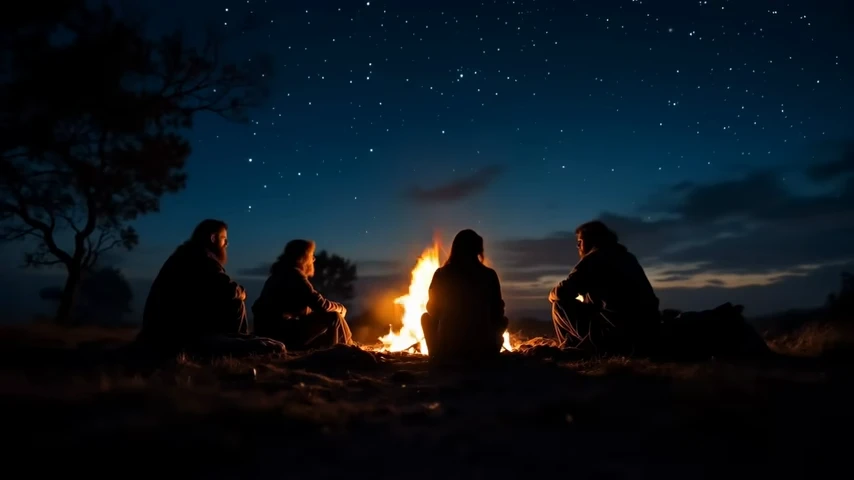
They couldn’t enter the temple, and their testimony wasn’t even valid in court.
But the only ones who worshiped the Messiah that night were they, the outcasts of society.
40 days later, Joseph and Mary brought Jesus to the temple in Jerusalem.
They offered two turtle doves.
It was the offering of the poor.
If they had had money, they would have brought a lamb.
Then an old man named Simeon took the baby in his arms.
He prophesied the child’s greatness, but then turned to Mary and spoke words that would mark her forever.
A sword will pierce your own soul.
She wouldn’t understand those words until 33 years later, standing at the foot of a cross.
Many assumed that after this moment, the family went back to their home in Nazareth.
They didn’t.
They returned to Bethlehem.
And to grasp what was about to happen, you need the backdrop.
Israel lived under a double terror.
Roman taxes skimmed off 40% of everything people earned.
Crucifixions were a constant public spectacle, a warning to anyone who dared think of rebellion.
And presiding over this chaos was Herod the Great, a paranoid, brutal king, and at that point a dying man.
Because while Jesus was growing up, Herod was wasting away.
He had gang green in his genitals.
And each day the pain drove him deeper into paranoia.
This was the man who drowned his favorite wife, Mariam.
The one who executed three of his own sons for fear they would steal his throne.
And then they came.
We call them the wise men, but they weren’t kings.
And they didn’t arrive the night he was born.
They were magi, astronomer priests from Persia.
They had seen something extraordinary in the sky, likely a conjunction of Jupiter and Saturn, and they spent 2 years on the road following that sign.
The magi entered Jerusalem and innocently asked, “Where is the one who has been born king of the Jews?” Herod had not been born king.
Rome had installed him.
He had no blood of David.
And these foreigners were talking about someone who actually had been born to reign.
So Herod called in the chief priests and asked, “Where is the Messiah to be born?” They knew the answer cold.
In Bethlehem of Judea, only about 6 mi away, just a couple of hours walk.
Yet not one of them went to check.
The magi traveled 2 years to worship him.
The priests wouldn’t walk 2 hours.
These would be the same religious leaders who 33 years later would cravenly shout, “Crucify him!” When the Magi found Jesus in Bethlehem, he was no longer a baby.
He was a small child.
They presented their prophetic gifts.
Gold for a king, frankincense for God, and myrr for his death.
and warned in a dream.
They returned to their homeland by another route.
Herod waited for the magi to return to his palace.
When he realized he’d been deceived, he exploded with rage.
He ordered the massacre of all children under 2 years old in Bethlehem and the surrounding area.
Bethlehem was small.
There were only 20 or 30 children.
To Roman historians, it was just one more of Herod’s atrocities, not even worth recording.
But for the mothers of Bethlehem, the world ended that night.
Suddenly, an angel woke Joseph.
Get up, take the child and his mother, flee to Egypt, and stay there until I tell you.
But it was more than 400 m from Bethlehem to Egypt.
How would they pay for such a long journey? God had already provided.
The Magi’s gold became the money that funded their exile and saved Jesus’ life.
And so, another prophecy was fulfilled.
Out of Egypt, I called my son.
Everything had to happen exactly this way.
That same night, they fled Bethlehem and set out on a long journey, weeks on the road until they reached Egypt.
Tradition holds they found refuge in Alexandria, where a large Jewish community lived.
Months later, Herod died in the most grotesque way imaginable, worms devouring him from within.
The stench was unbearable.
Word of it raced across the empire.
The monster had fallen.
Yet Joseph did not return when he heard the news.
He waited until an angel spoke to him.
Rise, take the child and his mother, and go to the land of Israel, for those who sought the child’s life are dead.
After months in exile, Jesus, Mary, and Joseph finally returned to Israel.
Jesus was now about 2 or 3 years old.
They chose the coastal route, avoiding Jerusalem.
a journey of more than 600 km over 370 mi.
But as they neared the borders of Judea, Joseph heard news that stopped him in his tracks.
Archelaus, Herod’s son, now reigned in his father’s place, and he was even more cruel.
He had begun his rule by massacring 3,000 Jews during a festival at the temple.
Fear paralyzed them.
But once again, an angel spoke to Joseph in a dream and said, “Do not go to Judea.
Go to Galilee.
” Without hesitation, Joseph obeyed, took Mary and the child, and headed north, crossing valleys and hills.
Thus, God steered the family north to a small village in Galilee called Nazareth.
This town does not appear even once in the Old Testament.
It was a village of barely 300 people, a place where no one, absolutely no one, would look for the Messiah.
But Nazareth held a secret.
Just 6 km away ran the Viamaris, the international highway that connected empires.
From the hills above his village, a young Jesus could see the Valley of Armageddon, the setting of the final battle.
And about an hour’s walk away stood Sephoris, a cosmopolitan bustling capital that Herod Antipus was rebuilding.
Jesus did not grow up isolated from the world.
He grew up watching the world pass by, hidden in plain sight.
God chose to hide his son where no one would look for him, yet where everyone would see him without recognizing him.
The son of God grew up like any other child in a small home surrounded by his parents.
But here the scriptures fall silent.
Of the next 30 years of Jesus’ life, we know only a single moment.
When Jesus turned 12, he became a young adult under Jewish law.
And for the first time, he could go with his parents to celebrate Passover in the holy city, Jerusalem.
They set out on the journey, a trek of over 60 mi to the spiritual heart of Israel, the temple.
But on the way back home, Jesus went missing.
Mary and Joseph were traveling in a caravan with a group.
And for a whole day, they assumed he was with another group.
They searched desperately until 3 days later they found him in the temple sitting among the teachers of the law.
But he wasn’t there to learn.
He was asking questions.
and his questions were so profound they left the experts without answers.
When his anguished parents asked why he had done this, Jesus replied, “Didn’t you know I must be about my father’s business.
” It was the first time in history anyone spoke of God with such intimacy so personally.
No one had ever called God father.
It was scandalous.
Not even Mary and Joseph understood.
But after that moment they returned to Nazareth and the Bible falls silent again.
Another 18 long years of silence until finally after three decades of waiting, work and quiet, Jesus left the town that watched him grow up.
He left his family who tried to stop him and walked toward the Jordan River where a prophet named John was baptizing.
Did you know that the story of Jesus begins literally at the lowest place on earth? Yes, the Jordan River, where Jesus was baptized, flows 430 m below sea level.
It is the lowest land point on the planet.
It is also a place loaded with beginnings and endings.
It is the exact spot where Israel, led by Joshua, first crossed into the promised land, the same place where the prophet Elijah was taken up to heaven in a chariot of fire.
We are on the banks of the Jordan River.
A man named John is baptizing one by one a long line of people.
Then Jesus came to be baptized, but John recognized him at once, his own cousin.
John tried to stop him.
Baptism was for sinners, and he knew Jesus had no sin, but Jesus told him it was the sign to inaugurate his mission.
And John immersed him in the water.
And then it happened.
The moment Jesus rose from the water, the heavens were torn open.
and a voice said, “This is my beloved son.
” For the first time in history, the Trinity revealed itself together.
The Father spoke, the Spirit descended like a dove, and the Son came up out of the water.
The silence was over.
The Messiah had been presented to Israel.
Then the Holy Spirit led him into the vast Judeian wilderness.
There Jesus fasted for 40 days and 40 nights, and Satan tempted him without rest.
40 days of relentless assault.
We know only the final three temptations, the three that nearly broke him.
But Jesus overcame every temptation and defeated Satan.
Exhausted, he was now ready to begin his ministry.
Jesus came home.
He returned to Nazareth and filled with the power of the spirit, walked into the synagogue.
But the people who had watched him grow up, his neighbors and friends, weren’t ready for what was about to happen.
Before everyone, he spoke the sentence that changed everything.
Today this scripture has been fulfilled in your hearing.
At first the people marveled, but then someone whispered, “Wait, isn’t this Joseph’s son, the carpenter?” The murmur swelled.
Wonder turned to doubt and doubt to offense until rage erupted.
They seized him and dragged him out of the town to the edge of a cliff to kill him.
But Jesus, with sovereign calm, simply walked right through the furious crowd and went on his way.
No one could lay a hand on him.
Jesus left Nazareth.
His own people had rejected him.
He would never go back to Nazareth.
But he didn’t stop.
He traveled to the shore of Galilee.
And there, as he walked along the sea, he saw two fishermen exhausted and frustrated because they had caught nothing.
Jesus urged them to cast their nets into the water.
And what happened defied all logic.
The nets filled with so many fish, they began to tear.
In that moment, the catch no longer mattered.
Simon, Andrew, James, and John left everything, and they followed Jesus.
The journey continues.
Jesus, his mother, and his new disciples are invited to a wedding in Kaa, a small town in Galilee.
But in the middle of the celebration, a social disaster strikes.
The wine runs out.
It was there, at the most inconvenient moment, that Jesus performed his first public miracle.
He turned six water jars, about 26 gallons each, into the finest wine anyone had ever tasted.
There was no spectacle and no announcements.
No one knew what had happened except the servants, but this was only the beginning.
From there, Jesus went down for a few days with his family to the bustling fishing village of Capernaam.
But soon the Passover festival arrived, and he had to go up to Jerusalem.
There on a quiet night speaking with a religious leader named Nicodemus, he delivered one of the most famous lines in history.
For God so loved the world that he gave his one and only son that whoever believes in him shall not perish but have eternal life.
With these words, Jesus made it clear that his message wasn’t just for the Jews.
It was for the whole world.
Jesus kept moving.
To head back north, he took a route most Jews avoided.
Samaria.
There he stopped at a place steeped in history, the well of Jacob.
And here’s an amazing fact.
That well, already ancient in Jesus’ day, still exists.
It sits beneath a church in today’s West Bank.
There, after speaking with a Samaritan woman about the living water of eternal life, Jesus returned to Kaa where he healed a royal official son without even being there.
His fame was growing, but that was nothing compared to what Jesus would do in the town of Capernaum on the shore of the Sea of Galilee, which is where he went next.
Jesus chose this bustling town as his base with his followers.
Why here? Capernium sat at a strategic point on the Via Maris, the ancient trade route that connected Egypt with Damascus.
But it was also a corrupt border town with a custom station where tax collectors like Matthew collected taxes for Rome.
So why didn’t Jesus settle in Jerusalem? He had everything he needed to succeed in the religious capital.
He performed miracles, knew the law, and had charisma.
Yet Jesus chose Galilee, a region despised by the religious elite because it was full of Gentiles.
And it was there that the miracle happened that set everything in motion.
Jesus healed many and one day a man with leprosy approached him.
At that time leprosy was incurable.
It was more than a disease.
It was seen as a divine curse, a living death sentence.
No one touched a leper.
But Jesus reached out his hand and the man’s skin was restored in an instant.
It stunned everyone.
There was an ancient belief that only the Messiah, the Savior King, would have the power to heal a leper.
So this wasn’t just another miracle.
It was a declaration of identity so powerful that the news spread like wildfire and crowds began to follow Jesus wherever he went.
People packed the doorways searching for a word, a touch, a hope, the sick, the oppressed.
Those who had lost everything came to him with hearts heavy with desperation.
And then the miracles began.
At the pool of Bethesda in Jerusalem, Jesus made a paralyzed man walk.
But the miracle was the least of it.
Jesus did something that made the Pharisees blood run cold.
He compared himself to God.
He said he had the power to give life just as the father does.
The Jewish people had gone 400 years without hearing from a prophet.
And now this young man was claiming to be not only a prophet, but the promised king who would overthrow Rome.
To the religious leaders, this was intolerable blasphemy.
From that moment on, they no longer wanted merely to argue with him.
They began actively plotting his death.
After Jerusalem, Jesus went to the Jordan River to baptize alongside his cousin John.
But tragedy struck.
King Herod, enraged by John’s rebukes, ordered his arrest.
Not long after, John was executed.
With his cousin in prison, Jesus returned with his followers to the region of Galilee where he chose 12 men, fishermen, tax collectors, zealots.
Together, they traveled through nine cities of Galilee.
Jesus would say, “Let’s go on to the nearby town so I can preach there as well.
That’s why I’ve come.
” People came from every direction seeking the healing only Jesus could give.
There was no pause, no rest.
In Kaa, he healed a Roman centurion servant without even being there.
Then he went to Nine and raised a widow’s only son.
He visited Chazine, preaching and healing.
But none of this compared with what was about to happen.
Jesus returned to Galilee to prepare the most important message of his life, the sermon on the mount.
Jesus’ fame had spread throughout the region.
The hills around the sea were packed.
The air was electric with expectation.
Then Jesus appeared on the crest of a hill and delivered the most revolutionary address in history.
Jesus took everything the world admires, strength, money, power, and turned it upside down.
He declared the poor, the mourers, the meek, and the persecuted to be heirs of the kingdom.
He commanded us to love even our enemies and to turn the other cheek.
Facing a crowd of fishermen, farmers, and the forgotten, he proclaimed, “You are the salt of the earth.
You are the light of the world.
” And he gave them a mission to live in defiance of everything the system rewards.
This message changed the course of Western civilization.
It was so revolutionary that even today it is still breaking every established system.
It challenged the beliefs of its time and of all times.
and it redefined success and happiness.
When the sermon ended, Jesus looked across the Sea of Galilee toward the region of Gdara, a gentile land.
With his 12 disciples, he climbed into a boat to cross over.
Out on the water, the fiercest storm they had ever seen rose up.
Panic gripped them, but with only three words, Jesus stilled the storm.
As the disciples were still trying to process what had just happened, they arrived at Gdara.
Something dark was waiting for them there.
A naked man covered in self-inflicted wounds and possessed by a legion of demons came charging at them with inhuman strength.
Jesus, however, didn’t flinch.
He raised his hand and set the man free from the demons.
But that was nothing compared to what Jesus would do when they returned to Capernium.
A crowd was waiting for them on the shore.
And so was terrible news.
Gyrus’s daughter had died.
He went to the room where the 12-year-old girl lay lifeless.
Jesus took her by the hand and said, “Talithumi,” which means, “Little girl, I say to you, get up.
” In that moment, the girl’s eyes opened.
She drew a deep breath and sat up.
A hush of astonishment fell over everyone in the room.
They were aruck.
Each miracle outshone the last.
Jesus not only healed diseases, but held power over death itself.
Jesus warned them sternly, “Tell no one what has happened.
” But the news could not be contained.
As they left the house, whispers began to spread.
The sick, the desperate, the curious, everyone crowded around the master, eager for a word.
Knowing the weight he carried, Jesus chose to cross to the far side of the Sea of Galilee to find a moment of quiet.
But the calm didn’t last.
When they reached the shore at Bethsida, a crowd was waiting.
Instead of withdrawing, Jesus spent hours preaching about the kingdom of God.
And when hunger swept through the vast multitude with only five loaves and two fish, he fed more than 5,000.
The bread kept multiplying in the apostles hands as they broke it.
For hours, each of them felt the laws of physics shatter between their fingers.
In the end, 12 baskets were left over, one for every tribe of Israel.
But then the crowd tried to make him king by force.
Their plan was to seize him and march on Jerusalem.
Suddenly, Jesus withdrew alone to the mountain and told the 12 disciples to get into the boat and cross the Sea of Galilee.
But out in the middle of the sea, a deadly storm trapped them.
Panic took hold.
For hours, they fought the power of waves over 16 ft high.
Then, in the dark of night, they saw the impossible.
A figure was walking on the water toward them.
It was Jesus.
Here’s a detail few people know.
His plan wasn’t to rescue them.
He was heading for the far shore, and his route passed right by them.
Peter leaped toward him in faith, and he too walked on the water.
And the moment he doubted and began to sink, Jesus caught him.
When the two of them climbed into the boat, the wind died down.
In an instant, the storm vanished as suddenly as it had begun.
The boat sailed on beneath stars that lit a clear sky.
They left Galilee behind, taking quieter roads and moving away from the crowds.
He traveled north to the gentile cities of Ty and Siden.
There, though many rejected him, he worked astonishing miracles.
Then he went down to the region of the Decapus, where he healed a man who was deaf and mute.
And again, his compassion overflowed when he saw another hungry crowd.
With only a few loaves and fish, he fed 4,000 people.
Afterward, he went up to Magdala, the hometown of a woman named Mary Magdalene.
Seven demons had tormented her.
Jesus cast them all out.
From that moment on, she never left him.
She became one of his most faithful followers, traveling with him wherever he went.
When they arrived in Capernaum, the crowds who had eaten the loaves and fish welcomed them.
They wanted more miracles.
But Jesus had something to say to them.
He declared, “I am the bread of life.
Whoever eats my flesh and drinks my blood has eternal life.
” Many were scandalized.
To them this sounded like madness.
Many of his followers turned back and stopped following him.
But Jesus kept going.
And so at last Jesus came with his disciples to a strange place, Cesaria Philippi.
The place everyone knew as the gates of hell.
A mountain so high its peak stays snowcapped even in summer.
The pagans called it the mountain of the gods and built temples on its slopes to worship Bal and Pan.
They literally believed it was an entrance to the realm of the dead.
And Jesus chose this place, the farthest from the temple in Jerusalem to reveal who he truly was.
There Peter received a revelation and said aloud, “You are the Christ, the son of the living God.
” It was a moment of perfect clarity.
Jesus turned to Peter and said, “You are Peter, and on this rock I will build my church, and the gates of Hades will not prevail against it.
” But then Jesus dropped a bombshell.
He told them he would suffer, be rejected, and die in Jerusalem.
The disciples were stunned.
The Messiah dead.
Impossible.
Peter even rebuked him.
They didn’t understand.
Yet the real message Jesus wanted to drive home in that dark place was that no matter how evil the world becomes, nothing will ever stop God’s plan for those who love him and believe in him.
6 days later, Jesus led his three closest disciples, Peter, James, and John, up to the heights of Mount Hermon.
And there, right before their eyes, the impossible happened.
Suddenly, Jesus was transfigured.
His face shone like the sun.
His clothes became whiter than snow.
But that wasn’t all.
Moses and Elijah, the greatest of the prophets, appeared.
They were talking with Jesus about his departure in Jerusalem.
Peter blurted out awkwardly and suddenly a cloud covered them and a voice thundered from heaven.
This is my beloved son.
Listen to him.
The disciples fell to the ground terrified and when they looked up only Jesus was there.
This transfiguration confirmed an unthinkable truth.
Jesus was divine.
It was no longer a question.
It was a certainty.
Jesus was the fulfillment of the law and the prophets and his glory was real.
The death he spoke of would not be the end, but the road to an even greater glory.
Coming down the mountain, they walked into chaos, an anguished father, his son convulsing on the ground, and the rest of the disciples, frustrated, unable to heal him.
Jesus set the boy free with a single command.
And moments later, with the crowd still amazed, he turned to his disciples and repeated the message.
He would be handed over into human hands and killed.
The map of his life now pointed to a single place.
His destiny was set, but time was running out.
Then Jesus set his face to go to Jerusalem.
He had to arrive in time to deliver a crucial message.
The journey was long.
He passed through the villages of Samaria and the region of Perea across the Jordan River, teaching about the kingdom of God and preparing his followers for the end.
When they finally arrived in Jerusalem for the feast of tabernacles, Jesus went straight to the temple and began to teach.
The tension with the religious leaders could be cut with a knife.
Right in the middle of the debate, Jesus threw down a challenge.
Truly, truly, I tell you, whoever keeps my word will never see death.
The Pharisees scoffed.
Are you greater than our father Abraham? He died.
You’re not even 50 years old.
And you say you’ve seen Abraham, Jesus fixed his gaze on them and spoke the words that sealed his fate.
Before Abraham was, I am.
The impact was immediate.
I am was the sacred name of God revealed to Moses at the burning bush.
Jesus wasn’t just saying he existed before Abraham.
He was claiming to be God.
For them, that was the limit.
An intolerable blasphemy.
They grabbed stones from the ground to kill him on the spot.
But Jesus slipped through the crowd and disappeared from the temple.
His hour had not yet come.
He escaped to Bethany to the home of his friends Mary, Martha, and Lazarus.
He needed time, but time was exactly what he didn’t have.
When the waters finally calmed, Jesus returned to Jerusalem.
There he healed a blind man at the pool of Silleum, a place you can still visit today.
But that fresh display of power only stoked the flames.
During the feast of dedication, what we call Hanukkah.
The religious leaders cornered him in the temple.
They demanded a straight answer.
Are you the Messiah? The saving king were waiting for.
Tell us plainly.
Once again Jesus left them speechless.
He said, I and the father are one.
Five simple words, the definitive claim.
And once again, the reaction was the same.
They picked up stones to execute him for blasphemy.
For the second time Jesus slipped away, this time fleeing to the region of Perea.
There he received terrible news.
His friend Lazarus was gravely ill in Bethany.
But Jesus didn’t go to save him.
He waited two full days.
His disciples couldn’t make sense of it.
When they finally reached Bethany, Lazarus had been dead and buried for 4 days.
Then Jesus did something that would make almost the entire nation hail him as king.
The most public miracle of his life was about to unfold.
Martha heartbroken said, “Lord, if you had been here, my brother would not have died.
” Jesus looked at her and said, “I am the resurrection and the life.
Whoever believes in me, even though he dies, will live.
” And standing before the tomb, with a voice that thundered with divine authority, he shouted, “Lazarus, come out.
” Suddenly, the man who had been dead walked out of the tomb.
It was the most public and provocative miracle of all.
There was no going back.
The news spread like wildfire.
All Jerusalem was talking about the resurrection of Lazarus.
For the religious leaders, this was the last straw.
The Sanhedrin, the Jewish ruling council, called an emergency meeting.
They were terrified.
Caiaphas, the high priest, argued that Jesus had to die because if everyone started following him, the Roman emperor would see rebellion and crush the nation.
But that wasn’t the truth.
They were jealous, envious that the crowds followed him and not them.
They voted and the decision was unanimous.
Jesus had to be executed.
From that day on, they officially plotted his death.
The end was drawing near, and Jesus knew it.
It was time to fulfill the purpose for which he had been born, to die.
After preaching in Perea and Jericho, he returned to Bethany.
“There, 2 weeks before his death, Mary anointed his feet with an extremely expensive perfume.
” “For my burial,” Jesus said softly.
She was the only one who understood.
The appointed moment had arrived.
Passover.
The final week of his life was a masterpiece of provocation.
It began with the triumphal entry.
Jesus headed for Jerusalem.
And the news that the man who had raised someone from the dead was nearby, so close to the city, drew a massive crowd.
Then Jesus mounted a young donkey and began descending the Mount of Olives toward the city, fulfilling the prophecy of Zechariah 9.
The crowd welcomed him like a king, waving palm branches and shouting, “Hosana! Blessed is he who comes in the name of the Lord, the King of Israel.
” The next day, Jesus went into the temple, and when he saw the marketplace they had made of his father’s house, his anger flared.
The court of the Gentiles, the only place where non-Jews could pray, had been turned into a noisy, crooked bazaar.
He braided a whip from cords and unleashed chaos.
He overturned the tables of the money changers, set the animals free, and drove out the changers and merchants, shouting, “It is written, “My house shall be called a house of prayer, but you have made it a den of thieves.
” The final act had begun.
The merchants fled while the religious leaders watched from the shadows.
“You could cut the tension in Jerusalem with a knife.
The religious leaders were desperate to stop Jesus, but they faced a serious problem.
The crowd adored him.
How could they do it without sparking a riot? Their opportunity came from where they least expected.
On a dark night, Judas Iscariat knocked on their door.
He was one of the 12, the treasurer who handled the group’s money.
The Bible says Satan entered into Judas, and he made them an offer.
He would hand over his master for 30 pieces of silver, the price of a slave.
The priests accepted at once.
The plan was set in motion.
The next day, Jesus gathered his disciples.
He knew what was coming.
They were going to celebrate Passover, but this supper would be the last.
During the meal, Jesus dropped a bombshell.
Truly, I tell you, one of you will betray me.
A murmur swept around the table.
Then Jesus dipped the bread and gave it to Judas.
What you’re going to do, do quickly.
Judas’s heart pounded in his chest.
He stood without a word and stepped into the night.
The traitor had been revealed.
The others didn’t understand what had just happened.
Then Jesus took the bread.
He broke it and said, “This is my body.
” Then he took the cup of wine.
“Drink from it, all of you, for this is my blood of the new covenant poured out for many for the forgiveness of sins.
” The disciples drank without realizing they were witnessing the birth of a sacrament that would still be celebrated 2,000 years later.
And just when they thought the night couldn’t grow any more intense, Jesus did something unexpected.
He took off his robe and one by one began to wash their feet.
Only gentile slaves did this.
The teacher knelt like a servant, teaching that leadership in his kingdom was rooted in humility and service to others.
When the meal was over, they went out to the Mount of Olives.
Jesus didn’t alter the plan.
Judas knew that once dinner ended, Jesus would head to a garden called Gethsemane, just outside Jerusalem’s walls, where he often went to pray late into the night.
In fact, that olive grove still stands today.
Some of those trees are over 2,000 years old.
They may be the very ones under which Jesus prayed that night.
Jesus knelt to pray, but his anguish ran so deep that the inexplicable happened.
The Bible says his sweat became great drops of blood that fell to the ground.
This is not just a metaphor.
It’s a real extremely rare medical condition called hematidrosis, where crushing stress can rupture the skin’s capillaries so that blood mixes with sweat.
Jesus knew the physical and spiritual agony that awaited him.
Even so, his prayer was complete surrender.
Father, not my will, but yours be done.
Suddenly the silence shattered.
Torches, swords, the roar of a crowd.
Judas had arrived with the temple guards to arrest him.
A kiss on the cheek was the signal.
The kiss of betrayal.
Peter drew his sword and sliced off the ear of the high priest’s servant.
But Jesus touched the man, healed him instantly and said, “Whoever lives by the sword will die by the sword.
” And then the unthinkable happened.
Seeing Jesus in custody, all the disciples fled.
All of them.
The very ones who hours earlier had sworn to defend him to the death abandoned him.
Why? What changed in a heartbeat that made his loyalty disappear? It will all make more sense in a moment.
But first, you need to see what happens to Jesus next.
The soldiers dragged Jesus through the darkness toward the upper city.
It was an exclusive neighborhood, home to the rich and powerful.
Here in a lavish mansion, Annas, the former high priest, was waiting.
The Jewish priests ruled like monarchs over their people.
But they had no authority to execute anyone.
They needed help from someone else.
From whom that question would shape the coming hours by their own law.
Jewish trials were forbidden at night.
Trials during Passover were forbidden.
Executions on the same day as the verdict were forbidden.
That night, the religious leaders broke all their own rules.
Anna’s questioned Jesus, “Where are your followers? What is it you teach?” What Anna didn’t know was that two of his closest disciples, Peter and John, were right there, hidden among the crowd, watching everything in silence.
Jesus answered calmly, “I have spoken openly.
Ask those who heard me in the temple.
” At that, a guard struck him.
It was the first blow of many, but the worst was yet to come.
Jesus was about to say something that would seal his fate and turn nearly everyone against him.
But before he spoke those fateful words, something terrible was unfolding outside in the courtyard.
While Jesus was being questioned, Peter waited in the courtyard.
A servant girl stared at him.
“You were with Jesus.
” “I don’t know him,” Peter lied.
Twice more he was recognized.
Twice more he denied his master.
Then the rooster crowed.
At that moment, Jesus, beaten and bleeding, crossed the courtyard.
His eyes met Peter’s.
Jesus had predicted this exactly.
Before the rooster crows, you will deny me three times.
Peter fled, weeping bitterly.
Midnight was approaching.
They now brought Jesus before the high priest at the time, Caiaphas.
Caiaphas had been planning this night for some time.
He looked at Jesus and demanded, “Are you the Christ, the son of God?” Jesus answered, “I am, and you will see the Son of Man seated at the right hand of power.
” Jesus wasn’t improvising.
He was quoting the prophecy of Daniel 7 written 500 years earlier.
By claiming this text for himself, Jesus wasn’t just saying he was the Messiah.
He had just proclaimed himself to be God.
The verdict was immediate, guilty of blasphemy.
They now had their excuse to do away with him.
But there was a problem.
The Jewish leaders couldn’t execute him.
Judea was under Roman rule and only Roman authority could issue a death sentence.
They needed Ponteus Pilate.
The sun was beginning to rise.
Jesus now stood for a third trial.
This time a formal one before the full Sanhedrin.
Meanwhile, elsewhere in the city, Judas was running toward the temple.
It seemed Satan’s grip on him had lifted because an unbearable guilt was crushing him.
He went before the priests, hurled down the 30 pieces of silver, and cried out, “I have sinned.
I have betrayed innocent blood.
” But his confession changed nothing.
He left the temple, likely through these very gates, and made for a nearby valley, the valley of Hinnam.
And here is where it all connects.
This valley, Gehenna, the very one we mentioned at the start, is the oursed place that gave hell its name, a place of evil and pagan sacrifice.
And there consumed by guilt, Judas chose to end his life.
Caiaphas led Jesus to the palace of Herod the Great from which Ponteus Pilate now governed.
The Jewish leaders led Jesus to the palace gates but did not go in.
They didn’t want to be defiled right before Passover and the palace was filled with statues of Roman gods.
So where did the trial actually happen? The answer lay hidden underground for centuries until archaeologists uncovered the foundations of a raised platform.
Pilate would come out of the palace and sit on his judgment seat on that elevated platform.
This was already Jesus’ fourth trial in less than a day.
And his enemies didn’t want a quick death.
They wanted the most torturous death the empire knew.
Crucifixion reserved only for rebel slaves and enemies of the state.
But Pilate hesitated.
History shows he questioned Jesus multiple times going in and out of the palace.
“Are you the king of the Jews?” he asked bluntly.
And Jesus answered, “My kingdom is not of this world.
” With those words, Pilate saw no threat to Rome.
He came out and declared Jesus innocent.
The crowd erupted in fury.
Pilate was bewildered.
What had this man done to stir up so much hatred? But then, amid the chaos, Pilate noticed a crucial detail.
Jesus was from Galilee and Galilee fell under the jurisdiction of another ruler, Herod Antipus.
And by an incredible historical coincidence, Herod was visiting Jerusalem for Passover.
Pilate saw a chance to hand the problem to someone else and sent Jesus to Herod’s vacation palace.
Herod, unlike Pilate, was excited.
He had heard about Jesus’ miracles and wanted a show.
He asked Jesus to perform one of his tricks.
But Jesus didn’t say a single word.
By then he had already been beaten and spat on by the temple guards.
Now Herod’s soldiers wanted their turn.
They draped a royal robe over his blooded back to mock his supposed kingship.
Herod laughed, declared him innocent as well, and like a package sent him back to Pilate.
But when Jesus returned, things had gotten worse.
The sun was already high, and the crowd had swelled dramatically.
Here’s where the story takes a terrible turn.
But you might be wondering why was this same crowd who days earlier had hailed him now demanding his death.
These same Jews had welcomed Jesus as king just 5 days earlier.
They believed Jesus would defeat Rome.
They wanted a warrior, a political liberator.
But now they saw him chained, spat on, beaten.
They saw a fraud.
Their warrior messiah was a weak, defenseless prisoner.
disillusionment [clears throat] turned to rage and they shouted without stopping, “Crucify him!” Pilate, desperate, tried one last compromise.
He would hand Jesus over to his soldiers to be flogged.
A brutal punishment he hoped might satisfy the crowd.
A scourging was no mere whipping.
The soldiers used a whip with several leather straps, and at the ends of those straps, they tied sharp pieces of bone and small metal balls.
It was a torture designed to flay a man alive.
Many never survived the scourging, and for Jesus, this was only the beginning.
The Roman soldiers took pleasure in tormenting him.
It was their entertainment.
They wo a crown of thorns and pressed it into his head as they mocked him.
When they brought him out before Pilate and the crowd, Jesus was unrecognizable.
Even then, the crowd wasn’t satisfied.
They shouted again and again, “Crucify him!” Then Pilate tried one last move.
It was Passover and tradition required releasing a prisoner.
Who do you want me to release? He asked.
Jesus or Jesus Barabus? Yes, you heard that right.
Barabus’s name was Jesus, too.
That detail often lost in the telling, is one of the Bible’s most chilling ironies.
Pilate was literally asking, “Which Jesus do you want? The murderer or the savior?” They chose the murderer.
And not only that, they shouted one of the most tragic lines in history, sealing their decision.
Let his blood be on us and on our children.
Pilate gave in.
He washed his hands and handed him over to be crucified.
Jesus was only hours from his final breath.
The soldiers dragged him out of the ptorium.
They hoisted the cross beam onto his shoulders, rough, heavy, already stained with the blood of other condemned men.
Every step was agony.
Jesus went from the Ptorium to Golgatha, threading through the heart of Jerusalem’s old city.
That path, barely 600 m, is today one of the most sacred places on earth, the way of the cross, the Via Dolar Roa.
But that day, it was just an ordinary street turned into a corridor of death.
Jesus was so weakened by the scourging that his body gave out on the way.
He fell to the ground, the weight of the wood crushing him into the dust.
At last, he reached his final destination, a rocky hill outside the city walls called Golgatha.
There they stripped him in front of everyone.
His body was a road map of pain.
And as they exposed him, the soldiers divided up his clothes, unwittingly fulfilling a prophecy written hundreds of years earlier.
Then the moment came.
At 9 in the morning, they nailed him to a cross.
Beside him, two other criminals met the same fate.
One hurled insults.
The other, however, did something no one saw coming.
He admitted his guilt, and he affirmed Jesus’s innocence.
Most people assume a crucified person died from pain or from blood loss caused by the nails.
But the truth is far more horrific.
The real cause of death was asphyxiation, a slow, agonizing struggle for every breath.
And understanding that is the key to grasping what truly happened that day.
Roman crucifixion was a public warning.
It was engineered to inflict maximum pain for the longest possible time.
To draw even a single breath, Jesus had to push his whole body upward using his feet as a lever again and again for hours.
Meanwhile, the crowd mocked him.
Mary and John, the beloved disciple, wept together.
He was the only disciple who stood there in the darkest moment.
But then something unexplainable happened.
From noon until 3:00 in the afternoon, darkness covered the land.
In broad daylight, the sky grew heavy, thick.
It was as if all creation held its breath.
The lamb was bearing the weight of the world’s sin.
And in the midst of that strange twilight, Jesus breathed out his final words.
It is finished.
That was his mission.
No one took his life from him.
He gave it.
He suffered willingly for every wrong you and I have ever done.
In that instant, the earth responded.
An earthquake split the temple in Jerusalem in two.
The symbolic barrier between God and humanity was torn apart.
Access to the Father would no longer be limited.
But Jesus didn’t just defeat death on the cross.
He conquered it by rising 3 days later.
Because the cross wasn’t the final destination.
It was the doorway, the beginning of something extraordinary.
To understand how he overcame death, we must follow in his footsteps.
For 40 days, Jesus appeared in places all across the map.
In Jerusalem, in Galilee, on the road to Emmas.
More than 500 people saw him, and many of these witnesses died for proclaiming what they saw.
After Jesus’ death, the disciples hid in Jerusalem.
The religious leaders had sealed Jesus tomb and stationed Roman guards.
3 days later at dawn on Sunday, Mary Magdalene came to the tomb with other women.
And then the impossible happened.
The two-ton stone had been rolled away and the tomb was empty.
The body of Jesus was no longer there.
In the midst of the confusion, Mary Magdalene sat down weeping.
Then a man approached her, but her tear blurred eyes kept her from recognizing him until the man called her by name.
Mary.
Mary looked up and recognized him.
It was him.
In that instant, everything changed.
Jesus was alive.
She wanted to come close to embrace him, to cling to him.
But Jesus lifted his hand gently and said to her, “Don’t hold on to me, for I have not yet ascended to the Father.
Go to my brothers and tell them, I am ascending to my father and your father, to my God and your God.
” Mary understood this was not a reunion to linger in.
It was a mission.
Without a moment’s delay, Mary ran back to the upper room where the disciples were hiding.
The other women who were with her saw the same thing and ran back to the city.
But on the way, Jesus suddenly appeared.
He greeted them with a simple greetings.
They embraced him.
He was real flesh and blood.
Jesus was alive.
And he said to them, “Do not be afraid.
Go and bring the news to my brothers.
” The women ran overjoyed to deliver the great news to the disciples.
But the disciples did not believe them.
In those days, a woman’s testimony counted for nothing.
It wasn’t even admitted in a Jewish court, no matter how many women testified.
Jesus chose a group of women, the very ones the world rejected, to announce the most important event in history.
Everyone had lost faith.
Everyone except Peter and John, who ran to the tomb with a spark of hope.
When they arrived, the grave was empty.
Jesus wasn’t there.
All they found were the linen strips, neatly laid out, as if the body had evaporated from within them.
The headcloth was folded up by itself, set apart in another place.
A strange detail John never forgot.
But not all the disciples were in Jerusalem waiting for news.
Two of them, hearts on the floor, had lost all hope.
They were walking to their village, Emas, about 7 mi away.
For them, it was over.
On the road, a stranger joined them and began charting a path through the scriptures.
From Moses to the last of the prophets, he showed how everything pointed to a Messiah who had to suffer before entering his glory.
Like Mary, they didn’t recognize him either.
They walked and talked with him for hours.
It wasn’t until they sat down to dinner in Emmas when Jesus took the bread, blessed it, and broke it that their eyes were opened.
It was him, and in that very instant, he vanished.
The shock was so great that they retraced their steps.
They ran the 7 mi back to Jerusalem in the dead of night to tell the others.
And as they told the rest of the disciples their incredible story, Jesus himself appeared in the middle of the room.
It was his third appearance, he didn’t open the door.
He simply appeared and his greeting was the same.
Peace be with you.
But they didn’t feel joy.
They felt terror.
They thought they were seeing a ghost.
Even with him right in front of them, doubt was stronger.
It wasn’t until he showed them the wounds in his hands and feet and ate a piece of broiled fish in front of them that they began to believe.
Even so, one was missing.
Thomas wasn’t there that night, and when they told him, he refused to believe.
A week later, Jesus appeared for the fourth time with a clear purpose.
He went straight to Thomas and said, “Put your finger here.
Look at my hands.
Reach out your hand and place it in my side.
Stop doubting and believe.
Thomas didn’t need to touch him.
He fell to his knees and cried out one of the greatest confessions of faith in all of scripture.
My Lord and my God.
Up to this point, every appearance of Jesus seemed designed to overcome doubt and to prove that he had truly risen.
But the last three appearances are different.
They unfold far from Jerusalem’s turmoil in the calm of Galilee.
8 days later, the disciples were back home doing what they knew best, fishing.
They were in their boat, discouraged, when a man called out to them from the shore.
It was Jesus.
There by the sea, Jesus looked at Peter and asked him three times, “Do you love me?” Three times Peter answered that he did.
Then Jesus revealed his future.
When you are old, you will stretch out your hands, and someone else will dress you and lead you where you do not want to go.
Peter didn’t grasp it then, but Jesus had just foretold his death.
Peter and all the disciples would die in horrific ways, crucified, stoned, burned alive.
Just for saying that Jesus rose from the dead, believing that someone rose from the dead is hard for many to accept.
Jesus knew that and he staged his final two appearances accordingly.
Jesus asked the disciples to meet him on a mountain near the Sea of Galilee and there something extraordinary happened.
Not only did the 11 disciples appear, but so did 500 of his followers.
Suddenly, we weren’t talking about 11 witnesses anymore.
We were talking about 500 500 people who claimed to have seen the risen Jesus.
This helps explain why Christianity exploded and became the fastest growing faith in history.
And so we come to the final appearance.
They gathered on the Mount of Olives near Jerusalem.
There they saw with their own eyes as Jesus ascended into heaven until a cloud hid him from view.
In that final moment, Jesus didn’t give them a physical sign, but a promise, one that would become the most powerful evidence of all.
He promised that the spirit of God would descend on them and that this spirit would draw people to him throughout history.
50 days later, 3,000 people were converted in a single day.
Within a few years, the message had reached the entire Roman Empire.
Maybe as you’ve read these words, you felt something in your heart, an echo of truth.
Perhaps deep down, you know these events are real.
But you feel too lost or unworthy to come near to him.
I want to tell you something.
Jesus came into the world to save you.
He did this by dying on a cross, paying the price for your sins and mine so that you could know God.
And to help this message reach more people who don’t know Jesus.
It would help us a lot if you’d like this video.
Leave a comment thanking God for giving us his greatest gift, eternal life with him.
Now you know Jesus full map.
But before he left, he gave his 12 disciples one unfinished mission to take the gospel to the whole world.
How did they do it? Where did they go? To understand how the apostles changed the world, you have to watch this video, the apostles map.
You’ll see on a map where each apostle went, the roots and journeys where they proclaimed Christ, and where they faced death.
Without that map, this story is incomplete because you won’t understand how the gospel reached you.
You have to watch this video.
Don’t miss it.