Carlo Acutis and His Astonishing Vision of Purgatory
Carlo Audis was just 5 years old when he said something that left his mother speechless.
I saw grandpa.
He’s in purgatory.
He needs prayers.
Words no child could invent, especially one who didn’t even know what purgatory was.
Why did Carlos say this? What did he really see that night? And most importantly, why did he offer all his sufferings to God so I won’t have to go to purgatory and can go straight to heaven in the final days of his life? If purgatory is real, these are not just moving words.
They are a warning for every one of us.

In today’s video, we’ll discover why the church took these words seriously, how Carlo turned this vision into a daily mission, and why his final offering might hold the key to our own salvation.
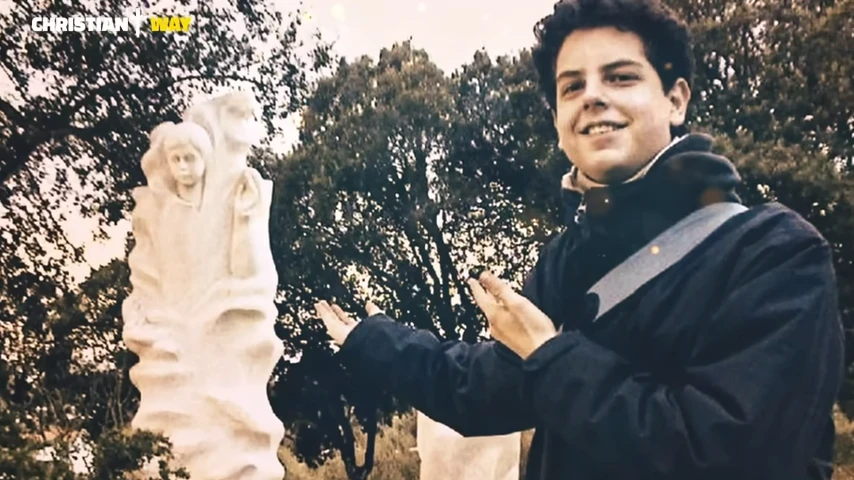
Carlo Audis was born in London in 1991, but grew up in Milan in a well-off family.
At first glance, he was a boy like any other.
He loved programming, video games, soccer, and his dogs.
a computer genius, a popular kid, always smiling.
But it’s precisely in this contrast that the secret of his holiness hides.
Behind the boy with jeans and sneakers was a soul on fire with love for God.
His faith was not something he lived only at church.
It overflowed into every gesture.
He set aside his pocket money not to buy the latest video game, but to give it to the poor in his neighborhood.
At school, he defended disabled classmates who were bullied, even stepping physically between them and their attackers.
His mother, Antonia, often said that it was Carlo who dragged her back to faith.
She was a non-practising Catholic faced with a mystery.
How could such a small child have such a great thirst for the infinite? She was forced to ask questions, to study, to seek answers.
Her son became her little catechist.
It was in this context that a sudden family tragedy prepared the stage for a supernatural event.
Carlo’s maternal grandfather died unexpectedly.
A few months later, Carlo told his mother about an experience too vivid to be a simple dream.
He had seen his grandfather with a sorrowful expression who told him he was in purgatory and needed prayers to be freed.
Antonia was not only shocked but deeply shaken.
Her faith was still fragile.
She wondered whether it was simply a child’s imagination processing grief.
But the details were too precise.
Carlo had never heard talk of purgatory at home.
Struck by such a clear and urgent request, she not only began praying for her father’s soul, but also started to investigate further.
That moment became for her tangible proof that the afterlife was not an abstract idea but a real dimension we can interact with.
But why pray for someone who has already died? Here at just 5 years old, Carlo was living out one of the oldest teachings of the church.
The Bible itself in the second book of Mcabes speaks about offering sacrifices for the dead so they may be loosed from their sins.
Carlo was putting into practice the communion of saints, the belief that the church is not divided between heaven, earth, and purgatory, but is one single body united in charity.
That nighttime vision was not an isolated event.
It became the driving force behind a mission Carlo carried out with adult seriousness.
He began what he called his spiritual piggy bank.
every small sacrifice, every little act of self-denial, every prayer was offered for a specific soul in purgatory.
He called it one of the best investments you could ever make.
He explained to his friends that helping those souls enter heaven meant gaining powerful friends who once before God would not forget the ones who had helped them.
And what was the most powerful tool Carlo used in this mission? The Eucharist, of course.
He knew the value of a single mass is infinite because it is the very sacrifice of Christ renewed.
This is why attending mass and offering holy communion for the dead was to him the greatest act of charity.
His devotion to purgatory and to the eukarist were two sides of the same coin.
A total love for the body of Christ.
both present in the sacrament and suffering in the church of purgatory.
That glimpse of the afterlife wasn’t just a story to tell.
It was preparation.
It shaped his entire view of life, suffering, and death, preparing him for his final and greatest trial.
Carlo’s life suddenly accelerated brutally.
Almost overnight, a sore throat turned out to be the first sign of acute promyalitic leukemia, the most aggressive form.
When he was hospitalized, he immediately understood the seriousness of his situation.
And yet, everyone who entered his room was amazed.
Doctors and nurses testified that they never heard him complain.
On the contrary, when they asked how he was doing, he would answer, “Good.
” There are people who suffer much more than me.
He worried more about sparing his parents’ pain than about his own condition.
It was in that hospital bed that he made his definitive offering, looking at his parents with a maturity beyond his 15 years.
I offer all my sufferings for the Pope and for the church so I won’t have to go to purgatory and can go straight to heaven.
Let’s pause on that statement.
He wasn’t just offering his suffering for himself.
First, he offered it for the pope and for the church, showing immense love for the bride of Christ.
And then he added his personal desire so I won’t have to go to purgatory.
This was not pride, but the theological awareness of a saint.
Carlo knew that suffering when united to Christ’s on the cross has immense redemptive and purifying value.
The catechism teaches that purgatory is that final purification that makes us perfect for the encounter with God.
Carlo through his offering was asking God to complete that purification here and now on earth through the fire of illness so that he could fly straight into God’s arms.
It was the desire of a lover who does not want to wait one more second to see the face of the beloved.
His death on October 12th, 2006 was a masterpiece of faith.
Smiling, he said, “I die happy.
” He asked for the anointing of the sick and received his final communion, his highway to heaven, one last time.
Carlo’s story is not a museum relic.
It is a mirror.
It forces us to ask uncomfortable questions.
What are we doing to prepare for our meeting with God? Are we wasting time, which Carlo called precious? or are we using it to store up treasures in heaven? Praying for the dead, as Carlo did, is an act of charity that transforms us.
It teaches us to look beyond the narrow horizon of this life and reminds us that we are all tied together by a common destiny.
The church gives us concrete tools, the mass, the rosary, indulgences.
Carlo knew them and used them as an athlete uses equipment to prepare for the most important race.
In the end, his life is a bridge linking ancient doctrine with modern life.
He was not a medieval mystic but a 21st century teenager who took seriously the call to holiness.
And he tells us this road is open to everyone.
This week, choose a soul to pray for.
It can be a grandparent, a friend, or a forgotten soul no one remembers.
Offer a rosary, a mass, or a small sacrifice for them.
Together, we will form a chain of prayer for the souls in purgatory.
Their prayers once they reach heaven will become our strength.
Let’s not let this moment pass us by.
Let us live each day with our eyes fixed on heaven.
For holiness is our true destiny.