Nick Fuentes EXPOSES JD Vance as a Puppet of Israel and Palantir: “He’s NOT a Peacemaker!”
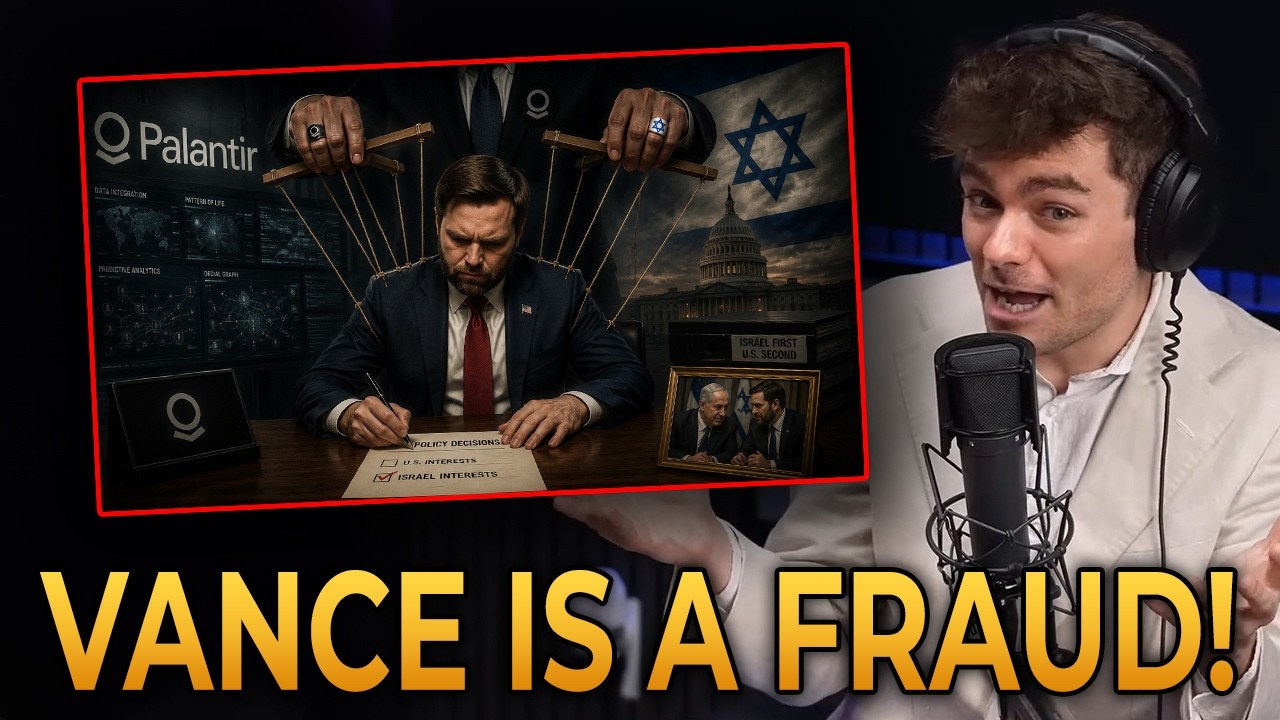
Is JD Vance Being Rebranded as the Peace Candidate? The Growing Debate Inside America’s New Right
Politics rarely stands still. Today’s hawk can become tomorrow’s peacemaker, and yesterday’s supporter of military action can suddenly emerge as the face of diplomatic restraint. That transformation is exactly what some critics believe is happening with Vice President JD Vance—and they argue it is no accident.
A growing faction within the American right believes a carefully managed political rehabilitation is already underway. Their claim is straightforward: after the Iran conflict divided conservative voters and challenged the “America First” coalition, influential figures are now attempting to reshape Vance’s public image before the 2028 presidential race.
Whether that argument is persuasive or not, it has become one of the most fascinating debates inside conservative politics.
A War That Changed the Political Conversation
Foreign policy has long been one of the biggest fault lines in American politics, but the recent confrontation involving Iran exposed divisions that many conservatives had assumed no longer existed.
For years, Donald Trump’s “America First” movement presented itself as an alternative to the interventionist foreign policy associated with both Republican and Democratic establishments. The promise was simple: fewer overseas wars, greater focus on domestic priorities, and skepticism toward military interventions that seemed to produce endless costs with few tangible benefits.
But when military action against Iran became reality, many supporters felt the movement had drifted away from those principles.
Some accepted the administration’s actions as necessary for national security.
Others viewed them as a betrayal of the very promises that helped build the modern MAGA coalition.
That disagreement created a political problem—not just for President Trump, but for every senior official associated with the administration.
Among them, JD Vance.
The Critics’ Central Argument
One of the strongest arguments made by critics is not simply that Vance supported aspects of the administration’s Iran policy. Instead, they argue that his current image as a leading advocate for diplomacy ignores many of his earlier public statements.
According to these critics, Vance previously argued that the United States should take a much tougher approach toward Iran, including stronger military responses if conflict became unavoidable.
Now, however, they see him appearing more frequently in discussions about negotiations, ceasefire efforts, and diplomatic solutions.
To them, this represents more than a natural evolution of policy.
They believe it represents political repositioning.
The theory is that if the Iran conflict ultimately becomes unpopular with Republican voters, Vance needs to be remembered less as someone connected to the decision to fight and more as someone who helped end the conflict.
Whether that interpretation is fair remains open to debate, but it has gained traction among commentators who are skeptical of both the Republican establishment and traditional conservative media.
Why 2028 Already Matters
Presidential campaigns rarely begin during election years.
Potential candidates often spend years quietly shaping their public image before officially announcing a campaign.
Critics who advance the “rehabilitation” theory argue that Vance’s political future depends heavily on how Republican voters remember the Iran conflict.
If voters conclude that the war damaged America’s economy, increased inflation, or weakened Republican electoral prospects, anyone closely associated with those decisions could face difficult questions during the next presidential primary.
Supporters of this theory believe the strategy is already visible.
Instead of allowing Vance to become identified with the decision to use military force, they argue he is increasingly being presented as someone who promoted diplomacy and helped bring the conflict toward a negotiated conclusion.
In politics, perception often becomes almost as important as reality.
The Role of Conservative Media
Another major theme emerging from this debate concerns the influence of conservative media personalities.
Critics point to figures such as Tucker Carlson, who has repeatedly emphasized the difficult position occupied by a vice president serving under a sitting president.
The argument generally goes like this:
A vice president has limited freedom to publicly oppose the president’s decisions. Once the administration adopts a policy, loyalty becomes part of the job.
Critics reject that explanation.
They argue that history provides examples of vice presidents publicly distancing themselves from presidents on matters of principle.
One historical example frequently mentioned is John C. Calhoun, who openly opposed President Andrew Jackson’s tariff policies before eventually resigning from the vice presidency.
Whether that comparison is appropriate is debatable, given the vastly different constitutional and political circumstances of the nineteenth century. Nevertheless, critics use it to argue that high-ranking officials always retain some capacity to express disagreement if they choose to do so.
Their conclusion is simple:
If Vance genuinely opposed aspects of the Iran conflict, they believe he could have made that opposition far more visible.
A Network of Influential Allies
Another topic discussed by critics involves the political and financial relationships surrounding JD Vance.
They frequently point to influential technology investors and entrepreneurs—including David Sacks and Peter Thiel—as part of a broader network that has supported Vance’s political rise.
These relationships are not secret.
Vance has openly acknowledged Peter Thiel’s early support, and Thiel has played an important role in his political career.
The criticism, however, goes further.
Some argue that influential technology figures possess both the financial resources and media influence necessary to shape political narratives inside the Republican Party.
Under this view, presenting Vance as a future non-interventionist leader would be strategically valuable if the party wants to preserve support among anti-war conservatives while moving beyond controversies surrounding the Iran conflict.
Supporters of Vance reject this characterization, arguing that political alliances are a normal part of modern campaigns and do not prove coordinated image management.
David Sacks and the Anti-War Messaging
Particular attention has focused on David Sacks after he publicly argued that military escalation with Iran should come to an end.
Critics note that Sacks has longstanding relationships with both Vance and several influential figures within the technology sector.
Because of those connections, some commentators interpret his public statements as the beginning of a broader effort to reposition Vance politically.
That interpretation remains speculative.
There is no public evidence demonstrating coordinated political planning.
Nevertheless, within dissident conservative circles, these overlapping relationships have become a significant subject of discussion.
Tucker Carlson’s Delicate Position
Few media figures carry more influence among anti-interventionist conservatives than Tucker Carlson.
His criticism of military intervention has earned him credibility with voters frustrated by decades of overseas conflicts.
At the same time, Carlson has generally avoided making JD Vance the primary target of his criticism.
Instead, he has often emphasized the institutional constraints facing a vice president.
For some observers, this reflects fairness.
For others, it appears unusually protective.
Critics argue that if Carlson eventually endorses Vance during a future presidential campaign, many conservative voters may accept the narrative that Vance privately opposed intervention even if he publicly defended administration policy.
Supporters would likely argue that such an endorsement would reflect Vance’s overall record rather than any single foreign policy dispute.
The Larger Fight Inside the Republican Party
Beneath the discussion about JD Vance lies a much broader struggle over the future identity of the Republican Party.
One faction continues to favor a muscular American role overseas, believing military strength remains essential for protecting national interests and supporting allies.
Another faction argues that decades of intervention have produced enormous financial costs, increased national debt, and repeated military commitments with uncertain strategic outcomes.
The Iran conflict intensified this disagreement.
It forced Republican politicians to clarify whether “America First” primarily means avoiding foreign wars—or whether military action remains acceptable under certain circumstances.
That question remains unresolved.
Can Political Images Be Rewritten?
History suggests that politicians frequently reinvent themselves.
Positions evolve.
Coalitions change.
Public priorities shift.
Successful candidates often emphasize some parts of their record while placing less attention on others.
The current debate over JD Vance reflects this broader reality.
His supporters see a politician adapting to changing circumstances and helping pursue diplomatic solutions after military conflict.
His critics see an attempt to rewrite political history before voters begin evaluating potential presidential candidates.
Which interpretation ultimately prevails may depend less on speeches than on events themselves.
If diplomacy succeeds and tensions continue to decline, voters may remember Vance as someone associated with peace negotiations.
If conflict resumes or public dissatisfaction deepens, earlier statements supporting tougher action against Iran are likely to receive renewed attention.
Money, Influence, and Modern Politics
The discussion also highlights broader concerns about money in American politics.
Many observers across the political spectrum believe wealthy donors, technology entrepreneurs, advocacy organizations, and media personalities exercise enormous influence over candidate selection long before primary voters cast ballots.
Financial backing can provide access to advertising, campaign infrastructure, influential endorsements, and media exposure.
Critics argue this creates an environment where narratives can be carefully managed, allowing candidates to redefine themselves with remarkable speed.
Supporters counter that voters ultimately retain the final decision and that no amount of money can permanently overcome widespread public dissatisfaction.
History offers examples supporting both perspectives.
The Road to 2028
Although the next presidential election remains years away, conversations about potential Republican candidates have already begun.
JD Vance is widely expected to remain a prominent figure in those discussions.
Whether he emerges as the leading heir to the Trump movement will depend on far more than endorsements from influential donors or media personalities.
Republican voters will likely evaluate his record on immigration, the economy, inflation, foreign policy, government spending, and his role within the Trump administration.
The Iran conflict is only one chapter in that larger story.
Still, it may become one of the most closely examined chapters.
Final Thoughts
The debate surrounding JD Vance illustrates how quickly political narratives can evolve in modern America.
Some commentators believe they are witnessing an organized effort to reposition him as the leading anti-war voice of the next generation of conservative politics. Others simply see a vice president responding to changing geopolitical realities while remaining loyal to the administration he serves.
What is clear is that foreign policy has once again become one of the defining issues shaping the future of the Republican Party.
The argument is no longer simply about Iran.
It is about the meaning of “America First,” the legacy of intervention abroad, the influence of wealthy political networks, and who will inherit one of the most influential political movements in modern American history.
As the 2028 campaign slowly begins to take shape, these questions are unlikely to disappear. Instead, they will probably become even more central to the battle over the future direction of American conservatism—and over who will ultimately lead it.