They Set a Single Dad Up With the Woman Everyone Mocked — His Reaction Left the Room in Tears
They Set a Single Dad Up With the Woman Everyone Mocked — His Reaction Left the Room in Tears
Inside the Monroe Grand Hotel, the massive crystal chandeliers scattered the early winter light across a ballroom polished to look like a memory of better times.
Servers in black and white moved seamlessly between round tables draped in heavy cream linen, and a pianist near the south wall played something slow and unobtrusive. The charity gala held that night to raise money for families who had lost their homes in a recent string of devastating apartment fires had drawn close to four hundred guests in custom tuxedos and floor-length gowns.
Most of the attendees had come because their accountants had told them to. A smaller number had come because they truly cared about the displaced families, and almost none had any idea that in a side parlor off the main hall, a man named Clinton Brooks was waiting to humiliate someone he barely understood.
Clinton stood near the mahogany bar, holding a lowball glass of premium bourbon and adjusting a silk tie that cost more than he had earned in his entire first year out of trade school. Around him sat four colleagues from the regional maintenance contracting firm where he worked—all dressed in rental suits a size too tight, all already a little too loud, and all eager for entertainment. Clinton had told them earlier that evening that the joke would be perfect, that it would finally take the air out of the man they all secretly resented.
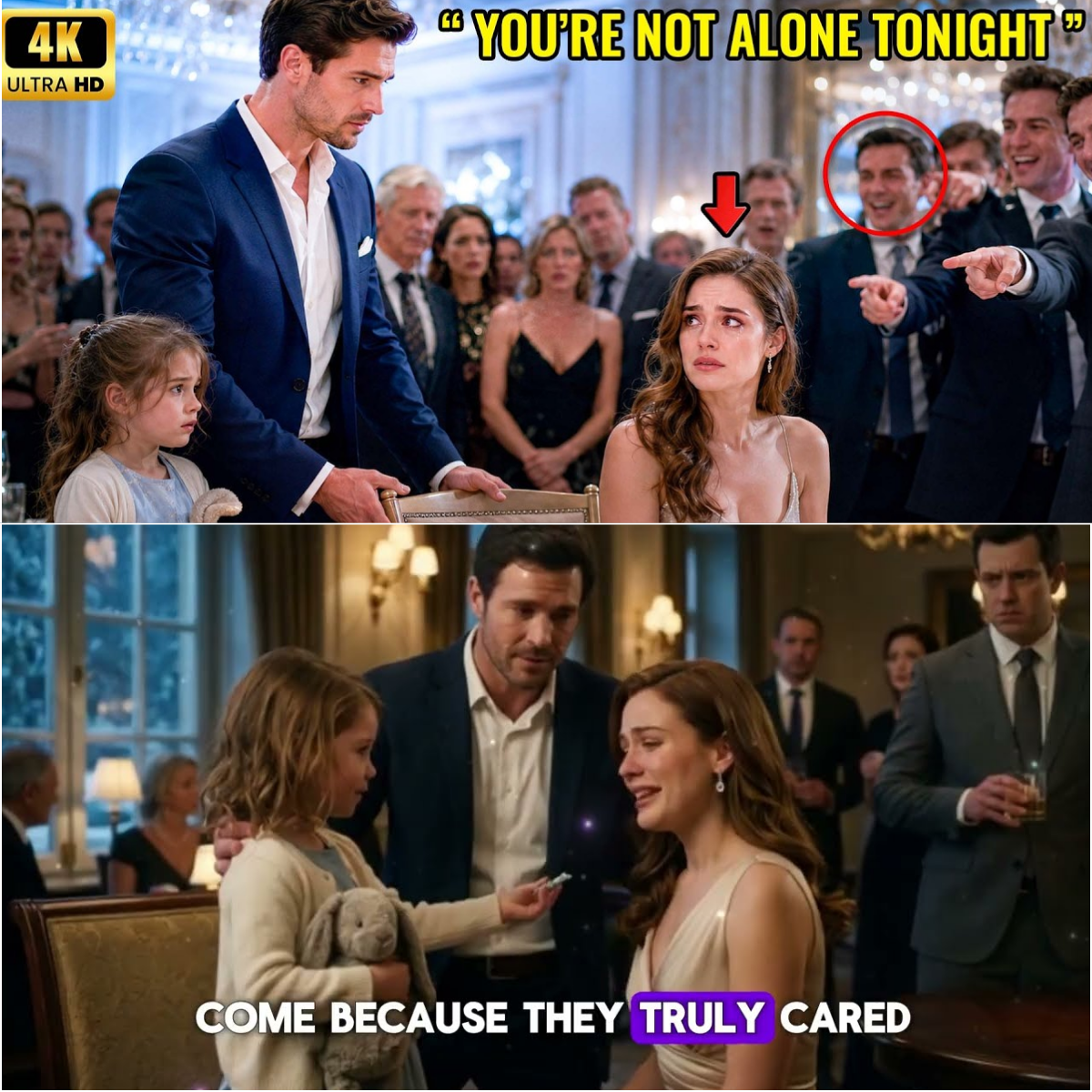
The man, of course, was Corbin Reed. And the woman they had chosen to humiliate beside him was a quiet, solitary figure already seated at the center table of the parlor—a woman with rich chestnut hair and a champagne-colored gown that caught the dim light.
When the side parlor door clicked open a few minutes later, Corbin Reed stepped through it, holding the small, warm hand of his six-year-old daughter, Louisa. Corbin wore a navy suit that he had owned for almost a decade, a crisp white shirt he had carefully ironed on his kitchen counter that afternoon, and a pair of leather dress shoes that had been polished so many times the toes had gone soft. He looked in every direction like a man who did not quite belong in a luxury hotel. And yet, he stood with the patient, quiet dignity of a man who had decided long ago never to apologize for his circumstances.
Louisa wore a simple, pale blue cotton dress and clutched a worn rabbit plush named Milo tightly against her chest. The moment they crossed the threshold, the laughter from Clinton’s table rose like a flock of birds startled out of a winter tree.
Corbin had not always been a single father. He had grown up in a quiet, working-class suburb west of the city, the son of an independent electrician and a night-shift pediatric nurse. From the time he was a young boy, he had loved the way broken things became whole again under careful, patient hands. He had not gone to a four-year university because his family simply could not afford the tuition, and he had never been the kind of young man to resent that reality. He had learned a valuable trade, taken deep pride in his workmanship, and married at twenty-two a woman who had, at first, loved his absolute steadiness.
Later, however, she grew to resent it. As the years grew thin and the bills did not, the romance faded. When Louisa was barely past her first birthday, his wife had left a folded note on the laminate kitchen table that read only that she could not do this anymore. She was gone before the sun rose over the highway.
Corbin had stood for a very long time in the quiet hallway that morning, holding the cold note in one hand and the warm, breathing weight of his infant daughter in the other. Somewhere in the silence between those two things, he had decided what kind of father he would be. He would not be loud, he would not be perfect, but he would never be absent, and he would never let his daughter learn from him that the world owed her bitterness.
In the years that followed, he had taught himself to braid hair from old internet videos, to make a comforting chicken soup that Louisa called “the warm one,” and to hand-mend the cuffs of a small winter coat outgrown three seasons in a row. At work, the foreman trusted him completely because his repairs lasted, his invoices were fundamentally honest, and he had never once raised his voice on a chaotic job site.
But Clinton Brooks and the men who orbited him had decided early on that Corbin’s quiet decency was a silent insult to their louder, lazier lives. They had taken to calling him “Mr. Lunchbox” behind his back because he carried his lunch to work every single day in a scratched steel container his father had given him in 1994.
Once, in the company breakroom, Clinton had said something incredibly cruel about Corbin needing a wife the way a stray dog needs a home, unaware that little Louisa had been waiting down the hall. That night, in the small kitchen of their apartment, Louisa had looked up from her dinner and asked him if she made him hard to love. Corbin had set down his fork, looked at her for a long, silent moment, and told her very gently that she was the exact reason he tried to be a man worth loving. He remembered that conversation vividly as he buttoned his old navy suit jacket on the night of the gala.
At the center table of the parlor, Adelaide Monroe sat with her hands folded carefully in her lap, the way a woman sits when she has been taught from childhood to hold perfectly still under cold inspection. She was twenty-eight years old, with chestnut hair that fell in loose, natural waves past her shoulders, and a champagne gown that caught the chandelier light along its narrow, elegant hem. She was, by any objective measure, a beautiful woman, but the kind of beauty she carried was not the kind that asked to be looked at. It was the kind that had survived being looked at the wrong way for far too long.
Six years earlier, Adelaide had been the proud daughter of a small-town hotelier whose lifelong business partner had cheated him out of nearly everything he owned. Her father had died of a sudden, grief-induced stroke three months after the bankruptcy. Her mother had grown terribly ill that same winter, and Adelaide, then just twenty-two, had taken a grueling job in the laundry room of a massive commercial hotel her family had once supplied with fine linens. She had folded heavy sheets for fifty hours a week, bringing home the bitter smell of industrial bleach in her hair, and she had told absolutely no one that her last name had once meant something important in those very rooms.
On a wet, slick night in October, while driving home from a double shift, her compact car had been violently struck by a delivery truck that ran a dark red light. The months of surgeries and painful physical therapy that followed had permanently taken from her the easy, graceful gait she had grown up with. When she finally returned to public life with a slight, subtle limp, the affluent people who had once eaten lavish dinners at her father’s table had a cruel name for her. They called her behind cupped hands “the charity case,” because they believed she only existed at high-society parties so that other people could feel kind for tolerating her presence.
At one such party, a prominent local man in a tailored gray suit had told her loudly enough for the entire room to hear that he did not perform charity on the dance floor. She had carried the weight of that sentence with her for almost six years. And although she had quietly built a hospitality empire in those six years that now owned more than forty luxury properties across the country, the phantom sting of that sentence had never quite left her.
She was at the gala that night because her company, Monroe Hospitality Group, had finalized the massive purchase of the Monroe Grand Hotel that very morning. She had explicitly told her executive assistant that she did not want her arrival to be announced to the press. She had told the general manager, an older, traditional man named George Whitman, that she would be observing the historic property’s internal culture from the inside out. So, she had taken an unassuming seat in the side parlor, asked a waiter for a simple glass of water, and watched the unfolding room the way a woman watches a familiar, predictable storm.
Clinton Brooks had been waiting anxiously for his cue. The moment Corbin and Louisa stepped further into the carpeted parlor, Clinton rose flamboyantly from his seat, raised his glass of bourbon high, and called across the room in a booming voice meant to carry.
“Well, look who finally made it!” Clinton announced, grinning broadly. “I am so incredibly glad Corbin has arrived, because the boys and I have spent the last week finding the absolute perfect match for him! A woman so perfectly suited to a tired, broken-down single father that the two of them might as well have been ordered directly from the same discount catalog!”
A few of the men at his table laughed loudly before they had even fully processed the punchline, but Adelaide, sitting at the center table, did not look up from her glass. Corbin walked the length of the parlor in total silence, with Louisa pressed close to his hip. He stopped a respectful distance from the center table, gave a polite nod to the seated woman, and said, “Good evening,” with the calm, innate courtesy he would have offered to any stranger on the street.
Adelaide returned the nod subtly without lifting her eyes. Clinton, sensing the room was not yet hot enough for his liking, stepped forward onto the plush carpet to fan the flames of the humiliation.
“Come on, don’t be shy, Corbin!” Clinton announced, his voice echoing off the gilded walls. “This pairing is an absolute gift to the city! A single father with absolutely no time or money for his own life, and a woman the city itself decided to forget years ago! I invite the entire room to raise a glass to the couple of the year. No one else in this town wanted either of them, so it’s only fair they’re stuck with each other!”
The laughter that followed that remark was significantly thinner than Clinton had hoped for. A few of the older guests at neighboring tables completely stopped chewing their food. One elegant woman in a dark gray dress set her fork down with a sharp click and looked, for the first time, at the small, innocent girl standing beside Corbin’s leg.
Louisa did not understand the exact meaning of all the words being thrown around, but she understood the harsh, cutting shape of them. She tightened her grip on Milo, pressed her shoulder hard into the side of her father’s thigh, and did not cry. She had learned early—the way some children unfortunately learn too early—that crying in public only made certain kinds of men laugh harder.
One of Clinton’s friends, a heavy-set man with a thin mustache, glanced over at Louisa and added in a voice he mistakenly believed to be charming, “Hey, look on the bright side, Corbin! The woman across the table can practice being a stepmother right away and save herself some time!”
The remark landed in the parlor like a heavy glass dropped on hard ceramic tile. A waiter standing near the wall closed his eyes for a short moment, as though the sheer ugliness of the sound had struck him personally.
Corbin, who until that exact second had been quietly weighing whether or not to leave the room with finality, felt something deep inside his chest move from cautious restraint into absolute resolve. He did not raise his voice. He did not even turn his body toward Clinton’s rowdy table.
Instead, he bent down slowly and whispered to Louisa to stand close beside him for just a brief moment. Then, he walked over to the empty chair at Adelaide’s table, drew it back with a smooth, deliberate motion, and offered it to her with the same simple, reverent gesture a son offers his mother on a Sunday afternoon. He pulled out a second chair for Louisa, gently settled the small girl into it, and placed her stuffed rabbit carefully on her lap.
Only then did he take his own seat across from Adelaide, lifting his eyes to meet hers directly.
“I am so incredibly sorry,” Corbin told her in a low voice meant only for her ears. “Whatever this evening was arranged to be, you do not deserve to be made into a cheap punchline by men who haven’t earned the right to speak your name.”
The words were not loud enough to silence the entire room, but they were said clearly enough that the guests at the nearest tables heard them perfectly. One by one, the surrounding conversations slowed to a halt.
Adelaide lifted her gaze from her water glass for the first time since Corbin had entered the parlor. What she saw on his face surprised her infinitely more than the apology itself, because she saw a man who genuinely had not noticed that he had done anything noble. He was simply being human.
Clinton, sensing the moral authority of the room shifting rapidly away from him, gave a short, forced laugh and called out, “Oh, come on, Corbin, don’t be so dramatic! The whole thing was just a friendly joke among colleagues.”
Corbin turned his head then, slowly, and looked directly at the man he had worked beside for almost three years.
“Clinton,” Corbin said evenly, his voice cutting through the parlor, “if this is your idea of a joke, I understand now why you don’t know how to respect any woman at all.”
A few people at neighboring tables drew in a sharp breath at the same time. But Corbin was not finished. He kept his eyes locked on Clinton.
“I came here tonight because a co-worker told me there was a kind woman who wished to meet me,” Corbin told the room, never once raising his voice. “I did not come to sit in a room where grown men insult complete strangers and call it humor. And,” he added, looking briefly down at Louisa’s upturned face, “I will not allow my daughter to learn that laughing at someone else’s pain is the same thing as having a sense of humor.”
The side parlor went deeply quiet in a way that even the pianist a wall away seemed to instinctively feel, because the music outside slowed down and dropped to a much softer, distant phrase. Adelaide watched Corbin’s profile in that sudden, heavy quiet, and she felt something inside her—something that had been frozen solid for a very long time—shift just slightly. It was the way the first thin crack runs across the surface of a frozen lake that has not moved in years.
He turned back to Adelaide once the silence had fully settled, and his tone changed entirely, becoming softer, almost entirely private. Although every single guest within twenty feet had completely stopped pretending not to listen, he spoke to her as if they were entirely alone.
“If you want to leave this parlor right now, I will walk you out myself,” he told her gently. “If you want to stay, I will sit across from you for as long as this evening lasts. Whatever you choose, you will not have to face the rest of this night alone.”
Adelaide had not been given a real, meaningful choice in a very long time. Her family’s bankruptcy had been chosen for her by men in expensive suits with thin pens. Her devastating physical injury had been chosen for her by a reckless driver who never even wrote her a letter of apology. Her reputation in this city had been decided for her by superficial people who had determined long before she ever arrived what kind of woman she was permitted to be.
So, she sat for a moment in the beautiful quiet that Corbin had built for her, feeling the incredible shape of an offer she had almost forgotten how to recognize. When she finally answered him, her voice was steady in a way that surprised even her.
“I would like to stay,” she said.
He nodded once, told her simply, “Then we’ll stay,” and the matter for him seemed entirely closed.
Louisa, who had been watching the exchange with the absolute seriousness only a six-year-old can manage, reached into the small velvet pocket of her pale blue dress. With immense care, she drew out a single mint candy wrapped in crinkly waxed paper. She slid it slowly across the white tablecloth toward Adelaide with the careful gravity of a child handing over a rare, priceless gem.
“My dad gives me one of these whenever I feel sad,” Louisa whispered to Adelaide. “You can have mine if you need it more tonight.”
The small mint sat between them on the linen like a small white stone. Adelaide looked down at the candy, then at the beautiful child who had offered it, and finally at the father whose hand rested protectively on the back of his daughter’s chair.
“Thank you, sweetie,” Adelaide said, her voice dropping to a gentle whisper. “But will you have any left for yourself if you give this one away to me?”
Louisa thought about it for a short moment, tilting her head. “I’ll still have my dad,” she told Adelaide completely seriously. “And that’s always enough. So the candy can be yours.”
The sentence was not designed to wound, and that was precisely what made it so incredibly dangerous. Adelaide pressed her fingertips tightly to her mouth for a moment to steady her trembling lips. She lifted the small candy carefully and set it right beside her water glass, treating it as though it were a sacred relic she had been entrusted to guard.
“Thank you, Louisa,” she whispered, and her voice did not entirely belong to her when she did. Corbin gave his daughter a small, proud pat on the shoulder.
The first course of the dinner arrived in a respectful hush, and the table found, almost by accident, the comfortable rhythm of two people who had decided to be entirely present for each other. Corbin asked Adelaide whether she preferred the salmon or the chicken, and Adelaide, sounding faintly surprised at the sheer ordinariness of the question, told him she didn’t really mind either way. He asked her if she attended high-profile charity events like this often.
“I used to, in a very different version of my life,” she told him honestly. “But it has been a very long time since I have felt easy in a room full of strangers.”
He did not press her for details. Adelaide had been studied and analyzed for years by manipulative men who wanted something from her, and she had grown incredibly skilled at recognizing the sharp angles of their hidden motives. She did not recognize any angles in Corbin’s questions. He was asking what he asked simply because he wanted her to be comfortable, and that was so utterly unfamiliar to her that she found herself opening up.
“Are you always this calm under fire?” she asked him, leaning in slightly.
“I’m not,” Corbin admitted with a faint smile. “But I taught myself years ago never to lose my temper or my dignity in front of my daughter. That lesson cost me more than I like to admit, but it has saved me more than I could ever repay.”
She glanced down at Louisa, who was now coloring intently on the back of a paper place card with a ballpoint pen Corbin had pulled from his inside jacket pocket. “She clearly trusts you completely,” Adelaide noted.
“I can’t give her everything the world has to offer,” Corbin answered softly, his eyes fixed on his daughter’s dark curls. “But I decided long ago to give her the one thing I can actually promise, which is that when I say I will be there, I will be there.”
He said the words without any hint of performance or bravado, and Adelaide had to look down at her silver fork for a moment to gather her emotions. Then, slowly, she chose to share a piece of her own story with him—only the smallest, most honest portion.
“Years ago, I was invited to a party in this very hotel,” she told him quietly. “It was right after my family lost everything. The people at the table recognized who I was, and they made an entire evening’s entertainment out of reminding me how far I had fallen. After my car accident, the names they gave me stuck. Even now, in rooms much larger than this one, I still sometimes hear them whispering.”
Corbin listened intently, never once interrupting her. When she finished, he looked at her with an expression of absolute clarity. “A person worth respecting does not need to know your past in order to decide whether to treat you well right now,” he said.
“Aren’t you afraid of being laughed at yourself?” she asked him, gesturing slightly to the room. “For sitting here with me in front of all these people?”
Corbin looked down at Louisa, who had begun to draw a small, uneven heart on the corner of the place card. “I am infinitely more afraid of my daughter someday seeing me stay silent,” he said.
Clinton had been watching the center table from across the parlor, and what he saw there had begun to completely ruin his evening. The boisterous laughter at his own table had entirely thinned out. Two of his colleagues were studying their plates in silence. An elegant woman at a neighboring table had turned her chair slightly so that her shoulder was completely angled away from him. The joke he had constructed so carefully was no longer funny, and Clinton, who had spent his entire adult life mistaking loud attention for genuine respect, could not bear the loss of the room.
He stood up abruptly, gripping his bourbon glass, and crossed the carpet with the loose, aggressive stride of a man who believed he could still recover the night through sheer bravado. He stopped right at the edge of Adelaide’s table, looking down at the three of them with a smirk.
“Well, aren’t you three just the picture of perfection?” Clinton remarked loudly, his voice dripping with sarcasm. “A poor single father playing the grand gentleman, and a woman the city pitied years ago playing the fine lady. It’s almost beautiful.”
The parlor cooled by several degrees instantly. Adelaide’s hands stilled completely on the stem of her glass. Louisa stopped coloring. Corbin set his fork down very carefully on the rim of his plate.
Clinton, seeing he had successfully recaptured the room’s attention, leaned in closer and addressed Corbin directly. “Come on, Corbin, be honest just this once in front of the people who actually know you. If you had any other choice in the world tonight, would you really be sitting at this particular table with this particular woman?”
The question was the exact kind of question a small, insecure man asks when he desperately wants a larger man to lie in public. Corbin glanced at Adelaide first, his expression carrying a deep, protective softness that was not for Clinton at all. It was the way a man checks on someone he has decided to keep safe.
Then, Corbin stood up. He did not lean forward aggressively. He did not push his chair back hard against the floor. He simply rose to his full height, looked Clinton dead in the eye, and answered in a voice that did not need a shred of volume to reach every single corner of the parlor.
“Yes,” Corbin said clearly. “I would still sit here. In fact, I would sit at any table where someone is being insulted, because I could not in good conscience sit at a table with the person insulting them.”
Clinton tried to maintain his smirk, his face flushing. “Oh, so now you’re acting like you’re morally superior to everyone else in this room?”
Corbin shook his head once, his expression perfectly calm. “I am not trying to be better than anyone in this room, Clinton. I am only trying to live my life in a way that ensures my daughter will never, ever be ashamed to call me her father.”
As he spoke, several of the guests at the surrounding tables looked over at Louisa. For the first time that evening, they allowed themselves to truly see what was happening. They saw a small, innocent six-year-old girl with damp eyes who was learning in real time exactly what kind of grown-ups inhabited her world.
Adelaide saw it, too. She saw the child quietly absorbing the cold cruelty of a room full of wealthy adults, and she recognized in the tight fold of Louisa’s mouth the exact same expression she herself had worn at a different table in this very hotel six years ago. The sudden shock of recognition struck her so cleanly that she could no longer hold her composure. A single, silent tear slipped down her cheek, and she lifted her linen napkin to it, almost apologetically.
Louisa watched the tear fall. With a profound seriousness, the little girl set her crayon down, climbed completely off her chair, and walked the few steps to stand directly between her father and the man with the bourbon glass. She held Milo tightly against her chest with both arms, looked up at Clinton, and spoke. Her voice was small, but it carried through the absolute quiet of the parlor like a crystal note struck on fine glass.
“Sir,” Louisa said, using the polite word her father had taught her to use for men he did not respect. “My dad says that grown-ups who are really kind don’t make other people cry and then call it a joke.”
She said it with the absolute certainty of a child reporting an unshakeable truth learned at school. Then, she turned her small body toward Adelaide.
“It’s okay,” Louisa told her softly. “You don’t have to cry anymore. If no one else in this room wants to sit with you, my dad will sit with you, and so will I.”
She held out one small hand, palm up, the way children do when they are offering a pure, uncomplicated friendship.
The parlor did not so much fall silent as entirely remember how to be silent. The faint clatter of silverware at distant tables stopped completely. The pianist outside let one final note hang in the air and did not begin the next phrase. A woman in a long gray dress by the window lifted her hand to her mouth in shock. Even the waiter, who had been actively pouring wine at the side of the room, set the bottle down with immense care, as if terrified of making a single sound.
Adelaide reached out and took the small, warm hand that had been offered to her. She did not trust her own voice, so she did not try to speak. Corbin knelt down slowly on the carpet, gathered Louisa back into his arms, and told her in a low, tender whisper that she had done a beautiful thing. He pressed his cheek briefly to the top of her head.
Across the table, Adelaide was crying without a single sound—the way women cry who have not allowed themselves to show vulnerability in front of strangers in a very long time. And the room around them, caught in the sudden weight of their own collective silence, seemed to be crying with her.
The side parlor’s double doors opened then, not with theatrical drama, but with the quiet, authoritative swing of a hinge that had been waiting all night to open.
The general manager of the Monroe Grand Hotel, a distinguished, silver-haired man named George Whitman, stepped through the doorway with two sharply dressed assistants trailing closely behind him. He had been searching the sprawling property for Adelaide for the better part of an hour. The moment his eyes landed on her sitting at the center table with a napkin pressed to her face, his expression slackened with deep concern and then instantly sharpened with profound apology.
He crossed the parlor quickly, ignoring everyone else, and bowed his head toward her with a level of formal deference that did not belong to ordinary hotel work.
“Miss Monroe,” George said quickly, his voice carrying clearly across the quiet room. “I am so incredibly sorry for the delay. The entire board of directors is waiting for your arrival in the main hall. I had absolutely no idea you had taken your seat in this side parlor instead. Do you require anything at all before I escort you to the head table?”
A soft, frantic murmur immediately ran through the parlor—the sound of four dozen wealthy guests repeating one single name to themselves and finding it entirely terrifying in this new context.
Clinton’s mouth opened slightly, but he did not manage to produce a single coherent sentence. He looked at the revered general manager, then at the quiet woman in the champagne gown, and then back again. His face shifted through three distinct shades of color before finally settling on something close to ash gray.
George Whitman turned his head then, noticing Clinton standing aggressively over Adelaide’s chair for the first time. His eyebrows rose sharply. He chose his next words with the clean, lethal precision of a man who had spent forty years in luxury hospitality management.
“For those of you who are unaware,” George announced to the entire parlor, his voice echoing with absolute authority, “this is Adelaide Monroe. She is the Chief Executive Officer of the Monroe Hospitality Group. Her company finalized the multi-million-dollar acquisition of the Monroe Grand Hotel at precisely nine o’clock this morning. Which means, ladies and gentlemen, that you are all quite literally her guests tonight.”
The parlor did not gasp. It did something much more profound and complete. It contracted.
The older woman who had earlier whispered cruel comments about Adelaide’s family lowered her gaze deeply into her wine glass. The heavy-set man with the thin mustache suddenly discovered something absolutely fascinating about the napkin in his lap. Clinton took a slow half-step backward, as if physical distance could somehow rewrite the narrative of the last hour.
Adelaide rose from her chair smoothly. She lifted her linen napkin, set it neatly beside her plate, and adjusted the elegant sleeve of her gown with the absolute calm of a woman who had survived far worse rooms than this one. She did not raise her voice. She did not need to. She turned her body, looked Clinton fully and squarely in his pale face, and spoke.
“I am entirely aware that you had no idea who I was when you walked over here tonight, Mr. Brooks,” Adelaide told him. “And that is precisely why what you did tonight matters so much.”
The sentence settled across the room like heavy winter snow.
“Miss Monroe, please,” Clinton stammered, the last of his arrogant composure completely evaporating. “It was… the whole thing was just a misunderstanding. It was a joke. Just a joke between guys from the office, I swear.” He used the word “joke” like a drowning man uses a frayed rope.
Adelaide listened to him without a single interruption. When he finally trailed off, she answered him with a single line that would later be widely quoted in hospitality trade journals across the country.
“A joke is only a joke, Mr. Brooks, when the person it is aimed at can also laugh,” she said coldly.
She turned away from him entirely, addressing George Whitman. “George, I want the complete guest list for this side parlor, the exact name of the maintenance contracting firm currently under retainer with this property, and a full report on the behavioral standards expected of our contractors.”
George nodded instantly, drawing a silver pen from his jacket. “Right away, Miss Monroe.”
Behind Clinton, his two remaining colleagues quietly gathered their coats from the back of their chairs and began to slip out the back exit. What Adelaide did next was the exact thing that would define the story in the city for years to come. She did not order Clinton to be publicly humiliated. She did not have security drag him out of the building by his collar—an act that would have been intensely satisfying to everyone present, but entirely beneath her in every way that mattered.
Instead, she turned her eyes to the parlor as a whole.
“True elegance does not live in the crystal chandeliers above our heads, and it does not live in the cost of the wine on these tables,” Adelaide told the quiet room. “It lives entirely in how each of us, on any given night, chooses to treat the people who can do absolutely nothing for us in return.”
She turned back to Corbin, her expression transforming instantly into something warm, respectful, and deeply genuine. She looked down at Louisa, who was once again holding her hand out. Adelaide took the little girl’s hand in hers, turning to Corbin.
“Mr. Reed,” Adelaide said softly, “the board of directors can wait a little longer. If the offer still stands, I would be absolutely honored to spend the rest of my evening at this table with you and your daughter.”
Corbin looked at her, a quiet, handsome smile touching the corners of his eyes. He drew her chair back once more. “The offer stands,” he said.
As Adelaide took her seat, the pianist outside struck a new, beautiful chord, and the room began to breathe again. Clinton Brooks stood frozen in the shadow of the chandelier for a moment longer, entirely invisible, before walking out into the cold winter night alone.