Tucker Carlson Issues Critical WARNING About Iran Deal: “Israel Will Sabotage It!”
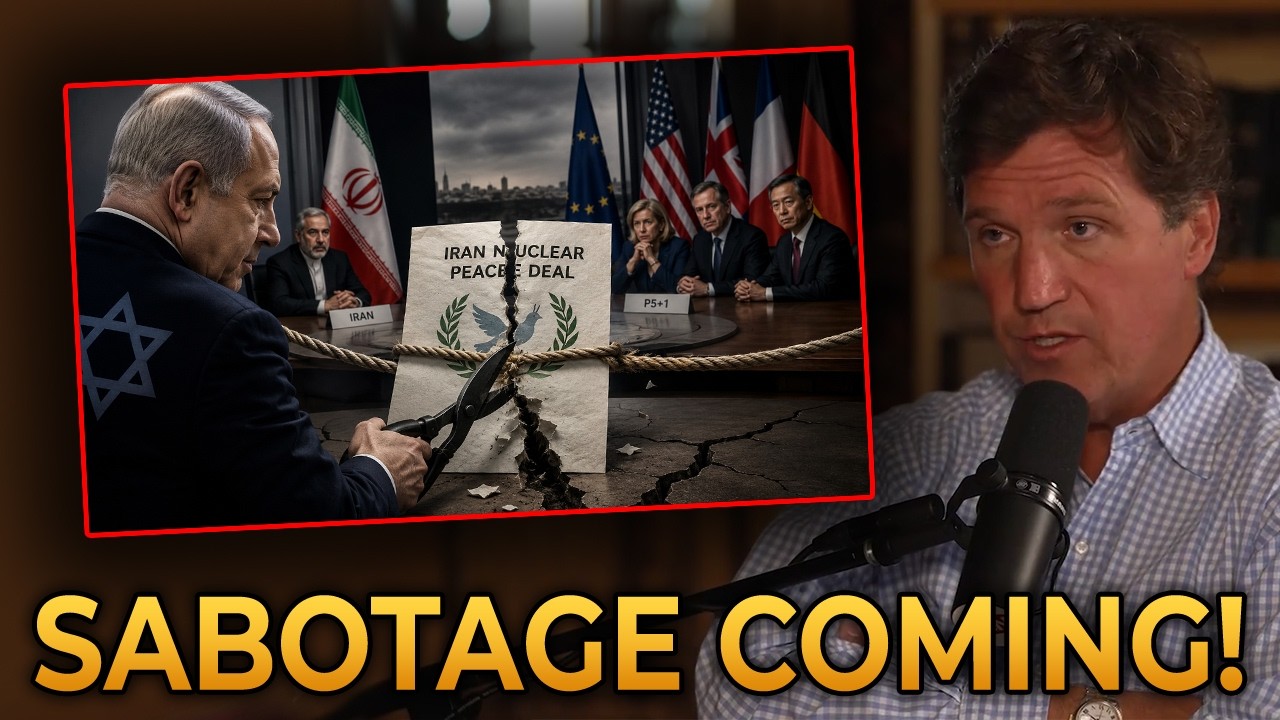
Did the U.S. Really Lose the Iran Conflict? Why Tucker Carlson Says Washington Had No Choice but to Make a Deal
History rarely announces itself with fireworks. More often, it arrives disguised as a compromise.
When governments celebrate diplomacy after months of promising total victory, one uncomfortable question inevitably follows: Who actually won? That question now sits at the center of one of the fiercest debates in American politics—not just between Democrats and Republicans, but within the conservative movement itself. At the heart of that debate is a claim that has sparked outrage across Washington: the agreement between the United States and Iran was not a strategic triumph, but an acknowledgment that America could not achieve the objectives it originally set out to accomplish.
That argument, championed by Tucker Carlson and echoed by several foreign policy skeptics, has opened a political fault line few expected to see. The same coalition that stood largely united behind Donald Trump on national security issues is suddenly divided over one of the most consequential foreign policy decisions of his presidency. Israel’s strongest supporters are openly criticizing Trump, while many anti-intervention conservatives are urging him to hold the line and resist renewed pressure for escalation.
Whether one agrees with Carlson’s conclusion or rejects it entirely, the debate exposes something much larger than a single ceasefire or diplomatic memorandum. It forces Americans to confront difficult questions about military power, alliance politics, economic limits, and the true costs of modern warfare.
The Argument That Washington Couldn’t Ignore
For months, the public was told that overwhelming American military superiority would eventually force Iran into submission.
Supporters of military action argued that sustained pressure would cripple Iran’s capabilities, weaken its regional influence, and potentially create conditions for political change inside the country. Critics warned from the very beginning that those expectations dramatically underestimated both Iran’s geography and its ability to absorb military pressure.
Now, according to Carlson, the final agreement itself tells the story.
His central claim is remarkably simple.
If the original objectives included forcing regime change, dismantling Iran’s missile capabilities, eliminating its regional influence, or compelling unconditional surrender, then any agreement that leaves the Iranian government intact represents an admission that those goals proved unattainable.
In Carlson’s view, the document is significant not because of what it says explicitly, but because of what it silently acknowledges: Iran remains a major regional power whose government must be negotiated with rather than removed.
That conclusion carries enormous symbolic weight.
Throughout modern history, great powers have often measured success not simply by battlefield victories but by their ability to dictate political outcomes. When negotiations replace demands for surrender, critics argue that the balance of leverage has shifted.
Carlson believes exactly that has happened.
More Than a Military Debate
The discussion extends far beyond military strategy.
Carlson argues that America’s greatest mistake was entering a conflict whose political objectives were never realistically achievable.
Military historians have long distinguished between tactical victories and strategic success. An army may win individual battles while failing to achieve its broader political goals. History offers numerous examples—from Vietnam to Afghanistan—where overwhelming military capabilities did not translate into lasting political outcomes.
According to Carlson, Iran belongs in that category.
His reasoning begins with geography.
Iran is not a small state vulnerable to rapid occupation or political collapse. It is a nation of roughly ninety million people, protected by difficult mountainous terrain, extensive missile infrastructure, and one of the world’s most strategically significant coastlines.
Even critics of the Iranian government generally acknowledge that occupying such a country would require an enormous military commitment extending far beyond air strikes or limited missile campaigns.
Carlson argues that this reality made many of the original objectives unrealistic from the start.
If regime change required a massive ground invasion that no American administration was politically willing to undertake, then the promised outcome was never actually attainable.
In that sense, he argues, the agreement merely formalized a reality that already existed.
Why the Strait of Hormuz Changes Everything
Perhaps the most important part of Carlson’s analysis focuses not on weapons but on geography.
Iran occupies the northern side of the Strait of Hormuz, one of the world’s most important maritime chokepoints.
A substantial share of global energy exports passes through this narrow waterway each day. Any prolonged disruption has the potential to send energy prices sharply higher, affecting economies around the globe.
Carlson argues that this geographic advantage gives Iran leverage that cannot simply be destroyed through conventional military operations.
Even without matching the United States in overall military strength, Iran retains the ability to threaten global energy markets during periods of conflict.
That, he suggests, creates a powerful deterrent.
In his interpretation, the agreement represents an implicit recognition that geography—not ideology or military technology—ultimately shaped the outcome.
History has repeatedly demonstrated that strategic geography often outlasts military campaigns.
Governments change.
Weapons evolve.
Technologies become obsolete.
But mountains remain mountains, and narrow waterways continue to influence world politics long after wars have ended.
A Divided Conservative Movement
Perhaps the most politically significant consequence of the agreement is not its effect on Iran but its effect on American conservatives.
For years, Republican foreign policy largely revolved around strong support for Israel and a willingness to project American military power abroad.
That consensus now appears increasingly fragile.
Carlson argues that many conservative voters who once accepted interventionist policies have grown skeptical after decades of costly conflicts that produced uncertain outcomes.
The Iraq War, the war in Afghanistan, intervention in Libya, and continuing instability across the Middle East have all contributed to growing fatigue among parts of the American electorate.
The Iran agreement has intensified that divide.
Some conservatives argue that accepting negotiations rewards Iranian aggression and weakens American credibility.
Others contend that endless military escalation would have imposed even greater costs while offering little chance of achieving the stated objectives.
This disagreement is no longer confined to think tanks or academic journals.
It now reaches television studios, congressional offices, and the Republican Party itself.
Is This America’s Suez Moment?
One of Carlson’s most provocative comparisons reaches back nearly seventy years.
He invokes the 1956 Suez Crisis, when Britain and France launched military operations against Egypt only to discover that they lacked the political and economic power to impose their preferred outcome without American support.
Many historians regard that crisis as a defining moment in Britain’s transition from global empire to secondary power.
Carlson does not argue that the United States is experiencing an identical decline.
Instead, he suggests the agreement could become one of those historical moments that later generations identify as a turning point.
The comparison is intentionally dramatic.
Whether it proves accurate remains an open question.
The United States continues to possess the world’s largest defense budget, unmatched global military reach, and extensive alliances across multiple continents.
Yet Carlson argues that military capability alone does not determine geopolitical influence.
The more important question is whether that capability can consistently achieve political objectives at an acceptable cost.
If not, then even overwhelming military superiority may have practical limits.
That possibility lies at the heart of the current debate—and explains why reactions have been so emotionally charged.
For supporters of the agreement, diplomacy represents a necessary off-ramp from an increasingly dangerous conflict.
For critics, it risks signaling weakness at a moment when rivals are carefully watching every American decision.
As the political battle intensifies, one reality has become impossible to ignore: the conversation is no longer just about Iran.
It is about the future of American power itself.