God Came Down on This Mountain in Saudi Arabia — You Can Still See the Evidence
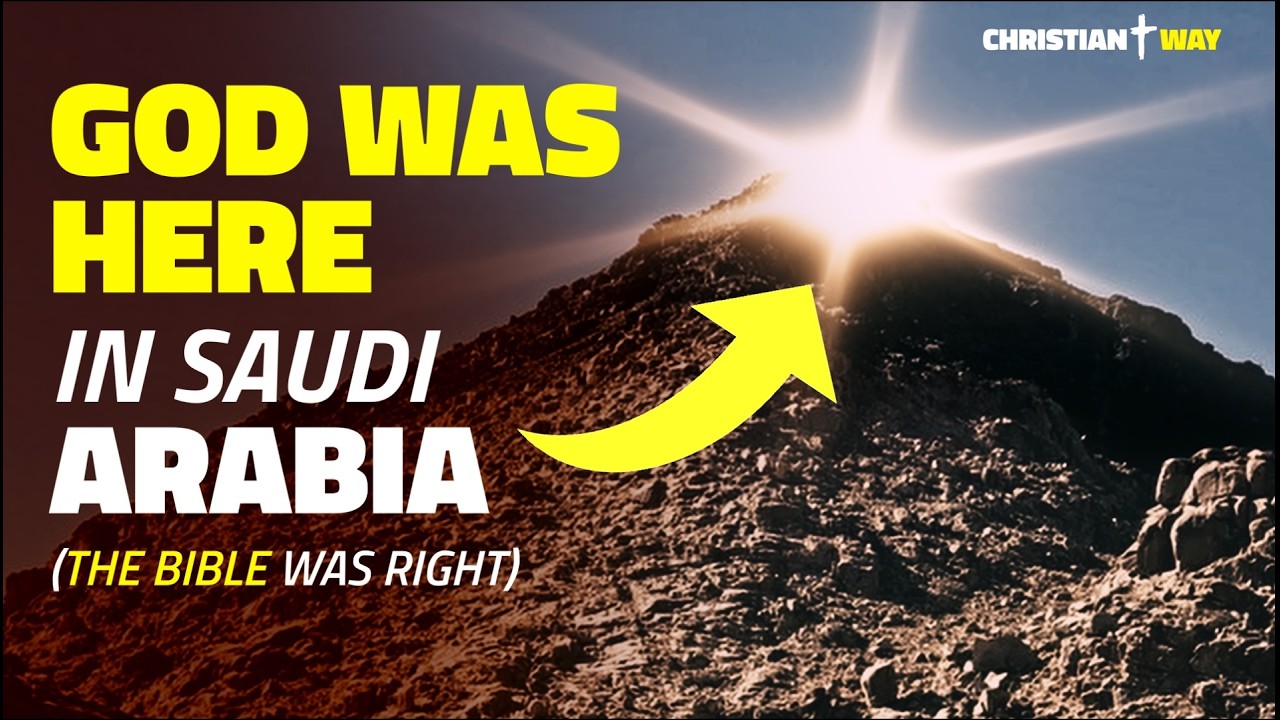
The Forbidden Mountain of Arabia: Could the Real Mount Sinai Be Hidden in Saudi Arabia?
For nearly four decades, a remote region deep inside the Saudi desert remained heavily restricted, guarded, and largely inaccessible to outsiders. No oil fields. No military bases. No strategic installations. Just a mountain, a collection of ancient stone structures, and a landscape that has fueled one of the most explosive debates in biblical archaeology.
What if the mountain traditionally identified as Mount Sinai is not the real one? What if the actual location of one of the most important events in human history has been hidden in plain sight, waiting for the modern world to discover it?
The deeper you investigate the mystery of Jebel al-Lawz, the harder it becomes to dismiss.
A Mountain Surrounded by Questions
For centuries, most Christian maps have identified Mount Sinai with the mountain near Saint Catherine’s Monastery in Egypt’s Sinai Peninsula.
Millions of pilgrims have visited the site.
Countless books, documentaries, and religious guides have accepted it as the place where Moses received the Ten Commandments.
Yet a growing number of researchers argue that this traditional identification may be wrong.
Their argument begins with a surprisingly simple observation.
The Bible itself appears to place Mount Sinai in Arabia.
One of the most frequently cited passages comes from the New Testament. In his letter to the Galatians, the Apostle Paul refers to Mount Sinai as being located in Arabia.
For many researchers, this raises an obvious question.
If Scripture points toward Arabia, why has the traditional location remained in Egypt for so long?
Some historians explain that the Egyptian tradition became widely accepted during the fourth century when Christian pilgrimage sites were being established throughout the Holy Land and surrounding regions.
Others argue that geographical assumptions gradually became fixed through centuries of tradition.
Whatever the reason, the question remains.
Could the biblical mountain actually be somewhere else?
The Land of Midian
To understand why some researchers focus on northwestern Saudi Arabia, we must revisit the story of Moses.
According to the biblical narrative, Moses fled Egypt after killing an Egyptian overseer.
Where did he go?
The answer is Midian.
The Bible describes Moses spending decades in the land of Midian, marrying there, raising a family there, and tending flocks there.
Importantly, many historians place ancient Midian within the region that today lies in northwestern Saudi Arabia.
It was there, according to Scripture, that Moses encountered the burning bush.
It was there that God called him to return to Egypt.
And it was there that Moses was told he would worship God on the mountain after leading the Israelites out of slavery.
For advocates of the Arabian Sinai theory, the logic appears straightforward.
If Moses encountered God in Midian and was later instructed to return to that same mountain, then Mount Sinai would naturally be located within or near Midian.
This interpretation forms the foundation of the entire theory.
But geography is only the beginning.
The Black Mountain
Among the most striking features associated with Jebel al-Lawz is its unusual summit.
Visitors approaching the mountain often notice something immediately.
The surrounding mountains display the typical light-colored granite common throughout the region.
Yet the upper portion of Jebel al-Lawz appears dramatically darker.
The summit looks blackened.
To supporters of the theory, this visual contrast is significant.
The book of Exodus describes Mount Sinai being covered in smoke and fire as God descended upon it.
The mountain shook.
Smoke rose upward.
The scene was portrayed as overwhelming and terrifying.
Could the blackened summit be physical evidence of that event?
Supporters argue that samples from the mountain reveal lighter-colored rock beneath the darker exterior layer.
They suggest that the black coloration appears concentrated on the surface rather than throughout the mountain.
This has led some to speculate about exposure to intense heat.
Critics, however, point out that natural geological processes can also produce dark surface coatings on rock formations. Desert varnish, mineral oxidation, and weathering effects are well-known phenomena in arid environments.
The debate remains unresolved.
Yet the visual impact of the mountain continues to capture attention.
Standing before a peak that appears scorched against the surrounding landscape, it is easy to understand why the discussion persists.
The Boundary Markers
Another frequently cited feature involves a series of stone formations near the base of the mountain.
According to Exodus, Moses established boundaries around Mount Sinai to prevent the Israelites from approaching the holy mountain during God’s presence.
The people were specifically warned not to cross the designated limits.
Researchers who support the Arabian Sinai theory point to rows of stone markers that appear to form a perimeter around portions of the mountain.
Could these be remnants of ancient boundary markers?
Supporters believe the possibility deserves serious consideration.
They argue that the arrangement appears deliberate rather than random.
Skeptics respond that stone alignments occur naturally and that many ancient cultures constructed stone features for purposes unrelated to biblical events.
Without definitive dating and contextual evidence, certainty remains elusive.
Still, the resemblance between the biblical description and the physical landscape continues to intrigue investigators.
An Altar in the Desert
Nearby lies another feature that has attracted considerable attention.
Researchers have identified a stone structure resembling an altar.
What makes the site particularly interesting is that the stones appear largely uncut.
This detail matters because Exodus contains instructions concerning altars built from natural stones rather than carefully shaped blocks.
Supporters of the Arabian Sinai theory view the structure as another potential piece of a larger puzzle.
They argue that the design corresponds remarkably well with biblical descriptions.
Could this be evidence of worship associated with the Israelites during their wilderness journey?
As with many archaeological mysteries, the answer remains uncertain.
Ancient stone structures can be difficult to interpret conclusively, especially when multiple explanations remain possible.
Yet taken together with other discoveries, the altar contributes to the growing fascination surrounding the site.
The Golden Calf Connection
Perhaps the most controversial claim involves a collection of rock carvings discovered in the region.
According to Exodus, while Moses remained on the mountain, the Israelites constructed a golden calf for worship.
The incident became one of the most dramatic moments in biblical history.
Researchers exploring the area near Jebel al-Lawz have reported petroglyphs depicting bovine figures carved into stone surfaces.
Some argue that these carvings display artistic characteristics reminiscent of Egyptian religious imagery.
This observation has generated enormous interest.
Why would Egyptian-style bovine imagery appear deep within the Arabian desert?
Supporters propose that such carvings could reflect the cultural influence carried by a population that had recently departed Egypt.
To them, the carvings represent potential archaeological echoes of the golden calf episode.
Critics caution against drawing conclusions too quickly.
Cattle imagery appears in many ancient cultures and cannot automatically be linked to a specific biblical event.
Even so, the presence of the carvings adds another layer of intrigue to the mystery.
The Split Rock of Horeb
Of all the features associated with Jebel al-Lawz, none has captured imaginations more powerfully than the enormous split rock often identified with the biblical Rock of Horeb.
The formation is astonishing.
A massive granite boulder stands isolated above the surrounding terrain.
Most strikingly, it is divided by a dramatic vertical fracture extending from top to bottom.
The split appears almost surgical in its precision.
Visitors often describe the formation as unlike anything they expected to see.
But it is not merely the split that attracts attention.
Researchers have also noted evidence of erosion around the base of the formation.
Some argue that the smoothing and shaping of nearby rocks suggest significant historical water flow.
This observation is particularly remarkable because the region is now among the driest on Earth.
Supporters connect the site to the biblical account in which Moses struck a rock and water flowed forth to sustain the Israelites.
Could this formation be the very rock described in Exodus?
The possibility captivates many believers.
Geologists, however, note that large rock fractures can occur naturally through tectonic stress, weathering, and temperature variations over long periods.
As with many aspects of the site, interpretations differ sharply.
Yet the visual impact of the formation is undeniable.
Standing before the towering split rock, one cannot help but feel that it belongs to a larger story.
A Symbol Greater Than Archaeology
For Christians, the significance of the split rock extends beyond historical questions.
The Apostle Paul offered a profound interpretation when writing to the Corinthians.
He described the miraculous rock in the wilderness as a symbol of Christ.
Just as water flowed from the struck rock to save the Israelites from death, Christians believe that spiritual life flows through Christ to save humanity.
This symbolism transforms the archaeological discussion into something deeper.
The rock becomes more than a geological feature.
It becomes a visual reminder of redemption.
Whether one accepts the identification or not, the symbolism remains powerful.
Elijah and the Cave
The mountain’s significance does not end with Moses.
According to the Bible, centuries later the prophet Elijah journeyed to Horeb, described as the mountain of God.
Exhausted and discouraged, Elijah sought refuge there.
Scripture recounts how he entered a cave and experienced a profound encounter with God.
Researchers exploring Jebel al-Lawz point to cave-like formations near the mountain’s upper slopes.
Some suggest these formations could correspond to the biblical account.
Although definitive proof remains impossible, the possibility adds yet another layer to the site’s growing reputation.
If true, the mountain would have witnessed encounters involving two of the most important prophets in biblical history.
Why Was the Area Restricted?
One question frequently raised by supporters of the Arabian Sinai theory concerns the region’s long-standing restrictions.
For years, access to portions of the area was limited.
Military presence and controlled access fueled speculation.
Some concluded that authorities were intentionally concealing evidence.
Others argue that the restrictions had more practical explanations, including border security, archaeological preservation, and regional management concerns.
Regardless of the reasons, the restricted status contributed enormously to the mountain’s mystique.
When a place remains inaccessible, curiosity naturally grows.
Stories multiply.
Questions deepen.
Mystery thrives.
What Does the Evidence Really Show?
The debate over Jebel al-Lawz ultimately highlights an important truth.
Archaeology rarely produces absolute certainty.
Instead, researchers assemble clues, compare interpretations, and evaluate competing explanations.
Supporters of the Arabian Sinai theory point to a remarkable convergence of evidence:
A location within ancient Midian.
A blackened mountain summit.
Possible boundary markers.
An altar-like structure.
Egyptian-style bovine carvings.
The massive split rock.
Cave formations associated with biblical descriptions.
Taken together, they argue, these features create a compelling case.
Skeptics counter that each piece of evidence can be explained in other ways and that none independently proves the mountain’s identity.
The discussion remains active precisely because neither side possesses conclusive proof.
The Stones That Continue to Speak
Whether Jebel al-Lawz is truly Mount Sinai remains one of the most fascinating questions in biblical archaeology.
Perhaps future discoveries will strengthen the case.
Perhaps new evidence will challenge it.
For now, the mountain stands silently beneath the desert sky.
Its black summit rises above the surrounding landscape.
Its split rock continues to inspire wonder.
Its ancient structures continue to provoke debate.
And its mysteries continue to attract pilgrims, researchers, and seekers from around the world.
The most remarkable aspect of this story may not be whether every claim proves correct.
It may be that thousands of years after the events described in Exodus, people are still asking the same questions.
Did these events really happen?
Can traces of them still be found?
And if they can, what does that mean for our understanding of history, faith, and the relationship between God and humanity?
The answers remain elusive.
But the mountain remains.
Waiting.
Silent.
And perhaps, as many believe, still telling its story to anyone willing to listen.