Evidence Found in America: They Knew About Jesus’ Death as It Happened (Ancient Documents)
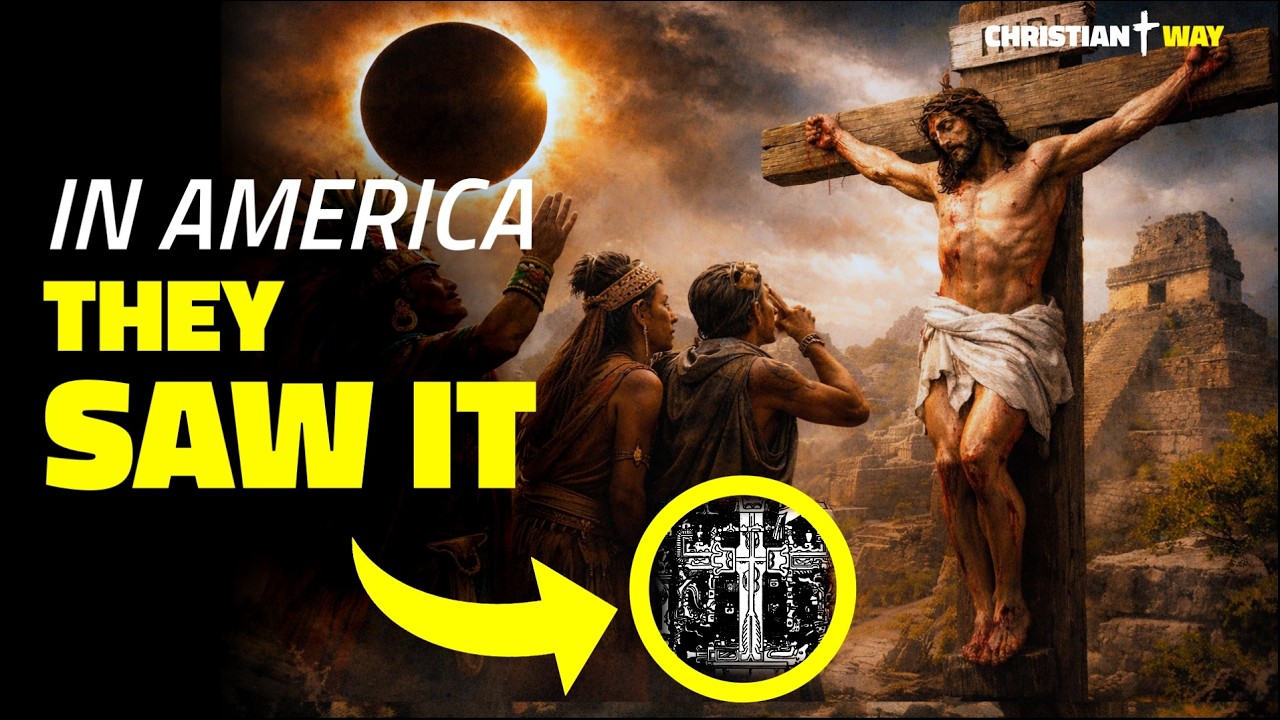
Did Ancient America Know About Christ? The Astonishing Mystery of the Crosses, Prophecies, and Legends Found Before the Spanish Arrived
Imagine entering an ancient temple deep in the jungles of Mexico expecting to find only the symbols of forgotten gods—and instead discovering a cross standing at the center of worship.
Not a decoration. Not a random carving. A sacred symbol associated with life, salvation, and victory over death.
That is exactly the mystery that confronted some of the first Christian missionaries who arrived in the Americas. The deeper they explored the traditions, legends, and monuments of the Maya and Aztec civilizations, the more disturbing—and fascinating—the puzzle became. How could cultures separated from Europe and the Middle East by vast oceans possess symbols, stories, and traditions that appeared strikingly similar to themes found in Christianity?
Was it coincidence? Was it cultural misunderstanding? Or could these ancient civilizations have preserved fragments of truths far older than anyone imagined?
For centuries, historians, theologians, archaeologists, and believers have debated these questions. While definitive answers remain elusive, the evidence has inspired one of the most intriguing mysteries in religious history: the possibility that traces of biblical truths existed in the Americas long before the arrival of Columbus.
The story begins with a cross carved in stone.
The Crosses Hidden in Ancient Temples
When Spanish missionaries first encountered certain sacred sites among the Maya, they were surprised by what they found.
At places such as Palenque and Cozumel, crosses occupied important positions within religious imagery and ceremonial spaces. To the Maya, these symbols were often associated with sacred trees, cosmic order, and life itself.
One of the most famous examples is the so-called “Cross Group” at Palenque, where elaborate carvings depict a stylized sacred tree in the shape of a cross.
To modern scholars, these symbols are generally understood within the context of Mayan cosmology rather than Christianity. Yet for the missionaries who first encountered them, the resemblance was impossible to ignore.
They saw a civilization that had never received the Gospel, yet possessed a symbol that Christians associated with redemption and eternal life.
This raised an obvious question.
Why did a people isolated from Europe develop a sacred symbol that looked so familiar?
Some argued it was coincidence. After all, intersecting lines are among the simplest symbols imaginable.
Others believed something deeper was occurring.
Perhaps humanity’s spiritual memory preserved echoes of truths that stretched back to a common origin.
Whatever the explanation, the cross was only the beginning of the mystery.
The Legend of the Man Who Came From the Sea
As missionaries continued studying indigenous traditions, they encountered stories that seemed even more remarkable.
Throughout Mesoamerica, various cultures preserved legends about a mysterious teacher who arrived from across the sea.
Among the Aztecs, he became known as Quetzalcoatl.
Among the Maya, a similar figure appeared under the name Kukulkan.
Modern popular culture often portrays these figures primarily as feathered serpent deities. Yet early accounts and indigenous traditions contain descriptions that are far more complex.
Some narratives describe a wise teacher who came from the east.
A man associated with peace rather than conquest.
A figure who opposed certain forms of violence and sought to elevate the moral and spiritual life of the people.
Most intriguing of all were descriptions that portrayed him as unusually different from the local population.
According to some early chroniclers, he was depicted as bearded, dressed in distinctive garments, and possessing knowledge that seemed to come from another world.
These details fascinated the Spanish missionaries.
Who was this mysterious visitor?
And why did so many traditions remember him?
Quetzalcoatl and the Search for Identity
The figure of Quetzalcoatl remains one of the most debated subjects in Mesoamerican history.
Historians caution that many descriptions recorded after the Spanish conquest may have been influenced by cultural misunderstandings, translation issues, or later interpretations.
Nevertheless, the legends themselves remain extraordinary.
Quetzalcoatl was often associated with wisdom, learning, order, and spiritual refinement.
In some traditions, he departed with a promise to return.
That detail would later become highly significant.
When Hernán Cortés arrived in Mexico in 1519, stories emerged suggesting that some people interpreted his arrival through the lens of existing prophecies concerning Quetzalcoatl’s return.
Whether these stories accurately reflect historical events remains debated, but they reveal the profound influence the legend exercised over the imagination of both indigenous peoples and Europeans.
For Christian missionaries, the parallels seemed impossible to ignore.
A teacher from the east.
A bringer of spiritual truths.
A figure connected with moral transformation.
A promise of return.
Could these stories somehow preserve distant echoes of Christian teachings?
Or were observers seeing similarities where none truly existed?
The debate continues to this day.
The Bold Theory of a Forgotten Apostle
Among the most fascinating theories proposed during the colonial era was the possibility that an apostle of Christ had somehow reached the Americas centuries before Columbus.
Several writers speculated about this possibility, and one name appeared repeatedly.
The Apostle Thomas.
According to ancient Christian tradition, Thomas traveled remarkably far east after the resurrection of Christ, reaching regions as distant as India. Christian communities associated with his mission still exist there today.
Because of this extraordinary journey, some thinkers wondered whether Thomas—or another early disciple—might have traveled even farther.
Could a missionary have crossed oceans long before recorded history suggests?
Could stories of Quetzalcoatl preserve a distant memory of such a visitor?
Most historians consider this theory highly speculative. There is currently no accepted archaeological evidence proving that an apostle reached the Americas before the modern era.
Yet the idea continues to fascinate believers because it offers a possible explanation for the similarities some missionaries thought they observed.
Even if the theory remains unproven, it highlights a profound question.
Could God’s work have reached places history has forgotten?
Surprising Ritual Similarities
The mystery deepens when examining certain religious practices observed among Mesoamerican peoples.
When missionaries arrived, they occasionally encountered customs that appeared surprisingly familiar.
Some rituals involved symbolic purification through water.
Others included forms of confession or public acknowledgment of wrongdoing.
Certain ceremonies featured sacred foods consumed during religious observances.
To Christian observers, these practices seemed to echo themes found within Christianity.
Modern scholars generally explain these similarities through the universal nature of religious experience. Across cultures, people often develop rituals involving purification, sacrifice, repentance, and sacred meals.
Yet for many believers, these parallels remain meaningful.
They suggest that humanity possesses a deep spiritual longing that repeatedly expresses itself in similar ways.
Across continents and centuries, people search for cleansing, forgiveness, redemption, and connection with the divine.
The forms may differ, but the desire remains the same.
Did Ancient Americans Remember the Flood?
One of the most intriguing connections involves flood traditions.
Stories of a great flood appear in cultures across the world.
Mesopotamia has flood narratives.
Ancient Greece has flood narratives.
India preserves flood traditions.
China contains accounts of catastrophic flooding.
And the Americas are no exception.
Numerous indigenous cultures preserved stories describing an ancient deluge that destroyed much of humanity.
Some versions include survivors preserved through divine warning.
Others involve boats, mountains, birds, and the rebuilding of civilization afterward.
These similarities have fascinated researchers for centuries.
Skeptics argue that floods are common natural disasters and therefore likely to generate similar stories independently.
Believers often see something different.
They view these widespread traditions as evidence of a shared historical memory stretching back to humanity’s earliest generations.
Regardless of interpretation, the global presence of flood stories remains one of the most remarkable features of human mythology.
The Darkness at the Death of Christ
Perhaps the most dramatic claim connecting the Americas to biblical history concerns the crucifixion itself.
According to the Gospels, darkness covered the land during the final hours of Christ’s suffering.
This extraordinary event became one of the defining moments of the Passion narrative.
Over the centuries, researchers have searched for references to unusual celestial phenomena recorded by cultures outside the Roman world.
Some writers have pointed to indigenous traditions describing periods of unusual darkness, celestial disturbances, or cosmic upheaval.
Others have suggested that certain ancient records preserve memories of extraordinary events observed in the sky.
While historians debate the reliability and interpretation of these accounts, the possibility captures the imagination.
Imagine people separated by thousands of miles, unaware of events unfolding in Jerusalem, witnessing unusual phenomena at precisely the moment Christianity claims history changed forever.
Whether literal or symbolic, the image is powerful.
A universe responding to a moment of cosmic significance.
A Universal Search for God
Perhaps the most important lesson emerging from these mysteries has less to do with proving specific theories and more to do with understanding human nature.
Across continents separated by oceans, people asked remarkably similar questions.
Where did we come from?
Why do we suffer?
How can we be forgiven?
What happens after death?
Is there a Creator?
The Maya searched the heavens with extraordinary astronomical precision.
The Aztecs developed complex religious systems attempting to explain the relationship between humanity and the divine.
Like civilizations everywhere, they sought answers.
The existence of these spiritual quests reminds us that the search for God is not confined to one nation or one culture.
It is woven into the human story itself.
Shadows and Fulfillment
Many Christian thinkers view the religions of the ancient world as containing shadows of greater truths.
Not complete revelation.
Not the Gospel itself.
But fragments.
Hints.
Preparations.
Questions waiting for answers.
From this perspective, similarities between Christian themes and indigenous traditions become understandable.
If God created all humanity, then traces of spiritual truth might appear in many places.
The longing for redemption.
The expectation of a savior.
The belief in divine judgment.
The hope of renewal.
These themes emerge repeatedly across civilizations.
For believers, they point toward a common source.
What the Stones of Mexico Still Tell Us
Today, visitors walking among the ruins of Palenque, Chichén Itzá, Teotihuacán, and other ancient sites encounter extraordinary achievements of human creativity.
Massive pyramids rise toward the sky.
Stone carvings preserve forgotten stories.
Astronomical alignments demonstrate astonishing knowledge.
These monuments testify to civilizations that wrestled with profound questions about existence.
The mystery lies not merely in what they built but in what they believed.
Why did so many traditions speak of divine visitors?
Why did sacred symbols appear across distant cultures?
Why do flood stories, purification rituals, and expectations of redemption emerge again and again?
No single explanation satisfies everyone.
Yet the questions themselves remain fascinating.
The Message for Our Time
Whether one views these connections as evidence of divine preparation, cultural coincidence, or something in between, they reveal an important truth.
Human beings have always searched for meaning.
The Maya searched.
The Aztecs searched.
Ancient peoples everywhere searched.
They looked to the stars, built temples, created myths, and developed rituals because they sensed there was something beyond themselves.
The story of Christianity claims that this search ultimately finds its answer in Christ.
Others may disagree.
But the persistence of humanity’s spiritual quest is undeniable.
The ancient stones of Mexico remind us that the longing for truth did not begin yesterday.
It stretches back thousands of years.
Across oceans.
Across cultures.
Across civilizations.
And perhaps that is why these mysteries continue to fascinate us.
Because they suggest that history may be more connected than we realize.
That beneath the differences of language, geography, and culture lies a common human desire—to know who we are, why we are here, and whether the Creator has been reaching toward us all along.
The missionaries who first entered those jungle temples expected to find only foreign gods and unfamiliar symbols.
Instead, they found questions.
Questions carved in stone.
Questions whispered through legends.
Questions preserved across centuries.
And those questions continue to echo today.