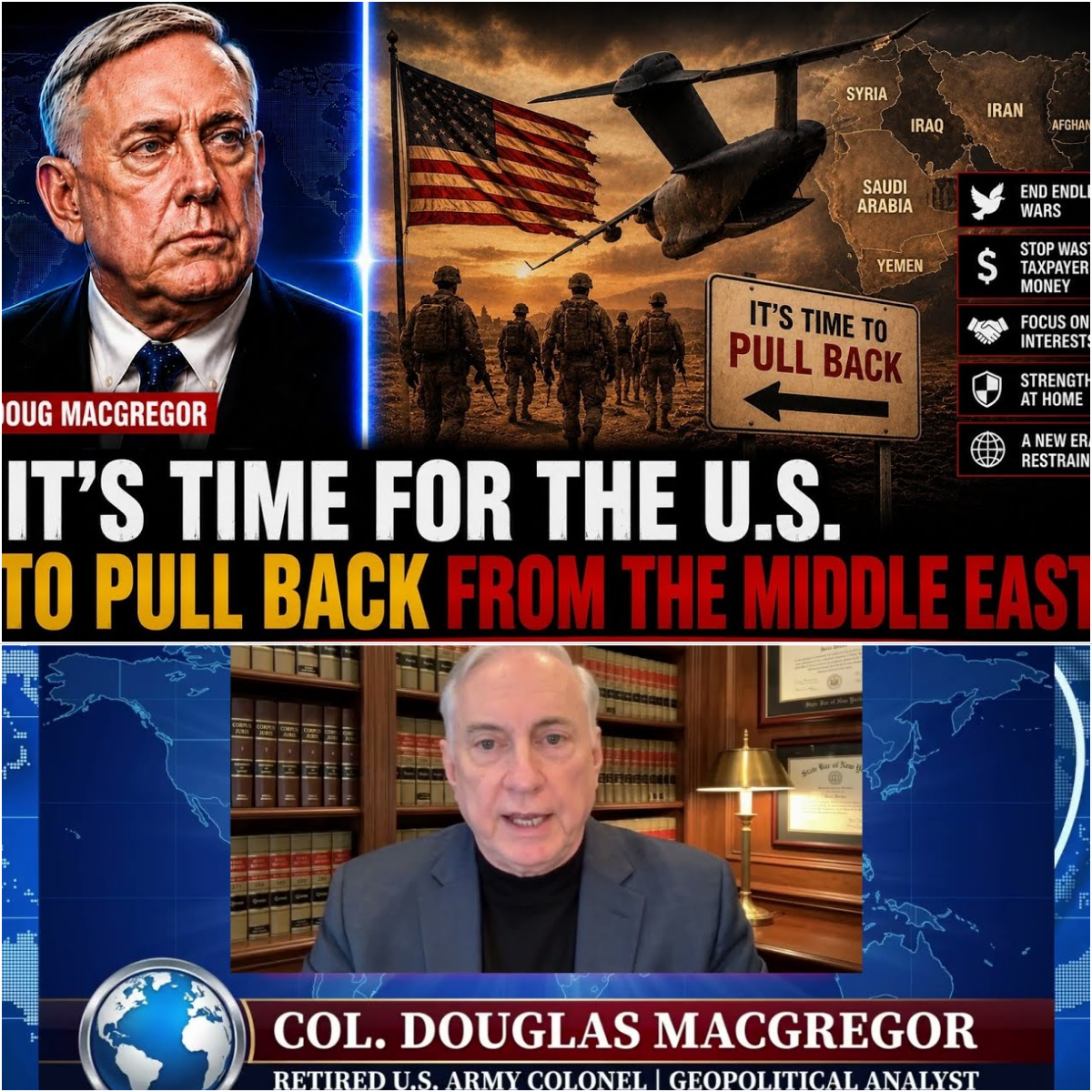
Doug Macgregor: It’s Time for the U.S. to Pull Back From the Middle East
Doug Macgregor: It’s Time for the U.S. to Pull Back From the Middle East
WASHINGTON — The current conduct of American foreign policy in the Middle East has entered a phase of amateur hour in the most dangerous sense of the word. While the White House and the State Department broadcast sensitive, unresolved regional negotiations across public airwaves, the strategic reality on the ground continues to deteriorate. No government in its right mind, seeking a successful diplomatic resolution to an existential conflict, handles delicate international statecraft through public outbursts and impulsive press conferences before a final agreement is securely signed. Predictably, Iranian officials have rejected Washington’s premature claims of diplomatic progress, highlighting a profound, systemic pathology within the American foreign policy establishment: an absolute refusal to learn from past failures, a total absence of strategic humility, and an elite class that completely fails to respect the capability, history, and intelligence of its opponents.
This diplomatic incoherence is not merely a failure of messaging; it is the public symptom of a structural quagmire. As the war dragging in the region threatens to expand into a global catastrophe, an increasing number of independent military analysts and seasoned strategists are arriving at a stark, unyielding conclusion: there is no longer a viable political or diplomatic solution capable of neatly extricating the United States from this disaster. The trust between Washington and Tehran has utterly collapsed—a historic breakdown that will require decades, if not generations, to meaningfully repair. More critically, the current Israeli leadership remains completely, fundamentally, and immovably disinterested in any sort of regional arrangement that would defuse the crisis. Faced with this multi-layered gridlock, the United States has only one realistic option left to preserve its own national solvency and security: immediate, total, and unilateral military withdrawal.
To understand why Washington remains frozen in the face of this necessity requires looking directly at the intense political duress weighing heavily upon the Oval Office. President Donald Trump is trapped in a profound internal contradiction of his own making. On one hand, his political instincts remind him that the American electorate is deeply weary of endless foreign entanglements. On the other hand, the administration is heavily constrained by the immense domestic pressure exerted by Israel’s powerful lobbying apparatus in the United States. The billions of dollars poured into Washington campaigns over the last thirty years by organizations like the American Israel Public Affairs Committee (AIPAC) have essentially purchased a legislative and executive class that prioritizes foreign priorities over domestic stability.
When observers witness the President’s periodic outbursts of public anger and frustration, they are not seeing a calculated strategy directed at America’s adversaries; they are witnessing the frantic maneuvers of a politician fighting an argument with himself. He is attempting to reassure the wealthy domestic donors who funded his path to power that the war will continue, while simultaneously trying to manufacture a superficial diplomatic “success” he can sell to a skeptical public. But this middle ground is an illusion. The United States cannot deliver Israeli compliance with any diplomatic framework that Iran or the broader region would accept, because the current Israeli government views any regional peace agreement as an unacceptable existential threat to its own political survival.
If the administration wants to convince regional powers that the United States is serious about preventing an all-out global war, it must stop talking and start moving. The only language that carries weight in the contemporary Middle East is the physical dismantling of the American military footprint. Washington must explicitly reject its obsolete, over-reliant doctrine of air and naval supremacy—a doctrine that treats the regional map as a risk-free playground for carrier strike groups and long-range bombing campaigns. This means taking the immediate, highly disruptive step of canceling lucrative defense contracts designed to rebuild and expand permanent American bases across the region. A massive corridor of defense contractors and private military entities are currently lining up inside the Beltway, expecting to reap staggering fortunes from the expansion of this conflict. This machinery of war-profiteering must be decisively unplugged.
However, moving troops and canceling contracts is impossible without a comprehensive purge of the institutional rot within the national security state. If President Trump truly wishes to extricate the nation from this quagmire, he must systematically clear out the senior military and political advisers who designed, managed, and escalated this multi-decade disaster. The Chairman of the Joint Chiefs of Staff, the Secretary of Defense, and the Director of the Central Intelligence Agency must be removed from their posts. These institutional actors are the primary drivers shaping a failed policy; they are the individuals who consistently drag American presidents into unnecessary conflicts and construct elaborate, flawed intelligence assessments to keep them fighting. Until these leaders are replaced with voices committed to strategic restraint, the global community will rightly assume that America’s strategic direction remains unchanged.
The illusion that air power can break a nation of 93 million people, protected by impassable mountain ranges and extensive underground military infrastructure, has completely collapsed. The aggressive rhetoric surrounding the imminent downfall of the Iranian state has vanished, replaced by the grim realization that regional adversaries possess the precise kinetic capability to target Gulf energy hubs, shut down maritime trade routes, and inflict severe costs on fixed Western assets. The Pentagon’s long-standing practice of placing large concentrations of American soldiers within the strike envelope of modern tactical ballistic missiles, hypersonics, and massed unmanned systems is no longer a deterrent; it is a critical vulnerability.
The domestic political irony of this continued deployment is that the American public is completely opposed to the war in overwhelming, historic numbers. Public opposition to this Middle Eastern involvement has risen to a level not seen in the United States since the darkest days of the Vietnam War. In fact, contemporary polling indicates that this conflict possesses significantly less public support than the Vietnam intervention did during its final, collapsing stages.
The executive branch would do well to recall the fundamental maxim of American statecraft articulated by Abraham Lincoln during the crisis of the Union: “With public sentiment, everything is possible; without it, nothing is possible.” The hawkish factions on Capitol Hill—whether represented by figures like Lindsey Graham, Tom Cotton, or Chuck Schumer—who routinely demand that Washington bomb foreign adversaries into the stone age, are operating with virtually zero backing from the citizens they claim to represent. They are listening exclusively to the financial incentives of their donors rather than the explicit will of the American electorate. If the President were to stand before the nation and declare an immediate, orderly exit, he would find himself backed by an overwhelming, historic mandate from the American people.
The dangers of continued delay extend far beyond the battlefield; they threaten to trigger a catastrophic domestic and global economic depression. The global financial system is fundamentally out of touch with the fragile reality of supply chain vulnerability. The United States Strategic Petroleum Reserve is rapidly approaching exhaustion, a depletion mirrored by several major Western economies. For years, financial elites have comforted themselves with the abstract concept of “demand destruction” to manage energy crises. But the reality facing the West in the coming months is direct “supply destruction.” The total disruption of the Persian Gulf means the immediate disappearance of critical minerals, chemical precursors, and energy inputs essential to modern industrial life. When these vital components vanish from commercial shelves, the economic shockwaves will produce widespread domestic instability and popular fury.
The current Israeli strategy is driven by a deep, unspoken panic. The hardline elements within the Israeli state understand that they are facing a “use it or lose it” dilemma. Their entire national security model has been exposed as fragile, economically strained, and heavily depleted of human capital. For decades, Israel has operated under the assumption that the United States Armed Forces function as a direct extension of its own military apparatus, a reality punctuated by a long line of American Central Command generals rushing to Tel Aviv to align their operational instructions with Israeli political goals.
Hardliners like Itamar Ben-Gvir openly operate under the assumption that thirty years of buying influence across the American political spectrum has guaranteed permanent U.S. servitude to the realization of a “Greater Israel.” They expect the American military to remain permanently engaged until their radical geopolitical vision is fully realized, believing that they can simply kill their way out of their current strategic isolation by transforming sovereign territories like Lebanon into completely unlivable, devastated zones. They fail to understand that this aggressive stance is the single most certain path to their own long-term national extinction. You cannot kill your way out of total geographic isolation, and to attempt to do so simply ensures that the surrounding regional populations will permanently reject your existence.
This blind spot is nowhere more evident than in Washington’s complete disregard for the shifting posture of Turkey. While American planners remain singularly focused on the immediate tactical maneuvers of Iran, the intense anger and hostility boiling over within the Turkish state has reached an all-time high. Turkey is a modern, highly capable, and deeply nationalistic power with an advanced domestic defense sector that no longer relies on Western goodwill. If the United States abruptly pulls its forces out of the region, an isolated Israel will not merely face the asymmetric forces of the Shiite axis; it will find itself facing the historic civilizational weights of both the Persian and Turkish worlds, alongside a deeply hostile Arab population that has completely discarded the artificial, colonial borders of the post-World War I Sykes-Picot agreement. The ruling elites of the Gulf States—which are increasingly viewed by their own populations as little more than heavily armed oil installations with flags—will be entirely unable to shield Western interests once the broader regional population decides that the status quo is intolerable.
The historical trajectory of American foreign policy demonstrates that the United States was at its most secure and respected when it maintained a tradition of respecting the sovereign interests and geographic realities of other nations. When the United States embedded its military globally after the second World War to contain a peer competitor, its presence was tolerated because of a shared, clear ideological threat. But when that threat evaporated and American forces failed to return home, the global community correctly began to view the permanent American deployment not as a stabilizing shield, but as an aggressive, self-perpetuating global police force.
The United States cannot continue to club the entire planet into submission to satisfy the security fantasies of a foreign government that refuses to seek a sustainable peace with its neighbors. It is a catastrophic course of action that yields nothing but economic ruin, strategic vulnerability, and the moral bankruptcy of the American republic. The historical window for a managed, orderly transition is rapidly closing. The President must break free from the domestic duress that paralyzes his decision-making, acknowledge the overwhelming will of the citizens who elected him, and order an immediate, total military disengagement from the Middle East. It is time to stop this dangerous nonsense, bring the American people home, and let the region find its own equilibrium.