ANIMALS That Suffered Terrifying TRANSFORMATIONS CAPTURED on Camera
ANIMALS That Suffered Terrifying TRANSFORMATIONS CAPTURED on Camera
In an era where nearly every square foot of the habitable world is mapped by satellites and tracked by high-definition lenses, the ancient monsters that once haunted the edges of our maps have found a new place to hide: the digital glitch.
We live in a world of absolute surveillance, yet our screens are increasingly flooded with low-resolution anomalies that suggest reality is far more fragile than our algorithms care to admit. From the dusty alleyways of Coahuila to the neon-lit suburbs of Bangkok, viral videos capturing impossible animal behaviors and apparent physical transformations are challenging the ultra-rational framework of the twenty-first century. To a global audience consuming these clips on late-night algorithmic feeds, a grainy security loop is no longer just data—it is a digital portal into a resurrected world of folklore, cryptids, and cosmic terror.
The Ghost in the Ring Feed: Mexico’s Modern Nahuales
To understand the grip these images hold on the contemporary imagination, one must look to the borderlands of the American Southwest and the interior of Mexico, where the age-old myth of the nahual has migrated from oral tradition to home security networks. In Mesoamerican folklore, the nahual is a practitioner of indigenous witchcraft capable of shedding their human form to adopt the guise of an animal—typically a black dog, a jaguar, or a large bird of prey. For centuries, these accounts belonged to the realm of campfire cautionary tales. Today, they are uploaded to social media platforms in 1080p.
In a widely circulated clip from Coahuila, Mexico, a residential garage became the stage for an unsettling encounter. The video begins normally: a homeowner steps into his driveway, flanked by his domestic dogs. The atmosphere shifts instantly when one of the dogs freezes, its gaze locked on a dark, shifting mass in the upper corner of the frame. As the homeowner approaches, the creature appears to unfold. In a fluid, anatomical impossibility, the low-slung, quadrupedal shape elongates, rising onto two limbs and adopting a distinctly human silhouette. The homeowner retreats in visible panic; the entity fumbles with the latch of a gate before slipping into the night.
A similar narrative played out on a security feed in Chile, where a black dog running behind a thick hedgerow seemed to emerge from the other side as a fully grown man, continuing his stride without breaking rhythm. In another viral sequence from an American suburb, a creature crawling on all fours undergoes a shuddering structural realignment, its limbs lengthening into a humanoid gait before it vanishes past a treeline.
To cultural anthropologists, the viral success of these videos reveals a profound truth about how technology interacts with ancient beliefs. The security camera, designed to provide safety and empirical clarity, instead acts as a mechanism for documenting the impossible. When a camera’s compression algorithm struggles to resolve a moving object in low light, it creates “ghosting” or interpolation artifacts. To the analytical mind, it is a failure of data transmission; to a community raised on the legends of the nahual, it is the exact moment the sorcerer sheds his skin.
The Bovine Retribution of East Africa
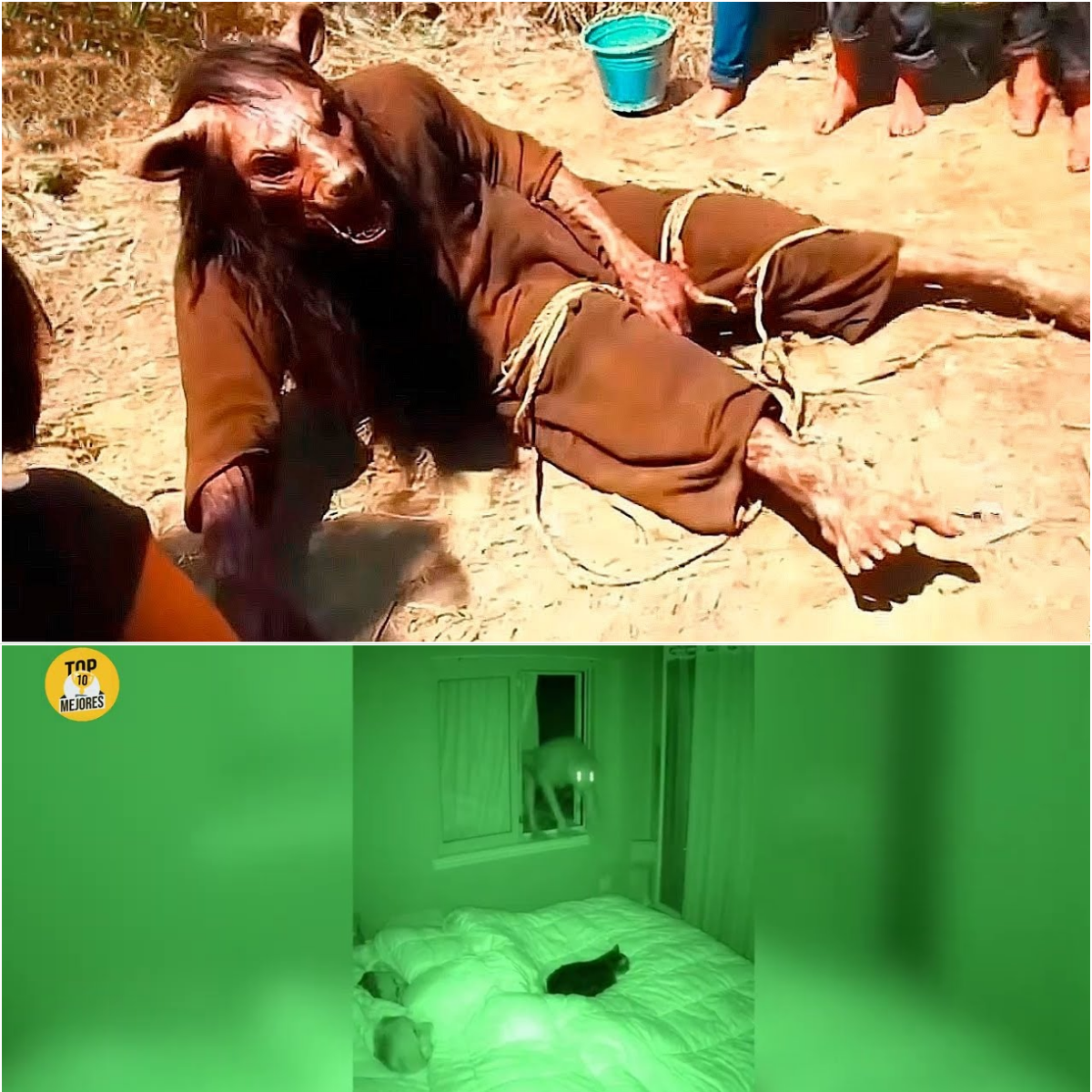
While Latin American accounts favor the stealthy transition from beast to human, an entirely different, highly moralistic form of shapeshifting folklore has taken root on the digital networks of East Africa. In Tanzania, viral videos have repeatedly surfaced depicting individuals allegedly undergoing a agonizing, literal transformation into livestock as a direct consequence of marital infidelity.
The visual grammar of these videos is remarkably consistent and deeply distressing. In one notable clip, a woman sits in the dirt of a rural village, surrounded by a crowd of onlookers and a local spiritual practitioner. From her lower torso extends what appears to be the unmistakable tail of a cow, which she swings with involuntary, animalistic jerks. Her legs, obscured by dust and clothing, terminate in shapes that the crowd insists are bovine hooves.
A corresponding video features a young man in a similar state of distress, weeping openly while emitting guttural, lowing sounds that mimic a distressed bull. The local commentary surrounding these clips rarely treats them as hoaxes; instead, they are framed as the enforcement of an ancient spiritual contract. In many regional traditions, specific curses—known locally as ustadh or witchcraft deployments—are said to be purchased by wronged spouses to permanently brand an unfaithful partner with the physical form of a beast.
For an American audience accustomed to the clinical, secular nature of relationship drama, these videos represent a shocking collision of public shaming and supernatural body horror. Even as Western skeptics point out the likely use of crude prosthetics, clever camera angles, or individuals suffering from severe, undiagnosed physical deformities exploited for regional theater, the psychological impact remains. These videos function as digital morality plays, broadcast worldwide to remind viewers that in certain corners of the earth, the price of a broken vow is the dissolution of your humanity.
The Uncanny Valley of Bipedal Beasts
There is perhaps nothing that triggers human revulsion and fascination more quickly than an animal that discards its natural posture to mimic the gait of Homo sapiens. It is a subversion of the biological order that feels deeply, fundamentally wrong. In recent years, two distinct videos—one from Mexico and one from India—have become central exhibits in the internet’s ongoing obsession with anthropomorphic animals.
In the Mexican segment, a small black dog dressed in a bright red sweater is filmed by bewildered neighbors as it walks upright on its hind legs through a residential courtyard. The dog does not merely hop or balance temporarily; it walks with a deliberate, heel-to-toe stride, pacing back and forth while staring directly into the camera lens with a cold, unblinking intensity. When confronted, the owners claimed this was simply the animal’s preferred method of locomotion, showing additional footage of the dog navigating its environment like a miniature, furry human.
Thousands of miles away, in a bustling village in India, a domestic goat achieved international notoriety for a similar feat. Captured on a smartphone by a passing motorist, the goat navigates a dirt road, walking completely erect on its hind legs for over ten meters with eerie fluidity. A motorcyclist slows down to stare, his face contorted in a mix of amusement and genuine discomfort.
Historically, an animal walking like a man was viewed as an omen of demonic inversion—the classical imagery of the goat-legged devil or the witch’s familiar mimicking human behavior. In the context of 2026’s digital ecosystem, these videos are stripped of their explicitly religious context but retain their psychological dread. Biologists note that animals can adopt bipedal movement due to spinal injuries, severe joint malformations, or intensive, often cruel training regimes designed to create novelty attractions. Yet, when filtered through a smartphone screen without context, the image of a standing goat or a pacing dog taps into a primal fear: the suspicion that the animals around us are putting on a performance, waiting for us to turn our backs.
Camera Artifacts and the Zombie Raven
The intersection of wildlife pathology and technological distortion often yields the most genuinely terrifying artifacts of the digital age. This reality was made clear in a viral video recorded in an American parking lot, where a driver encountered what the internet quickly dubbed the “Zombie Raven.”
The video, filmed through the windshield of a sedan, shows a large, jet-black corvid perched immovably on the asphalt. The bird does not flinch at the rumble of the engine or the proximity of the vehicle. Its head is cocked at a rigid, unnatural angle, and its eye—staring directly into the camera—is a solid, milky, opaque white, completely devoid of a pupil. The driver’s voice on the audio track shifts from casual amusement to genuine distress as the bird remains frozen, looking less like a living creature and more like a taxidermy specimen reanimated by an unseen force.
THE APPARENT PARANORMAL ANOMALY VS. BIOLOGICAL REALITY

[Viral Claim: "Zombie Raven"]
   ---> Pathological Reality: Advanced avian pox or cataracts combined with
        tonic immobility (predator freeze response).

[Viral Claim: "Thai Shapeshifting Snake"]
   ---> Optical Reality: Low-light infrared blooming, lens flare flare trails,
        and rolling shutter artifact combining two distinct animals.
The online discourse split into two predictable camps. Supernatural enthusiasts argued the bird was a vessel for something else—a corporate drone, a demonic watcher, or a physical manifestation of an impending disaster. Wildlife veterinarians, however, offered a more grounded, though no less tragic, explanation. The bird was likely suffering from an advanced case of avian pox or a severe bilateral cataract, rendering it completely blind in one eye. Its total immobility was not a supernatural stance, but a survival mechanism known as tonic immobility—a state of profound motor inhibition triggered by extreme fear or predatory stress.
A similar misinterpretation of technology occurred in Thailand, where a 2025 home security video appeared to capture a massive, glowing-eyed serpent slithering toward a house at impossible speed, only to “morph” into a strange dog upon entering the porch light’s arc. The video was hailed as definitive proof of a cryptid or nature spirit. A careful breakdown of the frame rate revealed a perfect storm of technical glitches: the camera’s infrared night-vision mode caused a severe optical blooming effect around the eyes of an ordinary stray dog, while the slow frame-rate interpolation stretched the animal’s moving body into a continuous, serpentine blur across the dark grass. The “transformation” was nothing more than the camera finally catching up with the light.
Pareidolia and the Faces in the Water
Human beings are evolutionary hardwired to look for faces. This psychological phenomenon, known as pareidolia, ensured our ancestors could spot a camouflaged predator in the brush. In the modern world, this deep-seated cognitive reflex turns ordinary aquatic biology into a source of internet hysteria.
In 2018, a tourist visiting a scenic village in Kunming, China, filmed a common carp swimming near the surface of a pond. The video caused an immediate internet sensation because the markings on the fish’s head—two dark vertical lines representing eyes, two dots for nostrils, and a horizontal compression resembling a mouth—formed a near-perfect approximation of a somber human face. As the fish broke the surface to breathe, it appeared as though a tiny, drowning human was peering out from beneath the scales.
A Russian fisherman, Roman Fedortsov, achieved global fame by documenting an even more extreme variation of this phenomenon. Working on deep-sea trawlers, Fedortsov regularly posts photographs of creatures brought up from the twilight zone of the ocean—fish with human-like teeth, bulging, expressive eyes, and structural deformities caused by the sudden drop in hydrostatic pressure. One specific video of a deep-sea specimen showed an animal with a wide, gaping mouth and two massive, symmetrical cranial protrusions that gave it the look of a cinematic extraterrestrial on the verge of detonation.
The viral success of these “human-faced” denizens of the deep points to a lingering, collective anxiety about the natural world. We have polluted the oceans, altered the climate, and disrupted ecosystems; when we look into the water and see a face looking back at us, the collective subconscious does not see an accidental arrangement of cartilage and pigment. It sees a mirror. It looks like nature adapting a human countenance to speak to us, or worse, to mock us.
The Grifter of Bangkok: The Logic of Survival
If these stories suggest that the animal kingdom is becoming increasingly strange or malevolent, the final case in this modern bestiary provides a necessary, brilliant antidote. It reminds us that while humans are busy looking for devils, animals are usually just looking for a free meal.
On the chaotic streets of Bangkok, Thailand, motorists and pedestrians were captivated by the sight of a scruffy street dog that appeared to be the victim of a catastrophic hit-and-run accident. The dog’s lower body was completely paralyzed; it dragged its hind legs limply along the asphalt, its spine twisting painfully as it used its front paws to pull its weight toward the sidewalk. It was a scene of heart-wrenching suffering that routinely caused traffic to grind to a halt.
In a sequence captured by a local commuter, a compassionate taxi driver pulls over, opens his door, and steps into traffic to lift the mangled animal from the road. The moment the driver steps within arm’s reach, the dog’s “paralyzed” hind legs instantly snap back into position. The animal jumps up, wags its tail, and trots casually onto the sidewalk, looking back at the dumbfounded driver with an expression of pure, unadulterated satisfaction.
Local shopkeepers later revealed that the dog, affectionately named Gae, had perfected the routine over several years. He was completely healthy, but had figured out that mimicking a horrific physical injury was the single most effective way to secure treats, attention, and scraps of street food from sympathetic humans.
Gae’s brilliant hustle highlights the real danger of our obsession with the internet’s supernatural animal archive. When we look at a viral clip of an upright goat, a “zombie” bird, or a shifting shadow in a garage, our default impulse is to project our own anxieties, superstitions, and narrative desires onto the screen. We want to believe in nahuales and curses because an enchanted, terrifying world is infinitely more interesting than a predictable one governed by camera sensor limitations and viral optimization algorithms.
But the reality is often far more fascinating. The animals are not transforming into monsters, nor are they serving as vessels for ancient spirits. They are doing what they have always done: adapting, surviving, and navigating a world increasingly dominated by human infrastructure. Sometimes they are suffering from the harsh realities of disease, sometimes they are caught in the distorting lens of our low-cost surveillance state, and sometimes, like the street-smart grifter of Bangkok, they are simply looking at our hyper-connected, easily distracted society and figuring out exactly how to play us for a fool.