Most Incredible Forest Moments Caught on Camera
Most Incredible Forest Moments Caught on Camera
The boundary between human civilization and the natural world has always been a fragile illusion, but never before has that line felt quite so precarious as it does today. Across the globe, ordinary travelers, campers, and rural residents are finding themselves thrust into surreal, life-threatening arenas where the earth itself seems to undergo a sudden, violent metamorphosis. From roads that transform into literal corridors of flame to forests that buckle, sway, and snap under invisible pressures, our modern encounters with the wild are revealing a sobering truth: when the environment shifts, our survival depends entirely on a matter of seconds.
The Roads Through Fire and Wind
In August 2020, Napa County, California, became the terrifying epicenter of the largest wildfire outbreak in the state’s modern history. Gripped by a severe, multi-year drought, the region’s dense forest canopies and parched chaparral had been reduced to a continental tinderbox. It required only a series of dry lightning storms—unaccompanied by rain—to ignite a catastrophic chain reaction. For those caught on the rural mountain passes, the world vanished into a suffocating, crimson twilight.
Dashcam footage and emergency transmissions from those harrowing hours reveal what survivors openly described as a “road through hell.” As family vehicles raced through the blinding smoke, tree trunks burned from the inside out like giant matchsticks, collapsing across the asphalt in showers of blinding sparks. The immediate instinct to flee was constantly thwarted by zero-visibility conditions and the erratic, predatory movement of the wind-driven flames. Drivers were left with a singular, desperate mantra whispered in the cabin: Go, go, go.
Yet, fire is not the only element capable of transforming a routine drive into a claustrophobic nightmare. Along narrow, forested corridors across the Pacific Northwest and the Scandinavian interior, gale-force winds regularly turn majestic timberlands into active weapon zones. When powerful atmospheric fronts collide, high-velocity gusts funnel through tight valley passes, catching the shallow root systems of ancient pines.
For a motorist navigating these winding ribbons of asphalt, the danger is both immediate and unpredictable. The forest canopy becomes a falling ceiling of heavy debris; massive branches shear off without warning, shattering windshields and blocking escape routes. To be trapped on a narrow road surrounded by buckling trees under a roaring gale is to understand the absolute vulnerability of human engineering when confronted by basic atmospheric momentum.
The Haunted Landscapes of Concrete and Dolls
While some landscapes threaten us with physical violence, others assault the human psyche through a profound, eerie atmospheric decay. Deep within Xochimilco, a historic district of Mexico City renowned for its sprawling, ancient maze of Aztec-era canals, lies the Isla de las Muñecas—the Island of the Dolls. This tiny, artificial landmass has become legendary among fans of the macabre, operating as a surreal monument to isolation and superstition.
The legend states that decades ago, a local hermit named Don Julián Santana Barrera discovered the body of a young girl who had tragically drowned in the murky canal waters bordering his property. Shortly thereafter, haunted by what he believed to be her restless spirit, Santana began collecting discarded, broken dolls from the canals and trash heaps, hanging them from the trees and cabin walls to ward off evil.
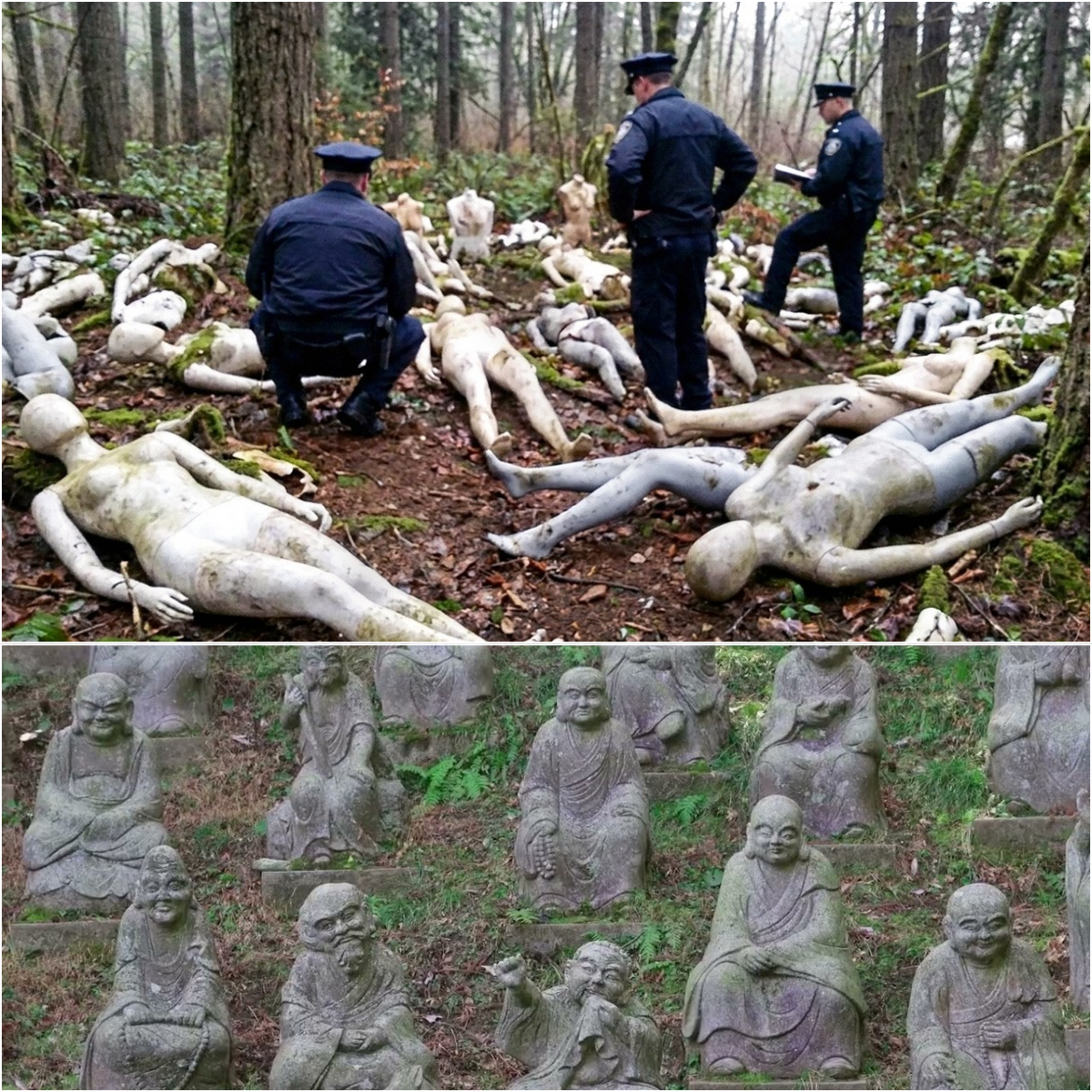
Today, hundreds of these dolls remain, decaying in the humid climate. Their plastic limbs are warped by the sun, their eyes hollowed out by time, and their synthetic hair tangled with invasive vines. For travelers navigating the silent canals by boat, the island presents an unsettling tableau where human grief and environmental decay have merged to create a living gothic horror story.
A similar, deeply arresting strangeness can be found hidden deep within the dense, moss-covered forests of Parikkala, Finland. There, scattered among the shadows of towering birch trees, lies the extraordinary sculpture garden of Veijo Rönkkönen. A reclusive artist who spent half a century in near-total isolation, Rönkkönen dedicated his life to creating hundreds of life-sized concrete human figures.
The figures are downright unsettling. Many possess real human teeth, and their wide, unblinking eyes—often made of glass or marbles—seem to track visitors as they walk along the narrow dirt pathways. The statues are frozen in various yoga positions, expressions of manic joy, or silent, agonizing contortions.
The forest has slowly reclaimed the artwork; green moss coats the concrete limbs, and invasive ferns sprout from the statues’ heads. This creates a mesmerizing, surreal dialogue between the permanence of stone and the relentless growth of the wild. Every year, tens of thousands of international visitors journey to this remote Finnish forest, seeking to experience a landscape that feels less like a public park and more like a physical manifestation of a fever dream.
Predators in the Blind Spots
For those who actively seek solace by sleeping beneath the stars, the wilderness occasionally introduces a more primal, biological terror. In recent years, backcountry campers have documented terrifying encounters where the thin nylon of a tent provided the only barrier between a sleeping family and an apex predator.
In one remarkably close call, a group of wilderness campers in northwestern Canada managed to escape disaster purely by the fortune of an early morning schedule. Having woken before sunrise to prepare for a heavy hike, the campers had already retreated to the safety of their hard-sided vehicle to retrieve gear when a massive grizzly bear materialized from the brush.
The predator, driven by an acute sense of smell, descended directly upon the campsite, tearing through the abandoned tents with effortless, terrifying kinetic force. Plastic support poles snapped like twigs, and heavy canvas sleeping bags were shredded in seconds as the animal searched for food. From the safety of their car, the campers watched their entire survival apparatus erased in a matter of minutes, left with the chilling realization of what would have occurred had the bear crawled into the structure while they were still asleep.
Other biological invasions are less physically destructive but arguably more horrifying for those who suffer from deep-seated phobias. Across the American Midwest and parts of Europe, hikers occasionally stumble upon massive, pulsating colonial gatherings of Harvestmen—commonly known as daddy-longlegs. While technically harmless to humans, these arachnids sometimes gather in defensive colonies hundreds or thousands strong, coating the bark of trees, fence posts, and old wooden cabins in a thick, vibrating blanket of long, spindly legs. When disturbed, the colony explodes into a chaotic, cascading wave of movement that can cause even the most experienced outdoorsman to recoil in instinctual horror.
The Slow Inundation of the Earth
There are moments when the earth does not merely shift; it completely overwrites the landscape, leaving humanity with no choice but to witness its own displacement. On the islands of Hawaii, this reality is written in the slow, unyielding advance of volcanic activity. Unlike the explosive eruptions of the Pacific Rim, Hawaiian basaltic lava often moves with a deceptive, glacial pace, creeping across highways, enveloping telephone poles, and snaking into residential subdivisions.
Yet, this slow movement does not lessen its absolute destructiveness. Reaching temperatures exceeding 1,000 degrees Celsius, the molten rock incinerates everything in its path. Asphalt bubbles and bursts into flame before being buried under meters of black, jagged stone.
Witnesses to these flows describe a distinct, heavy sound—a metallic crackling mixed with the deep, concussive thuds of methane explosions exploding beneath the cooling crust. In these zones, there is no battle to be fought, no engineering solution to deploy. The only rational human response is a systematic, bittersweet retreat, abandoning generations of infrastructure to the primal recycling of the planet.
In contrast to the molten destruction of Hawaii, the dense jungles of Malaysia harbor a bizarre, silent relic of human ambition abandoned to the elements. Deep within a remote forest clearing lies the rusted, hollowed-out wreckage of what appears to be a commercial airliner. To a casual explorer or an aerial surveyor, the sight immediately evokes the tragedy of a major aviation disaster.
The real story, however, is a fascinating testament to economic failure. The aircraft was deliberately hauled into the jungle as part of an ambitious, highly eccentric business project meant to transform the fuselage into a luxury, one-of-a-kind eco-hotel. When the venture collapsed due to financial bankruptcy, the heavy machinery was simply left behind.
Today, the plane sits as an accidental monument to human hubris. Its interior seating has been stripped, its windows are clouded with tropical moisture, and its luxury cabins have become a permanent sanctuary for wild animals, birds, and invasive jungle vines that are slowly dismantling the aluminum hull frame by frame.
Anomalies of the Timberlands
Even when the wilderness appears stable, a closer inspection can reveal anomalies that challenge our basic understanding of botany and geology. In a remote corner of northwestern Poland, near the town of Gryfino, lies the “Crooked Forest” (Krzywy Las)—a grove of approximately 400 pine trees that has baffled researchers, historians, and tourists for nearly a century.
The trees, planted around 1930 when the region was part of Germany, all exhibit the same radical, uniform deformity. Each pine grows with a sharp, 90-degree northward bend at its base before curving gracefully back upward to form a straight vertical trunk. The origin of this collective distortion remains an unresolved historical mystery.
The prevailing scientific theory suggests a highly calculated human intervention: local carpenters or shipwrights may have deliberately bent the young saplings using mechanical weights or ropes to produce naturally curved timber ideal for furniture making or boat ribs. However, the outbreak of World War II caused the local population to flee, leaving the grove to grow into maturity without ever being harvested, creating a silent, haunting forest of question marks.
Elsewhere, the landscape challenges our very sense of physical balance. In the waterlogged peat bogs of southern Germany, there exists a unique ecological phenomenon known colloquially as the “shaking forest.” Here, due to centuries of accumulated organic matter floating atop a deep subterranean reservoir, trees grow on a thick, elastic layer of waterlogged peat rather than solid soil.
When a human steps onto this forest floor, the ground behaves not like earth, but like a massive, natural trampoline. Every stride creates a visible, undulating wave that rolls through the mossy clearing, causing mature pine and birch trees to sway dramatically back and forth as if caught in a localized gale. It is a disorienting, surreal experience that strips the traveler of their most fundamental evolutionary assumption: that the ground beneath their feet is solid, permanent, and safe.
When Winter Closes the Trap
If the wilderness is unpredictable in the summer, the arrival of extreme winter weather converts the forest into a clinical, unforgiving trap. Across the northern latitudes, a sudden, deep freeze can alter the physical mechanics of the timberlands within a matter of hours. When heavy, moisture-laden rain is immediately followed by a plunging arctic front, an environmental phenomenon known as ice loading occurs.
The results are both beautiful and terrifying. Every needle, branch, and trunk is encased in a thick, glass-like sheath of heavy ice. As the weight increases, the forest begins to sound like a distant battlefield.
Under the immense stress, mature trees reach their structural limits and begin to snap under their own weight, sending multi-ton shards of timber crashing to the forest floor. For anyone seeking shelter in a woodland cabin or caught on a remote trail during an ice storm, the environment becomes a lethal lottery where the sky is constantly falling.
Similarly, the high-altitude mountain roads of Eastern Europe turn into absolute nightmares when the spring thaw begins. What was a stable, frozen highway in January dissolves into a churning, impassable sea of thick mud and loose shale by April. Heavy transport trucks find their multi-ton trailers dragging them backward down steep inclines, their tires spinning uselessly against a landscape that has lost its structural integrity. It is a seasonal reminder that our access to the remote corners of the world is entirely dictated by the thermal cycles of the earth.
The Lessons of the Wild
To look closely at these varied encounters—whether it is a hunter in North Dakota coming face to face with a curious, towering moose, or a cyclist in Thailand suddenly forced to halt as two massive monitor lizards engage in a violent wrestling match for alpha dominance in the middle of the road—is to recognize that the wilderness demands a constant, active humility.
We have built a civilization wrapped in concrete, glass, and digital networks, convincing ourselves that we have successfully insulated our lives from the chaotic rhythms of the natural world. Yet, the wild remains just beyond the perimeter fence, operating on an ancient, indifferent set of laws that cares nothing for our schedules, our infrastructure, or our comfort.
The stories of those who survived the fires of Napa County, navigated the shaking floors of Germany, or stood silent as an Alaskan brown bear claimed the right-of-way in Katmai National Park all converge on a singular insight. The wilderness is neither inherently malicious nor consciously cruel; it is simply immense, powerful, and neutral. When we choose to step across the boundary and enter its territory, we must be prepared to accept it on its own terms—and remember that our position at the top of the food chain is a luxury that vanishes the moment the trees begin to shake.