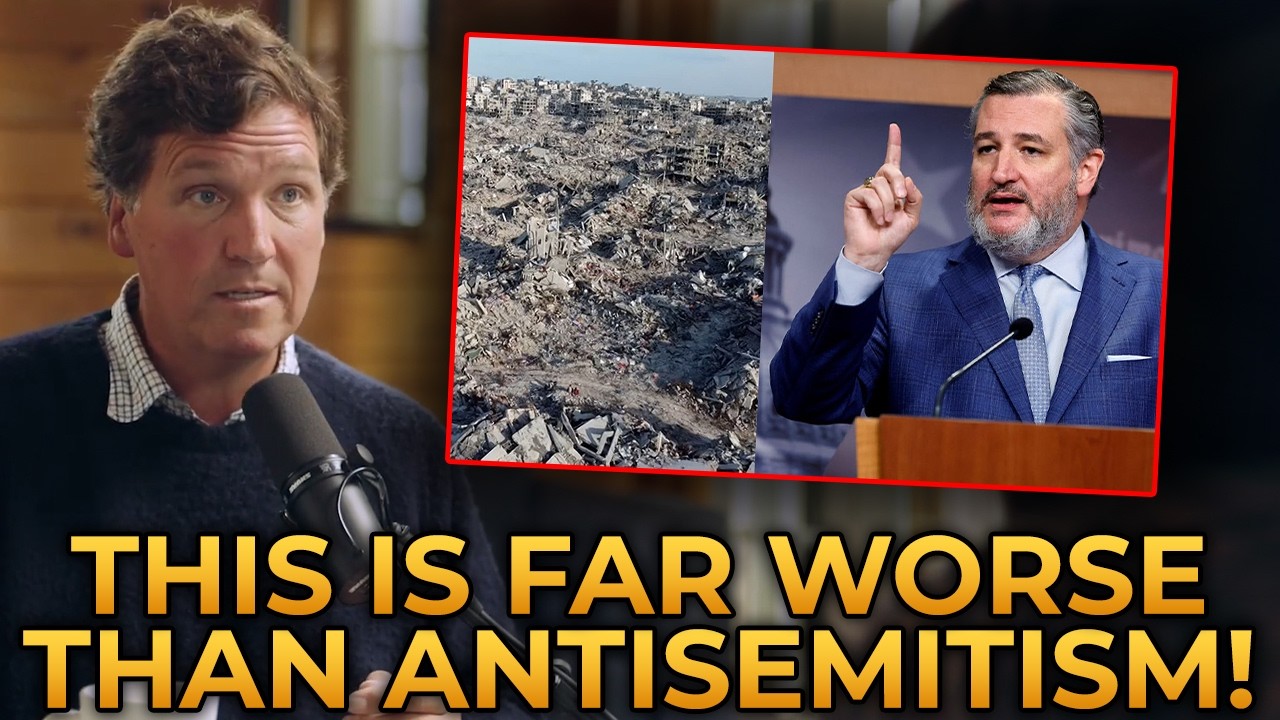
Tucker Carlson EXPOSES the Truth About the Israel Lobby: “Ted Cruz is Far Worse Than Nick Fuentes!”
When Speech Becomes the Battlefield
In the interview, Carlson is pressed on one of the most controversial edges of today’s political discourse: the boundary between criticism of Israel and antisemitism. The reporter’s concern is familiar in mainstream journalism—whether certain critiques of the Israeli government can unintentionally fuel hostility toward Jewish people as a whole.
Carlson pushes back hard. His argument is not subtle: criticism of a government, he says, is not the same as prejudice against an entire ethnic or religious group. Conflating the two, in his view, is not just intellectually sloppy—it risks turning political disagreement into moral accusation.
He also frames the issue in a broader way. If certain topics become effectively “untouchable,” then public debate itself changes shape. It is no longer about persuasion, but about permission.
That framing sets the tone for everything that follows.
The Fuentes Problem and the Limits of Association
The conversation quickly expands beyond policy into something more volatile: who is allowed to be part of public discussion at all.
The reporter raises Carlson’s past interview with Nick Fuentes, a figure widely described as far-right and controversial. The implication is clear: by speaking with someone considered extremist by many observers, Carlson is legitimizing harmful ideas.
Carlson rejects the framing. He argues that interviewing someone is not endorsement, and that refusing to engage certain voices outright can backfire by pushing them further into unfiltered, unchallenged spaces.
But the deeper disagreement is not about Fuentes himself. It is about whether exposure equals endorsement—and whether journalism should ever function as a gatekeeper of acceptable dialogue.
This tension has become one of the defining media disputes of the era.
A Question That Reverses the Moral Lens
The most striking moment in the exchange comes when Carlson reframes the moral comparison between an elected official and a fringe commentator.
He contrasts Fuentes—who, despite notoriety, holds no formal power—with figures like Ted Cruz, an elected senator with direct influence over legislation and national policy.
Carlson’s argument is simple but provocative: if moral responsibility is tied to real-world consequences, then those who vote on war, foreign policy, and military action should be scrutinized more intensely than those who merely speak about politics online.
The implication is not that extremist rhetoric is harmless. Rather, it is that institutional power and political authority carry a different ethical weight than commentary, however offensive or controversial.
This distinction—speech versus power—is central to the modern debate, yet rarely agreed upon.
The Censorship Anxiety
From here, the discussion shifts into a broader fear: that political disagreement is increasingly being managed through suppression rather than argument.
Critics of current media trends argue that social platforms, institutions, and even governments are drifting toward indirect forms of censorship—whether through content moderation, algorithmic visibility, or pressure on companies to limit reach.
Supporters of these measures respond that the goal is not censorship but harm reduction: preventing misinformation, extremism, or incitement.
The disagreement is not simply factual. It is philosophical.
Is limiting reach the same as silencing speech? Or is it simply part of how large-scale digital communication must be managed?
Carlson and his supporters tend to frame it as a slippery slope: once certain viewpoints are labeled dangerous enough to suppress, the definition of “dangerous” expands.
Opponents see a different risk: that unrestricted amplification of harmful rhetoric can distort public understanding and inflame real-world tensions.
Both fears are plausible. Neither is easily resolved.
Israel, Criticism, and the “Line” Problem
A core theme in the interview is the difficulty of defining where legitimate political criticism ends and prejudice begins.
Carlson argues that the boundary has been intentionally blurred over time, particularly in how institutions define antisemitism. In his view, this conflation makes it difficult to critique the policies of the Israeli government without being accused of hostility toward Jewish people more broadly.
He insists that such a framework is not only inaccurate but dangerous, because it discourages honest debate about foreign policy.
Supporters of the International Holocaust Remembrance Alliance (IHRA) definition of antisemitism counter that the line is necessary precisely because criticism of Israel has, in some contexts, been used to mask or fuel antisemitic narratives.
This is one of the most sensitive fault lines in contemporary politics. It is also one of the hardest to regulate fairly, because intent, impact, and interpretation often diverge.
The result is a constant state of accusation and counter-accusation—where one side sees censorship, and the other sees protection.
The Media as Arbiter of Acceptable Thought
Another major thread in the conversation is distrust of legacy media institutions.
Carlson suggests that mainstream outlets increasingly function not as neutral observers, but as participants in shaping moral boundaries around discourse. In this view, journalists are not merely reporting on controversy—they are actively defining what counts as legitimate opinion.
Critics of Carlson, in turn, argue that he is doing something similar from the opposite direction: challenging institutional narratives while amplifying voices that themselves sit outside established consensus.
This creates a paradox. Both sides accuse the other of distortion. Both claim to be defending truth. Yet they operate with fundamentally different assumptions about what journalism is for.
Is it meant to filter harmful ideas, or expose all ideas to scrutiny regardless of consequence?
The answer depends on whether one prioritizes stability or openness—and how each defines “harm.”
Nick Fuentes as Symbol, Not Just Individual
In much of the debate, Nick Fuentes functions less as an individual and more as a symbol.
To critics, he represents the danger of unmoderated online ecosystems where extreme views can circulate and grow.
To others, he represents something else: the downstream result of political frustration, cultural polarization, and institutional distrust.
Carlson’s defenders often argue that engaging such figures does not equal endorsement but reflects a broader belief that political ideas should be confronted rather than quarantined.
Yet even among those who support broad free speech protections, Fuentes remains a dividing line—raising questions about whether there is any meaningful boundary at all when it comes to platforming.
Historical Echoes: War and the Pressure on Speech
The idea that war intensifies pressure on speech is not new. Throughout modern history, governments have expanded surveillance, tightened rhetoric, and restricted dissent during periods of conflict.
From the First World War to the post-9/11 era, national security concerns have often been used to justify expanded state authority. In many cases, those expansions have remained long after the conflicts themselves ended.
The current debate echoes that pattern. Critics argue that geopolitical tensions today are once again pushing political systems toward greater control over information flows. Supporters of these controls argue that modern information warfare requires new defenses.
The disagreement is not about whether war changes society—it clearly does. It is about whether those changes are temporary safeguards or permanent shifts in the balance between security and liberty.
The Deeper Divide: Power vs. Speech
At the center of the entire discussion is a fundamental disagreement about moral weight.
One side emphasizes the danger of ideas: harmful rhetoric, extremist narratives, and the potential for speech to normalize violence or prejudice.
The other emphasizes the danger of authority: political decisions, military actions, and institutional power that shape real-world outcomes on a far larger scale than individual commentary.
This is why Carlson’s comparison between a commentator like Fuentes and a senator like Ted Cruz resonates with his supporters. It shifts attention from rhetoric to consequence.
But critics respond that speech itself is not neutral—it can influence behavior, justify action, and reshape social norms over time.
Both perspectives contain truth. The conflict arises in how each prioritizes risk.
Where This Leaves the Public Debate
What makes this moment distinct is not that these arguments are new, but that they are now fully public, highly polarized, and amplified by digital platforms that reward intensity.
The result is a political environment where disagreement quickly becomes moral indictment, and where neutrality is increasingly difficult to maintain.
Carlson’s critics see him as pushing boundaries that risk normalizing extremism. His supporters see him as challenging institutions that have become too comfortable defining truth from above.
Between those positions lies a shrinking space for shared agreement about what constitutes fair debate.
Conclusion: A System Struggling With Its Own Limits
The Carlson interview controversy is not just about one journalist, one senator, or one online commentator. It is about a broader structural question: how a society manages disagreement when trust in institutions is fractured.
As debates over censorship, antisemitism definitions, foreign policy criticism, and media legitimacy continue to collide, one thing becomes increasingly clear: the dispute is no longer about isolated incidents.
It is about who gets to define reality in public life—and what happens when no one can agree on the rules of that definition.
And that question, unlike the personalities involved, is not going away anytime soon.