Darryl Cooper Reveals the DARK SIDE of Winston Churchill and WW2
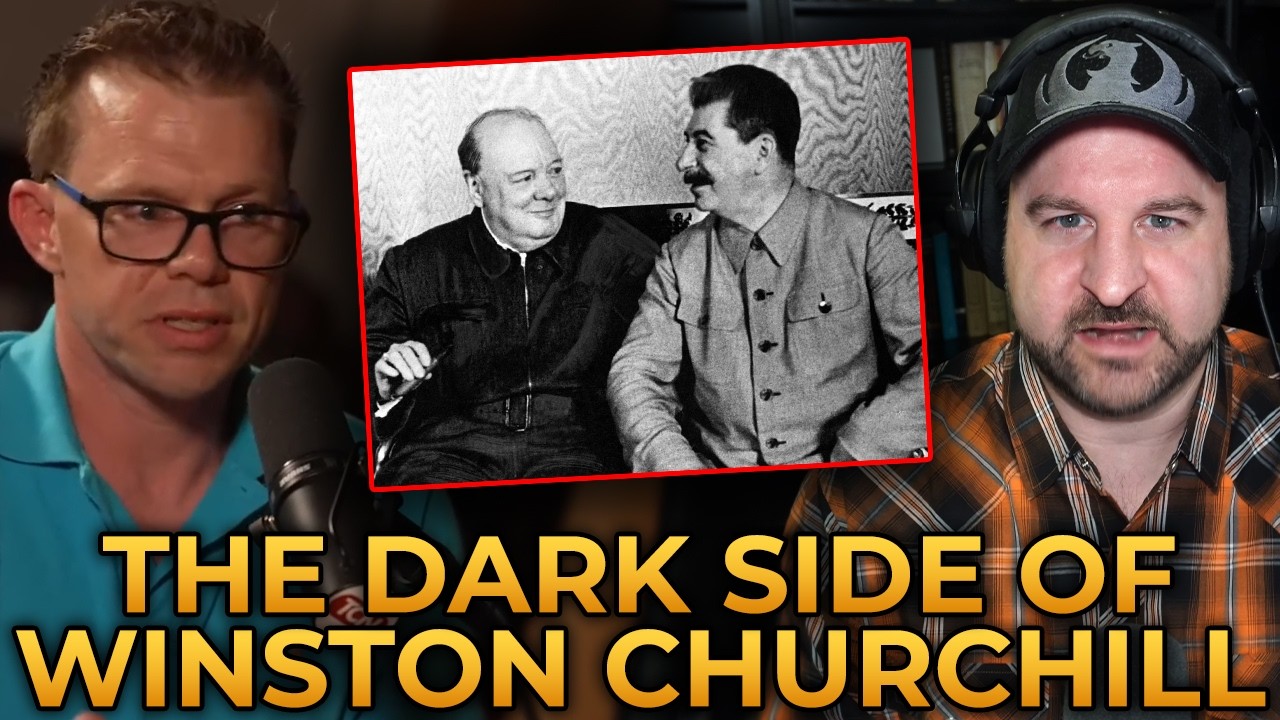
Was Neville Chamberlain Really the Villain of World War II? Rethinking Appeasement, Churchill, and the History We Think We Know
History is often remembered through heroes and villains. But what happens when those labels begin to fall apart?
For generations, we’ve been taught that Neville Chamberlain represents the fatal weakness of appeasement, while Winston Churchill embodies the courage that saved Western civilization. It is one of the most influential moral lessons in modern politics: never negotiate with aggressors, never compromise with dictators, and never mistake diplomacy for strength.
But what if that story is more complicated than most people realize?
A growing number of revisionist historians, political commentators, and independent scholars argue that the conventional narrative overlooks critical context—particularly the trauma of World War I, the diplomatic legacy of the Treaty of Versailles, and the difficult choices facing European leaders in the 1930s. They contend that Chamberlain’s decisions cannot simply be dismissed as cowardice, and that Churchill’s legacy deserves far more scrutiny than it usually receives.
Whether one agrees with these arguments or not, they raise fascinating questions about how history is written—and how it continues to shape modern foreign policy.
The Shadow of Munich
Few political words carry more emotional weight than “appeasement.”
Ever since the Munich Agreement of 1938, the term has become synonymous with surrender. Politicians invoke Munich whenever they argue that dictators must be confronted before they grow stronger. The lesson appears straightforward: Chamberlain tried diplomacy with Adolf Hitler, failed, and Europe paid the price.
But critics of this interpretation argue that the historical context is often forgotten.
When Chamberlain traveled to Munich, Europe had barely recovered from the devastation of World War I. That conflict had killed millions, bankrupted governments, shattered empires, and traumatized an entire generation.
The horrors were difficult to overstate.
Entire towns had lost much of their young male population. Economies remained fragile. Political extremism was spreading across the continent. For many Europeans, the overriding objective was simple: avoid another continental war at almost any cost.
Seen through that lens, Chamberlain’s efforts begin to look less like naïve optimism and more like an attempt—however imperfect—to spare Europe another catastrophe.
When he returned to Britain declaring “peace for our time,” he was not universally mocked. On the contrary, he was welcomed by large crowds who desperately hoped he had succeeded.
Only later, after Hitler violated the Munich Agreement by occupying the rest of Czechoslovakia, did Chamberlain become the enduring symbol of failed diplomacy.
The Power of Historical Narratives
One of the interview’s most interesting arguments is that the story of Chamberlain has evolved into something much larger than one historical figure.
According to this perspective, Chamberlain functions as a political cautionary tale.
Whenever modern leaders hesitate to use military force, critics often accuse them of “appeasing another Hitler.”
This framing creates what the interview describes as a built-in bias toward military escalation.
If diplomacy risks another Munich, then force increasingly appears to be the safer political option.
Whether discussing Iraq, Libya, Syria, Ukraine, or tensions involving China and Taiwan, references to the 1930s repeatedly emerge in public debate.
The implication is simple:
Negotiation is weakness.
Escalation is courage.
Critics argue that this interpretation oversimplifies both history and contemporary geopolitics.
Every international crisis has unique circumstances, and reducing them all to “another Hitler” risks ignoring important differences.
Why World War I Matters More Than Many Realize
One of the strongest themes throughout the discussion is that World War II cannot be understood without first understanding World War I.
According to this interpretation, the First World War fundamentally reshaped European politics.
The Treaty of Versailles imposed severe military restrictions and financial reparations on Germany. Many economists, diplomats, and political observers—including John Maynard Keynes—warned almost immediately that the settlement risked creating long-term instability rather than lasting peace.
Germany lost territory, military capabilities, and significant economic resources.
Many Germans viewed these conditions not simply as punishment but as national humiliation.
This sense of grievance became fertile ground for radical politics during the economic crises of the 1920s and early 1930s.
The interview argues that many people today mistakenly imagine Germany as an unstoppable military giant throughout the interwar period.
Instead, it emphasizes that Germany spent much of the 1920s heavily constrained under Versailles, with strict limits placed upon its armed forces.
Whether or not one accepts every element of this interpretation, it highlights how dramatically historical perspectives can shift depending on where the story begins.
Starting in 1938 produces one narrative.
Starting in 1919 often produces another.
The Sudetenland Debate
Perhaps no issue illustrates this better than the Sudetenland.
In mainstream history, Hitler’s demand for the Sudetenland is typically presented as the opening stage of territorial expansion that ultimately consumed Europe.
The interview acknowledges this but argues that the situation was more complicated than many modern summaries suggest.
The Sudetenland contained a large ethnic German population following the post-World War I border settlements.
Supporters of Chamberlain have argued that transferring these territories to Germany was not viewed by everyone at the time as inherently unreasonable.
Many policymakers believed they were resolving an ethnic dispute peacefully rather than rewarding aggression.
The problem, according to this interpretation, was not necessarily Munich itself.
The problem was what happened afterward.
When Hitler occupied the remainder of Czechoslovakia despite previous assurances, he destroyed whatever credibility remained for negotiated settlements.
At that point, critics argue, Chamberlain’s political position became almost impossible to defend.
Churchill: Hero or Imperial Statesman?
If Chamberlain has become history’s villain, Churchill has become its hero.
His speeches during Britain’s darkest hours remain among the most celebrated examples of political leadership ever delivered.
Few dispute Churchill’s ability to inspire national resistance during the Battle of Britain.
Yet the interview argues that public memory often ignores other aspects of his career.
Critics point to Churchill’s support for Britain’s imperial interests, his controversial positions regarding colonial policy, the Bengal famine during World War II, the strategic bombing campaigns against German cities, and proposals such as Operation Unthinkable, which explored military options against the Soviet Union after Germany’s defeat.
Historians continue to debate Churchill’s responsibility for many of these events.
Some argue that he bears significant moral responsibility.
Others emphasize wartime constraints, logistical realities, and the broader decision-making structures within the British government.
The interview ultimately suggests that Churchill should be viewed neither as a flawless hero nor as history’s sole villain, but as a complex political figure operating within an empire confronting existential challenges.
Poland and the Road to War
Another major topic concerns Britain’s security guarantee to Poland in 1939.
According to the interview, this guarantee deserves closer examination than it typically receives.
Supporters of this revisionist perspective argue that Britain lacked both the military capability and geographic position to effectively defend Poland if Germany invaded.
They question whether the guarantee served as a genuine deterrent or whether it effectively committed Britain to a war it was not prepared to fight.
The discussion also highlights that the Soviet Union invaded eastern Poland shortly after Germany’s invasion, raising questions about why Britain’s declaration of war applied only to Germany under the specific terms of the Anglo-Polish agreement.
Historians continue to debate the diplomatic significance of these decisions, but they remain central to revisionist interpretations of the origins of the war.
Can Catastrophes Be Avoided?
Beneath the historical details lies a much broader philosophical question.
Could World War II have been prevented?
Or was another major European war already inevitable?
The interview suggests that policymakers should always ask whether diplomatic off-ramps exist before embracing military solutions.
From this perspective, the tragedy of the Second World War lies not only in its unimaginable destruction but also in the possibility that opportunities for de-escalation may have existed earlier.
Others strongly disagree.
Many historians argue that Hitler’s ideological ambitions made major conflict unavoidable and that postponing confrontation only strengthened Germany militarily.
This debate has never truly disappeared.
Instead, it resurfaces whenever nations confront rising powers, territorial disputes, or authoritarian governments.
The Legacy of Appeasement in Modern Politics
Perhaps the most enduring significance of Chamberlain has little to do with the 1930s themselves.
Instead, it concerns how his legacy influences twenty-first century foreign policy.
Time after time, political leaders invoke Munich to justify military intervention.
The comparison appeared during debates surrounding Vietnam.
It resurfaced before the Gulf War.
It became central during discussions of Iraq in 2003.
Similar analogies continue to appear whenever governments consider whether to negotiate or confront geopolitical rivals.
Critics argue that these comparisons often oversimplify history while encouraging escalation rather than diplomacy.
Supporters counter that history demonstrates the dangers of allowing aggressive states to expand unchecked.
Either way, Chamberlain’s shadow continues to shape decisions decades after his death.
Why Historical Revision Matters
Historical revisionism often carries negative connotations, but revision itself is not inherently illegitimate.
Serious historical scholarship constantly revisits established interpretations as new evidence emerges or older assumptions are questioned.
That does not mean every revisionist argument is persuasive.
Nor does it mean traditional narratives are automatically correct.
Instead, history advances through continual examination of evidence, competing interpretations, and rigorous debate.
The interview encourages audiences to revisit figures like Chamberlain and Churchill with greater nuance rather than accepting simplified moral archetypes.
The Danger of Simple Stories
One reason historical myths endure is because they are emotionally satisfying.
Heroes inspire us.
Villains warn us.
Complicated people do neither particularly well.
Reality, however, is rarely so accommodating.
Neville Chamberlain was neither a cartoon coward nor an infallible peacemaker.
Winston Churchill was neither an untouchable saint nor history’s singular architect of empire.
Both operated within extraordinary historical circumstances that involved incomplete information, competing priorities, domestic political pressures, and consequences few could fully anticipate.
Reducing them to symbols risks obscuring the complexity that history actually teaches.
Conclusion
The debate over Chamberlain and Churchill is ultimately about far more than two British politicians.
It reflects a larger struggle over how societies interpret war, diplomacy, leadership, and the lessons of history itself.
One perspective argues that Munich demonstrates the fatal dangers of appeasing aggressive regimes.
Another argues that Munich has become an overused analogy—one that encourages military intervention while discouraging diplomatic solutions.
Neither view can erase the immense human tragedy that followed.
World War II reshaped the global order, destroyed much of Europe, and claimed tens of millions of lives.
Yet understanding how leaders reached those decisions—and whether different choices might have altered history—remains one of the most important questions historians continue to explore.
Perhaps the greatest lesson is not that diplomacy always succeeds or that military resistance is always justified.
Rather, it is that history is rarely as simple as the stories we inherit.
The closer we examine the past, the more we discover that certainty gives way to complexity—and that complexity may be history’s most valuable teacher.