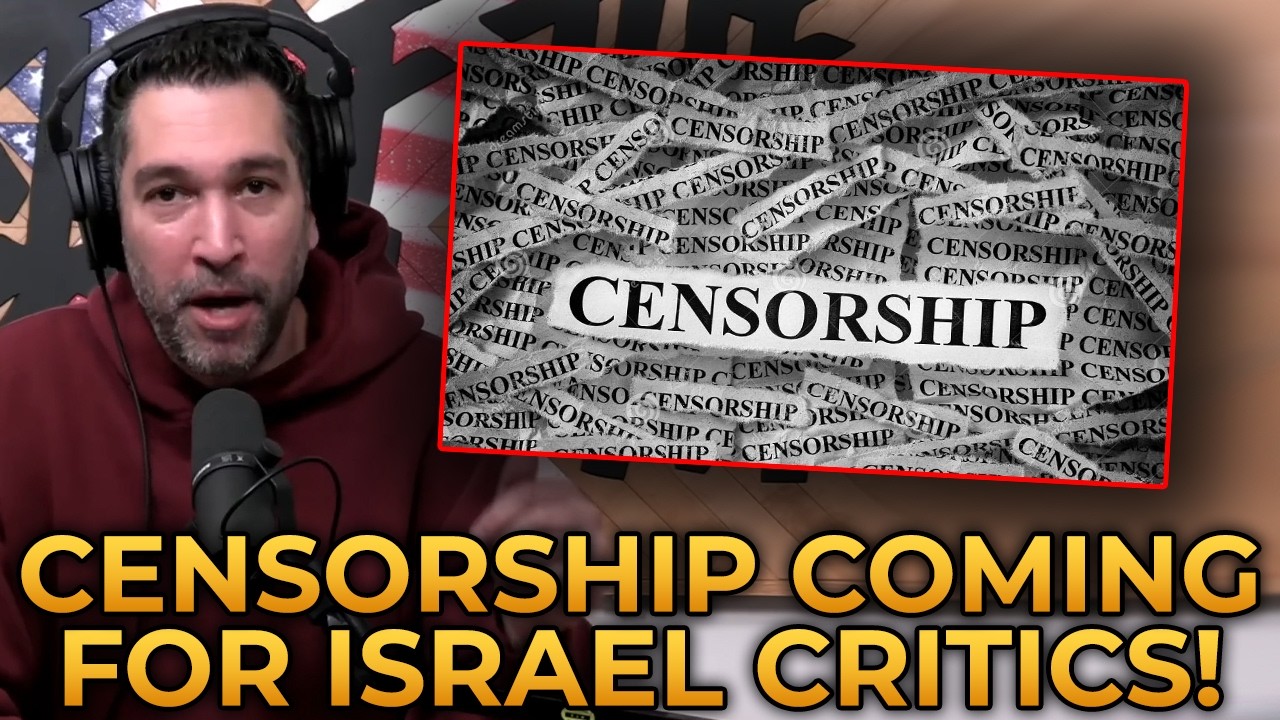
Dave Smith Exposes the Sinister Plan to SILENCE American Critics of Israel: “Censorship Is Coming!”
A New Information Battlefield
In the discussion, commentator Dave Smith argues that the modern American media and political environment is entering a phase where foreign policy debates are increasingly tied to domestic speech restrictions. The core concern raised is not just about war policy itself, but about who gets to criticize it—and what consequences follow when they do.
Smith’s framing is stark: he suggests that influential voices such as Tucker Carlson, Megyn Kelly, Candace Owens, Alex Jones, and Nick Fuentes have been marginalized or targeted in various ways because of their political commentary on foreign policy and cultural issues.
He connects this to a broader claim: that dissenting voices are not just being debated, but increasingly pushed toward deplatforming or algorithmic suppression.
Whether one agrees or disagrees, the underlying question is powerful: What happens to a democracy when major disagreements over war policy become entangled with disputes over who is allowed to speak at all?
War Policy and the Free Speech Pressure Valve
A central theme in the discussion is the idea that war—especially controversial or prolonged military engagements—often produces pressure for tighter information control at home.
Smith argues that during moments of foreign conflict, governments and aligned media institutions tend to become more sensitive to criticism. Supporters of this view often point to historical examples such as wartime censorship in the early 20th century or surveillance expansions after major conflicts.
In the conversation, he and others suggest that modern equivalents of this phenomenon may be emerging again, particularly in debates around Middle East policy and U.S. involvement in overseas conflicts.
Critics of this perspective counter that it overstates coordination and underestimates the role of fragmented media incentives. But even skeptics acknowledge a broader trend: political polarization has made speech itself a battleground, not just a tool for debate.
The Role of Influential Media Figures
A major flashpoint in the discussion is the role of media personalities like Mark Levin, Ben Shapiro, and Dan Bongino, who are described by Smith and others as strongly supportive of hawkish foreign policy positions.
The argument made in the conversation is not merely that these figures support military intervention, but that some of them are also linked—directly or indirectly, according to critics—to calls for tighter moderation of opposing viewpoints on social media platforms.
This is where the debate becomes more complex. Supporters of these media figures would argue they are advocating against misinformation or harmful rhetoric. Critics argue that the line between “content moderation” and political censorship is increasingly blurred, especially when the topics involve war and national security.
The discussion also highlights how closely modern media personalities are tied to political leadership. Figures like Donald Trump are frequently referenced as central nodes in this ecosystem, both influencing and being influenced by media commentary.
The Free Speech Coalition—Fragmenting or Expanding?
One of the most interesting tensions raised in the conversation is the idea that coalitions formed around free speech principles during previous political eras may now be fracturing.
In earlier years, especially during debates over COVID-era restrictions and social media moderation policies, many voices across the political spectrum aligned under a shared concern: that private platforms, often under governmental pressure, were suppressing dissent.
That coalition included libertarian commentators, independent journalists, and populist figures who argued that digital platforms had become too powerful in deciding what constitutes acceptable speech.
However, the current debate suggests that those alliances are under strain. Some voices who previously criticized censorship are now being accused of supporting moderation when it aligns with their policy preferences—particularly on foreign policy issues.
This perceived inconsistency is at the heart of the tension: is support for content moderation principled, or selectively applied depending on the political context?
The War Over Narrative Control
Another major figure in the conversation is commentator Dave Smith, who argues that public opinion on foreign policy has shifted significantly in recent years, particularly among younger audiences and independent media consumers.
According to Smith’s perspective, mainstream institutions may be losing control over the narrative surrounding foreign intervention, and this loss of influence is prompting stronger reactions—including calls for tighter regulation of online discourse.
Supporters of this interpretation point to the rise of independent platforms, podcasts, and decentralized media ecosystems as evidence that traditional gatekeepers no longer hold the same authority they once did.
Critics, however, argue that this decentralization also enables the spread of misinformation and amplifies extreme viewpoints, making some level of moderation necessary.
The tension between these two perspectives—openness versus control—forms the backbone of today’s information environment.
Historical Echoes: When Speech Meets Security
Throughout the discussion, participants draw comparisons to historical moments when national security concerns led to restrictions on speech.
They reference periods such as World War I, when dissent against military policy was often treated as subversive, and later Cold War-era surveillance programs that expanded government oversight of political activity.
The implication is that modern debates over social media moderation and algorithmic visibility may represent a digital evolution of older patterns.
However, historians often caution against direct comparisons. While past censorship regimes were typically state-driven, modern information control is often distributed across private companies, regulatory frameworks, and algorithmic systems rather than centralized government mandates.
Still, the underlying concern remains consistent: when does managing harmful speech become suppressing legitimate dissent?
The Algorithm Question
One of the more subtle but important themes in the conversation is algorithmic visibility. Rather than outright bans, critics argue that suppression today often takes the form of reduced reach—content being deprioritized, demonetized, or made less visible.
This concept has been widely discussed in relation to platforms like those overseen by Elon Musk after his acquisition of major social media infrastructure, where debates over transparency and moderation policies have become highly public.
The distinction between “removal” and “reduction in visibility” is central to the debate. One is explicit censorship; the other is harder to define but can have similar practical effects on public discourse.
This ambiguity is part of what makes modern speech debates so difficult to resolve. There is no single switch that turns censorship “on” or “off”—instead, there are layers of ranking, recommendation, and moderation decisions that collectively shape what people see.
Political Consequences and Polarization
The discussion also touches on the political fallout of these dynamics. Figures such as Ben Shapiro and others are described as being central to shaping conservative discourse, particularly around foreign policy.
At the same time, critics argue that opposing voices are gaining traction precisely because they are perceived as being excluded from mainstream platforms.
This creates a feedback loop:
Suppression claims increase audience sympathy for marginalized voices
Growing audiences intensify scrutiny from institutions
Increased scrutiny leads to more moderation or pushback
Which then reinforces the original narrative of suppression
The result is escalating polarization, where each side views the other not just as wrong, but as fundamentally unfair in how it engages in public discourse.
What Is Actually at Stake?
Beyond personalities and platforms, the deeper question raised in this debate is about institutional trust.
If citizens believe that:
Information is being selectively filtered
Political speech is being shaped by unseen incentives
Foreign policy debates are influenced by opaque networks of power
Then trust in both media and government institutions erodes.
On the other hand, if all content is left entirely unmoderated, critics argue that the information environment becomes vulnerable to manipulation, extremism, and misinformation.
This is not a new dilemma—but digital platforms have dramatically increased its scale and speed.
Conclusion: A System Under Pressure
The conversation ultimately reflects a broader instability in how modern societies manage disagreement.
Foreign policy, media influence, algorithmic control, and free speech norms are no longer separate issues—they are interconnected parts of the same system.
Whether one agrees with the claims made by Dave Smith or the figures he critiques, the underlying tension is undeniable: the struggle to define the boundaries of acceptable speech is becoming one of the defining political conflicts of the digital age.
And unlike earlier eras, this conflict is unfolding in real time, in public view, across platforms that millions of people use every day.
The question is no longer just who gets to speak.
It is also: who decides who gets heard?