British Travelers Enter Louisiana Bayou and Discover the America Cable News Forgot
British Travelers Enter Louisiana Bayou and Discover the America Cable News Forgot
A British traveler’s first day in Louisiana has gone viral for one simple reason: it shows an America that rarely survives the noise of politics, crime headlines, and online stereotypes.
There were no polished tourism boards. No luxury hotel lobby. No scripted influencer meet-up. No paid actors pretending to be friendly for the camera.
Just a quiet road in rural Louisiana, a bayou, alligators in the water, strangers in pickup trucks, country music on a boat, and a level of hospitality that left two visitors almost speechless.
The footage begins with a scene that many outsiders would instantly read as dangerous. Two travelers from the United Kingdom are parked on an isolated road near the Louisiana-Texas border, hoping to spot an alligator. There is no crowd. No obvious town nearby. Just swamp, trees, water, insects, and silence.
Then a car passes them.
It reaches the end of the road.
It stops.
It reverses.
Anyone raised on crime thrillers might expect tension. Instead, the driver had turned around because he thought they might need help.
That was their first impression of Louisiana.
Within minutes of entering the state, the travelers encountered what locals call ordinary decency and outsiders call shocking kindness. The man did not know them. He did not ask for anything. He simply saw people pulled over in the middle of nowhere and came back to check on them.
For the visitors, it was the first crack in a stereotype.
The American South is often portrayed from the outside as dangerous, backward, suspicious, and hostile. The internet has turned “redneck” into an insult and rural America into a cartoon. But in this video, rural Louisiana appears as something very different: watchful, generous, unpretentious, and deeply human.
The journey continues deeper into the bayou, where the travelers describe green water, hanging trees, insects, snakes, alligators, and swamp roads that feel like something out of a movie. They reference the fantasy version of Louisiana many foreigners know — Disney’s The Princess and the Frog, Southern novels, old music, and cinematic images of moss-covered trees.
But then the fantasy becomes real.
Sitting beside the water with a Twisted Tea, the traveler reflects on how strange and beautiful it feels to be deep in the Louisiana swamps and still have 5G service. That detail, funny as it sounds, captures the contradiction of America perfectly. One moment, he is surrounded by alligator country. The next, his phone has stronger reception than many people get in European cities.
Then a boat arrives.
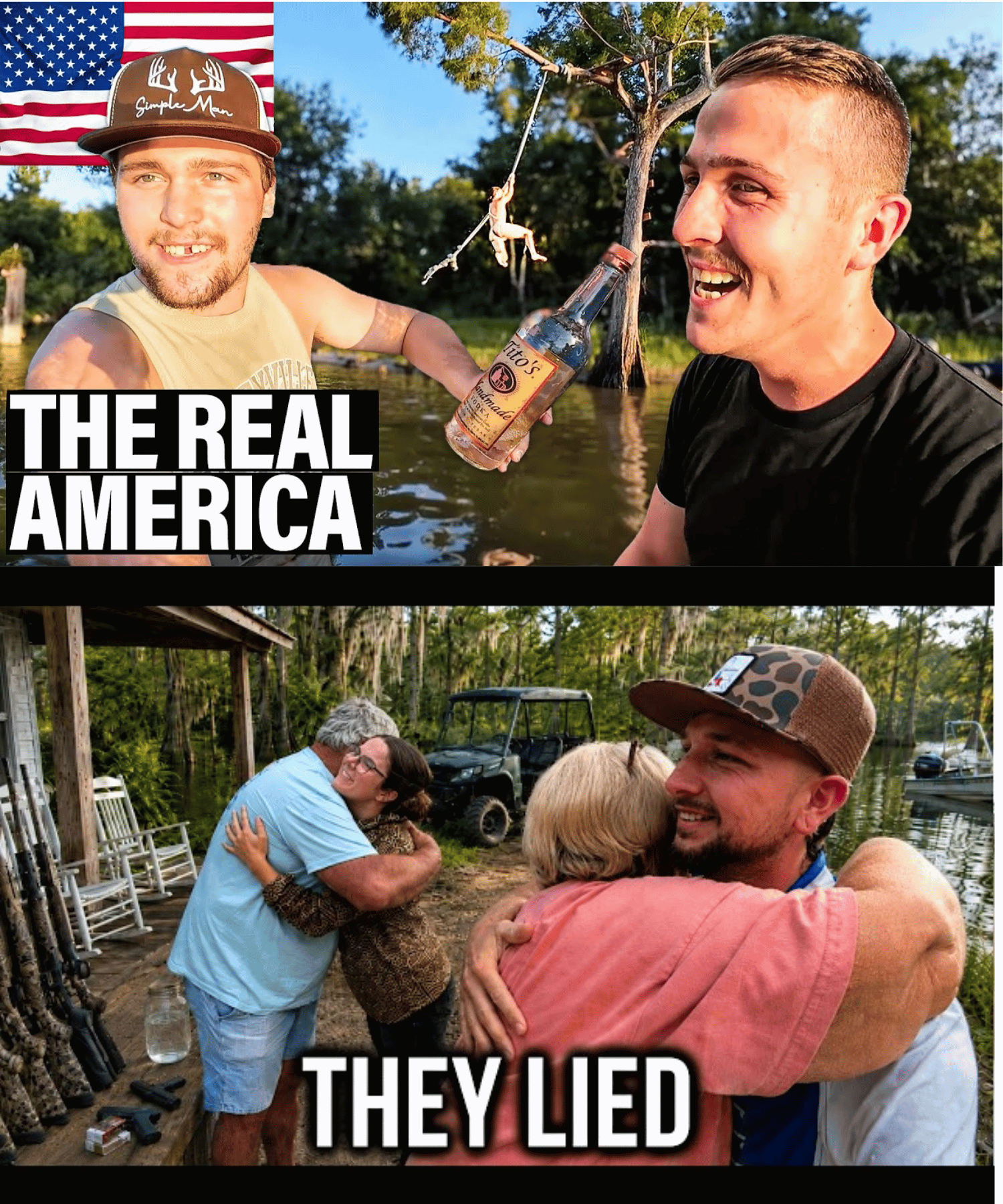
A local man preparing to launch into the bayou notices the visitors and casually asks if they want to come for a ride. They hesitate, not wanting to intrude. He insists it is no trouble. He and his companions have simply finished work and decided to take the boat out for sunset.
Within minutes, two strangers from Britain are climbing aboard a Louisiana boat with locals they have just met.
That is the moment the video turns from travel vlog into cultural document.
The locals do not perform hospitality. They live it. They offer seats. They explain the boat. They offer life jackets. They point out the trolling motor, the batteries, the controls, the posted land signs, and the strange water-access rules tied to old property claims. They explain the river, the border with Texas, the houseboats, the fishing, the local wildlife, and the pride people take in the place.
Then, perfectly timed, an alligator appears.
The traveler, who had waited by the water without seeing one, suddenly finds himself feet away from the creature he came to Louisiana hoping to spot. The locals laugh, guide the boat closer, and explain how alligators sometimes chase fishing lures. For a visitor, it is pure adventure. For them, it is Tuesday evening.
That difference is the heart of the story.
To outsiders, the bayou looks wild. To locals, it is home.
The boat ride becomes a rolling portrait of Southern life. Country music blasts. The boat speeds down the river. Local young men swim despite the known presence of alligators. People gather around rope swings. A bottle of Texas vodka gets passed around. The British visitor is offered a taste, then given the bottle as a souvenir. Later, he is invited to shoot a firearm for the first time under careful instruction, with locals showing him how to hold it safely, keep his finger off the trigger until ready, and aim away from people.
It is loud, risky, generous, funny, and unmistakably American.
For many viewers, this is exactly where the debate begins.
Some will see the footage and focus on danger: alcohol, guns, swamps, alligators, boats, and strangers. Others will see what the travelers saw — trust, confidence, community, and people sharing the life they know with guests who arrived by chance.
Both reactions say something about America.
The United States is a country where freedom often looks chaotic to outsiders. A boat ride can become a party. A stranger can become a friend. A river can become a playground. A gun can appear in the same evening as a rope swing and an alligator sighting. To people from more regulated societies, the whole thing can feel shocking.
But to the travelers, the overwhelming feeling was not fear.
It was gratitude.
Again and again, they say the same thing: the people are incredible. The hospitality is unbelievable. The kindness is almost impossible to explain. They expected Southern friendliness, but they did not expect strangers to take them out on a boat, show them alligators, teach them local customs, share drinks, offer them a place to stay, and finally hand them a $100 bill to help them get a hotel for the night.
That final moment is what makes the story feel almost unreal.
After hours of giving the visitors one of the most memorable experiences of their lives, a local man knocks on their car window and gives them cash. The travelers refuse at first. He insists. He tells them to use it for their journey.
The traveler is visibly stunned.
In a country often described abroad as individualistic, cold, expensive, and divided, here was a working man in rural Louisiana giving money to foreign strangers because he wanted them to be safe and comfortable.
That is not a headline Americans see often enough.
The video does not erase America’s problems. The South has poverty, inequality, racial history, health struggles, environmental challenges, and political divisions. Louisiana is not a fairy tale. The bayou is not a theme park. Guns and alcohol are not toys. Wild water can be dangerous. Rural life can be hard.
But the footage reveals something real that gets buried beneath national arguments.
There is still a version of America where strangers stop to help. Where people invite you onto their boat. Where local pride is shared, not sold. Where hospitality is not branding but instinct. Where working people finish a long day and choose to spend their sunset showing visitors why they love home.
That America does not trend often because kindness is quieter than outrage.
But when outsiders capture it honestly, it hits hard.
For the British travelers, Louisiana was not just a place on a map. It became a story they said they would tell their grandchildren: the day they arrived in the Deep South, saw alligators, rode a bayou boat, shot a gun for the first time, swung into the river, listened to country music, and met people generous enough to change the way they understood America.
That may be why the video resonates.
It is not only about Louisiana.
It is about the America people forget exists.
The America between the headlines.
The America where a stranger still turns the car around to ask, “Are y’all okay?”