Street Preacher’s Clash at DC Pride Erupts Into Viral Firestorm Over Christianity, LGBTQ Identity, and Free Speech in America
Street Preacher’s Clash at DC Pride Erupts Into Viral Firestorm Over Christianity, LGBTQ Identity, and Free Speech in America
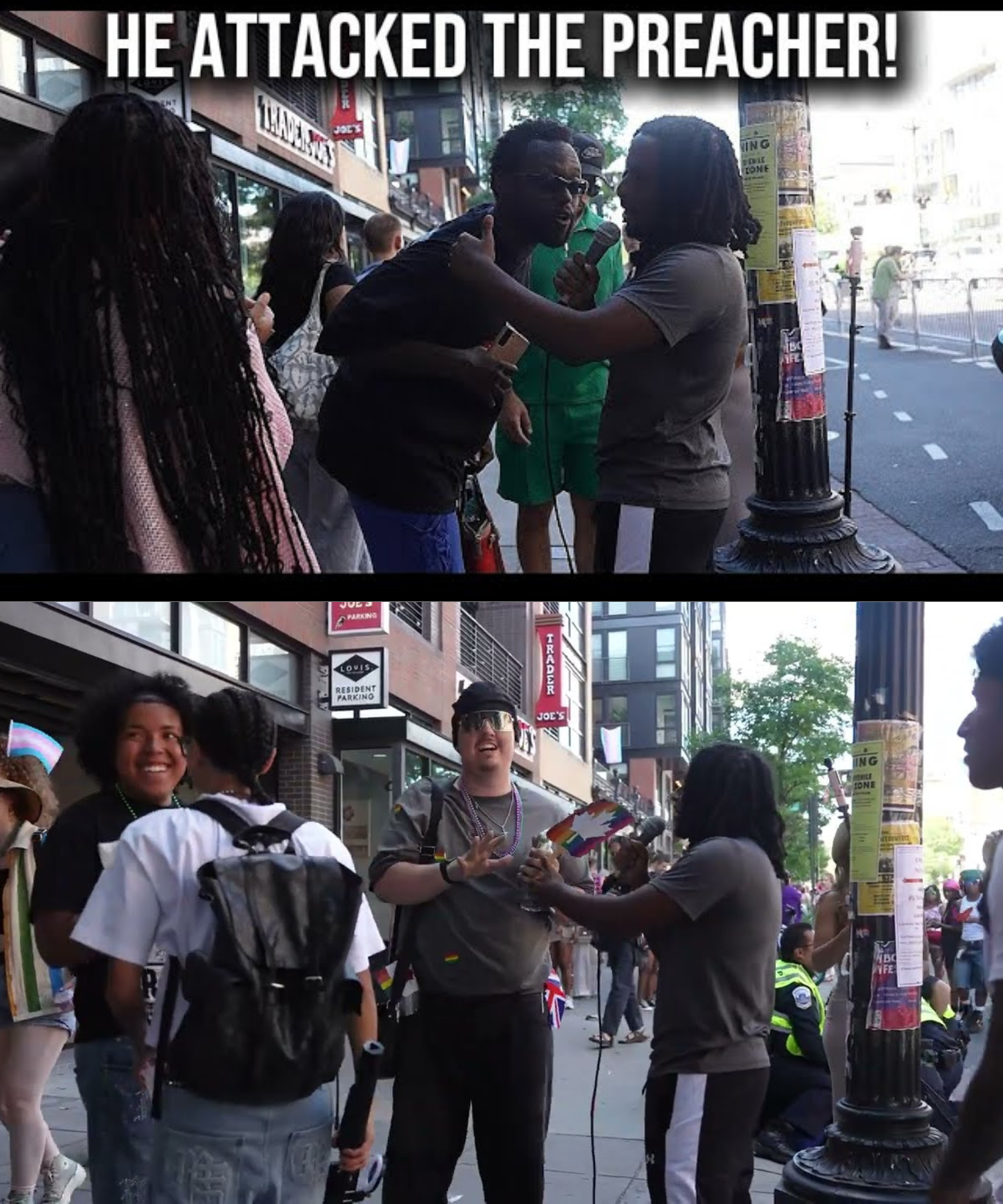
A tense confrontation at a Pride event in Washington, D.C., has exploded across American social media after a Christian street preacher was shouted down, challenged, splashed with water, and surrounded by angry attendees while preaching against what he called “pride” and sexual sin.
The incident, captured on video, unfolded in the middle of a public street during a crowded Pride celebration. Music, rainbow flags, costumes, and celebration filled the area. But on one street corner, a group of Christian evangelists arrived with a microphone, a speaker, and a message that instantly cut against the mood of the day.
The preacher opened by asking what people were celebrating. He argued that “pride,” from a biblical perspective, is not virtue but rebellion against God. He connected the word to Satan’s fall and warned that celebrating identity apart from God leads people away from spiritual truth. His tone was firm, direct, and unapologetically evangelical.
Almost immediately, the atmosphere shifted.
Some attendees ignored him. Others stopped to argue. One man approached, visibly irritated, questioning the preacher’s right to condemn homosexuality in the middle of a Pride event. The preacher insisted he was not there to condemn people personally, but to preach what he believed was the gospel of Jesus Christ.
That distinction did little to calm the crowd.
The first major confrontation came when one man challenged the preacher’s moral basis for calling homosexuality wrong. The man argued that homosexuality has existed throughout human history. The preacher countered that many things have existed throughout human history — including murder and sexual violence — but existence does not make something morally good. According to him, morality must come from an unchanging God, not human behavior.
The exchange quickly grew heated. The man moved closer. Voices rose. The preacher told him to relax and remain civil. Then the situation appeared to become physical, with the preacher warning him not to touch him.
“Get out of my face,” the man shouted.
The preacher stepped back, while others nearby tried to keep the situation from escalating. Despite the aggression, the preacher continued speaking, saying the reaction proved how offensive biblical truth can feel to people who reject it. He prayed for the man and said he hoped God would soften his heart.
That moment became the first flashpoint online.
Supporters of the preacher said the video showed the contradiction of a movement that preaches tolerance but cannot tolerate Christian dissent in public. They argued that Pride attendees had every right to celebrate, but Christians also have a First Amendment right to preach in public spaces.
Critics saw the situation differently. They accused the preacher of deliberately choosing a Pride event to provoke LGBTQ people, many of whom have painful histories with religious rejection. To them, bringing a loudspeaker into a celebration and telling people their relationships are sinful was not love. It was harassment disguised as ministry.
The debate only intensified as more attendees approached.
One young man told the preacher he loved God but also loved men. The preacher responded by quoting scripture and arguing that loving God requires obeying God’s commandments. He used the example of a man claiming to love his wife while abusing her, arguing that love must be proven by action, not words.
The young man pushed back, saying everyone sins and that homosexuality should not be singled out as worse than other sins. The preacher agreed that all people sin, including himself, but said true repentance means turning away from whatever God condemns. His message was clear: no one is saved by pretending sin is harmless.
Another attendee asked a question that cut to the heart of the argument: if someone is gay and happy, why would God want that person to deny who they are?
The preacher answered that Christianity requires self-denial. He quoted Jesus’ call for disciples to deny themselves, take up their cross, and follow Him. He argued that identity should not be rooted in desire, sexuality, or emotion, but in being a child of God.
That answer divided viewers sharply.
For conservative Christians, the preacher’s response was a clear expression of orthodox biblical teaching. For LGBTQ advocates, it sounded like spiritual pressure to erase identity and label love as rebellion. Many argued that the preacher’s words could deepen shame among people who already face high levels of rejection, depression, and family conflict.
Then came another chaotic moment.
Someone threw water at the preacher, and another person hurled insults. The preacher called it assault but said he would not retaliate. Police later approached to collect information related to the incident, but the preacher appeared reluctant to step away from his mission or formally pursue charges. He said he wanted to continue preaching.
That choice became another source of debate. Some praised him for refusing to be distracted by hostility. Others said public disorder should be handled through police, not turned into more content for a viral confrontation.
The most intense theological exchange came when attendees challenged the preacher’s use of Leviticus. Several argued that verses often used to condemn homosexuality had been mistranslated and originally referred to abuse or exploitation rather than consensual same-sex relationships. The preacher rejected that argument, insisting the text refers to male same-sex conduct and pointing to the surrounding verse as evidence that both participants are described as morally responsible.
The street corner briefly became a public Bible debate.
One side accused the preacher of cherry-picking scripture while ignoring other Old Testament laws. The preacher argued that they were misunderstanding the text and avoiding what it plainly says. The crowd mocked him. He pressed on. Every few minutes, the discussion shifted from theology to insults, from doctrine to emotion, from scripture to personal identity.
That is why the video has gone viral beyond the Christian and LGBTQ communities.
It captures a central conflict in American public life: what happens when absolute religious claims collide with modern identity politics in the same public space?
The First Amendment protects both sides. Pride attendees have the right to celebrate and advocate for LGBTQ visibility. Christians have the right to preach, evangelize, and criticize behavior they believe is sinful. But the legal right to speak does not remove the emotional impact of the words being spoken, and the emotional impact of speech does not justify threats or physical aggression.
That tension is now playing out everywhere — campuses, school boards, churches, city streets, and social media.
Supporters say the preacher modeled courage by standing in a hostile environment and refusing to repay anger with violence. Critics say he inserted condemnation into a space meant for celebration and healing. Both sides claim love. Both sides accuse the other of hatred.
By the end of the video, no consensus is reached. Some people walk away. Others keep arguing. The preacher continues reading scripture and calling people to repentance. Pride attendees continue pushing back, insisting that their lives and relationships are not problems to be solved.
The encounter did not settle America’s debate over Christianity and LGBTQ identity.
But it exposed how deep the divide has become.
On one side stands a religious conviction that truth must be preached even when it offends. On the other stands a community that hears that preaching as rejection, harm, and a denial of who they are.
Between them is the American street — loud, chaotic, protected by law, and increasingly unable to avoid the collisions that define the nation’s culture war.