Tucker Carlson Drops the HAMMER on Zionism: “America Doesn’t Owe Israel ANYTHING!”
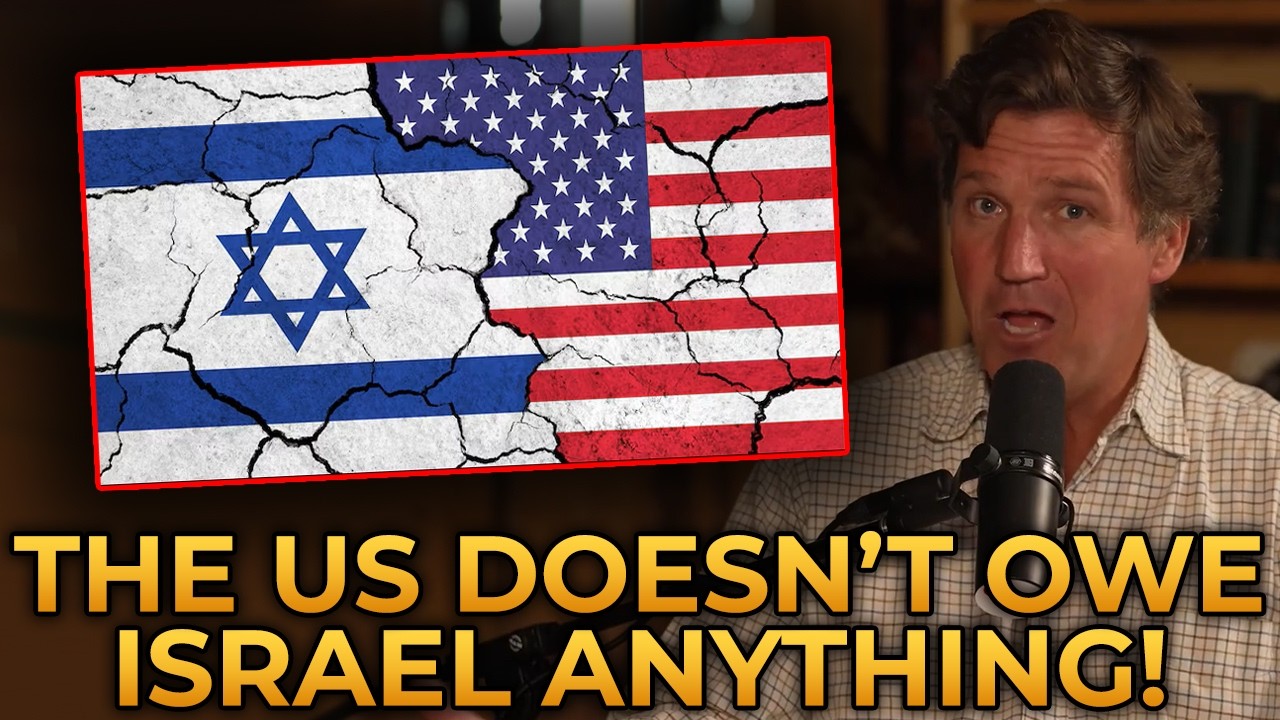
The United States is once again at the center of an explosive argument about its role in the world—and who, exactly, benefits from it.
In a fiery exchange that has gone viral, commentator Tucker Carlson challenged the foundations of U.S. foreign policy toward Israel, questioning whether American taxpayers are funding wars and strategic decisions that do not serve American interests. His remarks, and the reactions they provoked, cut into one of the most sensitive fault lines in modern politics: the intersection of national interest, foreign alliances, and public trust.
What followed was not just an argument about policy. It was a deeper confrontation over influence, loyalty, and whether American democracy is still fully in control of its own decisions.
And beneath it all lies a far more unsettling question: who is actually steering U.S. foreign policy?
A Debate That Goes Beyond Foreign Policy
At the center of the controversy is Carlson’s blunt assertion: the United States, he argues, owes Israel nothing. In his framing, decades of military aid, diplomatic alignment, and intelligence cooperation have drifted far from their original justification.
Instead, he suggests, the relationship has evolved into something structurally imbalanced—where American resources and political capital are used in ways that may not align with U.S. national interest.
This argument, while controversial, is not new in American political discourse. What makes it explosive is who is saying it, how directly it is being said, and the geopolitical context surrounding it—particularly ongoing tensions involving Iran and renewed debate over military engagement in the region.
Carlson’s comments were framed around a broader critique of interventionism: a belief that the United States has spent decades entangled in foreign conflicts that deliver unclear benefits at home while producing significant costs abroad.
The Core Claim: “America First” or Strategic Dependency?
One of the most striking elements of the discussion is Carlson’s insistence that American foreign policy has drifted away from its own declared principles.
He argues that under successive administrations—including those of Donald Trump and Joe Biden—the United States has repeatedly engaged in Middle Eastern policy decisions that prioritize foreign strategic objectives over domestic stability.
Carlson’s critique hinges on a simple question:
Why does the United States continue to provide extensive financial and military support to allies whose strategic interests may not always align with its own?
Supporters of U.S.-Israel relations argue that the partnership is rooted in shared democratic values and security cooperation. Critics like Carlson, however, frame it differently: as a system of influence that constrains independent policy-making.
This tension—between alliance and autonomy—has become one of the defining foreign policy debates of the 21st century.
The Interview That Sparked the Fire
The controversy escalated during Carlson’s adversarial interview with an Israeli journalist, where he doubled down on his claims.
He criticized what he described as the conflation of legitimate policy criticism with accusations of extremism, arguing that this dynamic discourages open debate about foreign policy decisions.
Carlson emphasized that criticism of the Israeli government should not be interpreted as hostility toward Jewish people, stating that political leaders across nations—including Israelis, Iranians, Arabs, and Americans—should be subject to scrutiny like any others.
He extended the argument further, suggesting that multiple powerful industries and geopolitical relationships influence U.S. politics, including defense, energy, and foreign lobbying networks.
But it was his framing of Israel as a “corrupting force” in American politics that generated the strongest backlash and widest attention.
The Question of Influence in Washington
To Carlson and like-minded commentators, the central issue is not cultural or religious identity, but political influence.
They argue that foreign policy decisions—particularly regarding the Middle East—often reflect the priorities of strategic partners rather than domestic voters.
In this narrative, the relationship between the United States and Israel is not purely transactional or diplomatic, but deeply embedded in legislative, military, and intelligence frameworks that shape long-term policy outcomes.
Critics of this view strongly reject such characterizations, arguing that U.S. foreign policy is driven by American national security interests, not external pressure. They also emphasize the complexity of global alliances and the necessity of cooperation in an unstable region.
Still, Carlson’s argument resonates with a growing segment of the public skeptical of long-standing foreign entanglements.
Iran, Intelligence, and the Question of War
A significant portion of the debate centers on Iran’s nuclear capabilities and the justification for potential military action.
Carlson pointed to intelligence assessments suggesting that Iran does not currently possess an active nuclear weapons program. He contrasted this with competing assessments reportedly presented by Israeli officials, arguing that conflicting intelligence played a role in shaping U.S. policy decisions.
The implication is controversial: that American leaders may have acted on flawed or externally influenced intelligence assessments, leading to decisions that escalate tensions in the region.
In this context, Iran becomes more than a geopolitical adversary—it becomes a focal point in the larger debate over who defines threats and how those definitions translate into military action.
A Broader Critique of Interventionism
Beyond Israel and Iran, Carlson’s argument fits into a broader ideological critique of U.S. foreign policy stretching back decades.
He references past conflicts such as Iraq, Libya, Syria, and Yemen as examples of what he sees as a pattern of regime-change interventions that failed to produce stability.
From this perspective, the issue is not isolated to one country or administration, but structural: a foreign policy establishment that repeatedly engages in overseas conflicts without clear domestic benefit.
Supporters of interventionism counter that U.S. global engagement has prevented larger conflicts, stabilized key regions, and maintained international order. Critics respond that the costs—financial, human, and geopolitical—have outweighed the benefits.
The Political Fallout and Public Reaction
The intensity of the debate reflects a broader shift in American political culture.
Once-reliable partisan alignments on foreign policy are breaking down. Figures like Carlson, who previously aligned with establishment conservative positions on certain issues, now openly challenge core assumptions of bipartisan consensus.
This shift has created unusual political coalitions—uniting libertarian-leaning conservatives, anti-interventionists, and segments of the progressive left who also oppose military expansion abroad.
At the same time, it has intensified polarization, with critics accusing Carlson of promoting misleading narratives, while supporters view him as one of the few mainstream voices willing to question entrenched power structures.
Trump, Foreign Policy, and Strategic Shifts
The role of Donald Trump in this debate is particularly complex.
During his presidency, Trump promoted an “America First” foreign policy, criticizing prolonged military engagements and advocating for reduced overseas commitments. However, his administration also took actions widely interpreted as strengthening alignment with Israel, including recognizing contested territories and withdrawing from international agreements such as the JCPOA nuclear deal framework.
This duality—rhetoric of restraint paired with strategic alignment—illustrates the complexity of translating campaign messaging into governance.
Carlson’s critique ultimately hinges on this tension: the gap between political promises and geopolitical realities.
Democracy, Representation, and Public Trust
Underlying the entire debate is a more existential concern: whether democratic systems adequately reflect public preferences in foreign policy.
Carlson’s argument suggests a disconnect between elite decision-making and voter sentiment, particularly regarding war and military engagement.
He frames this as a democratic deficit: a situation where policies with long-term consequences are made without meaningful public consent or debate.
Critics, however, caution that foreign policy requires expertise, confidentiality, and continuity that cannot always be shaped by immediate public opinion.
The result is a persistent tension between democratic accountability and strategic governance.
A System Under Pressure
What makes this debate so significant is not just the content of the arguments, but the environment in which they are taking place.
Information flows faster than ever, trust in institutions is declining, and media ecosystems amplify polarizing narratives. In this environment, foreign policy debates that once took place in closed academic or diplomatic circles are now public, viral, and highly contested.
Carlson’s remarks reflect this transformation. Whether one agrees with him or not, the scale of attention his views generate signals a deeper shift in how Americans engage with questions of war, alliance, and global responsibility.
Conclusion: A Debate With No Easy Answers
At its core, the controversy surrounding Tucker Carlson’s interview is not just about Israel, Iran, or any single policy decision. It is about the structure of American power itself.
How should the United States define its national interest?
How much influence should foreign partnerships have over domestic decision-making?
And who ultimately gets to answer those questions?
There are no simple resolutions. What is clear, however, is that these debates are no longer confined to policy papers or congressional hearings. They are happening in public, in real time, and with increasing intensity.
And as long as conflicts persist in the Middle East—and as long as the United States remains deeply involved—the questions raised in this conversation are unlikely to disappear anytime soon.