Viral Penn State Lecture Sparks National Firestorm Over “Woke Double Standards,” Race, and Free Speech in America
Viral Penn State Lecture Sparks National Firestorm Over “Woke Double Standards,” Race, and Free Speech in America
New York — A widely circulated lecture by Penn State sociology professor Sam Richards has ignited a heated national debate over race, workplace discipline, and what critics are calling “woke double standards” in modern American institutions.
The video, originally part of a classroom-style livestream discussion, features Richards examining controversial incidents involving racial language, workplace punishment policies, and public reactions to perceived discrimination. The lecture has since gone viral across social media platforms, where it is being debated as either a thoughtful academic exploration or a controversial critique of progressive racial norms.
At the center of the discussion are two high-profile incidents: a school staff member fired under a zero-tolerance racial slur policy, and a separate case involving a Muslim woman asked to remove her hijab at a public venue security checkpoint.
Zero-Tolerance Policies Under Fire
One of the key examples discussed in the lecture involves a school employee in Madison, Wisconsin, who was removed from his position after an incident in which a student used a racial slur during a confrontation.
According to the lecture, the staff member intervened in a disruptive situation and, during the process, repeated a racial slur in an attempt to stop the student from using it. Despite the context, the school’s zero-tolerance policy led to disciplinary action against the staff member.
Richards uses this case to question whether strict institutional policies can adequately account for context, intent, and situational nuance.
He argues that while racial slurs are inherently harmful, rigid enforcement without contextual consideration can lead to what he describes as disproportionate consequences, including job loss and reputational damage.
Critics of his framing argue that zero-tolerance policies exist precisely to prevent ambiguity in cases involving racial language, and that allowing contextual exceptions could weaken protections against discrimination.
The “Context vs Consequence” Debate
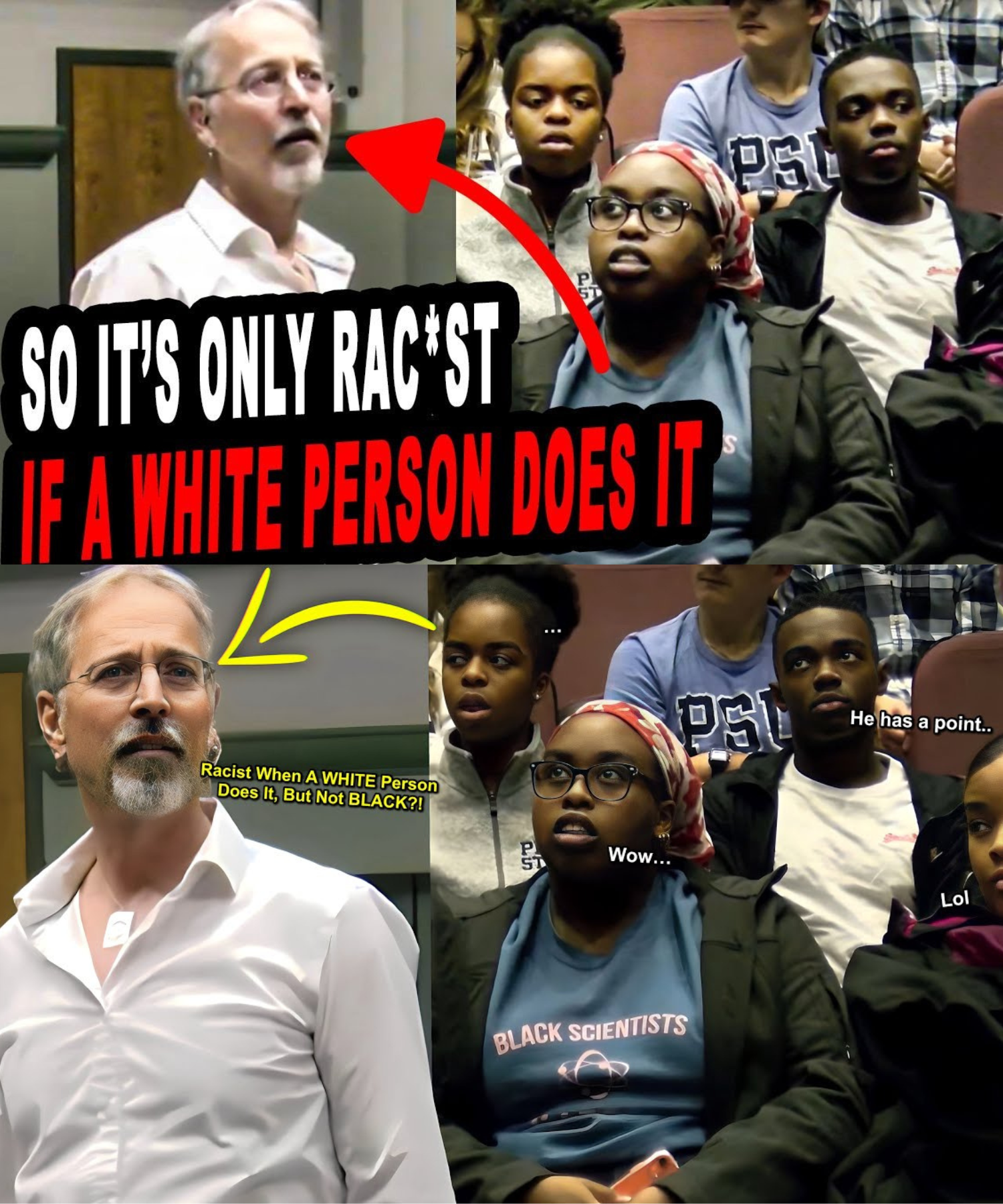
The lecture quickly expands into a broader philosophical debate: should intent matter when evaluating offensive language?
Richards suggests that modern institutional frameworks often prioritize absolute rules over situational judgment, leading to outcomes that some perceive as unfair.
He questions whether individuals should lose employment over isolated incidents, especially when actions occur in high-stress or disciplinary contexts.
Supporters of this perspective argue that society increasingly punishes individuals without considering nuance, while opponents argue that context should never excuse the use of racially charged language in professional environments.
The discussion has since become a focal point in broader debates over free speech, workplace accountability, and “cancel culture.”
Hijab Incident at Denver Arena Enters the Conversation
A second case discussed in the lecture involves a Muslim woman who was reportedly asked to remove her hijab during a security screening at a Denver arena while attending a child’s performance event.
According to the lecture, the woman initially refused, citing religious reasons, and requested a private room to comply with security requirements. Security staff allegedly denied the request, leading to confusion and escalation before another official intervened and allowed her entry under normal screening procedures.
The incident later circulated online, drawing criticism from advocacy groups who described it as an example of religious insensitivity and procedural failure.
Richards uses the example to highlight what he sees as inconsistent public reactions depending on race, religion, and perceived power dynamics in similar incidents.
He raises the question of whether security staff acted out of ignorance or bias, noting that the situation resolved without major conflict but still generated public controversy.
Civil liberties advocates have long emphasized the importance of accommodating religious dress in public spaces, provided security protocols are maintained.
Racial Double Standards and Institutional Criticism
Throughout the lecture, Richards explores what he describes as inconsistent institutional responses to race-related incidents.
He compares reactions to different scenarios involving racial language, religious dress, and public accountability, suggesting that public outrage can vary significantly depending on the identity of those involved.
He raises concerns that similar actions may be interpreted differently depending on whether the individuals involved are white, Black, or members of religious minorities.
This argument has sparked intense disagreement online.
Supporters say Richards is pointing to a real tension in modern diversity and inclusion frameworks, where context and identity often shape institutional outcomes.
Critics argue that his comparisons risk minimizing the historical and structural dimensions of racial discrimination in the United States.
The “Woke Standard” Debate Goes Viral
The lecture also critiques what Richards describes as a “zero tolerance culture” emerging in schools and workplaces, where individuals can face severe consequences for isolated language or misunderstandings.
He warns that such systems may discourage open dialogue and critical thinking, particularly in academic environments.
The video has since been widely shared by commentators critical of progressive policies in education and corporate diversity training programs.
Supporters of these policies argue that strict enforcement is necessary to maintain safe and inclusive environments, particularly in institutions with histories of discrimination.
Social Media Reaction: Deep National Divide
The viral spread of the lecture has produced sharply divided reactions across social media.
Supporters of Richards praise the lecture as a rare academic attempt to examine uncomfortable inconsistencies in modern racial discourse, particularly around punishment, intent, and institutional bias.
Critics argue that the framing oversimplifies complex racial dynamics and risks downplaying the lived experiences of marginalized communities affected by discrimination.
Some educators have defended zero-tolerance policies as necessary tools, while others acknowledge that such policies can produce unintended consequences in edge cases.
Experts Warn of “Context Collapse” in Online Discourse
Media scholars note that the controversy reflects a broader phenomenon known as “context collapse,” where academic lectures and classroom discussions are removed from their original setting and reframed as viral political statements.
In such environments, nuanced arguments can quickly become simplified into binary positions, intensifying polarization rather than encouraging understanding.
Experts emphasize that debates about race, language, and institutional discipline require careful contextual analysis rather than clip-based interpretation.
A Broader Cultural Fault Line in America
Beyond the specific incidents discussed, the viral lecture reflects a deeper cultural divide in the United States over how institutions should balance accountability, free expression, and historical awareness.
On one side are those who argue that strict rules are necessary to prevent discrimination and ensure equal treatment.
On the other are those who believe that rigid enforcement can sometimes ignore context and produce unjust outcomes.
This tension has become increasingly visible in schools, corporations, and public institutions nationwide.
No Consensus, Only Escalation
As the video continues to circulate, no consensus has emerged regarding Richards’ conclusions or the incidents he discusses.
Instead, the lecture has become part of a broader national conversation about race, fairness, and institutional power in America.
For some viewers, it represents a necessary critique of overly rigid systems.
For others, it reflects a misunderstanding of why such systems exist in the first place.
What remains clear is that the debate over race, language, and institutional justice in America is far from resolved — and continues to intensify as viral media amplifies complex issues into national controversies.