Viral Debate Between Israeli Streamer and Syrian Muslim Ignites Firestorm Across America Over Gaza, October 7, and the Quran
Viral Debate Between Israeli Streamer and Syrian Muslim Ignites Firestorm Across America Over Gaza, October 7, and the Quran
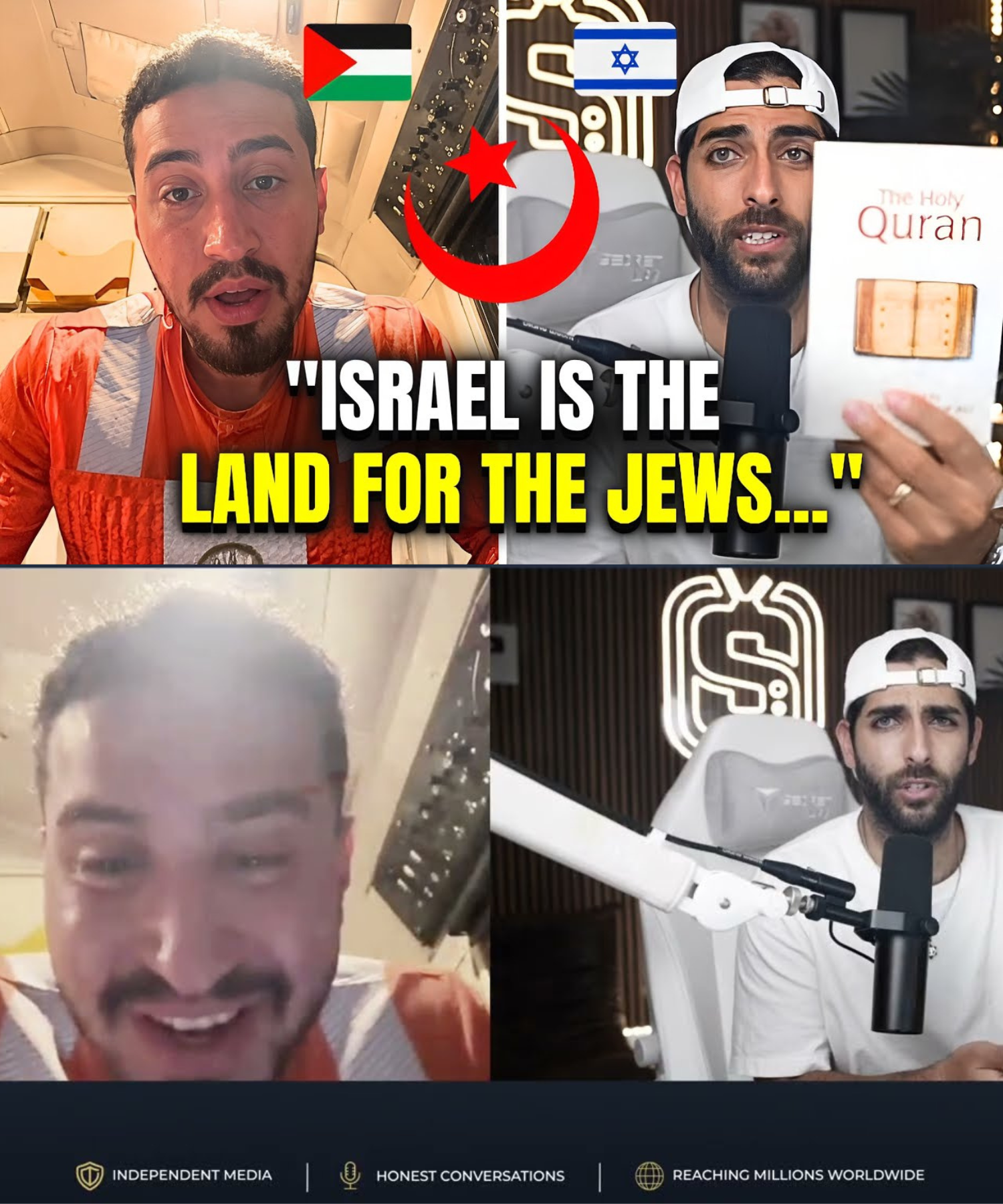
A heated online exchange between an Israeli streamer and a Syrian Muslim man has exploded across American social media, turning a livestream argument into another fierce battleground over Gaza, October 7, religion, war, and the question no one in the United States seems able to discuss calmly anymore: who has the stronger moral claim in one of the world’s most painful conflicts?
The clip, now circulating widely among U.S. political commentators, opens like many internet debates do — casually, almost randomly. The Israeli streamer asks where the other man is from. The answer comes back: Syria. For a moment, it sounds as if the conversation might become a human discussion about war, displacement, and survival.
Then everything turns.
The Israeli speaker begins by acknowledging Syria’s suffering, referring to the destruction caused by Bashar al-Assad’s regime and the staggering number of Syrians killed during the country’s civil war. But before he can finish, the Syrian man cuts in with a sharp accusation: Israel, he says, is killing children in Gaza.
From that moment, the conversation stops being personal and becomes political. More than political — explosive.
The Syrian participant challenges the Israeli speaker over civilian deaths, accusing Israel of killing children and elderly people without justification. The Israeli speaker pushes back, arguing that civilian deaths happen in every war and asking whether any war in history has avoided innocent casualties. He then turns the question back on Syria, asking why the world never protested for Syrian civilians with the same intensity now seen in demonstrations for Palestine.
That challenge became one of the most replayed moments in the clip.
Across the United States, where campus protests and street demonstrations over Gaza have already divided cities, universities, churches, and political parties, the question hit a nerve. Why, some viewers asked, did Syria’s catastrophic civil war never become the same kind of global protest symbol? Why did Gaza trigger a worldwide movement when other Middle Eastern tragedies received far less sustained attention?
Supporters of the Israeli speaker saw the question as devastating. Critics saw it as deflection. To them, the suffering of Syrians does not reduce the suffering of Palestinians, and one tragedy should not be used to silence another.
But the debate did not stop there.
The Syrian man insisted that Israel had no reason to be in Gaza. The Israeli speaker responded by pointing to the October 7 attacks, saying Hamas, Islamic Jihad, and other Palestinian fighters crossed into Israel, killed civilians, and triggered the war. He argued that Israel’s military campaign is aimed at stopping Hamas from firing rockets and preventing future attacks, not simply taking land.
The Syrian man rejected that framing. He questioned whether Gaza was Israel’s land and continued to accuse Israel of killing civilians without justification.
Then the conversation took a surprising religious turn.
The Israeli speaker told the Syrian Muslim that the Quran itself refers to the Holy Land being assigned to the people of Moses, known in Islamic tradition as Banu Israel. He directed him to verses commonly cited as Surah Al-Ma’idah 5:20–21, reading an English translation that describes Moses telling his people to enter the holy land assigned to them.
The Syrian man hesitated. At one point, he questioned the translation and suggested he would need to read the original Arabic text himself. The Israeli speaker pressed him, asking if he was suggesting there were different versions of the Quran or that the text was corrupted.
That exchange quickly became the center of online reaction.
For pro-Israel commentators in America, the moment was framed as a stunning contradiction: a Muslim man, they argued, was forced to confront verses from his own scripture that appear to acknowledge a historical connection between Banu Israel and the Holy Land. For pro-Palestinian viewers, the argument was far from settled. Many pointed out that religious texts are interpreted differently, and that ancient references do not automatically answer modern legal, political, or humanitarian questions.
Still, the clip’s emotional force was undeniable.
The Syrian participant eventually acknowledged that the verses refer to land, but asked which land specifically. The Israeli speaker answered that the passage refers to the Holy Land assigned to Moses and the Israelites — not necessarily Gaza alone, but the broader sacred geography at the center of Jewish, Christian, and Islamic history.
That is where the debate became larger than Gaza.
It became a fight over scripture, identity, inheritance, and history.
In America, those arguments carry special power. Millions of evangelical Christians view Israel through a biblical lens. Many Jewish Americans see Israel as both ancestral homeland and refuge after centuries of persecution. Many Muslim and Arab Americans see Palestine as a symbol of displacement, occupation, and injustice. Secular activists often reject religious claims entirely and focus instead on human rights, international law, and civilian suffering.
The livestream compressed all of that into a few tense minutes.
The most chilling part came near the end. The Syrian man, while saying he had to leave for work, issued a warning. He claimed that within a few years Israel’s government would be finished and that viewers would see him in Gaza. The Israeli speaker challenged him one last time, asking whether Israel’s repeated victories in wars meant God was on the side of the Jews rather than the Arabs. The Syrian man refused to answer directly and ended the exchange in frustration.
That final exchange sent the clip racing through American online spaces.
Conservative commentators described it as proof that religious hostility lies beneath much of the anti-Israel movement. Pro-Palestinian voices argued that the Israeli speaker was using rhetorical traps to avoid confronting the humanitarian crisis in Gaza. Others saw the clip as a perfect example of why online debates rarely solve anything: both men spoke from pain, loyalty, anger, and inherited narratives too deep to unwind in a livestream.
The broader American reaction reveals just how combustible the Israel-Gaza debate has become.
On college campuses, students have lost friendships over it. In Congress, lawmakers have turned it into a loyalty test. In synagogues and mosques, communities are dealing with fear, grief, and suspicion. Online, every clip becomes evidence. Every word becomes a weapon. Every argument is instantly sorted into one side or the other.
What made this video stand out was not that it contained a perfect answer. It did not. It contained accusation, interruption, selective history, religious interpretation, and emotional pain. But that is exactly why it went viral.
It sounded like the argument America is already having.
One side says Israel is fighting a war forced upon it by October 7. The other says Gaza’s civilians are paying an unbearable price. One side points to Jewish history and religious connection to the land. The other points to Palestinian suffering and displacement. One side asks why the world stayed quiet during other Middle Eastern wars. The other asks why that question is being raised now, when Gaza is burning.
The livestream ended, but the debate did not.
It moved into American living rooms, classrooms, podcasts, comment sections, and political shows. And once again, the country was left staring at the same painful truth: the Israel-Palestine conflict is no longer only a Middle Eastern crisis.
It is an American argument now.
And every viral clip makes that argument harder to escape.