Shroud of Turin Debate Reignites as Scientists Clash Over “Impossible Image” That Still Defies Modern Explanation
Shroud of Turin Debate Reignites as Scientists Clash Over “Impossible Image” That Still Defies Modern Explanation
A renewed wave of scientific debate is sweeping across the United States and Europe over one of the most studied religious artifacts in human history — the Shroud of Turin — after new discussions surfaced questioning whether modern science is still fundamentally unable to explain how the image on the cloth was formed.
For centuries, the 14-foot linen cloth preserved in Turin, Italy, has divided researchers into two camps: those who believe it to be the burial cloth of a crucified man, and those who insist it is a sophisticated medieval creation.
But according to recent scientific discussions and revisited studies, neither side has fully resolved the central mystery.
And the most controversial possibility now being raised is this: even the widely cited carbon dating test may not have examined the original material at all.
A Cloth That Refuses to Be Explained
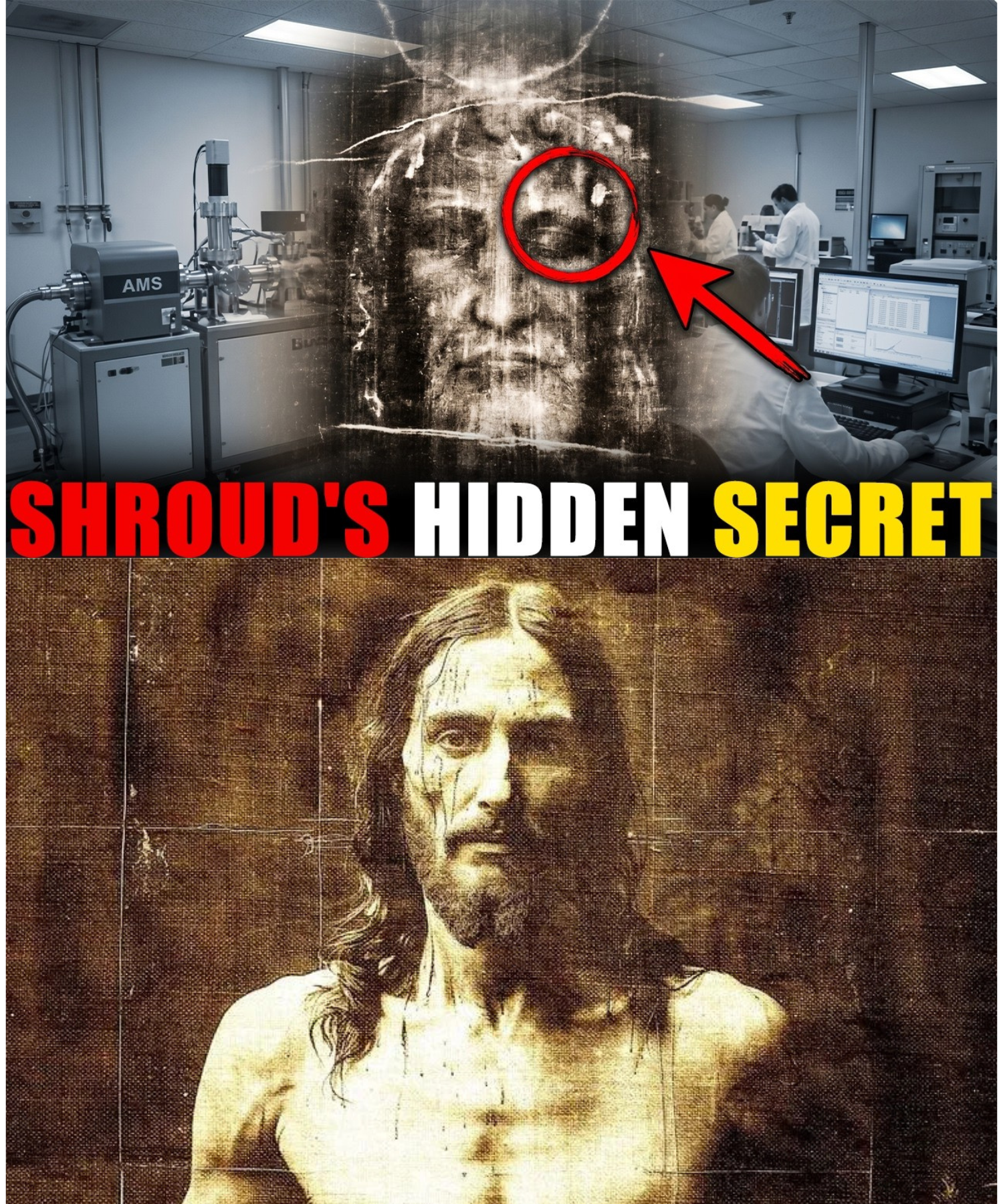
At first glance, the Shroud appears almost unremarkable — a faint, ghost-like imprint of a human figure on aged linen. But when photographed under specific conditions, particularly when reversed into a photographic negative, the image transforms into a strikingly detailed depiction of a man bearing wounds consistent with crucifixion.
Lash marks appear across the body in parallel lines consistent with Roman flogging instruments. Facial injuries suggest severe trauma. Most notably, the wrists — not the palms — appear to show puncture wounds consistent with Roman execution practices.
Forensic researchers have long noted that medieval art typically depicts crucifixion wounds in the palms, not the wrists, because the anatomical understanding of load-bearing structures was limited at the time.
This discrepancy has fueled decades of debate.
The Scientific Problem: No Known Image Process Works
Modern researchers attempting to replicate the Shroud’s image formation have repeatedly run into the same barrier: no known process fully reproduces its characteristics.
Under microscopic analysis, the image appears to exist only on the outermost fibers of the linen. It does not penetrate deeply into the threads, unlike paint, dye, or ink, which typically seep into fabric.
No brush strokes are visible under magnification. No pigment particles have been consistently identified. No directional application pattern typical of human painting techniques appears to exist.
Instead, the coloration seems to result from a chemical change in the fibers themselves — a form of oxidation or dehydration that selectively affects only the surface layer.
This has led to multiple competing theories.
The Sculpture Hypothesis: A Flat Body Hidden in Geometry
One of the most discussed modern theories comes from digital modeling research suggesting that the image may behave more like a projection from a low-relief sculpture than from a real human body.
Computer simulations comparing a fully three-dimensional human form with a shallow carved relief show a striking difference in how fabric contacts each surface.
When cloth is draped over a real body, it stretches, folds, and distorts significantly. But when pressed against a shallow sculpture, the resulting contact pattern is more uniform, producing less distortion in facial and bodily proportions.
Researchers argue that the Shroud’s image aligns more closely with this second model.
However, even this theory raises new questions.
If a sculpture was used, what method transferred the image onto cloth without leaving tool marks, pigment traces, or identifiable artistic residue?
No known medieval technique fully explains this.
The Radiation Hypothesis: A Partial Breakthrough
Another line of research focuses on high-energy radiation, particularly ultraviolet light, as a possible mechanism for image formation.
Experimental studies have demonstrated that intense UV bursts can produce shallow discoloration on linen fibers, similar in depth and appearance to those observed on the Shroud.
These experiments successfully replicate certain features: surface-level oxidation, lack of pigment penetration, and gradual fading patterns.
But they fall short in a critical way.
They can only produce small patches of discoloration — not a full-body, anatomically precise image spanning 14 feet of cloth.
Scaling the process up to match the Shroud’s full structure has not yet been achieved in any laboratory setting.
This leaves researchers with a partial answer, but no complete mechanism.
The Carbon Dating Controversy Returns
Perhaps the most controversial aspect of the Shroud debate remains the 1988 radiocarbon dating test conducted by three independent laboratories.
The results suggested a medieval origin, placing the cloth somewhere between 1300 and 1400 AD.
For many scientists, this seemed to settle the question.
But critics have long argued that the sample used for testing may not have been representative of the original cloth.
One hypothesis suggests the tested fragment came from a later repair or restoration area, rather than the primary material of the Shroud itself.
If true, the test would have dated a patch — not the original artifact.
This claim remains disputed, with no universal consensus in the scientific community.
However, renewed calls for non-destructive modern testing methods continue to emerge from researchers who believe the question has not been definitively resolved.
The DNA Findings Add Another Layer of Mystery
More recent analyses of microscopic material from the Shroud have introduced another controversial element: DNA sequencing results.
Researchers claim that genetic material recovered from the cloth includes markers associated with multiple geographic regions, including the Middle East, North Africa, and South Asia.
Under normal contamination theory, centuries of handling by clergy, scientists, and restorers would produce a random, mixed genetic profile dominated by European DNA.
Instead, the results reportedly show structured clustering patterns that some researchers describe as non-random.
Three geneticists reportedly refused to sign the final interpretation of the data, citing inability to classify the results within established biological frameworks.
One described the profile as “biologically inconsistent with known contamination models.”
However, critics argue that DNA degradation over centuries makes any firm conclusion extremely difficult.
A Mystery at the Intersection of Science and Faith
The Shroud of Turin occupies a rare position in modern science: an object simultaneously subjected to rigorous testing and intense theological interpretation.
Supporters of authenticity point to the anatomical precision, image formation anomalies, and unresolved dating questions as evidence that the cloth may be more than a medieval artifact.
Skeptics counter that extraordinary claims require extraordinary proof, and that unresolved scientific questions do not automatically imply supernatural origins.
What both sides agree on is simpler: the image remains unexplained by any single accepted mechanism.
The Core Problem That Remains Unsolved
After decades of study, three major investigative threads continue to run in parallel:
Digital modeling suggests a sculpture-like geometry rather than a real body imprint
Radiation experiments reproduce partial chemical effects but not full image formation
Carbon dating results remain disputed due to sample integrity questions
Each line of research answers part of the problem — but none resolve it completely.
And that is what continues to keep the debate alive.
Conclusion: A Scientific Mystery Still Open
More than seven centuries after its first documented appearance, the Shroud of Turin remains one of the most intensely studied artifacts on Earth.
It has survived fires, restorations, wars, and countless scientific examinations.
Yet the central question remains unchanged:
How was the image formed?
Whether the answer lies in medieval craftsmanship, unknown physical processes, or something not yet fully understood, the cloth continues to resist closure.
And in an age where science can sequence genomes, map planets, and reconstruct ancient faces, the Shroud still stands as a reminder that not every mystery has yielded to explanation.
Some, even today, remain unresolved.