Viral Jerusalem Travel Video Ignites Fierce Debate Over “Apartheid,” History, and Who Owns the Holy City
Viral Jerusalem Travel Video Ignites Fierce Debate Over “Apartheid,” History, and Who Owns the Holy City
New York — A travel video filmed inside Jerusalem’s Old City has gone viral across American social media, triggering an intense political firestorm over Israel, Palestine, religion, and the meaning of “apartheid” in one of the most contested cities in the world.
The footage, shot by British YouTuber Harry Jaggard, shows him walking through Jerusalem’s narrow streets, visiting religious landmarks shared by Jews, Christians, and Muslims, and speaking to locals and tourists about daily life in the city. But what begins as a travel documentary quickly transforms into a highly charged political commentary that has divided viewers across the United States.
At the center of the controversy is Jaggard’s description of Jerusalem as a place where “three of the world’s major religions exist side by side,” referencing the Western Wall, Al-Aqsa Mosque, and the Church of the Holy Sepulchre — all located within a small geographic area. He describes the city as beautiful but deeply divided, shaped by thousands of years of overlapping history and modern political tension.
However, the video becomes controversial when political framing enters the narrative.
“Apartheid” Claim Sparks Immediate Backlash
At one point in the video, commentary over the footage describes parts of Jerusalem as displaying “horrific apartheid,” pointing to multilingual street signs in Arabic, Hebrew, and English as evidence of separation and inequality.
The claim immediately drew backlash from pro-Israel commentators, who argue that the presence of multiple languages reflects multicultural coexistence rather than segregation. Critics of the video say that labeling Jerusalem as apartheid ignores the complexity of daily life in the city, where Jews, Muslims, Christians, tourists, and foreign workers interact in shared public spaces.
Supporters of the video argue that visible cultural separation, political restrictions, and unequal access to certain areas still reflect a system of structural division — particularly in contested zones such as East Jerusalem.
The term “apartheid,” however, remains one of the most controversial labels in global politics, and its use in relation to Israel is fiercely disputed in academic, legal, and diplomatic circles.
Western Wall and Al-Aqsa: Competing Sacred Narratives
The video also highlights the physical proximity of Judaism’s Western Wall and Islam’s Al-Aqsa Mosque, describing it as one of the most emotionally and politically sensitive spaces in the world.
Jaggard explains that the Western Wall is the last remaining structure from the Second Jewish Temple, destroyed by the Romans nearly 2,000 years ago, and that it remains the holiest prayer site in Judaism. Just steps away lies the Al-Aqsa Mosque and the Dome of the Rock, one of Islam’s most sacred sites, believed to be the place where Prophet Muhammad ascended to heaven according to Islamic tradition.
The video emphasizes how extraordinary it is that two of the world’s most sacred religious sites exist in such close proximity — a few hundred meters apart — within a city that also holds immense significance for Christianity.
But this proximity is also the source of enduring conflict.
Green Line and the Question of Borders
The video references the “Green Line,” the informal boundary established after the 1948 Arab–Israeli war and later reshaped after the 1967 Six-Day War. According to the narrative in the footage, East Jerusalem came under Israeli control following 1967, a point that remains highly contested in international politics.
Israeli supporters in the video argue that the war changed security realities and that access to holy sites for Jews was previously restricted before 1967. Critics counter that Israeli control over East Jerusalem is considered occupation under international law by many global institutions.
The video does not settle the dispute, but instead presents both perspectives, leaving viewers to interpret the layered history themselves.
Tourism Decline and Economic Strain
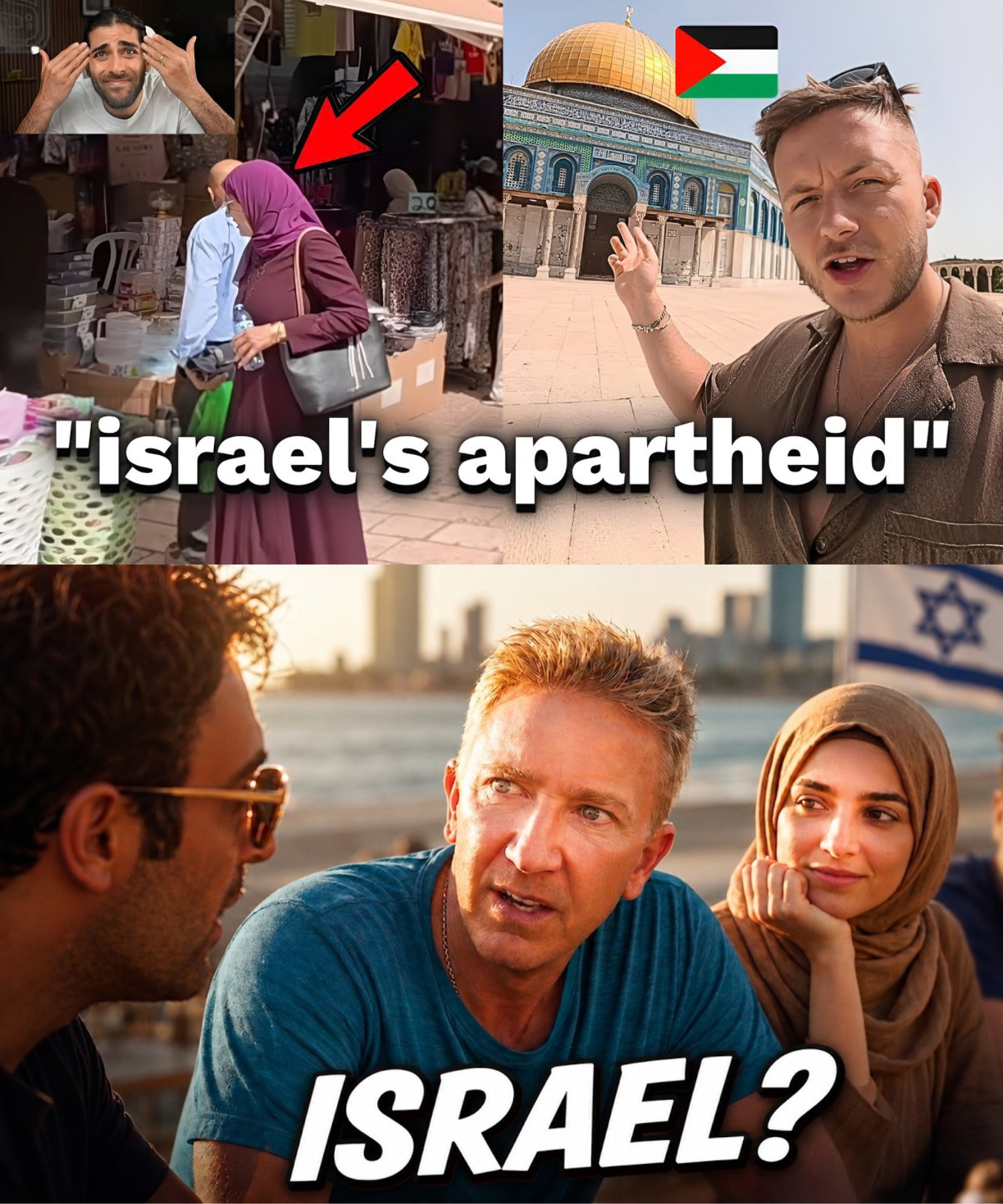
Another striking moment in the footage comes during street interviews with local shopkeepers, who describe a significant drop in tourism. One merchant claims business has slowed dramatically compared to previous years, pointing to regional instability and global political tension as key factors.
The video shows empty or quiet streets in some areas, which commentators use to argue conflicting interpretations: some see evidence of crisis, while others argue the footage is selective and does not represent the broader reality of Jerusalem’s active tourism economy.
The lack of consistent context fuels further debate online.
Palestinian Presence and Labor Claims
A particularly sensitive segment of the video features commentary suggesting that Palestinian labor movement and employment access have been heavily restricted since recent escalations, leading to increased reliance on foreign workers from countries such as India, Sri Lanka, and Ethiopia.
The video claims this shift reflects a broader restructuring of labor markets in Jerusalem and surrounding areas. Critics argue that the framing is politically loaded and oversimplifies complex migration, employment, and security policies. Supporters say it highlights real economic consequences of prolonged conflict.
Competing Narratives Over Identity and History
Perhaps the most controversial portion of the video involves claims about Palestinian identity itself. One commentator argues that Palestinian national identity was politically constructed in the 20th century, while others insist that Palestinians represent an indigenous population with deep historical roots in the land.
This clash reflects one of the core disputes in the Israel–Palestine conflict: whether identity is defined by modern political development or continuous historical presence.
In the video, both perspectives are presented, but neither is reconciled.
Social Media Reaction and Political Polarization
Once uploaded and circulated, the video rapidly spread across platforms, where it became a flashpoint in broader debates over Israel, colonialism, religion, and historical legitimacy.
Pro-Israel viewers praised parts of the video that emphasized Jewish historical connection to Jerusalem and questioned claims of apartheid. Pro-Palestinian viewers focused on structural inequality, restrictions on movement, and political control over East Jerusalem.
Meanwhile, neutral observers noted that the video reflects the difficulty of presenting Jerusalem in a purely “travel” context without immediately entering geopolitical controversy.
A City Where Narrative Is Reality
What makes the video particularly explosive is not just what it shows — but what it represents.
Jerusalem is not simply a city. It is a symbolic center of three major religions, a focal point of competing national identities, and a place where history, theology, and modern politics collide in real time.
Every street sign, every checkpoint, every religious site, and every conversation becomes part of a larger narrative battle.
The video captures that tension in raw form.
No Easy Conclusions
By the end of the footage, the traveler reflects on the emotional weight of the experience, describing Jerusalem as both beautiful and deeply sad — a place where spirituality and conflict are inseparable.
But online, the reactions show no consensus.
For some, the video confirms long-held beliefs about occupation, division, and inequality.
For others, it demonstrates coexistence, religious depth, and historical legitimacy.
And for many viewers in the United States, it raises a larger question that remains unanswered:
Can a city carry three sacred histories at once — without each one becoming a political weapon?