Poor Food Truck Girl Ignored the Millionaire CEO in Line—Until He Whispered, “Still Remember Me”
Poor Food Truck Girl Ignored the Millionaire CEO in Line—Until He Whispered, “Still Remember Me”
The morning rush on Fifth Avenue never slowed down for anyone. It was May 2026, and Midtown Manhattan was a roaring river of collective anxiety. There were the high-altitude suits racing toward glass-and-steel boardrooms, their eyes locked onto wireless earbuds; the tourists fumbling with navigation apps at the crosswalks; and the delivery cyclists weaving through gridlocked yellow cabs like line cutters in a panic.
None of it mattered to Maya Collins. She had been flipping grilled cheese sandwiches since 5:00 AM inside a space no larger than a walk-in closet, maintaining a steady, practiced smile that had long ceased to hurt her cheeks.
Her food truck, Golden Crust, was an artifact of pure survival. It was small, painted a cheerful buttercup yellow that had since faded under the relentless New York sun, and deeply dented on the left rear quarter panel—a souvenir from the time a city bus had clipped her side mirror on 42nd Street during a February blizzard.
Near the service window, the hand-painted menu board bore a small, slightly crooked sunflower in the bottom corner. Maya’s younger sister, Lily, had drawn it with permanent acrylics three years ago, just two weeks before the flashing lights and twisted metal of the interstate accident changed their lives forever. Maya had received multiple offers from local graphic designers wanting to wrap the truck in slick, modern vinyl, but her answer was always the same.
“Some things you just don’t paint over,” she would say, her fingers tracing the rough, dried ridges of the yellow petals.
She slid a cardboard sleeve over a paper cup of fire-roasted tomato soup and handed it to a construction worker whose vest was covered in gray concrete dust. She took his crumpled five-dollar bill, flattening it out with a thumb trained to count currency by feel alone.
“You’re an absolute angel, Maya,” the man said, inhaling the steam from the cup. “Seriously. This stuff is the only reason I survive the morning shift.”
“You say that every single Tuesday, Frank,” she replied, her laugh bright and echoing over the rumble of a nearby subway grate.
“And I’ll say it next Tuesday too,” Frank shouted back, disappearing into the crowd.
Maya turned back to the griddle. The black cast-iron surface was her anchor. Sourdough bread from a bakery in Queens, aged sharp cheddar that melted into thick, glossy ribbons, and a micro-thin spread of whole-grain artisan mustard that gave the crunch an unexpected bite. This was her world—small, physically grueling, honest, and entirely hers. Every dollar earned was a direct measurement of her own labor.
The Stranger in Line
The line on Wednesday morning stretched much further than usual, spilling past the steps of the public library. A massive, three-day international technology summit had taken over the Hilton two blocks down, injecting thousands of extra pedestrians into the neighborhood.
Suddenly, Maya’s humble truck was surrounded by a different breed of commuter. They wore unstructured Italian blazers, pristine white sneakers, and smartwatches that beeped with real-time stock notifications. They squinted at her handwritten chalkboard menu with a bizarre sort of intensity, looking at the words Classic Melt and Tomato Bisque as though they were written in an ancient, forgotten script.
Maya didn’t mind the cultural shift. In New York, rent was agnostic about who paid it. Money was money, and Lily’s college tuition installment was due in less than a month.
“Can I get a sourdough grilled cheese and a black coffee, please?” a voice requested from the front of the window.
Maya didn’t look up. Her hands were locked into a rhythmic, automatic sequence: layout the bread, brush the clarified butter, drop the cheddar blend, press. “Coming right up,” she said, sliding a steaming twelve-ounce cup across the stainless-steel counter without breaking her stride. “That’ll be nine-fifty.”
A brief pause hung in the air. The sounds of Fifth Avenue—the shrill whistle of a traffic cop, the hiss of air brakes, the chatter of a hundred simultaneous conversations—seemed to drop in volume, replaced by a sudden, heavy stillness right at the ledge of her window.
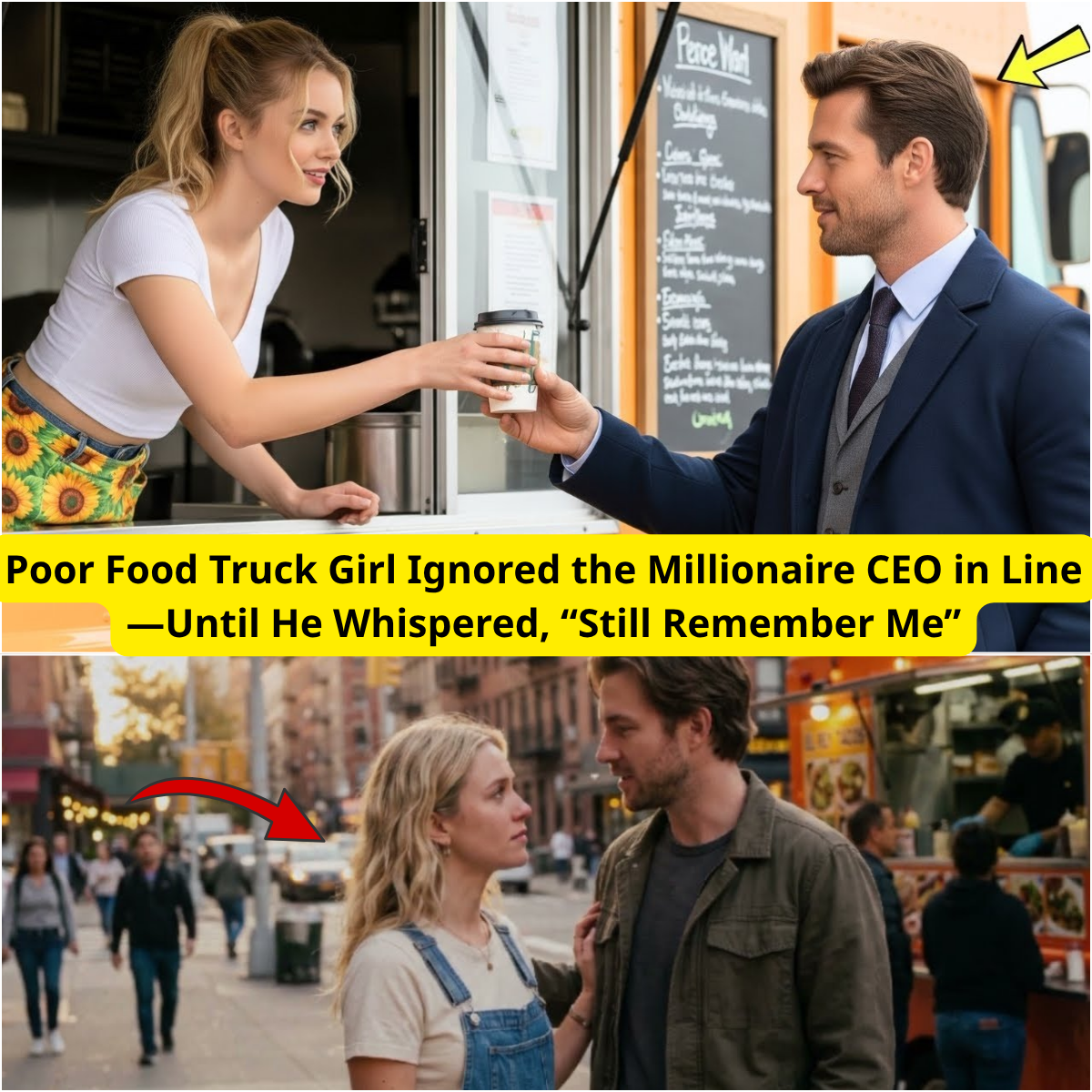
“Do you still remember me, Maya?”
The voice was quiet. Almost too quiet for the ambient roar of Manhattan, but it struck Maya with the terrifying precision of a lightning bolt.
Her hand froze on the handle of her heavy metal spatula. Her shoulders went rigid beneath her grease-stained apron. She knew that specific cadence, that slight Midwestern drawl buried under years of professional polish, the way an old farmer knows the smell of ozone right before the clouds break. Before she even turned her head, something deep within her chest cracked open—an old, jagged wound that she had spent a decade convincing herself had healed into flat, unfeeling scar tissue.
She turned around slowly, her wiping cloth gripped tight in her left hand.
Standing at her service window, holding the paper coffee cup, was Daniel Holt.
He was wearing a charcoal-gray three-piece suit that probably cost more than the entire commercial refrigerator inside her truck. He looked older, sharper, his jawline more defined by the brutal geometry of corporate warfare. Life had clearly carved him into something far harder, far more expensive, and infinitely more distant than the boy she had left behind. His hair was cropped short in a style that screamed executive privilege; his wrist bore a platinum watch that caught the morning light like a warning sign. Everything about his posture radiated immense power.
But his eyes—the deep, amber-brown eyes that looked at her through the square opening of the food truck—were exactly the same ones that had sat across from her in a cracked vinyl diner booth in Athens, Ohio, twelve long years ago. Back when they were twenty-two, entirely broke, sharing a single order of home fries, and completely, foolishly certain that love was a thick enough currency to survive on.
“Daniel,” she said. The name came out as a fragile breath, like air escaping a vault that hadn’t been unsealed for a generation.
He wasn’t supposed to be a real person anymore. Over the last decade, Maya had carefully disassembled her memories of him, filing them neatly away into a mental drawer labeled Things That Didn’t Work Out. She had buried him somewhere between the devastating timeline of her mother’s terminal diagnosis and her sudden, desperate decision to leave Ohio forever, arriving at Port Authority with nothing but four hundred dollars in a white envelope and a handwritten book of family recipes.
“You’re good at this,” Daniel said, his eyes tracking the neat rows of golden-brown sandwiches sizzling on her griddle. He nodded at the yellow truck. “This is… this is really incredible, Maya.”
Maya blinked, the heat from the grill suddenly rising to her face. “You came to a food truck on Fifth Avenue, Daniel. The entire city is packed with Michelin-star restaurants. Why are you standing in my line?”
“I was at the Hilton for the keynote,” he said, gesturing vaguely behind him toward the tech banners fluttering in the wind. “But I didn’t find this by accident. I looked you up.”
“Excuse me, miss, can I get a breakfast wrap?” a man wearing a blue silk tie cleared his throat loudly from three spots back in line, checking his watch with evident annoyance.
The spell broke. Maya handed Daniel his sandwich bag without thinking, her professional instincts overriding her emotional paralysis. Daniel stepped aside immediately. He didn’t walk away toward the corporate plaza across the street; he simply leaned his expensive shoulder against the yellow enamel of her truck, melting his suit into the background of her workspace like he had all the time in the world.
Like he wasn’t Daniel Holt, the founder and CEO of Holt Industries, a man whose net worth hovered somewhere north of three billion dollars according to the financial magazines Maya frequently glanced at while waiting in line at the grocery store checkout.
The Architecture of Aftermath
Maya served the next four customers entirely on autopilot. Her hands flipped bread, wrapped paper, and made change, but her mind was entirely occupied by the weight of the man standing six inches past her left fender. When the clock struck 10:15 AM and the morning rush finally ebbed into a slow trickle, she pulled her hair back into a fresh hair tie and stepped down from the high metal threshold of the truck’s side door onto the asphalt.
He was still there, his coffee cup empty, watching the yellow cabs crawl through the intersection.
“You didn’t have to wait,” Maya said, wiping her hands on her apron before realizing how defensive it sounded.
“I wanted to,” Daniel replied.
They stood in an awkward, heavy silence for three long seconds. In New York, three seconds of total silence between two people who share twelve years of unspoken heartbreak feels like a century. It was the kind of silence that held the weight of every unreturned phone call, every unwritten letter, and every anniversary spent on opposite sides of a continent.
“Why did you look me up, Daniel? Truly,” she asked, her voice losing its customer-service edge, becoming smaller, more vulnerable.
Daniel looked down at the plastic lid of his coffee cup, his thumb tracing the rim. “Because I’ve driven past three hundred food trucks in this city over the last twenty-four months, Maya. Every time I see a yellow truck or a lunch line, my driver slows down because my brain refuses to believe you just vanished. And then, last month, my car was stuck in a dead halt on 47th Street. I looked out the window, and I saw that sunflower painted on your menu board.”
Maya’s throat tightened into a hard knot. “Lily drew that,” she whispered, looking down at her own shoes. “Right before the hospital.”
“I know,” Daniel said softly, his voice dropping into a register that belonged strictly to their youth. “I remembered the shape of the leaves. I remembered how she used to paint them on the margins of your recipe notebooks.”
She looked away, watching a city bus roar past, its exhaust warm and smelling of sulfur. The city kept moving, entirely indifferent to the sudden collision of their pasts. New York was designed that way—a massive machine where your entire emotional history was nothing more than background noise to someone else’s morning commute.
“She’s okay,” Maya said, breaking the tension. “Lily, I mean. After the accident… she walks with a cane now, and winter is hard on her joints, but she’s okay. She’s a junior at NYU now. Creative writing.”
“I heard,” Daniel said, a small, genuine smile softening the hard lines of his mouth. “I’m glad, Maya. Really.”
Maya stopped, her eyes narrowing slightly as the implication of his words registered. “You heard? How could you hear that unless…” She trailed off. “You kept track of us.”
It wasn’t a question. Daniel didn’t attempt to deny it. He simply adjusted the cuffs of his charcoal blazer, his eyes unblinking. “Not in a way that would ever interfere with your life. But yes. I wanted to make sure the bills were being paid after your mother passed. I wanted to know you weren’t drowning.”
Here was the singular truth about Maya Collins that none of the thousands of commuters who bought her grilled cheese sandwiches ever knew: at twenty-three, she had been accepted into the prestigious Le Cordon Bleu culinary program in Paris. A full international scholarship. It had been the culmination of every late-night shift she had ever worked.
But that exact same month, Daniel’s first software startup had landed its initial seven-figure venture capital injection—the aggressive, unforgiving contract that required him to immediately relocate to Silicon Valley, assemble a development team from scratch, and completely submerge himself into the high-velocity machine of tech ambition.
They had stood at a literal and metaphorical crossroads in a damp apartment in Ohio, neither of them knowing how to say Come with me without it sounding like an ultimatum that would break the other person’s wings. So, terrified of being the cause of future resentment, they had said nothing at all. They had said a polite, agonized goodbye, and then they had spent the next decade building entirely separate, entirely successful, entirely lonely versions of their futures.
“I didn’t go to Paris,” she said suddenly, the words bursting out of her before she could filter them.
“I know,” Daniel replied.
“I stayed for Lily,” she said, her voice rising slightly, defending choices he hadn’t even criticized. “And then Mom got sick, and the medical bills accumulated, and then…” She gestured broadly with both hands toward the dented yellow truck, the smell of grease, and the stack of cardboard egg cartons visible through the open door. “Then this happened.”
Daniel looked at her—really looked at her, stripping away the grease-stained apron, the tired lines around her mouth, and the environment of the street, seeing the fierce, unyielding spirit that had always defined her. “Do you regret it?” he asked.
She thought about it honestly. She didn’t give him the polished, inspiring answer she usually gave to food bloggers or local journalists who asked about her journey from Ohio to the streets of New York. She looked at the dent in the yellow metal, then at the skyline above them.
“No,” Maya said, her chin lifting. “I don’t. This truck belongs to me. I didn’t inherit it, and nobody handed me the keys. I built this brand with my own skin. Every dent, every winter morning when the propane lines froze, and every dollar in that register—I earned it.”
Daniel watched her, and something profound shifted in his expression. It was the look of a man who had spent the last ten years collecting expensive, sterile things—board seats, luxury real estate, international accolades—suddenly understanding the exact nature of the rare, priceless thing he had walked away from in that Ohio apartment.
The Proposal
“I have a business proposal for you, Maya,” Daniel said, his corporate tone returning, though his eyes remained soft.
Maya raised an eyebrow, a small, wry smile tugging at the corner of her lips. “A business proposal? Let me guess—you want to buy out my secret blend of sharp cheddar for your corporate cafeteria?”
Daniel almost smiled. “Not exactly. Holt Industries is finalizing construction on our new sustainable employee campus in Brooklyn. It’s a full facility—four thousand employees, an automated wellness center, and a central food hall. I’ve spent the last eight months looking for the right culinary partners. The board wants me to hire a national corporate catering conglomerate. They want uniform, frozen, predictable food.”
He stepped closer to the truck, his voice dropping. “But I don’t want corporate catering. I want real food. Food with a soul. I want Golden Crust to take over the anchor location in the main hall.”
Maya stared at him, her spatula slipping slightly in her grip. “You want my food truck in a multi-billion-dollar tech headquarters?”
“I want the person who makes the food truck what it is,” Daniel corrected firmly. “I want your menus, your recipes, and your leadership. We will fund the entire build-out. A state-of-the-art kitchen, full staff lines, and total creative control remains with you. You’d be managing an operation twenty times this size.”
“That’s a terrifyingly big jump from a food truck window, Daniel,” she whispered, looking at the long line of traffic on Fifth Avenue.
“You’ve always been infinitely bigger than this window, Maya,” Daniel said, his voice carrying an absolute, unshakeable certainty. “You just never needed anyone else to tell you that.”
The New Horizon
Maya didn’t tell him yes that Wednesday. She didn’t let the ghost of her past dictate the reality of her present. She spent two full weeks running the numbers. She called Lily, who spent ten minutes crying into the phone before telling her that if she didn’t take the opportunity, she would personally walk from her dorm to Midtown with her cane and sign the contract herself. She called her friend Ro, a business-savvy restaurant consultant, who analyzed the preliminary term sheet, screamed into her microphone for thirty seconds straight, and then said, “If you don’t sign this, you’re legally insane.”
She read every clause of the contract twice. She hired an independent, sharp-eyed contract attorney to look it over once, ensuring there were no hidden clauses that gave Holt Industries ownership over her original recipes.
And on a crisp Thursday morning, sitting in a small coffee shop on the exact same Midtown block where her yellow truck had spent the last four years of its life, Maya signed her name on the dotted line.
She didn’t sign it because Daniel was the one offering the pen. She didn’t sign it out of some romantic, nostalgic fantasy about reviving a twelve-year-old relationship that had died in an Ohio winter. She signed it because she had earned every single letter of her own success. She had earned it through every freezing January morning, every blistering August afternoon, every customer who had left a generous tip in her jar, and every rude commuter who had thrown change at her counter.
The crooked sunflower on her menu board, the deep dent from the city bus, the grease stains on her old sneakers—all of it hadn’t been a series of dead ends. It had been an extended, grueling preparation for a moment where someone finally opened a door that matched the true size of her talent.
Golden Crust Brooklyn opened its doors eight months later inside the massive, light-filled atrium of the new campus. The line on opening day didn’t just stretch to the door; it wound completely around the block, a beautiful mix of tech developers, local neighborhood residents, and old customers who had traveled from Manhattan just to taste her food again.
Maya stood behind the expansive, gleaming stainless-steel service counter—her new window—watching the first lunch rush hit. She wore a clean, professional white chef’s coat with her name embroidered in green silk across the lapel. Near the registers, mounted into the polished concrete wall, was a beautifully framed square of yellow metal—the original, dented panel from her old food truck, complete with Lily’s hand-painted sunflower.
As the first order came through the digital ticket line, Maya looked up and saw Daniel standing near the back of the atrium, leaning against a glass pillar, holding a paper cup of coffee. He didn’t approach the counter, and he didn’t demand executive preference. He simply raised his cup toward her in a silent, respectful toast.
Maya smiled back at him—a genuine, brilliant smile that belonged completely to the woman she had become—and then she turned back to the grill, completely at home in the future she had built with her own two hands.