Single Mom Got Fired for Helping a Stranger — Unaware He Was the Billionaire Boss in Disguise
Single Mom Got Fired for Helping a Stranger — Unaware He Was the Billionaire Boss in Disguise
The white paper of the termination letter didn’t rattle in Sarah Collins’s hands; it felt too heavy for that, dense and unforgiving, like a slab of wet concrete sheetrock. It was a drizzly Thursday afternoon in Chicago. The fluorescent lights of the manager’s office at Bennett’s Market—Store #142—hummed with a low, mechanical vibration that seemed to vibrate straight into Sarah’s teeth.
Across the laminated particle-board desk sat Natalie Gray. Natalie’s hair was pulled into a bun so tight it seemed to pull the corners of her eyes into a permanent corporate squint. She didn’t look at Sarah. Instead, she adjusted her gold-plated name tag, which read Store Manager, ensuring it sat perfectly parallel to the collar of her green vest.
“It’s a matter of structural compliance, Sarah,” Natalie said, her voice carrying the flat, rehearsed cadence of an automated phone menu. “We run a high-volume grocery operation. The margin between profit and closure in this district is less than three percent. When you disrupt the throughput of Register 4 during the noon peak to engage with a non-paying individual, you aren’t just breaking corporate policy. You’re actively reducing our transactional velocity.”
“He needed a bottle of water, Natalie,” Sarah said, her voice dropping into a low register to keep it from breaking. She kept her hands tucked beneath the edge of the desk so Natalie wouldn’t see the skin-raw redness of her cuticles—a souvenir from three consecutive midnight shifts stocking the freezer aisles. “He was shivering. His shoes were literally falling apart at the seams. I didn’t use the store register’s till. I reached into my own apron pocket.”
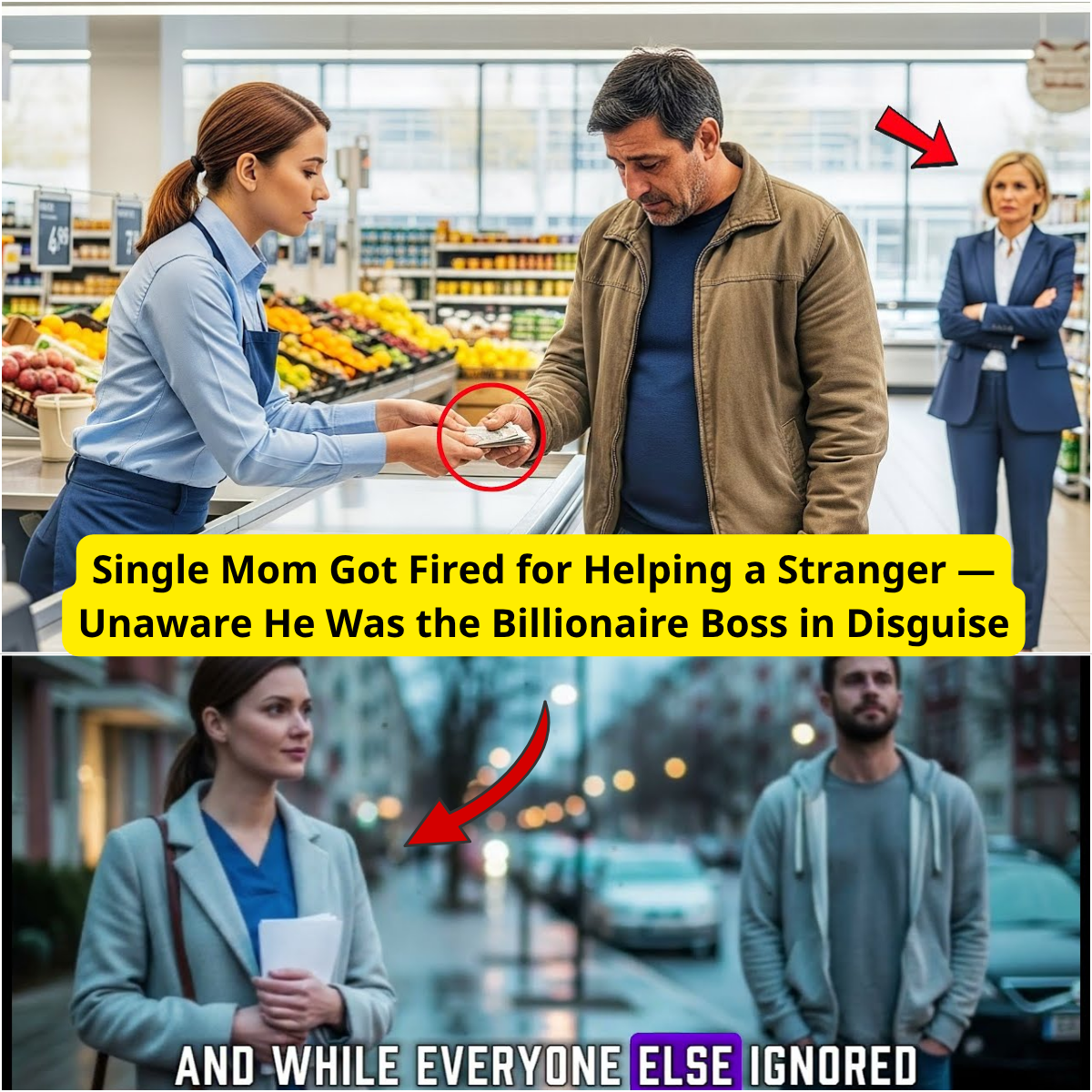
“And that is precisely the definition of an unauthorized operational variance,” Natalie snapped, finally looking up, her eyes cold. “Bennett’s Market is a publicly traded retail chain, not a municipal soup kitchen. We don’t permit cashiers to engage in personal philanthropic acts while operating company equipment. It creates a liability baseline. If that man had slipped on our mat while you were playing the Good Samaritan, our regional insurance premium would have spiked by five figures.”
Natalie tapped the bottom of the white page with the tip of a plastic pen. “Your locker needs to be cleared by five-fifteen. Your final pro-rated hours will be direct-deposited on Friday morning. Please leave your plastic barcode badge on the blotter.”
Sarah stood up slowly. Her legs felt hollow, the muscles behind her knees trembling from the nine hours she had already spent standing on the thin rubber mat behind the scanner. She reached up, unclipped the small white tag that read Sarah – Here to Help!, and laid it beside the letter.
She didn’t cry. She had learned long ago that tears were a luxury that required time, and time was something a twenty-nine-year-old single mother living in a third-floor walk-up on the South Side simply could not afford to waste.
The Breadline Calculus
The walk from the transit stop to her apartment complex was six blocks through a cold, persistent Midwestern mist that tasted of iron and diesel exhaust. Sarah walked with her head down, her old canvas tote bag slung over her shoulder, containing her uniform vest, a half-empty box of generic crackers, and the folded termination notice.
Every step was an exercise in basic addition and subtraction. Her rent was $1,150 a month, due in exactly eleven days. Her bank account held $142.80. The old refrigerator in her kitchen was currently occupied by a jar of yellow mustard, three eggs, and a plastic container of tap water. Her six-year-old son, Ethan, was turning six on Saturday. For three months, he had been talking about a commercial bakery cake—the kind with the bright blue vanilla frosting and the little plastic race cars anchored into the sugar.
“We’ll get it soon, champ,” she had whispered to him that morning as she tied his scuffed sneakers. “I promise. A big one.”
She had no idea how to fulfill that promise now. The grocery job had been her anchor—fourteen dollars an hour, thirty-two hours a week, supplemented by her nighttime house-cleaning gigs. Without the corporate stub from Bennett’s, her application for state childcare assistance would be flagged for administrative review. The entire delicate house of cards she had spent three years building since Ethan’s father disappeared into the wind was falling apart because of two dollars.
When she let herself into Apartment 3B, the smell of old pine cleaner and damp plaster greeted her. Ethan was sitting at the small laminate kitchen table, his tongue tucked into the corner of his mouth as he carefully colored a picture of a rocket ship with a stubby green crayon.
“Hey, Mommy!” he chirped, his eyes lighting up as she dropped her bag by the door. “Look. Miss Harper said my reading comprehension score went up by four points today. I read the whole book about the bears without stopping.”
Sarah walked over, leaning down to bury her face in his hair, which smelled of institutional soap and the rain. She forced her chest to expand, pushing down the iron weight of her anxiety until her voice sounded light, almost bright.
“I see that, rocket man,” she murmured, kissing the top of his head. “Four points? That means you get to pick the bedtime story tonight. Two chapters instead of one.”
“Can we get the pepperoni pizza tomorrow night?” Ethan asked, looking up with that raw, uncritical hope that only six-year-olds possess. “The one from the box with the cartoon chef?”
Sarah’s throat closed up, a sharp, physical pain behind her collarbone. She smoothed down his collar, concealing the frayed threads at his shoulder. “Maybe next week, sweetie. Mommy’s… Mommy’s schedule is shifting around a bit. We’re going to do a special surprise dinner tomorrow instead. Rice and cinnamon sugar. Like a desert island feast.”
“Okay,” Ethan said, easily distracted by his crayon. “With extra cinnamon?”
“With all the cinnamon we have,” she whispered.
After she put him to bed at eight, wrapping him in the thick fleece blanket with the faded cartoon cars, Sarah sat by the kitchen window. The rain had picked up, streaking the grime-crusted glass with vertical lines that looked like silver wires. She pulled her knees up to her chest on the vinyl chair, her fingers tracing the edges of the termination letter resting on the table.
She didn’t regret what she had done. If the same man walked into the store tomorrow with those same hollow, gray eyes, she knew she would reach into her pocket again. It wasn’t an act of grand heroism; it was just the primitive calculus of her life. When you have known the cold, you recognize it in someone else’s bones.
The Industrialist’s Wardrobe
Across the city, on the forty-second floor of the Reed Tower overlooking the black expanse of Lake Michigan, a different kind of calculation was taking place.
Alexander Reed stood in front of a floor-to-ceiling wall of glass, watching the red lights of the harbor towers blink through the storm. He was thirty-eight years old, a man whose name was synonymous with aggressive logistical efficiency and the consolidation of regional supply chains. He had spent the last seven years transforming Bennett’s Market from a regional grocery chain into an eight-billion-dollar empire.
On the white leather sofa behind him lay a damp, oversized gray cotton hoodie with a torn pocket, a pair of faded denim jeans stiff with dried mud, and a pair of generic running shoes that had lost their tread three seasons ago.
His executive assistant, Liam Vance, stood near the door holding a sleek black tablet, his face fixed in an expression of deep professional discomfort.
“The board was frantic for three hours this afternoon, Alex,” Liam said, checking his notifications. “They thought you were at a private health clinic in Zurich. If the financial press had found out you were wandering through the West Side locations dressed like a transient, the stock would have taken a four-point hit by the opening bell.”
“The board lives in an Excel spreadsheet, Liam,” Alexander said, his voice quiet, deep, and devoid of the corporate jargon that filled his company’s annual reports. “They think our core asset is our automated supply chain. They’re wrong. Our asset is the point of transaction. The five seconds where a human being with money encounters a human being behind a register.”
He turned around, picking up a small, crystal tumbler of water from his desk. “I visited six stores today. In four of them, security escorted me out before I could even reach the dairy aisle. In the fifth, the assistant manager threatened to call the police because I was sitting on the bench near the pharmacy waiting for the rain to slow down.”
He walked over to the desk, his fingers dropping into his pocket. He pulled out two crumpled, soft one-dollar bills. They were still slightly damp at the edges, smelling faintly of cheap lavender soap and grocery store receipt ink.
“But at Store 142,” Alexander murmured, smoothing out the bills on the polished mahogany surface, “a cashier named Sarah Collins stopped scanning a sixty-dollar basket of organic groceries. She looked at me. Not through me, Liam. At me. She asked if I was okay. And when her supervisor told her to ignore me because the company isn’t a charity, this woman reached into her own apron and gave me the money for a bottle of water.”
Liam frowned, looking at the tablet. “I just pulled the internal store log for 142, Alex. Natalie Gray logged a termination notice at four-forty PM. The employee was dismissed for ‘gross operational misconduct’ and violating the non-paying customer interaction protocol.”
Alexander’s eyes went dark, the skin around his jaw tightening into a hard, dangerous line. “Misconduct. For spending two dollars of her own money to preserve the dignity of a man she thought had lost his wallet.”
He looked at his assistant, his voice dropping an octave. “Prepare the car for seven-thirty tomorrow morning. And pull Sarah Collins’s complete employment file. I want to see everything she’s done since she signed her first tax form with us.”
The Marble Hall
On Friday morning, habit woke Sarah at 5:00 AM, long before the sun could penetrate the gray Chicago mist. Her body didn’t care about termination letters; her internal clock was still tuned to the opening routine of Store 142—the smell of the bakery ovens warming up, the cold snap of the plastic dividers in the produce bins, the rhythmic chime of the self-checkout terminals booting into service.
She made Ethan two pieces of dry toast, walked him to the elementary school entrance three blocks away, and stood by the chain-link fence until the red doors closed behind him. As she turned back toward her street, wondering which temporary agency she should target first, she saw the vehicle.
It didn’t belong on her block. It was a long, low Mercedes-Maybach, its midnight-black paint so polished it reflected the cracked brick of the tenement buildings like a dark mirror. The engine was completely silent, identifiable only by the thin plume of white vapor escaping its twin exhaust pipes.
As Sarah approached the stoop of her building, the rear door swung open. A tall man in a dark tailored overcoat stepped out onto the wet asphalt. He wasn’t the driver; he had the loose, unhurried posture of someone who owned the air he breathed.
“Miss Collins?” he asked, his voice steady against the morning wind.
Sarah stopped, her hand tightening around the strap of her tote bag. “Yes? If this is about the landlord, I already spoke to the office—”
“My name is Liam Vance,” the man said, offering a brief, respectful nod. “I’m the executive administrator for Bennett’s Holdings. Mr. Reed would like to speak with you at our central office downtown.”
Sarah felt a sudden, cold spike of panic in her stomach. Her first thought went to Natalie’s words: liability baseline… regional insurance. “Is this… am I being sued? Because of yesterday? I didn’t take anything from the register. I have the receipt for the water if—”
“No one is suing you, Miss Collins,” Liam interrupted gently, stepping aside to hold the passenger door open. “Mr. Reed simply believes your termination review requires his personal oversight. The car is heated. Please.”
The drive downtown was a blur of gray concrete and high-rise silhouettes. Sarah sat in the deep leather seat, her worn canvas bag resting on her lap like an old shield. She felt completely absurd—a fired cashier in a three-hundred-thousand-dollar car, being chauffeured toward the corporate citadel she had only ever seen on the header of her digital payroll stubs.
When the elevator doors opened on the forty-second floor of the Reed Tower, the transition was near-total. The floor was solid white Thassos marble, polished to such a high sheen that Sarah could see the reflection of her scuffed sneakers beneath her feet. The walls were lined with minimalist oil paintings, and the air was perfectly conditioned, smelling faintly of expensive paper and green tea.
Liam led her through a set of double oak doors into a corner office that looked out over the entire expanse of the lake.
Standing by the window, his back to her, was a man in a dark blue bespoke suit. His hair was combed neatly, his shoulders broad and square. But as he turned around, Sarah’s breath caught in her throat.
The clothes were different—the wool was fine, the linen crisp—but the eyes were unmistakable. They were the same deep, tired, amber-brown eyes that had looked at her from beneath the wet hood of a gray sweatshirt twenty-four hours ago.
“You,” she whispered, her hand moving automatically to the strap of her bag. “You’re… you’re the man from the entryway.”
Alexander Reed smiled faintly, walking around the long mahogany desk. “And you’re the only person in three districts who didn’t look through me as if I were made of glass, Sarah.”
He reached down to his desk, where her termination letter lay open. With a deliberate, slow movement, his fingers caught the edges of the white paper, and he tore it neatly down the center, dropping the pieces into the wastebasket.
“I didn’t know who you were,” Sarah said, her voice rising slightly as her defense mechanism returned. “If I had known you were the CEO, I wouldn’t have—”
“That’s exactly the point,” Alexander said, his tone dropping into a warm, supportive cadence. “If you had known, it would have been a transaction. It would have been marketing. You did it because you saw a man who was cold, and you decided that his comfort was worth more than the two dollars in your pocket. That isn’t something our corporate training modules can teach. It’s something you either have or you don’t.”
He walked over to a small credenza, picked up a thick blue cardstock folder, and held it out to her.
“Natalie Gray is no longer with the company,” Alexander said simply. “Her interpretation of our compliance guidelines was… short-sighted. But more importantly, I spent the night looking at your file. Before you were assigned to the register at 142, you managed the inventory logs for the regional distribution center in Cicero, correct?”
Sarah nodded, her mind spinning. “Yes. For two years. Until the shift hours changed and I couldn’t find childcare for Ethan after eight PM.”
“We are launching a new corporate initiative next month,” Alexander said, gesturing toward the folder. “The Bennett’s Foundation for Urban Logistics. It’s a direct-assistance program designed to redirect our near-expiry inventory straight to community pantries and single-parent housing centers across the West Side. It requires a Director of Operational Outreach—someone who understands how our distribution system works, but more importantly, someone who knows what it looks like when a family is actually out of options.”
He stepped closer, his eyes locking onto hers with an unshakeable seriousness. “The position is based here, in the central tower. The hours are flexible—nine to three—so you can pick your son up from school. It includes a standard management salary, full executive medical benefits, and a corporate childcare allowance.”
Sarah stared at the blue folder. The words on the cover—Director of Outreach—looked like a foreign language. Her mind tried to perform the addition again, but the numbers wouldn’t fit her old equations. Triple her previous income. Health insurance that didn’t require a fifty-dollar deductible. Nights spent in her own apartment rather than scrubbing the grease from someone else’s counters.
“I…” Sarah started, her eyes filling with the tears she had suppressed for two days. She wiped them away roughly with the back of her hand, her shoulders dropping as the terrible, suffocating weight of the coming month dissolved into the air of the room. “I don’t know what to say, Mr. Reed. I’m just a cashier.”
“You were never just a cashier, Sarah,” Alexander said softly, his hand resting briefly on the edge of the folder until her fingers closed around it. “You were the only person in this company who remembered that our labels are just paper. Go home. Take the weekend with your son. Buy him the largest cake in the district. I’ll see you on Monday morning at nine.”
The Bread and the Rose
The afternoon sun finally broke through the Chicago clouds around three o’clock, hitting the wet brick of Sarah’s street and turning the puddles into mirrors of bright, golden light.
When the school bell rang, Ethan came running through the double red doors, his backpack bouncing against his shoulders, his green crayon still tucked into his pocket. He stopped when he saw his mother standing by the gate. She wasn’t wearing her green grocery vest, and she wasn’t looking at her phone to check the transit schedule. She was just standing there, her face lifted toward the sun, smiling with a freedom he had never seen before.
“Mommy!” he shouted, throwing his arms around her knees. “We made paper planes today. Mine flew all the way to the water fountain!”
Sarah laughed—a clear, loud sound that made a couple of passing teachers turn and smile. She lifted him up, swinging him around once before setting him back on his feet.
“That’s because you’re a rocket man,” she said, her hands smoothing down his hair. “Guess what? Mommy got a new job today. A big one. Downtown in the high tower.”
Ethan’s eyes went round. “Does that mean… does that mean we can have the pizza with the cartoon chef?”
“We can have the pizza tonight, sweetie,” Sarah said, her arm wrapping around his shoulders as they turned toward the avenue. “And tomorrow morning, we’re going to the big bakery on 55th. We’re going to order a cake with the blue frosting and four race cars on top. No—five race cars.”
“Really?” Ethan beamed, his hand slipping into hers, his fingers small and warm against her chapped skin. “Why five?”
“Because,” Sarah said, looking up at the high glass towers of the skyline glistening in the distance, “sometimes the world changes because you have exactly two dollars left to give.”