She Gave Her Last $10 to a Stranger—Then Her Life Changed Forever
She Gave Her Last $10 to a Stranger—Then Her Life Changed Forever
The rain over the Willowbrook commuter rail station didn’t fall in clean, dramatic sheets; it misted sideways, driven by a raw October wind that smelled of wet asphalt, rusted tracks, and the exhaust of the morning buses. It was 6:15 AM on a Tuesday. The platform was already filling with the regular Northbound crowd—men and women in stiff trench coats, their eyes glued to the glowing screens of their smartphones, their shoulders hunched against the damp chill. They moved like ghosts through a gray landscape, careful to avoid eye contact, operating on the unwritten law of the morning commute: Keep moving, stay isolated, protect your space.
Alina stood near the rusted yellow safety line at the edge of Track 2, her fingers locked tightly around the strap of a faux-leather tote bag that had begun to peel at the seams three months ago. She was twenty-four, though the dark, hollow smudges beneath her eyes made her look older. Her canvas sneakers were entirely soaked through, having surrendered to a deep puddle on her forty-minute walk to the station. She had walked because the local bus fare was $2.75, and $2.75 was a luxury she couldn’t afford.
Inside her coat pocket, her right hand was wrapped around a single, crumpled ten-dollar bill. It was the absolute end of her money until Friday’s paycheck from her second job at the dry cleaner’s. Ten dollars meant two boxes of generic pasta, a half-gallon of milk, and perhaps a sleeve of saltines to get through the next seventy-two hours. It was a fragile, paper thin wall between herself and total hunger. Her stomach gave a dull, familiar ache, but she squeezed the bill tighter, focusing on the rhythmic click-clack of the distant signals.
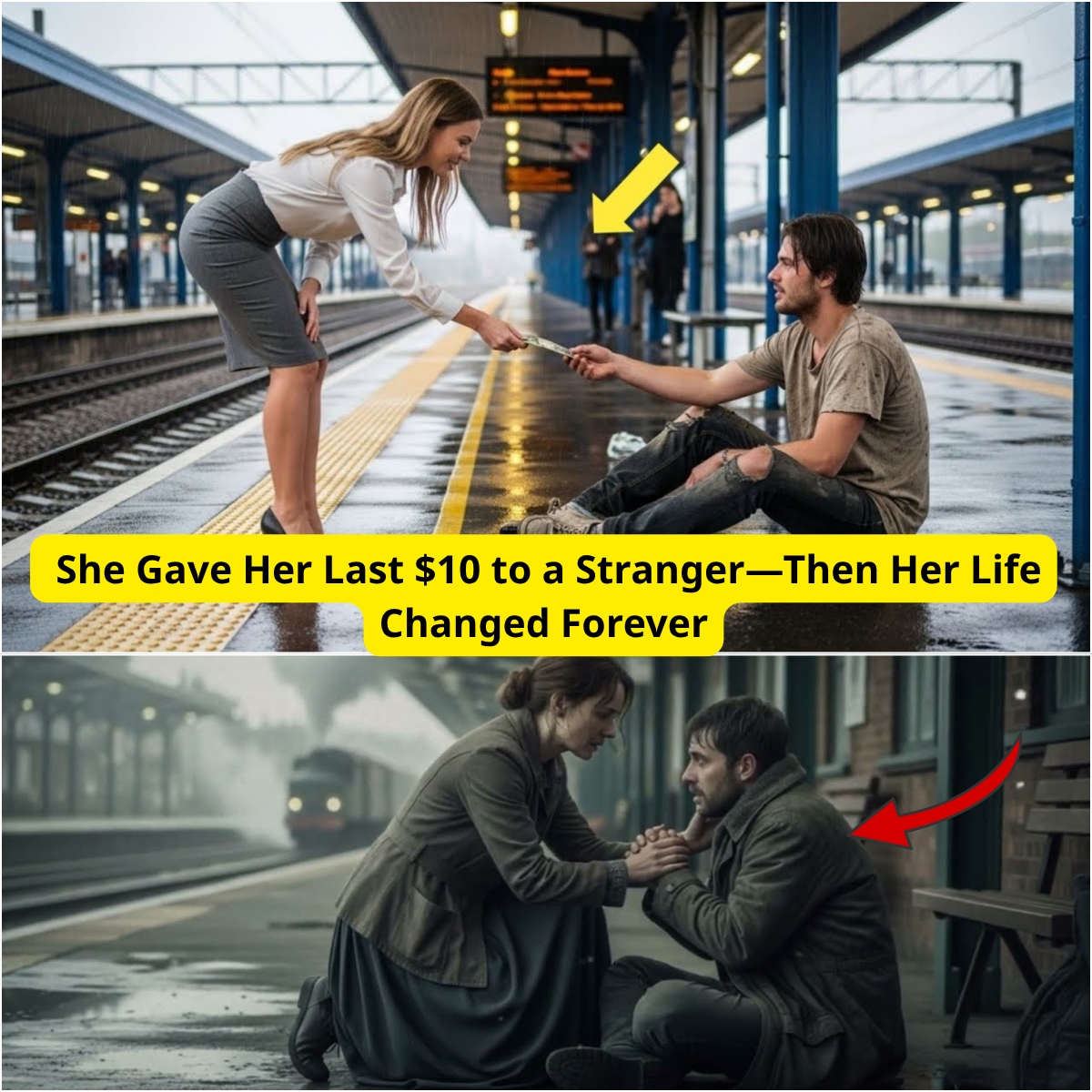
A few yards away, leaning against a damp concrete pillar near the old baggage scale, a man was slipping down toward the asphalt.
He didn’t look like the regular unhoused men who occasionally sought shelter under the Willowbrook awning. He was young—maybe late twenties—and wore a dark, heavy cotton t-shirt that was now black with rainwater. His hair was plastered to his forehead in thick, wet strands, and his teeth chattered with a violent, rhythmic clicking that Alina could hear even over the low hum of the crowd. He had his arms wrapped tightly around his midsection, his head dropped between his knees, shivering so hard his entire frame vibrated.
The commuters streamed past him in two distinct currents. Some adjusted their umbrellas to create a physical barrier between themselves and the man on the ground; others cast quick, sharp glances filled with the familiar, hardened judgment of the city—assuming a drug overdose, a bad drunk, or a mental health crisis. To them, he was an inconvenience, a visual blemish on their Tuesday morning routine.
Alina watched him. She saw the way his fingers dug into his own ribs, not with the loose posture of intoxication, but with the desperate, pale clenching of someone who was physically failing. When he tried to shift his weight to stand, his boot slipped on the wet concrete, and he collapsed back against the pillar with a low, breathless groan that was entirely swallowed by the wind.
Something pulled hard in Alina’s chest—a sharp, instinctive ache of recognition. She knew what it felt like to be invisible in a crowded room. She knew the specific humiliation of having your body betray you while the rest of the world kept its eyes on its shoes.
Leaving her spot in line, she walked toward the pillar. Her wet sneakers made a squelching sound against the concrete. As she approached, she knelt down, ignoring the cold brown puddle that instantly soaked through the knees of her denim skirt.
“Hey,” she said softly, her voice pitched beneath the roar of an approaching freight train on the express line. “Are you okay? Do you need me to call someone?”
The man’s head jerked up. His eyes were bloodshot, his face a ghostly, translucent white, but there was a striking, startling clarity in his gaze. He looked profoundly shocked—not by the cold, but by the sound of a human voice addressing him.
His name was Ethan, though the girl with the torn tote bag had no way of knowing that. Twelve hours earlier, Ethan had been a passenger on a late-night regional train from Manhattan, returning from a venture capital dinner. At a mid-line stop, a highly coordinated theft had separated him from his leather briefcase, which contained his laptop, his custom leather wallet, his phone, and his identification. When he stepped off the train at Willowbrook to find security, the station office was locked, his battery was dead on his watch, and he found himself marooned in a suburban town where nobody knew his face.
To the world, Ethan was one of the youngest software executives in New England, a self-made multi-millionaire whose facial recognition algorithms had just been acquired by a major defense contractor. But stripped of his titanium credit cards, his digital keys, and his tailored Italian wool overcoat, he was just a shivering male in a wet shirt, starving on a concrete floor.
“I…” Ethan’s voice cracked, thick with an embarrassment that ran deeper than the cold. He swallowed hard, his jaw tight. “I lost everything last night. My bags, my phone… I’ve been here since two in the morning. I just… I need something warm. I haven’t eaten anything since yesterday afternoon.”
He didn’t ask for money. He didn’t offer a dramatic story. He just looked at her with a raw, stripped-back vulnerability that made Alina’s hand move instantly to her pocket.
She pulled out the crumpled ten-dollar bill. She looked at the green ink, faded and soft at the edges. She knew the math. Giving this away meant her evening shift at the laundromat would be fueled by tap water. It meant the walk home tonight would be accompanied by a headache that she wouldn’t have the aspirin to cure.
She looked at Ethan’s hands—long, artistic fingers that were turning a dangerous, mottled blue at the tips.
Without allowing herself to run the numbers a second time, she stepped forward and pressed the bill into his wet palm. She closed his fingers over it with her own warm, chapped hands.
“There’s a small bakery open across the street behind the bus depot,” she said, her voice steady and bright, offering a small, reassuring smile. “They have hot tea and large rolls for four dollars. Go inside where it’s heated. Get something warm to eat, okay? You’re going to be all right.”
Ethan stared down at his closed hand. The bill was damp from her coat, but it felt incredibly heavy. For five years, Ethan had been surrounded by people who wanted something from him—board members demanding higher margins, developers wanting equity, friends looking for investments. He had forgotten what a gift looked like when there was no contract attached to it.
“I can’t take this from you,” he murmured, his eyes tracking the worn fabric of her shoes and the thinness of her polyester coat. He wasn’t blind; he could see she was living on the margins. “You need this.”
“I have a job to go to,” she lied gently, standing up and brushing the gray station grime from her wet skirt. “Just… when you get back on your feet, help someone else out. The world’s too cold for us to leave each other out in the rain.”
She turned and walked back toward the yellow line just as the 6:22 local train screeched to a halt, its air brakes releasing a hiss of warm, metallic steam. Alina stepped into the crowded car without looking back. Through the scratched glass of the window, as the train began to pull away into the gray fog, Ethan stood by the pillar, his eyes locked onto her car until the red tail lights vanished around the bend.
Using the ten dollars, Ethan walked to the bakery. The hot black tea and the thick, dense bread felt like medicine as they hit his system, the heat slowly radiating back into his core. An hour later, using the bakery’s landline, he reached his personal assistant via an emergency breakthrough code. By noon, a black town car had retrieved him; by 3:00 PM, his bank accounts were restored, his devices were replaced, and he was sitting in his high-rise penthouse overlooking the city.
Yet, as he looked out over the skyline through the floor-to-ceiling glass, the luxury felt oddly thin. He couldn’t shake the memory of the girl’s eyes—the quiet, unhesitating certainty with which she had handed over her survival money to a stranger who looked like a ghost.
The Search on the Platform
The next morning, the rain had cleared, leaving behind a sky the color of old pewter and a wind that bit straight through to the bone.
At 6:00 AM, Ethan was back at the Willowbrook station. He wasn’t wearing the wet t-shirt. He stood near the old baggage scale dressed in a bespoke charcoal suit, his coat a heavy, dark cashmere, his shoes polished to a mirror shine. His corporate security detail stayed forty yards back in an unmarked SUV, honoring his demand to be left entirely alone.
He watched the faces. He watched the tired mothers, the high school kids with heavy backpacks, the construction workers with thermoses of coffee. He stayed until 9:00 AM, until the platform grew empty and the ticket agent began to look at him with suspicion. She wasn’t there.
On Thursday, he returned again. He stood in the same spot from 5:30 AM until the mid-morning express roared through. He checked every car of every train that stopped on Track 2. He remembered every detail of her face—the slight tilt of her nose, the quiet determination in her mouth, the specific shade of faded navy blue on her coat—but she never appeared.
By Saturday morning, the air had turned crisp and dry, the first real smell of November in the wind. Ethan stood on the platform, his hands tucked deep into his pockets, wondering if she had been a temporary traveler, a visitor passing through a town she would never see again. He felt a strange, tightening frustration in his chest. It wasn’t about the ten dollars; it was about the unresolved balance of the world. He refused to let the single purest interaction of his adult life remain an unrequited debt.
Then, at 7:14 AM, he saw her.
She was walking down the concrete ramp from the street level, her movements slow, heavy, and visibly exhausted. Her hair was pulled up in a loose, hurried knot held together by a plastic clip. She was wearing the exact same thin coat, and the faux-leather tote bag hung from her shoulder, looking even more frayed than it had four days prior. She looked like someone who had spent the night working a double shift under fluorescent lights.
Ethan didn’t hesitate. He broke into a fast stride, cutting through the small cluster of commuters waiting for the weekend local.
“Alina,” he called out.
She stopped short, her eyes lifting from the concrete. She blinked, her brow furrowing as she looked at the tall, impeccably dressed man standing three feet away from her. The crisp white shirt, the tailored lines of his coat, the expensive scent of cedar and citrus—he looked like an executive from a television commercial.
“I’m sorry?” she said, her voice guarded, her hand instinctively tightening on her bag. “Do I know you?”
Ethan smiled, a genuine, warm expression that broke through his usual corporate mask. He reached into his pocket and pulled out a small, crisp slip of paper, along with a beautifully preserved, dry ten-dollar bill.
“You told me to go to the bakery behind the bus depot,” he said softly. “You told me the world was too cold for us to leave each other out in the rain.”
Alina’s eyes widened. She looked from his face down to the ten-dollar bill, then back up to his eyes. The recognition hit her like a sudden drop in temperature. “The… the guy by the pillar? You were shivering. You didn’t have a jacket.”
“My name is Ethan,” he said, extending his hand. “And last Tuesday, I was entirely at the mercy of this station. Hundreds of people walked past me, Alina. People who make six figures, people who have offices downtown, people who call themselves charity directors. They saw an eyesore. You saw a human being. And you gave me the last bit of security you had.”
Alina’s cheeks flushed a deep, self-conscious red. She looked around the platform, realizing a few commuters were now watching them. “It… it really wasn’t that big of a deal. You looked like you were going to freeze. Anyone would have done it.”
“No,” Ethan said, his voice dropping to a firm, unyielding pitch. “They didn’t. They ran the calculation and decided I wasn’t worth the risk. You didn’t run a calculation at all.”
He stepped closer, holding out a thick, textured cream-colored folder that had been resting under his arm.
“I spent the last three days working with my HR director,” Ethan said, placing the folder into her hesitant hands. “I don’t know what you do for a living, Alina, but I know how you handle a crisis. This is an official contract for a position at Vanguard Technologies. It’s an operations management role within our corporate foundation. It includes a comprehensive salary—triple what the average market rate is for entry-level—full medical coverage, a travel stipend, and an immediate advanced relocation bonus already deposited into a certified check inside that folder.”
Alina didn’t open the folder. She looked at it as if it were a strange, alien device that might detonate if she moved her fingers. Her breath came in short, shallow gasps.
“I don’t… I don’t understand,” she stammered, a single tear cutting a clean path through the light dust of dry-cleaner lint on her cheek. “I’m not an operations manager. I work retail. I fold shirts. Why are you doing this for me? You don’t even know me.”
“I know the only thing that matters,” Ethan said, looking down at her with a profound, quiet respect. “The world is full of brilliant people, Alina. It’s full of developers who can write beautiful code and managers who can hit quarterly targets. But it’s incredibly poor in people who have courage. You didn’t help me because of who I was; you didn’t even know my name. You helped me because of who you are. That’s the kind of character I want running my company’s outreach.”
Alina lowered her head, her shoulders shaking as the sheer weight of her daily survival—the skipped dinners, the midnight shifts, the constant, low-grade terror of an unpaid utility bill—abruptly lifted from her back. The silence between them on the platform felt absolute, even as the morning sun finally broke through the gray sky, turning the wet tracks into long, brilliant lines of silver.
“Your ten dollars changed the course of my week,” Ethan whispered, his hand resting gently on the top of the folder. “Let me change the course of your life.”
She looked up, wiping her face with the sleeve of her coat, and for the first time in as long as she could remember, she smiled without any fear behind it. The train arrived, its doors opening with a loud, mechanical hum, but neither of them stepped on board. They walked off the platform together, leaving the cold concrete of Willowbrook behind them, moving toward a world that had suddenly become very warm indeed.