Gad Saad Clashes With Piers Morgan Over Grooming Gangs, Elon Musk, and the West’s “Suicidal Empathy” Crisis
Gad Saad Clashes With Piers Morgan Over Grooming Gangs, Elon Musk, and the West’s “Suicidal Empathy” Crisis
A fierce exchange between Professor Gad Saad and Piers Morgan has reignited a transatlantic political firestorm, after the two men clashed over immigration, Islamophobia accusations, Tommy Robinson, Elon Musk, and the British grooming gangs scandal that continues to haunt Western governments years after the first major investigations shocked the public.
The debate began with Elon Musk.
Morgan opened by noting that Musk had endorsed Saad’s book, praising its central warning that Western civilization could be doomed unless what Saad calls “suicidal empathy” is recognized and confronted with hard but necessary action. That endorsement instantly raised the temperature of the conversation. Musk’s social media feed has become one of the loudest global platforms criticizing mass migration, political correctness, and institutional failure across Europe. To supporters, Musk is exposing truths legacy media ignored. To critics, he is amplifying voices they consider inflammatory or anti-Muslim.
Then Morgan turned the conversation toward Tommy Robinson, a controversial British activist who has built much of his public identity around criticizing Islam, migration, and the grooming gangs scandal. Morgan pressed Saad on whether figures like Robinson focus so intensely on Muslims that their activism becomes something darker than concern for victims.
Saad did not retreat.
His answer was blunt: not all immigrants are the same, and not all immigrant groups are equally likely to assimilate into Western values. He used a sharp analogy. A house cat and a wild lion are both felines, he argued, but that does not mean a person should treat them the same. His point was not that all Muslims are dangerous. He explicitly said Muslims, like all people, come in many varieties — some peaceful and law-abiding, others not. But he argued that certain ideas common in Islamic societies may conflict more sharply with Western liberal values than ideas from other societies.
That sentence alone was enough to ignite controversy.
For Saad’s supporters, it was obvious realism. They argue that Western leaders have spent decades pretending that culture does not matter, that every group assimilates in the same way, and that borders can be managed by slogans about compassion. For critics, Saad’s language risks treating billions of Muslims as a collective problem rather than individuals. They warn that such framing can feed suspicion, hostility, and discrimination against peaceful Muslim families who have no connection to crime or extremism.
Morgan pushed that point hard.
He acknowledged that Britain’s grooming gangs scandal was real, horrific, and covered up in part because officials feared confronting the ethnic and religious identity of many perpetrators. He admitted that in towns such as Rotherham and Telford, many of the men involved were British Pakistani Muslims and that many victims were young white English girls. He called the scandal a disgrace and agreed that authorities failed shamefully.
But Morgan also warned against turning that scandal into a broader attack on all Muslims. The vast majority of Muslims, he noted, do not commit sex crimes. The vast majority live ordinary lives, work, raise families, and follow the law. He argued that when activists talk almost exclusively about Muslim offenders while ignoring crimes committed by white men or other groups, the result can become distorted and dangerous.
That was the heart of the debate.
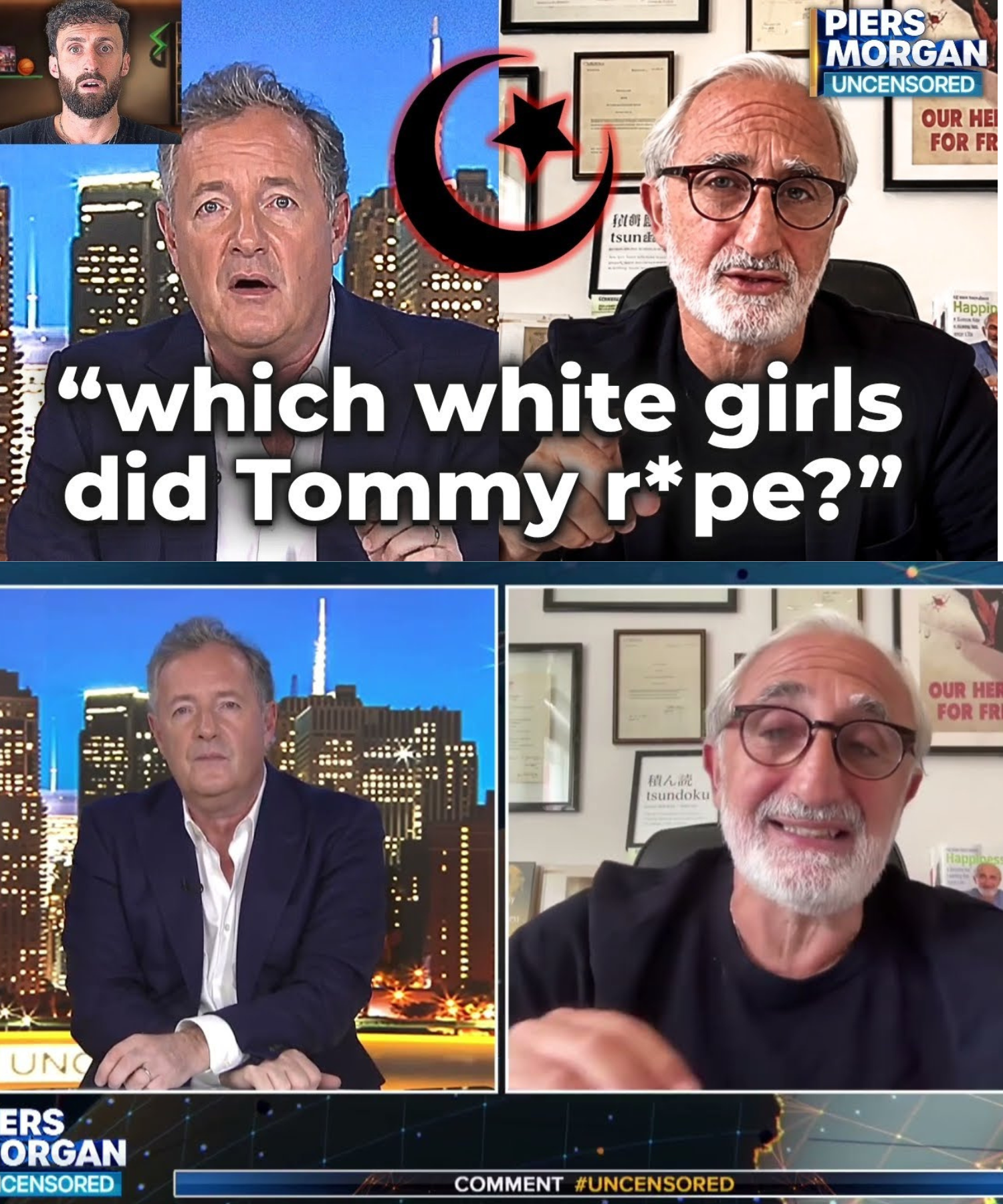
Saad’s response was that the issue cannot be judged only by raw totals. It must also be judged per capita, by group pattern, and by institutional reaction. If a specific network of crimes is concentrated in a particular community, he argued, then refusing to say so is not compassion. It is cowardice.
Then he brought the discussion back to his central concept: suicidal empathy.
In Saad’s framework, suicidal empathy happens when a society directs compassion toward the wrong target and abandons the people it is morally obligated to protect. In the grooming gangs scandal, he argued, authorities faced a basic choice: protect children or protect the image of multicultural harmony. His accusation was devastating. He suggested that officials effectively allowed vulnerable girls to suffer because they feared that naming the perpetrators honestly would increase accusations of racism or Islamophobia.
That claim is why the exchange has gone viral in America.
The United States is not Britain, but the argument feels familiar. American cities are already fighting over migration, police reporting, crime statistics, sanctuary policies, school safety, border enforcement, and whether political leaders hide uncomfortable facts to protect ideological narratives. From New York to Chicago, Denver to Los Angeles, Americans have seen local governments struggle with migrant arrivals, budget pressure, and public mistrust.
The grooming gangs debate now functions as a warning.
It asks whether Western governments can still tell the truth when the truth threatens their preferred narrative. It asks whether protecting minorities from prejudice can become an excuse for ignoring victims. It asks whether fear of being called racist can become stronger than the instinct to defend children.
That is the moral grenade at the center of Saad’s argument.
Morgan was not defending the cover-up. In fact, he condemned it. But he pressed Saad on the danger of obsession — the danger that some public figures focus only on Muslim crime, never on similar crimes committed by non-Muslims, and then use selective outrage to smear an entire religion.
Saad’s answer was that all criminals should be punished equally. Jewish offenders, Christian offenders, Muslim offenders, white offenders, black offenders — none should receive protection. But he insisted that the grooming gangs scandal had a specific profile, and that refusing to discuss that profile is precisely the problem.
The debate became less about Tommy Robinson and more about the limits of public honesty.
When does naming a pattern become bigotry?
When does avoiding a pattern become betrayal?
For American viewers, that question cuts through nearly every political debate of the decade. Crime. Immigration. Race. Religion. Policing. Education. Terrorism. Media bias. Every issue now comes wrapped in the fear that one wrong phrase can destroy a career, while one buried fact can destroy public trust.
A commentator reacting to the debate argued that suicidal empathy reflects an “inversion of morality,” where elites elevate victimhood as a virtue while treating punishment as cruelty. In that view, politicians and institutions deploy empathy not to protect the vulnerable, but to protect themselves, their brands, their donors, and their narratives.
That accusation is severe, but it resonates because so many ordinary people believe institutions no longer speak plainly.
Parents want to know who is hurting children.
Citizens want accurate crime data.
Taxpayers want border policy that makes sense.
Victims want justice without political filtering.
And communities want protection from both prejudice and silence.
That is why this debate exploded.
It did not offer easy answers. It did not prove that every critic of migration is noble or that every warning about Islam is fair. It did not erase the reality that Muslims can also be victims of prejudice, violence, and collective suspicion. But it forced a brutal question into the open:
What happens when a society becomes more afraid of offending perpetrators than protecting victims?
That is the nightmare Saad calls suicidal empathy.
And whether Americans agree with him or not, one thing is clear: the argument is no longer confined to Britain. It has crossed the Atlantic, entered the American bloodstream, and become part of a much larger battle over whether the West still has the courage to tell the truth when the truth is dangerous.