Viral “West Has Fallen” Video Ignites Firestorm Across America Over Islam, Immigration, and Free Speech
Viral “West Has Fallen” Video Ignites Firestorm Across America Over Islam, Immigration, and Free Speech
A new viral video has triggered an explosive debate across the United States, pulling together some of the most sensitive issues in American public life: religious freedom, immigration, anti-Western rhetoric, public safety, and the growing fear that cultural divisions are moving from online arguments into real-world confrontations.
The video, presented as part of a series called “The West Has Fallen,” features a rapid sequence of clips from the United States, Europe, and other parts of the world. The creator frames the montage as evidence that Western societies are under cultural pressure from radical religious and political movements. But as the video spreads across American social media, critics and supporters are clashing fiercely over what it really shows — and what it dangerously risks becoming.
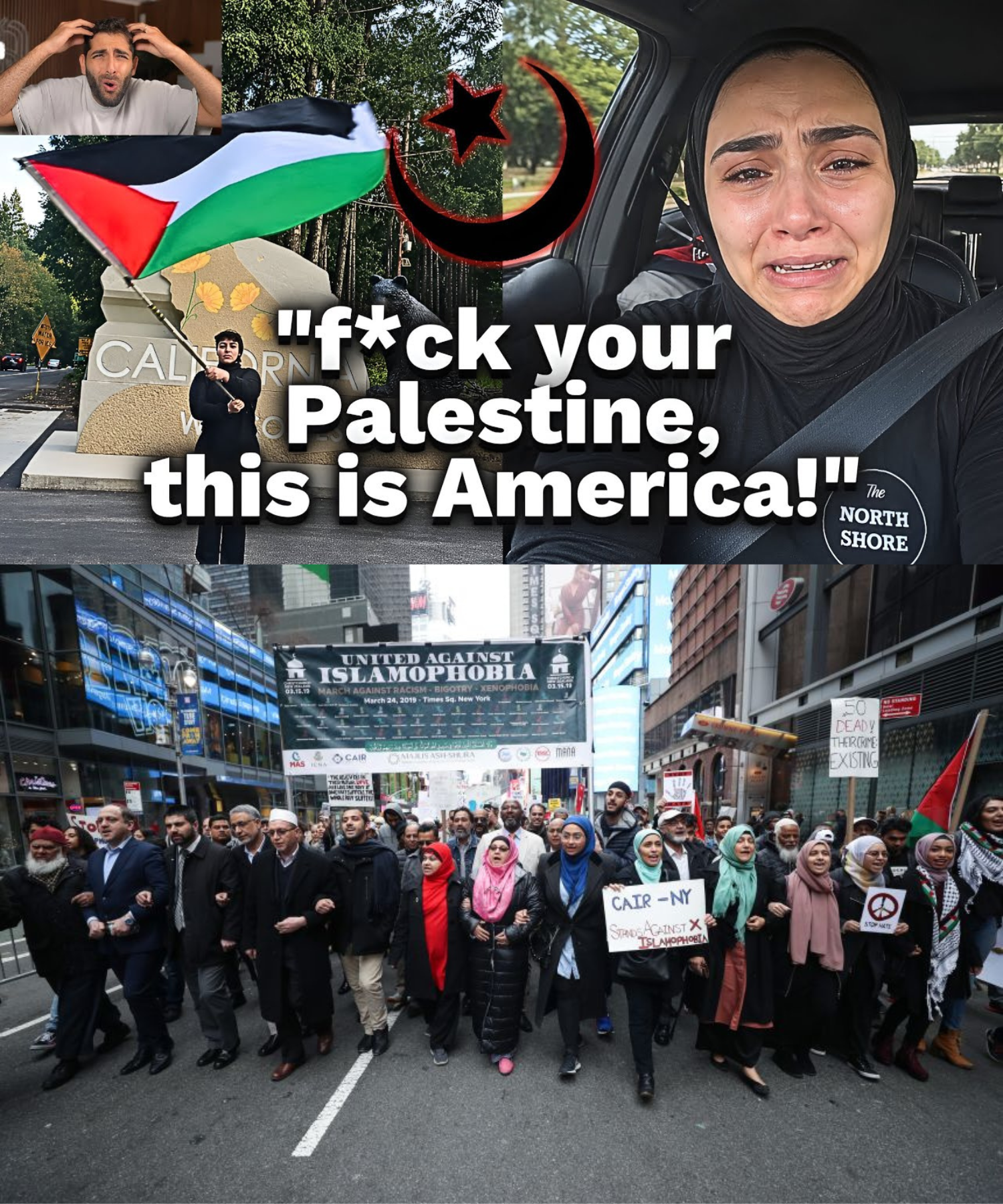
At the center of the controversy is a scene from California, where a Muslim woman waving a Palestinian flag says she was shouted at by passing drivers chanting “USA” and cursing at her. In the clip, the woman appears shaken, saying the experience made her feel as if she were back in school being bullied. She says she had to pull over, calm herself down, and check whether anyone was following her.
For many viewers, that moment was disturbing. It raised concerns about how quickly international conflicts can turn ordinary people in America into targets of anger. Palestinian flags, Israeli flags, religious clothing, and political slogans have all become symbols that can trigger intense reactions in public. What one person sees as solidarity, another sees as provocation. What one person calls patriotism, another experiences as intimidation.
That scene alone could have opened a serious discussion about protest, fear, and the right to express unpopular views in public. But the video quickly moves into much harsher territory, blending clips of religious preachers, street arguments, protests, alleged harassment, and confrontations in several countries. The narrator presents these clips as part of a single warning about Islam and the future of the West.
That framing is what made the video so controversial.
Supporters of the video argue that Americans have become afraid to discuss radical religious ideology honestly. They say some preachers and activists openly condemn Western values, call for the downfall of American power, or reject secular law, and that citizens have a right to be alarmed. To them, the video is not an attack on ordinary Muslims, but a warning about extremist beliefs that can exist inside any society if left unchallenged.
Critics see something much more dangerous. They argue that the montage blurs the line between extremists and millions of peaceful Muslims who live, work, vote, serve in the military, run businesses, and raise families in the United States. By stitching together the most inflammatory examples, they say, the video risks encouraging viewers to see an entire religious community as a threat.
That is the central tension now driving the debate.
America protects religious freedom. It also protects the right to criticize religion. A person can criticize Christianity, Islam, Judaism, atheism, or any ideology. But when criticism becomes a broad accusation against all believers, the debate enters dangerous ground.
Civil rights advocates warn that anti-Muslim hostility is already a serious issue in America. Muslim Americans have faced surveillance, workplace discrimination, school bullying, mosque vandalism, and public suspicion, especially after terror attacks or major Middle East conflicts. They argue that viral content like this can make everyday Muslims feel unsafe even when they have nothing to do with radical politics.
At the same time, national security analysts and free-speech advocates say the public should not be silenced when discussing extremist messages. Several clips in the video feature speakers using hostile language toward America or the West. In one segment, a speaker in Dearborn, Michigan, refers to America as an empire that must fall. For many Americans, that kind of rhetoric is deeply alarming, especially when spoken inside the country whose constitutional protections allow such speech in the first place.
That contradiction has become one of the video’s most powerful talking points.
The United States allows people to criticize the United States. That freedom is one of the core principles of American democracy. But when activists use that freedom to celebrate the downfall of the country, many citizens see it as proof that tolerance is being used against itself.
The video also includes segments about religious law, public prayer, modesty disputes, and claims involving the treatment of Christians in Muslim-majority countries. Those clips have intensified debate among conservative Christian audiences, many of whom believe Western leaders ignore the persecution of Christians abroad while demanding limitless tolerance at home.
But experts caution that history cannot be reduced to viral clips. The experiences of Christians in Egypt, Iraq, Syria, and other regions are real and often painful, but using those stories to condemn every Muslim in America is both unfair and dangerous. Many Muslim Americans came to the United States precisely because they wanted freedom from authoritarianism, extremism, war, or religious coercion.
That distinction is often lost online.
The most dramatic portions of the montage involve alleged threats, aggressive street encounters, and a disturbing exchange involving a teenage girl in a public park. Viewers reacted strongly to those clips, arguing that public safety concerns should not be dismissed simply because discussing them is politically uncomfortable. Others warned that isolated incidents, especially when presented without full context, should not be used to suggest that immigrants or Muslims as a whole are dangerous.
The result is a national argument with no easy resolution.
On one side are Americans who feel their culture, laws, and national identity are being weakened by elites who refuse to confront radical ideas. On the other are Americans who fear that panic over extremism is being turned into suspicion of an entire religion.
Both concerns can exist at once.
America can reject radicalism without demonizing Muslims. It can defend religious freedom while opposing religious coercion. It can protect free speech while condemning harassment. It can welcome immigrants while demanding loyalty to constitutional law. It can criticize anti-American rhetoric without attacking every person who wears a hijab, attends a mosque, or supports Palestinian civilians.
That balance is difficult — and the viral video shows how easily it can collapse.
The reason the footage has spread so widely is not because it offers a complete picture. It does not. It is a montage, designed to provoke an emotional reaction. But it succeeds because it touches real fears already present in American life: fear of cultural fragmentation, fear of extremist ideology, fear of political violence, fear of censorship, and fear that public debate has become too dishonest to solve anything.
In a healthier country, the video might lead to a serious conversation about integration, religious pluralism, civic loyalty, and the limits of tolerance. Instead, it has become another weapon in the culture war.
For supporters, it is proof that the West is waking up too late.
For critics, it is proof that anti-Muslim panic is being repackaged as patriotism.
For everyone watching, it is a reminder of how fragile America’s social trust has become.
One viral montage cannot prove that the West has fallen. But it does prove something else: the United States is struggling to decide how to defend freedom without letting fear destroy it.