Viral “West Has Fallen” Compilation Sparks U.S. Firestorm Over Islam, Immigration, Sharia, and Public Safety
Viral “West Has Fallen” Compilation Sparks U.S. Firestorm Over Islam, Immigration, Sharia, and Public Safety
A new viral compilation of confrontations involving Islam, immigration, street preaching, public transport disputes, antisemitic rhetoric, and migrant crime has ignited a fierce debate across the United States, where viewers are once again asking whether Western societies are losing control of their public spaces — or whether fear-driven political media is turning isolated incidents into a sweeping cultural panic.
The video, framed as part of a series called “The West Has Fallen,” moves rapidly from one country to another: the United States, Texas, New York City, Britain, France, Italy, Scotland, Canada, and other parts of Europe. Each clip is presented as evidence of a broader collapse — a West allegedly too afraid, too guilty, or too politically correct to defend its own values.
But the reaction in America has been deeply divided.
To supporters of the video, the footage captures a reality that elites refuse to discuss: public intimidation, religious extremism, hostility toward Jews, refusal to integrate, and ordinary citizens being told to stay silent when they feel threatened. To critics, the compilation is a dangerous example of how viral media can stitch together disturbing but separate incidents and imply that entire communities — especially Muslims and migrants — are a collective danger.
That tension is exactly why the video spread so quickly.
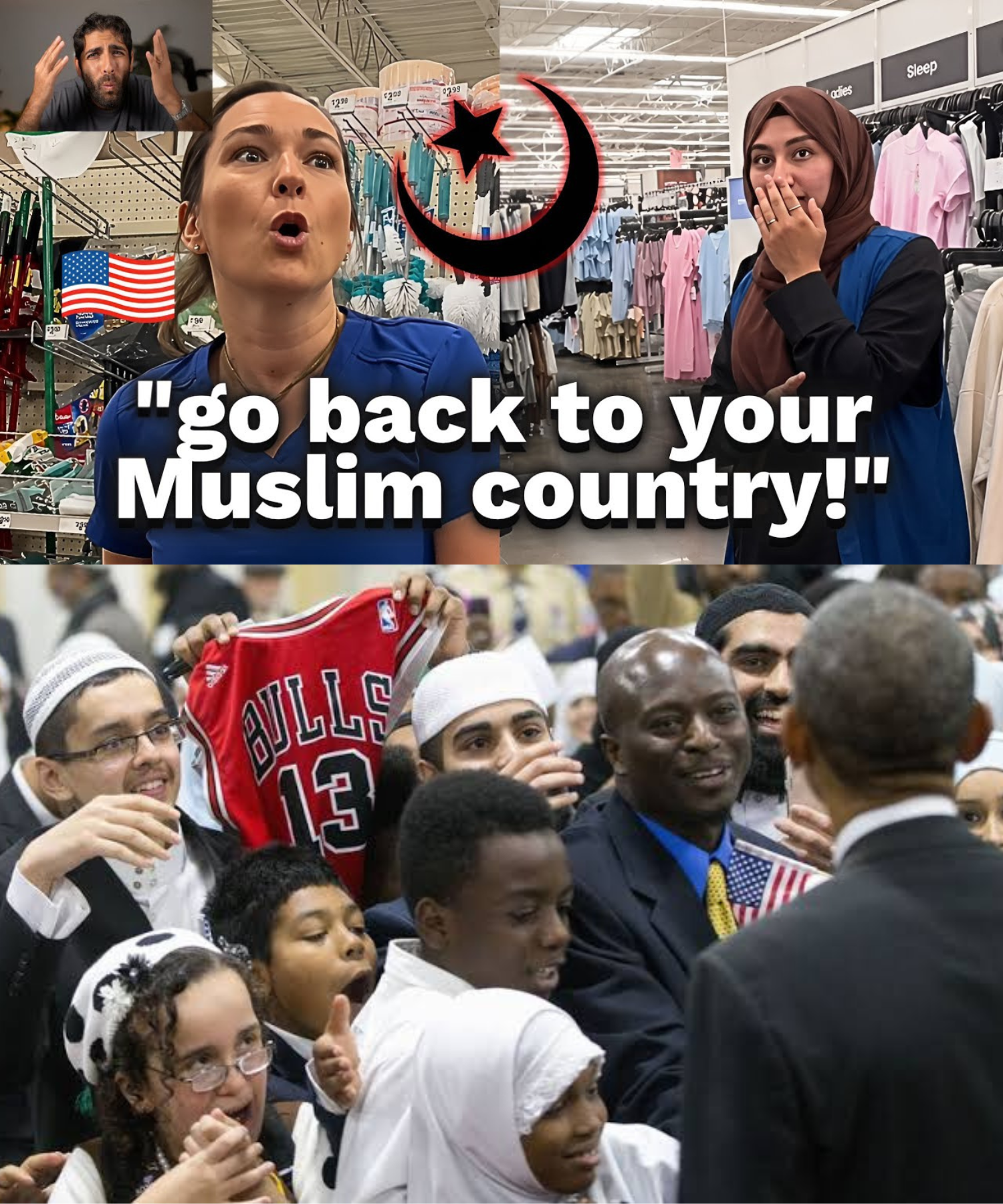
The first clip that triggered outrage shows a woman in medical scrubs confronting a Muslim woman in the United States and telling her to “go back” to an Islamic country. The woman also calls Islam a terrorist organization rather than a religion. The exchange is ugly, tense, and uncomfortable. For many viewers, it represents the anger building in parts of America after years of terror attacks, campus radicalism, public debates over Sharia, and fears about Islamist ideology.
But for others, the clip crosses a clear moral line.
A Muslim woman working in healthcare is not automatically responsible for extremism anywhere in the world. Muslim Americans are citizens, workers, patients, veterans, business owners, teachers, parents, and neighbors. Telling someone to leave the country because of religious identity is not a defense of Western values. It is a betrayal of them.
That contradiction runs through the entire viral debate.
The next major scene moves to Texas, where a booth calling for Sharia to be banned from the United States draws Muslim participants into a heated argument. One side claims Islam teaches violence against unbelievers. The Muslim woman pushes back, saying Islam means following the Quran and Sunnah to be a good person, not cheating, killing, or committing crimes. A Christian speaker responds that Muhammad was a false prophet and that Christianity requires him to say so openly.
Surprisingly, that exchange ends with a measure of civility. The two sides disagree sharply, but they speak. They challenge each other’s theology. They part without violence.
For many American viewers, that was the most important moment in the video. It showed that disagreement over Islam, Christianity, the Bible, the Quran, and salvation does not have to end in chaos. In a free society, people must be allowed to criticize religious ideas, including Islam. But they must also be able to do so without threatening ordinary believers.
That is the line America is struggling to draw.
Another clip shows a Christian preacher in Britain questioned by police after allegedly criticizing Muhammad. The preacher denies calling Muslims pedophiles but says he criticized Muhammad based on Islamic sources about Aisha’s age. Whether viewers agree with his framing or not, the moment raises a serious free-speech question: should police be involved when someone criticizes a religious figure?
In the United States, the First Amendment gives broad protection to offensive religious criticism. Americans can criticize Jesus, Muhammad, Moses, Buddha, atheism, Christianity, Islam, Judaism, Hinduism, or any other belief. The government cannot punish speech simply because it hurts religious feelings. For many U.S. viewers, the clip reinforced the fear that Europe is becoming less free when it comes to discussing Islam.
Then the compilation turns to New York City, where public Islamic chanting over loudspeakers is shown as a “dominance spectacle.” Supporters of the video argue that public religious displays by Muslims are treated differently from public Christianity, with critics of Islam often branded bigots. But defenders of religious pluralism respond that public prayer, chanting, and religious expression are protected in America as long as they follow noise and permit laws. A Muslim call to prayer is not inherently more threatening than church bells, street preaching, or public worship.
Still, the symbolism is powerful.
For some Americans, the sound of Islamic chanting in a major U.S. city feels like diversity. For others, it feels like cultural displacement. That emotional divide is at the heart of the country’s immigration debate.
The video also includes a campus conversation in which Muslim students are challenged over the meaning of Islam, submission to Allah, Jerusalem, the Quran, and treatment of nonbelievers. When pressed on whether nonbelievers should be taxed or subjugated under Islamic law, one participant tries to end the discussion. The commentator frames this as proof that deeper questions about Sharia are often avoided.
For Americans watching, the exchange taps into a growing anxiety: are universities creating environments where religious and political claims are promoted without serious scrutiny? Or are critics using aggressive questioning to make young Muslims look extreme on camera?
Both can be true.
The compilation then turns darker, showing clips of public disorder, fights, harassment, antisemitic outbursts, and alleged crimes involving migrants. One video from Scotland shows a man on public transport speaking angrily about Jews and Palestine before another passenger tells him to be quiet. Another clip from Canada shows an apparent attack on a Jewish father near his child. The video presents these moments as evidence of rising public antisemitism and the failure of authorities to protect Jewish communities.
That theme has resonated strongly in America.
Since October 7 and the war in Gaza, Jewish Americans have reported feeling increasingly unsafe in public spaces, schools, protests, and online platforms. Criticism of Israel is protected speech. But hatred of Jews, glorification of violence, harassment of Jewish families, and attacks on Jewish people are not legitimate political expression. They are bigotry.
The compilation also includes crime stories involving asylum seekers or migrants, including a horrifying case in which a woman working at a hotel was allegedly killed after helping distribute snacks to residents. The commentator describes it as “suicidal empathy,” arguing that Western compassion is being exploited by dangerous people.
That framing is explosive.
Victims deserve justice, and governments must take public safety seriously. But one migrant accused of a terrible crime does not prove that all migrants are dangerous. The challenge for Western societies is to protect citizens without abandoning fairness, due process, and human dignity.
The viral video succeeds because it taps into real fears: fear of violence, fear of antisemitism, fear of religious extremism, fear of losing cultural identity, fear that leaders are ignoring problems. But it also risks turning fear into collective suspicion.
America now faces the same challenge Europe has struggled with for years.
Can the West defend free speech without demonizing minorities? Can it reject Sharia as state law while protecting Muslim citizens’ right to worship? Can it demand integration without humiliating immigrants? Can it fight antisemitism without silencing legitimate debate over foreign policy? Can it protect public safety without becoming cruel?
The answer will determine the next chapter of the American culture war.
The video claims the West is falling.
The deeper truth may be more complicated: the West is arguing with itself over what it still believes.