Viral Street Clash Video Ignites Firestorm in America Over Protest Violence, Free Speech, and Public Intimidation
Viral Street Clash Video Ignites Firestorm in America Over Protest Violence, Free Speech, and Public Intimidation
A chaotic viral video showing a street confrontation between a political YouTuber and aggressive protesters has exploded across American social media, sparking a fierce debate over free speech, protest culture, public safety, and the growing fear that political demonstrations are becoming less about persuasion and more about intimidation.
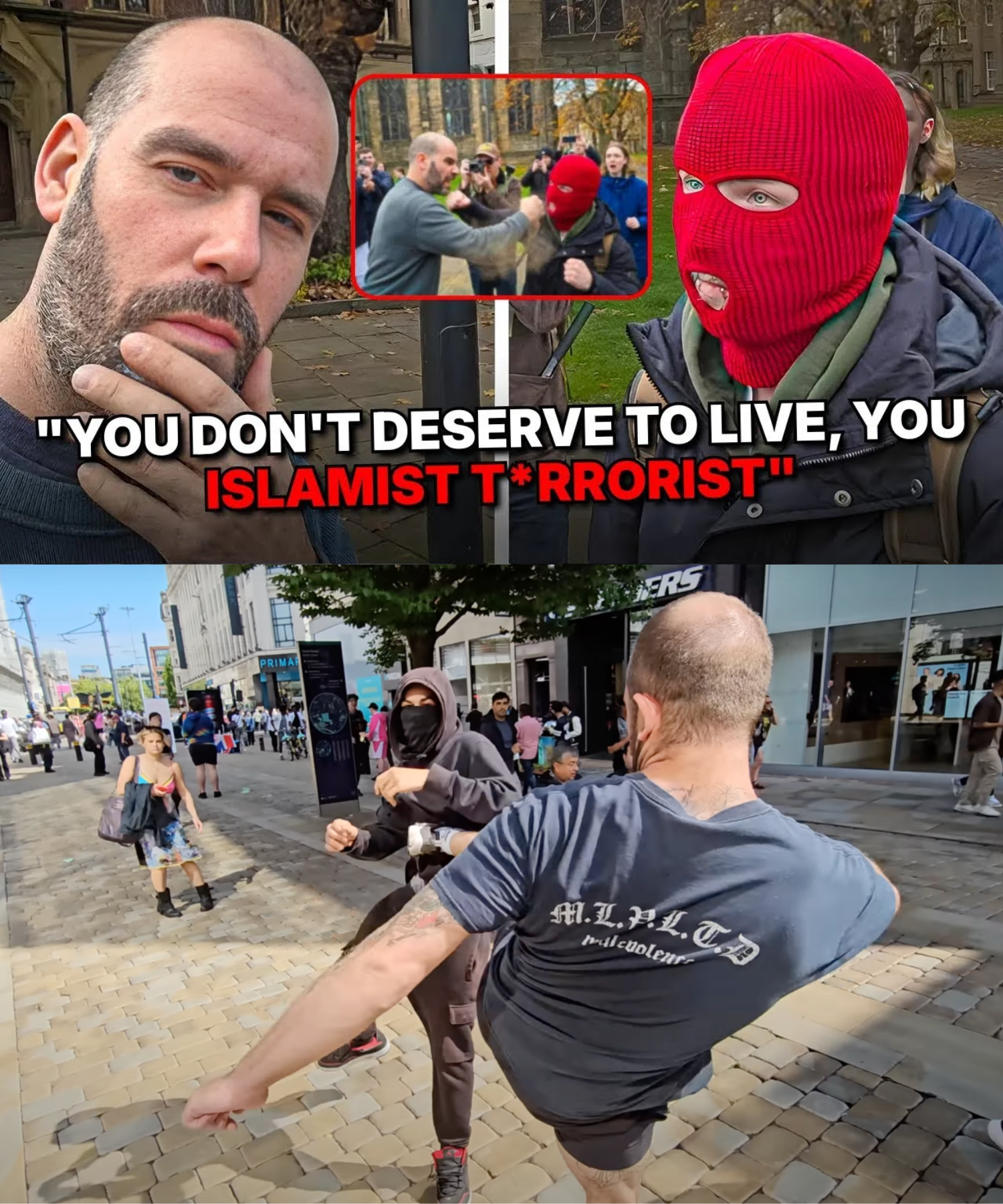
The footage, centered around British YouTuber Charlie V., first appeared to show another tense day at a pro-Palestine rally overseas. But once the clip reached U.S. audiences, it quickly became something larger: a warning, supporters say, about what happens when street politics turns physical and public filming becomes treated like an act of provocation.
The video follows Charlie as he moves through a crowded urban protest scene, camera in hand, commenting on signs, chants, police lines, face coverings, and the atmosphere around him. The crowd includes pro-Palestinian demonstrators, left-wing activists, masked protesters, counter-protesters, and police trying to keep opposing groups apart. At first, the footage has the strange rhythm of modern protest livestreams: sarcasm, shouting, slogans, cameras pointed at cameras, and people trying to control who gets to record whom.
Then the mood changes.
Several demonstrators appear to follow Charlie and his group, trying to block his camera and challenge his presence. The tension builds in small moments — a hand too close to the lens, a shoulder turning into his path, a sharp insult, a warning, a demand to stop filming. In the world of viral politics, these moments are no longer background noise. They are the story.
For American viewers, the scene felt familiar.
Over the past several years, U.S. cities and college campuses have seen their own waves of emotionally charged demonstrations — over Israel and Gaza, police, race, immigration, abortion, gender, and national identity. Many have remained peaceful. Others have produced confrontations, arrests, property damage, and accusations that certain activists are trying to silence opponents rather than debate them.
That is why this video struck a nerve.
Supporters of Charlie framed him as a citizen journalist documenting public behavior in a public place. They argued that if protesters choose to march in the streets, chant slogans, carry political signs, and block public spaces, they cannot then demand total control over how they are filmed or portrayed. In their view, the camera is not violence. The threat to free speech begins when activists decide that being recorded is reason enough to surround, harass, or attack someone.
Critics saw it differently. They accused Charlie of deliberately provoking people, mocking them, and turning a volatile political issue into content. To them, the camera was not neutral. It was part of a performance designed to produce a reaction, clip it, upload it, and feed an audience already hostile to the protesters.
That disagreement has become central to the American debate.
Is a political YouTuber documenting public disorder, or manufacturing it? Are protesters defending themselves from harassment, or trying to intimidate critics into silence? Is the viral clip evidence of rising extremism, or another edited battle in the online culture war?
The most dramatic moment comes when a man in black appears to approach Charlie’s camera aggressively. In the footage, the YouTuber says the man smashed his camera and claims the incident was caught on video. Police are then seen dealing with the situation as the crowd continues to move. The clip’s narrator presents the moment as proof that street activists who talk about justice can quickly turn to force when challenged.
That image — a camera allegedly knocked away during a public demonstration — became the symbol of the entire controversy.
In the United States, where filming police, protests, and public officials has become a major civil liberties issue, the moment triggered strong reactions. Many Americans believe the right to record in public is essential. Without cameras, they argue, powerful groups and aggressive mobs can rewrite events. Cameras protect truth. Cameras protect citizens. Cameras expose what institutions sometimes prefer to hide.
Others warn that cameras can also be weaponized. A person can follow, mock, provoke, and selectively edit a target until the most emotional moment becomes the only moment anyone sees. Viral video rarely shows the full day. It shows the explosion.
The protest footage also touches another explosive issue: the language of “globalizing” conflict. Some signs and slogans in the video are interpreted by critics as calls to spread the struggle beyond the Middle East. Supporters of the protests often say such phrases represent resistance, solidarity, or anti-war activism. Critics argue that the same language can sound threatening, especially to Jewish communities and others who associate it with violence.
That ambiguity has followed similar debates across America. On college campuses, phrases chanted at rallies have been defended as political speech and condemned as intimidation. Administrators have struggled to draw lines between protest, harassment, and threats. Students have been suspended. Donors have pulled funding. Congressional hearings have turned campus speech into a national scandal.
The viral Charlie video now feeds directly into that atmosphere.
Conservative commentators in the U.S. seized on the clip as evidence that Western societies are losing control of public spaces. They argued that activists who hide their faces, follow opponents, and interfere with filming are not engaging in democracy, but attempting to enforce ideological territory. Some described it as a street-level version of cancel culture: if critics cannot be fired, they can be surrounded; if they cannot be deplatformed online, their cameras can be blocked in public.
Progressive critics pushed back, warning that the video risks portraying all pro-Palestinian demonstrators as dangerous or extremist. They argued that many protesters are motivated by genuine concern for civilians in Gaza and that isolated confrontations should not be used to smear entire movements. They also noted that counter-protesters and political content creators can bring their own aggression into volatile spaces.
The truth may be more uncomfortable than either side wants to admit.
Political demonstrations today are no longer just demonstrations. They are media events. Every person with a phone is a broadcaster. Every argument can become a viral clip. Every shove, insult, chant, and reaction can be edited into proof of a larger narrative. In that environment, the street becomes a studio, and politics becomes performance.
But performance can still become dangerous.
Police in the video appear to manage the crowd through barriers, controlled routes, and public order restrictions. That too has drawn attention from American viewers, especially those concerned about how far governments should go to control protests. If police restrict movement, some call it necessary for safety. Others call it a suspension of civil liberties. If they do not restrict movement and violence erupts, they are accused of failing to protect the public.
This is the trap modern democracies face.
They must protect the right to protest. They must protect the right to criticize protesters. They must protect religious and ethnic minorities from harassment. They must protect public order without crushing free speech. And they must do all of this in front of millions of cameras, with every decision judged instantly by people who already know which side they support.
That is why the video has traveled so far beyond its original location.
For Americans, it is not really about one British YouTuber, one protest, or one smashed camera. It is about whether public life is still governed by rules, or by whoever can shout loudest, swarm fastest, and control the footage afterward.
The final lesson is unsettling.
A free society depends on people being able to stand in public, speak, film, protest, and be challenged without violence. Once that breaks down, politics stops being debate and becomes domination.
And that is why this viral clash has become such a powerful symbol.
The camera kept rolling.
The crowd kept moving.
And once again, America saw its own fears reflected in someone else’s streets.