Viral Israeli-Palestinian Livestream Explodes Across America Over Keffiyeh, Nakba, and Forgotten Jewish Refugees
Viral Israeli-Palestinian Livestream Explodes Across America Over Keffiyeh, Nakba, and Forgotten Jewish Refugees
New York — A tense livestream conversation between an Israeli-Iraqi Jewish commentator and a Palestinian trans Muslim musician has ignited a fierce debate across American social media, pulling viewers into one of the most emotionally charged and least discussed corners of the Israel-Palestine conflict: the erased history of Jews expelled from Arab and Muslim-majority countries.
The exchange, which began with a conversation about a keffiyeh, quickly turned into a sprawling confrontation over identity, memory, displacement, colonialism, Mizrahi Jews, Palestinian nationalism, and whether one people’s tragedy has been allowed to dominate the world’s imagination while another has been pushed into silence.
For American audiences already divided by campus protests, Gaza demonstrations, antisemitism hearings, and accusations of anti-Palestinian racism, the video landed like a match in dry grass.
It did not offer a clean argument.
It exposed a wound.
The Keffiyeh Becomes the Flashpoint
The livestream opens with the Israeli-Iraqi Jewish speaker noticing the Palestinian guest wearing a keffiyeh, the black-and-white scarf widely recognized today as a symbol of Palestinian resistance.
The guest explains that the scarf was given by a fan and describes it as a symbol of Palestinian identity, solidarity, and struggle.
But the host interrupts the familiar framing and presents a dramatically different claim: that the keffiyeh, or kufiya, has deep Mesopotamian roots and was worn historically by Iraqis, including Jewish Iraqis, long before it became globally associated with Palestinians.
He claims the scarf’s design symbolizes fishing communities, river patterns, and the Tigris and Euphrates — tying it to southern Mesopotamia rather than the Levant.
To many pro-Palestinian activists, the keffiyeh is an unquestioned national symbol.
But in this conversation, the host reframes it as something else entirely: a cultural object that, in his view, was taken from Iraqi Jews and later transformed into a Palestinian nationalist emblem after Jews were expelled from places like Iraq.
That claim shocked viewers.
Not because every historian agrees with every detail of the argument, but because it challenged a symbol many Americans have seen at protests from Columbia University to Los Angeles.
“You’re Wearing What My Grandparents Wore”
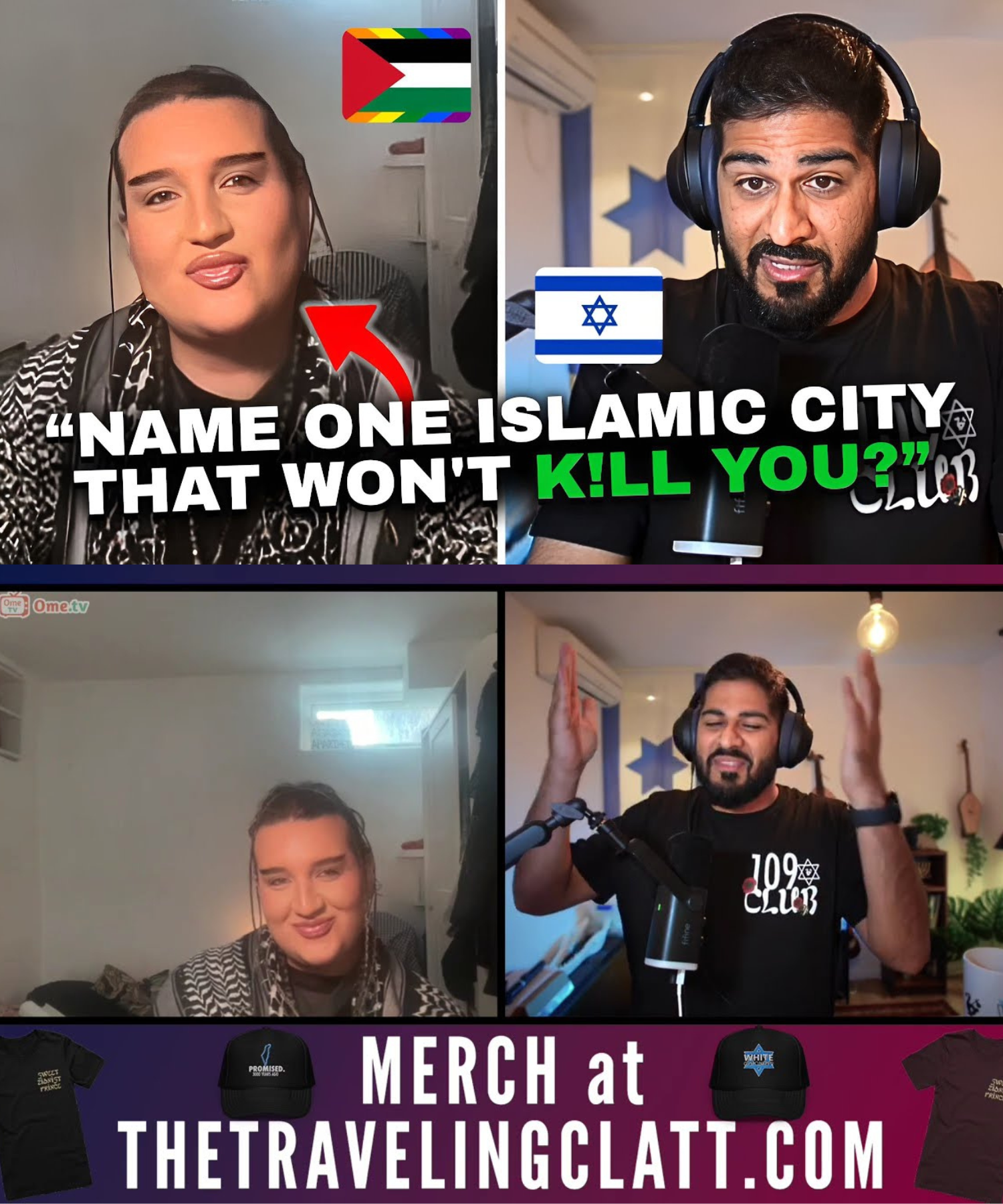
The most emotional section comes when the host tells the guest that his grandparents were expelled from Iraq, where Jewish communities once numbered in the tens of thousands.
He contrasts the global focus on Palestinian displacement in 1948 with the lesser-known displacement of Mizrahi Jews from Arab and Muslim-majority countries during the twentieth century.
The speaker argues that while Palestinians speak of the Nakba — the catastrophe of displacement during Israel’s founding war — Jews from Iraq, Syria, Egypt, Yemen, Morocco, Libya, Tunisia, and other countries also suffered expulsions, violence, dispossession, and exile.
This point has become the center of the video’s viral power.
Many American viewers know the Palestinian refugee story. Far fewer know that hundreds of thousands of Jews left or were forced out of Arab lands in roughly the same era.
For supporters of the Israeli speaker, the moment is a long-overdue correction to a one-sided narrative.
For critics, it risks minimizing Palestinian suffering by turning one historical trauma against another.
“One Nakba” vs “Both Should Hold Weight”
The conversation grows more heated when the host describes the Jewish expulsion from Arab countries as the “real Nakba.”
The Palestinian guest pushes back, saying such language feels like it invalidates Palestinian suffering.
The host insists that his family’s experience was different because Jews in Iraq were not fighting a war; they were simply attacked, expelled, and reduced from a large historic community to almost nothing.
The guest responds that both tragedies should carry weight, and that language matters because calling one catastrophe more “real” can erase the other.
This exchange crystallizes one of the most difficult questions in the conflict.
Can two peoples hold trauma at the same time?
Or has the conflict become so zero-sum that recognizing one side’s pain is treated as betrayal by the other?
In the United States, that question is no longer theoretical. It is playing out on campuses, in city councils, in protests, in synagogues, in mosques, and inside families.
The Question: What Is a Palestinian?
The conversation then turns to identity itself.
The host asks the guest to define what a Palestinian is, comparing it with the modern Israeli identity, which he describes as a nationality made up of diverse groups — Ashkenazi Jews, Mizrahi Jews, Ethiopian Jews, Arabs, Christians, Muslims, Druze, Samaritans, and others.
The Palestinian guest acknowledges difficulty defining Palestinian identity with precision, saying Palestinians are ethnically diverse and that many families, including her own, may have Jewish ancestry.
The host presses further, asking whether Palestine ever existed as a state, kingdom, or country in ancient history.
Eventually, the guest acknowledges that Palestine did not exist as a state in the historical sense being discussed, but argues that statehood is not the only measure of peoplehood.
That moment has become one of the most clipped portions of the exchange.
Supporters of Israel argue it exposes weakness in Palestinian nationalist claims.
Supporters of Palestine argue it proves nothing, because many peoples existed before formal statehood and still possess rights to identity, homeland, and self-determination.
One State, Two States, or No Palestine?
The Palestinian guest says she supports a one-state solution: a secular state called Palestine where all people have equal rights.
The host challenges whether such a model exists anywhere in the Arab or Muslim world and questions whether local populations would actually accept secular governance.
The guest argues that the Israel-Palestine situation is unique and that equal rights should be the guiding principle.
The host responds that the Middle East is not Denmark, not America, and not a theoretical classroom. In his view, Israel is the only place in the region where LGBTQ Arabs, secular Muslims, Jews, and others can live openly with significant freedom.
This argument struck American audiences sharply because it mirrors the debate over “Queers for Palestine” and whether progressive activists in the West understand the social realities of Gaza, the West Bank, or broader Middle Eastern politics.
Mizrahi Jews Demand a Place in the Story
The deepest frustration in the livestream comes from the host’s insistence that Mizrahi Jews are not guests, not colonizers, and not outsiders.
He argues that Jews from Iraq and across the Middle East were indigenous minorities who suffered under Arab and Islamic rule for centuries, then fled or were expelled, eventually finding safety in Israel.
He says that when Palestinians call Israel a settler-colonial state, they erase the fact that many Israeli Jews are not Europeans, but Middle Eastern refugees and their descendants.
This point has become increasingly prominent in U.S. pro-Israel activism.
For decades, American debates often reduced Israel to European Jews versus Arab Palestinians.
The Mizrahi story complicates that frame.
It forces a harder question: what happens when the supposed “settlers” are themselves refugees from the same region?
A Rare Moment of Listening
Despite the tension, the conversation remains unusually human.
The Palestinian guest listens for long stretches, acknowledges parts of the speaker’s pain, and says she would be open to creating space for Mizrahi Jewish voices in pro-Palestinian settings.
The host, though confrontational, repeatedly says the guest is one of the most thoughtful Palestinians he has spoken with.
That rare mutual recognition is why the video has spread so widely.
Viewers are not only watching an argument.
They are watching two historical wounds collide in real time.
America’s Campus War Reframed
The livestream has immediate relevance in the United States, where pro-Palestinian protests often feature keffiyehs, “Free Palestine” slogans, and accusations of Israeli apartheid.
The video challenges activists to ask whether they know the full history behind the symbols they wear and the slogans they chant.
It also challenges pro-Israel voices to confront Palestinian pain without reducing every claim to propaganda.
The emotional force of the exchange lies in its refusal to keep the conflict simple.
The Unfinished Argument
The conversation ends without resolution.
The Palestinian guest still believes in Palestinian rights and a future of equality.
The Israeli-Iraqi host still rejects Palestinian nationalism as historically incoherent and morally blind to Mizrahi suffering.
Neither side fully convinces the other.
But something important happens: the forgotten Jewish refugee story enters the room.
For American viewers, that may be the true impact of the video.
The Israel-Palestine debate is not only about 1948, Gaza, occupation, or statehood.
It is also about Baghdad, Damascus, Cairo, Tripoli, Tehran, and the nearly vanished Jewish worlds that once lived there.
And until those stories are included, the argument will remain incomplete.